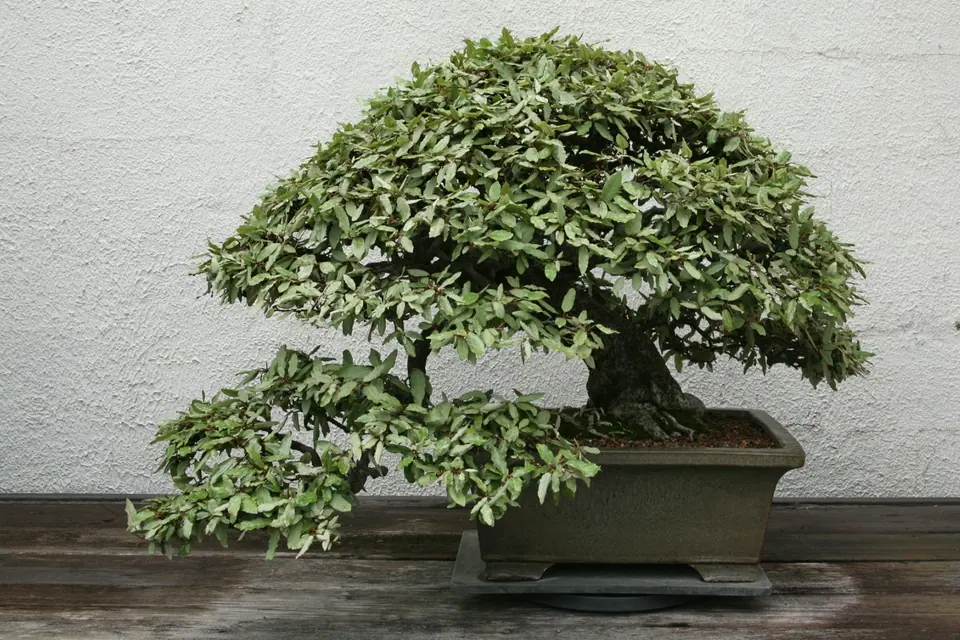

Bonsai care
thorny olive
Elaeagnus pungens
Written by Emilio Marruso
Each step is quoted from bonsai growers, clubs and magazines. Where they disagree we show every school of thought.
Care
Position and light
Full sun or partial shade.
- Note
- bonsai4me: guida di genere (Elaeagnus; names E. pungens as useful for bonsai). Broward Bonsai Society (Florida) page covers Elaeagnus; it cites bonsai4me as a source.
Documented: 2 or more sources
POSITION: Full sun or partial shade.Light: Full Sun or partial shade.Watering
Keep soil moist in summer and never let it dry out; reduce water slightly in winter.
- Note
- Broward Bonsai Society (Florida) page covers Elaeagnus; it cites bonsai4me as a source.
To be verified: 1 source
Watering: Keep soil moist during summer months, never allow to dry out; reduce water slightly during winter months.Feeding
Feed every two weeks through the growing season.
- When
- growing season
- Note
- bonsai4me: guida di genere (Elaeagnus; names E. pungens as useful for bonsai).
Documented: 2 or more sources
FEEDING: Every two weeks throughout the growing season.Fertilizing: Every 2 weeks through growing season with acid fertilizerStructural pruning
Hard pruning in winter.
- When
- winter
- Note
- bonsai4me: guida di genere (Elaeagnus; names E. pungens as useful for bonsai).
Documented: 2 or more sources
PRUNING: Hard pruning should be carried out in Winter.Hard pruning should be carried out in winter.Maintenance pruning
Trim new shoots throughout the growing season; clip and grow, trimming back to 2 leaves.
- When
- growing season
- Note
- bonsai4me: guida di genere (Elaeagnus; names E. pungens as useful for bonsai).
Documented: 2 or more sources
Trim new shorts throughout the growing season.New shoots- trim back to 2 leaves: clip and grow method.Wiring
Branches can be wired; wire new branches before they become inflexible, older branches are stiff.
- Note
- No season given. Broward Bonsai Society (Florida) page covers Elaeagnus; it cites bonsai4me as a source.
To be verified: 1 source
Branches can be wired.Wire new branches before they become too inflexible. Older branches are stiff and hard to move.Defoliation
Can be defoliated to encourage ramification; defoliation and more trimming reduce the large leaf.
- Note
- Broward Bonsai Society (Florida) page covers Elaeagnus; it cites bonsai4me as a source. No month given. adamaskwhy is a hobbyist blog about an old E. pungens.
Documented: 2 or more sources
Elaeagnus can be defoliated to encourage ramification.The leaf is biggish- but it can be reduced- Unlike what I’ve done here, it simply takes more trimming and a defoliation schedule.When to repot
Repot every two or three years in spring, as new buds extend.
- When
- spring, as new buds extend
- Note
- bonsai4me: guida di genere (Elaeagnus; names E. pungens as useful for bonsai).
Documented: 2 or more sources
REPOTTING: Every two or three years in Spring as new buds extend.Repotting: Repotting in early spring every 2 to 3 years as leaf buds extend.Repotting soil
Well-draining, non-alkaline soil with some organic matter, pH 5.5-6.5.
- Note
- Broward Bonsai Society (Florida) page covers Elaeagnus; it cites bonsai4me as a source.
To be verified: 1 source
Soil: Prefers well-draining, non-alkaline soil with some organic added. pH 5.5-6.5.Winter and frost (in a pot)
Schools of thought: the sources disagree, each position is shown with its own sources.
Give frost protection below -5 C.
- Lowest temperature
- -5 °C (23 °F)
- Note
- bonsai4me: guida di genere (Elaeagnus; names E. pungens as useful for bonsai). Threshold for protection.
To be verified: 1 source
Give frost protection below -5 °C.Protect below 40 F.
- Lowest temperature
- 4.4 °C (40 °F)
- Note
- 40 F = 4.4 C. Broward Bonsai Society (Florida) page covers Elaeagnus; it cites bonsai4me as a source.
To be verified: 1 source
Temperature: Protect below 40° F.Pests and diseases
Resistant to pests and disease, but can suffer from scale and aphids; susceptible to coral spot.
- Note
- Broward Bonsai Society (Florida) page covers Elaeagnus; it cites bonsai4me as a source.
Documented: 2 or more sources
Insect/Disease: Resistant to pests and disease, but can suffer from scale and aphids, also susceptible to coral spot.PESTS AND DISEASES: Susceptible to coral spot.Propagation
Sow seed outside in autumn; greenwood cuttings in late spring; semi-ripe cuttings of deciduous species in mid-summer.
- When
- autumn (seed); late spring / mid-summer (cuttings)
- Note
- bonsai4me: guida di genere (Elaeagnus; names E. pungens as useful for bonsai).
To be verified: 1 source
PROPAGATION: Sow seed outside in Autumn.Take greenwood cuttings in late Spring or semi-ripe cuttings of deciduous species in mid-Summer.Styles
Informal upright forms in small to large sizes; also multiple trunks, group and cascade.
- Note
- bonsai4me: guida di genere (Elaeagnus; names E. pungens as useful for bonsai).
Documented: 2 or more sources
STYLING: Informal upright forms in small to large sizes.Styles: Can be trained into various styles like multiple trunks, informal upright, group planting, as well as cascading; adapts well to many styles.Sources
Every value above is quoted from these documents. Links lead to the original publisher.
- Elaeagnus / Elaeagnus Bonsai – Bonsai4Me · bonsai4me.com, consulted
- D - I · browardbonsai.com, consulted
- Old elæagnus pungens bonsai – Adam's Art and Bonsai Blog · adamaskwhy.com, consulted