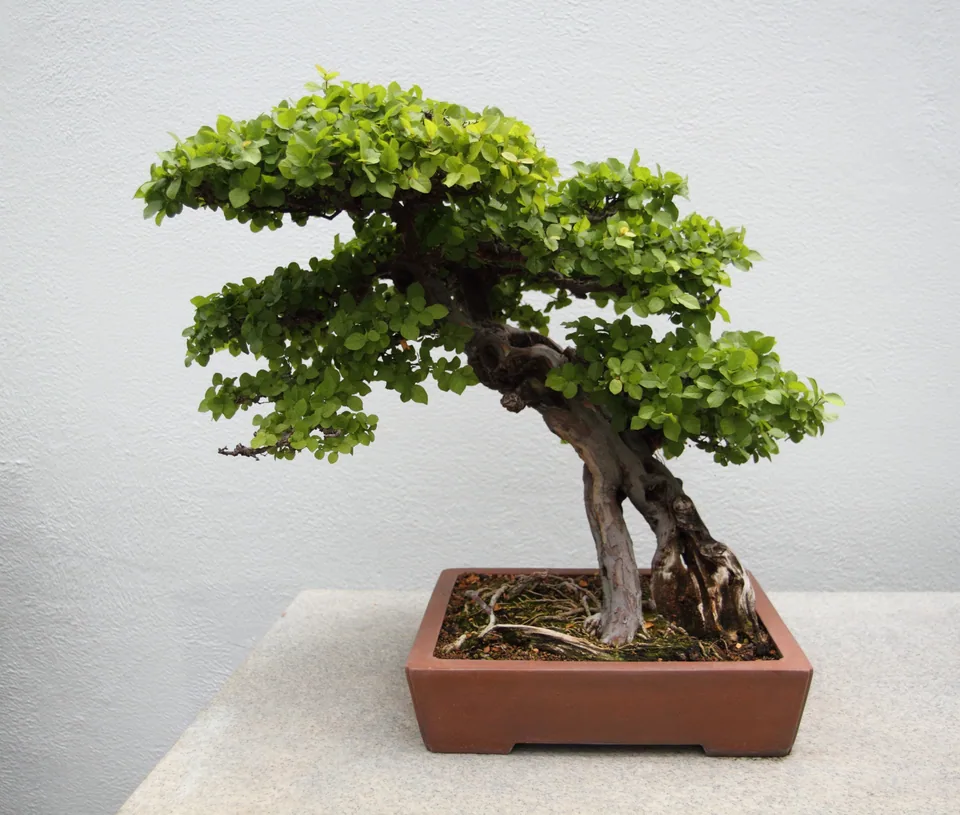

Bonsai care
Chinese sweet plum
Sageretia thea
Written by Emilio Marruso
Each step is quoted from bonsai growers, clubs and magazines. Where they disagree we show every school of thought.
Care
Position and light
Good light, but out of full sun and not in afternoon sun behind glass.
Documented: 2 or more sources
Good light but out of full sun.The foliage can easily scorch in direct sunlight and the tree can die if the soil becomes too hot and dry.Watering
Keep moist but not flooded; check daily; more often in spring and summer.
Documented: 2 or more sources
Keeping the substrate moist, but not flooding, is essential.You should never let the roots dry out entirely since this can make the tree lose its foliage.Feeding
Feed in the growing season, every one to two weeks; less in winter.
- When
- spring and summer
- Note
- Intervals differ by source.
Documented: 2 or more sources
Every two weeks in Summer, monthly in Winter when in active growth.Fertilize every 7-10 days with a liquid fertilizer specifically for bonsaiStructural pruning
Structural pruning in spring or summer.
- When
- spring or summer
To be verified: 1 source
It is preferably carried out during spring or summer, removing thick or out-of-design branches.Maintenance pruning
Schools of thought: the sources disagree, each position is shown with its own sources.
Trim to shape throughout the growing season.
- When
- growing season
To be verified: 1 source
Trim to shape throughout the growing season.Pinching can be done all year.
- When
- all year
To be verified: 1 source
Pinching: It can be done all year round, cutting shoots when they have 4-6 leavesWiring
Schools of thought: the sources disagree, each position is shown with its own sources.
Wiring can usually be avoided; shape by selective pruning.
To be verified: 1 source
so can be shaped by selective pruning and wiring can be avoided.Wire young lead branches in spring.
- When
- spring
To be verified: 1 source
This should be done in spring when the branches are still young.When to repot
Repot every two years in spring.
- When
- Spring
To be verified: 1 source
Every two years in Spring, use a basic soil mix.Repotting soil
Basic bonsai mix; one guide gives 80% akadama and 20% kiryuzuna or volcanic gravel.
Documented: 2 or more sources
Mix 80% akadama (Japanese clay) with 20% kiryuzuna, or volcanic gravel.Every two years in Spring, use a basic soil mix.Winter and frost (in a pot)
Schools of thought: the sources disagree, each position is shown with its own sources.
Survives just below freezing, but keep it where it rarely drops below about 10 C.
- Lowest temperature
- 10 °C (50 °F)
- Note
- The source says it survives temperatures just below freezing.
To be verified: 1 source
Sageretias will survive temperatures just below freezing but it is highly recommended to keep them in conditions that rarely drop below around 10°CKeep indoors when nights fall below 12 C.
- Lowest temperature
- 12 °C (54 °F)
Documented: 2 or more sources
it's essential to keep Sageretia indoors, especially if temperatures drop below 12 degrees Celsius.It prefers 53 – 72 degrees F or 12 – 22 degrees C.Pests and diseases
Aphids and whitefly, especially under glass; mildew.
To be verified: 1 source
Can be affected by aphids and whitefly particularly when grown under glass.Propagation
Softwood and hardwood cuttings root easily in the growing season.
- When
- growing season
To be verified: 1 source
Softwood and hardwood cuttings root easily throughout the growing season.Styles
Suitable for all forms and sizes.
To be verified: 1 source
Suitable for all forms and sizes.Remedies
Each remedy shows what official sources say about it; traditional remedies without an official source are marked as such. Harmful ones are listed so you know to avoid them.
Treating the plant
mildew
increase air circulation, do not lower humidity Not verified
Traditional remedy, not verified by an official source.
How: More air movement.
Sources
Every value above is quoted from these documents. Links lead to the original publisher.
- Sageretia theezans/ Chinese Bird Plum Bonsai – Bonsai4Me · bonsai4me.com, consulted
- Growing and Caring for a Plum Bonsai Tree (Sageretia theezans) | Florgeous · florgeous.com, consulted
- Sageretia theezans Care: An Expert Guide to Healthy, Beautiful Bonsai · en.jardineriaon.com, consulted