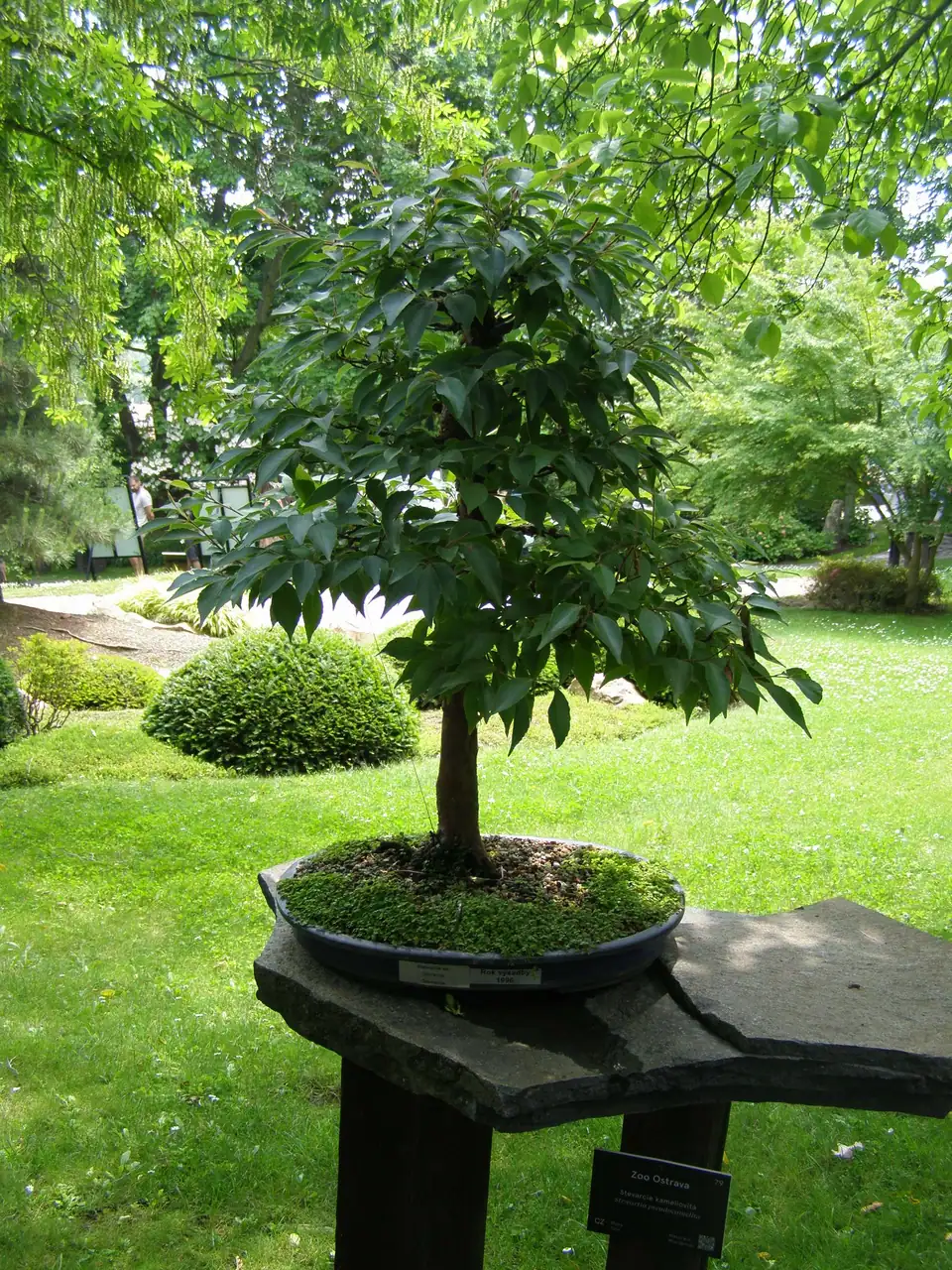

Bonsai care
Japanese stewartia
Stewartia pseudocamellia
Written by Emilio Marruso
Each step is quoted from bonsai growers, clubs and magazines. Where they disagree we show every school of thought.
Care
Position and light
Schools of thought: the sources disagree, each position is shown with its own sources.
Needs a cool root zone; shade the pot during the hottest part of the day in hot areas.
- Note
- East Bay Bonsai Society writes for California; the page covers Japanese stewartia (S. monadelpha and S. pseudocamellia).
To be verified: 1 source
A cool root zone is a requirement so growing them in the hotter part of our area may take some care, particularly shading them during the hottest part of the day.Full sun in spring while new growth emerges; partial shade once summer heat arrives.
- When
- full sun in spring; partial shade from early June through late September
- Note
- Guida di genere: Eisei-en page names Stewartia monadelpha, not S. pseudocamellia; written for California.
To be verified: 1 source
Deciduous bonsai trees do best if kept in full sun in the spring as the new growth is emerging.we place our deciduous bonsai under 30-40% shade cloth starting in early June through late September.Watering
Schools of thought: the sources disagree, each position is shown with its own sources.
Keep the soil constantly moist and never let it dry out; the tree shows distress quickly when dry.
- Note
- Page covers Japanese stewartia (S. monadelpha and S. pseudocamellia).
To be verified: 1 source
They need a constantly moist somewhat acid soil and quickly show their displeasure when allowed to dry out.Keep slightly moist; water when the soil surface becomes dry and avoid misting the foliage.
- Note
- Guida di genere: Eisei-en page names Stewartia monadelpha.
To be verified: 1 source
Water as the soil surface becomes dry and avoid misting the foliage, as this can lead to burn and disease.Maintenance pruning
Let shoots extend, then cut them back to two leaves, repeating through the season; prune little and often.
- When
- after new growth hardens off in May; not in fall
- Note
- Eisei-en page names Stewartia monadelpha (guida di genere); East Bay page covers Japanese stewartia; Swindon names the genus incl. S. pseudocamellia.
Documented: 2 or more sources
At that point, it is possible to cut the shoots back to two leaves and then perform partial outer canopy defoliationDo not prune in fall, though, as this may produce another flush of growth that will not harden off before the first frost, potentially resulting in branch dieback.let the branch grow out to 5 or six sets of leaves and then cutting back to two leaves.Prune little and often rather than remove large quantities at once as this improved back budding with regular pruning and retains a more even shape and canopy.Wiring
Schools of thought: the sources disagree, each position is shown with its own sources.
Wire in winter just after leaf fall, or in late spring after partial defoliation; use aluminium wire and remove it within 1 to 2 months.
- When
- winter, just after the leaves have fallen, or late spring after partial outer canopy defoliation
- Note
- Guida di genere: Eisei-en page names Stewartia monadelpha; written for California.
To be verified: 1 source
Wiring and styling these species is best done either in the winter, just after the leaves have fallen or in late spring, just after performing partial outer canopy defoliation.Wire will likely need to be removed within 1 to 2 months after application to avoid biting into the branches.Avoid wiring unless necessary because the bark is soft; check often for wire marks.
- Note
- Genus page (Stewartia) naming S. pseudocamellia; UK club.
To be verified: 1 source
The bark is softer so avoid wiring unless necessary and ensure to check this often to avoid wire marks.Defoliation
Defoliate partially: strip most outer-canopy leaves after the first flush hardens, or cut leaves in half to let light in and reduce leaf size.
- When
- after new growth hardens off in May
- Note
- Eisei-en page names Stewartia monadelpha (guida di genere); East Bay page covers Japanese stewartia (S. monadelpha and S. pseudocamellia).
Documented: 2 or more sources
partial outer canopy defoliation, removing 80-90% of the leaves from the outer canopy of the tree.Fortunately, Stewartias are quite amenable to defoliation by cutting the leaf in half.When to repot
Repot in early spring as the buds begin to swell.
- When
- early spring, as buds begin to swell (March in the northern hemisphere)
- Note
- Guida di genere: Eisei-en page names Stewartia monadelpha.
To be verified: 1 source
Repotting Apricot, Stewartia, and Chinese Quince bonsai is best done in early Spring just as the buds begin to swell.Repotting soil
Slightly water-retentive mix such as Aoki Blend or akadama, lava rock and pumice 2:1:1; acid soil.
- Note
- Eisei-en page names Stewartia monadelpha (guida di genere); Swindon names the genus incl. S. pseudocamellia.
Documented: 2 or more sources
Use a slightly more water-retentive soil medium, such as [nome commerciale] or a mixture of akadama, lava rock and pumice in a ratio of 2:1:1.They prefer an acid soil that is rich in organic matter that is well drained but does hold moistureWinter and frost (in a pot)
Protect from hard frosts; exposed trees can suffer branch dieback.
- Note
- No temperature given in the source. Genus page naming S. pseudocamellia.
To be verified: 1 source
They respond well to pruning but can suffer branch die back if left exposed in winter so protection from hard frosts is essential.Propagation
From seed, stem cuttings or air layering; seed germinates better after soaking in water for a few days.
- When
- around May to June
- Note
- Swindon: genus page naming S. pseudocamellia; East Bay page covers Japanese stewartia.
Documented: 2 or more sources
They can be propagated from seed, stem cuttings and air layering and the timing for this is around May to June.soaking them in water for a few days before sowing them helps.Styles
Suits informal upright, group plantings, and twin-trunk or clump styles.
- Note
- Genus page naming S. pseudocamellia.
To be verified: 1 source
good as an informal upright, group plantings and twin trunk or clump styles work well.Sources
Every value above is quoted from these documents. Links lead to the original publisher.
- Choosing A Stewartia At Your Next Bonsai – East Bay Bonsai Society · eastbaybonsai.org, consulted
- Care and maintenance guide for various Japanese deciduous bonsai – Eisei-en · bjornbjorholm.com, consulted
- Stewartia as bonsai - Swindon & District Bonsai · swindon-bonsai.co.uk, consulted