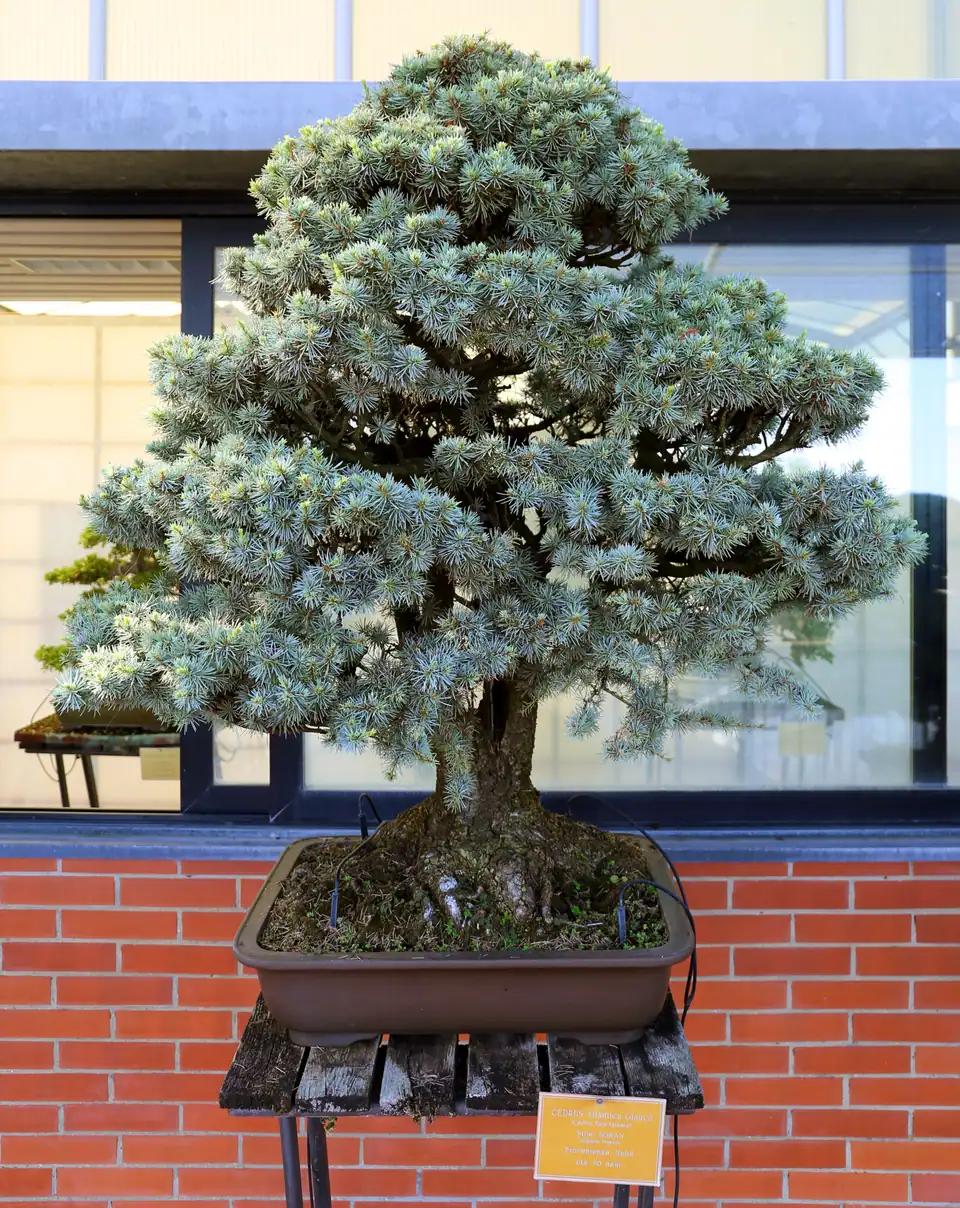

Cuidados del bonsái
Atlas cedar
Cedrus atlantica
Escrito por Emilio Marruso
Cada paso se cita de cultivadores, clubes y revistas de bonsái. Donde no coinciden mostramos todas las escuelas de pensamiento.
Las indicaciones de cuidado están en inglés por ahora; las citas se mantienen en el idioma de la fuente.
Cuidados
Ubicación y luz
Outdoor tree in full sun all year; strong light keeps growth compact and the blue colour strong.
- Nota
- Blue Atlas (Glauca) form.
Documentado: 2 fuentes o más
Full sun, all day. Strong direct light is what drives the dense, compact growth and the intense blue colorNecesita mucho sol directo para mantenerse compacto.Riego
Keep on the dry side: water well when the top soil has started to dry, never leave it soggy; overwatering is the main killer.
Por verificar: 1 fuente
Lean dry. This is a drought-tolerant mountain conifer, and overwatering is the chief way people kill it.Abonado
Feed modestly through the growing season, from spring to early autumn; no feeding in winter.
- Cuándo
- spring through early autumn
Documentado: 2 fuentes o más
Feed during the active growing season, spring through early autumn.Orgánico sólido (biogold, hanagokoro) de abril a octubre.Poda de formación
Escuelas de pensamiento: las fuentes no coinciden, cada postura aparece con sus propias fuentes.
Do structural pruning in late winter to early spring, before the spring flush.
- Cuándo
- late winter to early spring
- Nota
- Second quote is a genus guide (Cedrus).
Por verificar: 1 fuente
The best time for structural pruning is late winter to early spring before the flush.Structural pruning: Do larger cuts in late winter to early spring; seal larger wounds (cedar can bleed resin).Do structural pruning in autumn; pruning too much in winter is a common mistake.
- Cuándo
- autumn
- Nota
- Spanish site.
Por verificar: 1 fuente
Podar demasiado en invierno (mejor en otoño).Poda de mantenimiento
Pinch extending new shoots in spring and summer to keep pads tight and dense; pinch by hand.
- Cuándo
- spring and early summer
- Nota
- Second quote is a genus guide (Cedrus).
Por verificar: 1 fuente
Pinch or trim back extending new shoots in the growing season to keep the pads tight and encourage density.New-shoot pinching: In spring/early summer, pinch back extending new shoots to maintain the pads and encourage budding on the spurs.Alambrado
Wire in autumn (to winter), when shoots have matured; branches are stiff, so wire young wood and check often for bite.
- Cuándo
- autumn/winter
- Nota
- First quote is a genus guide (Cedrus); second is a Spanish site.
Documentado: 2 fuentes o más
Wiring: Best in autumn/winter; branches are fairly brittle, so bend carefully and watch for wire biteMejor época para alambrar , ya que los brotes han madurado.Cuándo trasplantar
Escuelas de pensamiento: las fuentes no coinciden, cada postura aparece con sus propias fuentes.
Repot in early spring as buds begin to swell, every 2 to 4 years; work the roots conservatively.
- Cuándo
- early spring, as buds swell
- Nota
- Intervals quoted: 2 to 4 years (Bonsai Wonderland), 3 to 4 years (Bonsai Urbano).
Documentado: 2 fuentes o más
Repot every 2 to 4 years depending on age and vigor, in early spring as buds begin to swell.Trasplante cada 3–4 años, en primavera, cuando las yemas empiezan a hincharse.repot it in early spring has been my experience but someone else might have different ideas.One grower starts repotting in January, and younger trees in November and December, where winters are mild.
- Cuándo
- January (mild winter climate)
- Nota
- Bonsai Tonight, San Francisco Bay Area; says many species start growing in January there. Not specific to this species' advice but the grower repots this tree then.
Por verificar: 1 fuente
I usually start repotting in January where I live, and sometimes I repot younger trees in November and December.Sustrato del trasplante
Free-draining, gritty, mostly inorganic mix such as akadama, pumice and lava rock; never bare-root.
Por verificar: 1 fuente
Use a free-draining, gritty, inorganic-heavy mix. A standard conifer blend of akadama, pumice and lava rock (roughly equal parts) works wellTrue cedars resent heavy root disturbance, so do not bare-root themInvierno y heladas (en maceta)
Hardy in the ground to about -10 to -15 C; in a pot, shelter from cold drying winds and protect the roots from hard freeze; water sparingly.
- Cuándo
- winter dormancy
- Nota
- The -10 to -15 C figure (14 to 5 F) is for trees in the ground; no limit given for the potted tree.
Por verificar: 1 fuente
Winter: Dormant. Shelter from cold drying winds and protect the roots from hard freeze in the pot.Hardy to roughly 14 to 5°F (−10 to −15°C) in the groundPropagación
The plain species is grown from seed; blue selections do not come true and are grafted; cuttings root poorly.
- Cuándo
- sow in spring; graft in winter
Por verificar: 1 fuente
Cuttings of cedars root poorly and slowly, so they're rarely used.do not come true from seed and are side-veneer grafted onto Cedrus seedling understock in winter under glassRemedios
Cada remedio indica qué dicen las fuentes oficiales; los remedios tradicionales sin fuente oficial aparecen marcados. Los perjudiciales están para que sepas evitarlos.
Cuidar la planta
scale insects and aphids
potassium soap or neem oil No verificado
Remedio tradicional, no verificado por una fuente oficial.
Fuentes
Cada valor anterior se cita de estos documentos. Los enlaces llevan al editor original.
- Blue Atlas Cedar Bonsai Care: Zones 6 to 9 · bonsaiwonderland.com, consultado
- Bonsái Cedrus atlantica: cuidados, estilos y guía completa · bonsaiurbano.com, consultado
- Cedar Bonsai Care · bonsaiwonderland.com, consultado
- Cedrus Atlantica - Atlas Cedar - AusBonsai · ausbonsai.com.au, consultado
- Repotting a neglected atlas cedar - Bonsai Tonight · bonsaitonight.com, consultado