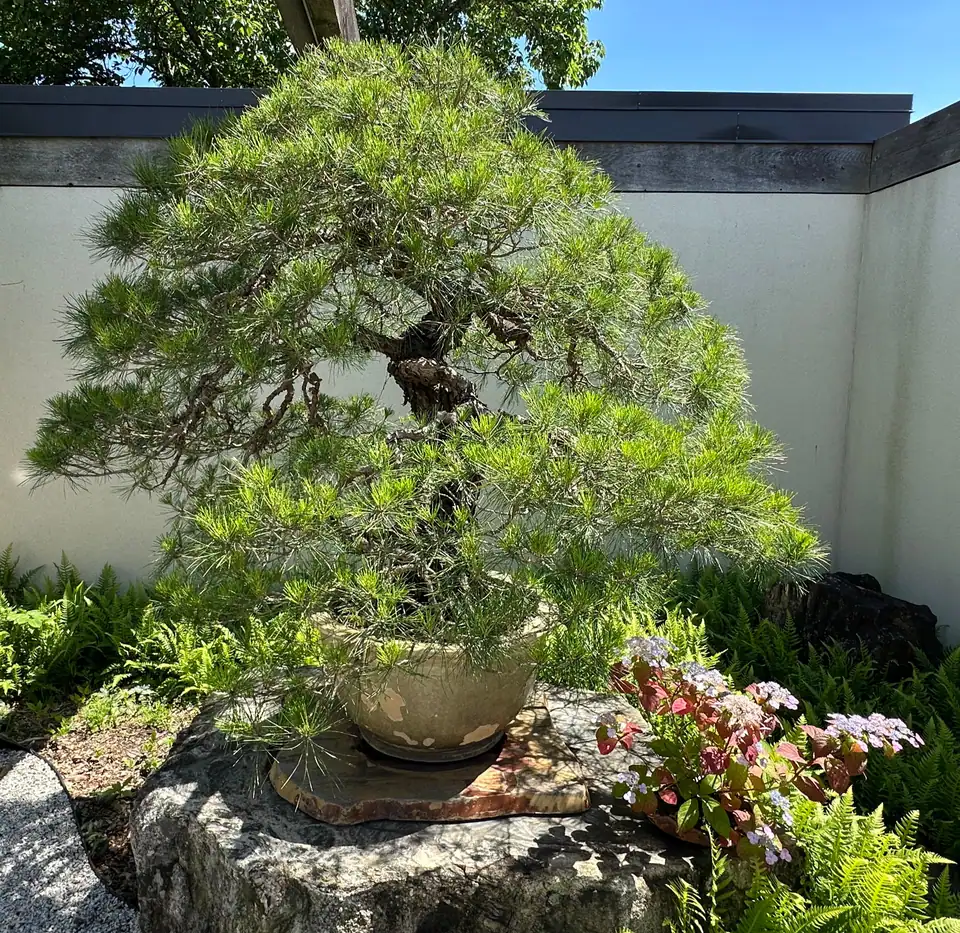

Cuidados del bonsái
Japanese red pine
Pinus densiflora
Escrito por Emilio Marruso
Cada paso se cita de cultivadores, clubes y revistas de bonsái. Donde no coinciden mostramos todas las escuelas de pensamiento.
Las indicaciones de cuidado están en inglés por ahora; las citas se mantienen en el idioma de la fuente.
Cuidados
Ubicación y luz
Full sun all year; Japanese red pine can stay in full sun all day even in heat.
- Nota
- Eisei-en (USA), pagina sui pini giapponesi che nomina P. densiflora.
Por verificar: 1 fuente
Place Japanese pine bonsai in full sun year-round.Japanese Black and Japanese Red Pine can stay in full sun all day.Riego
Water when the soil surface dries; usually once a day, sometimes twice, in the growing season.
- Nota
- Eisei-en: guida ai pini giapponesi.
Por verificar: 1 fuente
Water as the soil surface becomes dry.Most pine bonsai will need to be watered at least once per day, and sometimes twice per day, during this period.Abonado
Double-flush pine: organic fertilizer from early spring, stop at the June decandling, resume when the second flush hardens in early autumn.
- Cuándo
- early spring; stop in June; resume early Fall
- Nota
- Eisei-en: Japanese Red Pine rientra tra i double-flush.
Por verificar: 1 fuente
In regards to double-flush Japanese pine bonsai, begin fertilizing with an organic fertilizer cake in early spring to increase the vigor and health of the first set of candle growth.When that growth is then decandled in June, remove the fertilizer and do not apply new fertilizer until the second flush of growth hardens off in early Fall.Poda de formación
Heavy pruning and needle plucking in late summer through fall to induce back-budding.
- Cuándo
- late August through October
- Nota
- Eisei-en.
Por verificar: 1 fuente
Heavy pruning on all native Japanese pine species is best done in the late Summer through Fall, from late August through October.Poda de mantenimiento
Decandling (mekiri): in June to early July remove strong and medium candles to induce a second flush, with more ramification and shorter needles.
- Cuándo
- June to early July
- Nota
- Eisei-en: Japanese Red Pine è double-flush. Decandling riportato qui perché non c'e una chiave dedicata.
Por verificar: 1 fuente
In June to early July, completely remove the strong and medium-strength candlesBy performing mekiri, or decandling, it is possible to produce twice as much branch ramification and shorter needles in one growing season.Alambrado
Wire and style in late summer through fall; avoid spring and summer, when new buds and candles are easily damaged.
- Cuándo
- late Summer through Fall
- Nota
- Eisei-en.
Por verificar: 1 fuente
Wiring and styling Japanese pine bonsai is best performed in the late Summer through Fall.Avoid wiring and styling pine bonsai in the Spring through the Summer, as this is when the new buds and candles are forming, which can easily be damaged.Cuándo trasplantar
Escuelas de pensamiento: las fuentes no coinciden, cada postura aparece con sus propias fuentes.
Repot in spring just as the buds begin to swell (around March in the northern hemisphere).
- Cuándo
- Spring, buds begin to swell
- Nota
- Eisei-en.
Por verificar: 1 fuente
Repotting Japanese pine bonsai is best done in Spring just as the buds begin to swell.Repot in late summer or early autumn instead of late spring; repot every 3-5 years once established.
- Cuándo
- August-September
- Nota
- Bonsai4Me: guida di genere Pinus.
Por verificar: 1 fuente
Repot in August-September (late Summer/early Autumn), this is a much better window of opportunity than the more traditionally advised timing of late Spring.Once established in a good quality soil, repot infrequently every 3-5 years.Sustrato del trasplante
Free-draining mix such as akadama, lava rock and pumice 1:1:1; leave a core of old soil under the trunk.
- Nota
- Eisei-en.
Por verificar: 1 fuente
Use a free-draining soil medium, such as [nome commerciale] or a mixture of akadama, lava rock and pumice in a ratio of 1:1:1.When repotting, do not remove all of the original soil, but rather leave a core of older soil beneath the trunk to preserve the health of the bonsai.Invierno y heladas (en maceta)
Very hardy; protect from freezing winds while the roots are frozen.
- Nota
- Bonsai4Me: guida di genere Pinus. Nessuna soglia numerica.
Por verificar: 1 fuente
Though very hardy in Winter, Pines should be protected from freezing winds when their roots are frozen.Plagas y enfermedades
Aphids, borers, caterpillars, mealybugs and weevils; tip blight, needlecast and rust.
- Nota
- Eisei-en: pini in generale.
Por verificar: 1 fuente
Pine bonsai are susceptible to a number of pests including aphids, borers, caterpillars, mealybugs and weevils.The most common diseases that affect pines are tip blight, needlecast and rust.Propagación
Sow seed outside in early spring (seed needs frost); cultivars by grafting in late winter.
- Cuándo
- early Spring; late Winter
- Nota
- Bonsai4Me: guida di genere Pinus.
Por verificar: 1 fuente
Sow seed of species outside in early Spring, the seed needs to be exposed to frosts to germinate.Cultivars need to be propagated by grafting in late Winter.Estilos
Suits informal upright, cascade and bunjin.
- Nota
- Eisei-en.
Por verificar: 1 fuente
Each of these species lends itself well to a variety of bonsai styles from informal upright to cascade to bunjin design.Remedios
Cada remedio indica qué dicen las fuentes oficiales; los remedios tradicionales sin fuente oficial aparecen marcados. Los perjudiciales están para que sepas evitarlos.
Cuidar la planta
yellow needles across the whole tree
replace compacted soil with a better draining, aerated mix No verificado
Remedio tradicional, no verificado por una fuente oficial.
Cómo: change the soil slowly over several years
Fuentes
Cada valor anterior se cita de estos documentos. Los enlaces llevan al editor original.
- Care and maintenance guide for native Japanese Pine Bonsai (Pinus) – Eisei-en · bjornbjorholm.com, consultado
- Pinus/ Pine Bonsai – Bonsai4Me · bonsai4me.com, consultado