After the first frost: 6 garden mistakes to skip and what to do
Blackened leaves after a frost are not always the end. Six mistakes to avoid, plus the scratch and bend tests that show what is still alive.
by Emilio MarrusoPublished
The morning after the first hard frost can be a shock: leaves hang limp, flowers turn brown and tender plants look scorched. Injury often does not show until days after a freeze, and plants adapted to the local environment usually are not permanently harmed [1].
After a severe freeze, University of Tennessee specialists said the best action may be to be patient and do nothing [3]. Here is how to read the damage, the six mistakes to skip and the simple checks that tell you what is still alive.
Find frost dates by ZIP code or city
Avoid these six mistakes
Pruning right away
Damaged leaves and stems still insulate the rest of the plant, so delay pruning if you can [2]. Pruning now could also expose living tissue to more cold in the coming weeks [3]. UC IPM advises waiting until you are certain which tissues are dead, preferably until new growth begins in spring or summer; the exception is a limb or trunk that could fall [1].
A winter daphne frozen in December, photographed by an NC State Extension agent, looked hopeless at the end of January, then pushed out new green leaves by early March [6].
Feeding plants to help them recover
Late fall fertilization can trigger flushes of growth that are more vulnerable to cold [2]. UT Extension does not advise fertilizing until spring [3], and UF/IFAS suggests waiting until spring growth resumes, then using a light, slow-release fertilizer without high nitrogen [4].
Forgetting to water, or drowning the roots
Check what your plants need after a freeze: they can lose a lot of moisture in windy cold, and the soil in containers can freeze and leave the roots without water [2].
Watering helps plants thaw and rehydrate [2]. Keep an eye on evergreens so they do not dry out [3], but aim for soil that is slightly moist, not saturated, and water in the morning when you can [4].
A big cleanup with the mower
Skip extensive cleanup, mowing and heavy pruning of woody plants for now [3]. Borderline perennials such as elephant ears, canna and calla, and often-evergreen plants such as Lenten rose and heuchera, may die back to the ground, and that dead top growth can insulate the parts that survived [3].
Last year's leaves and stems also shelter plant crowns from cold and wind [5]. Our guide to plants to leave standing in winter shows how those stems can feed birds too.
Walking on a frosty lawn
Walking or driving on grass covered in frost can damage the plant crowns, and the result shows up in spring as dead spots shaped like footprints or tire marks [5].
Giving up on a plant too soon
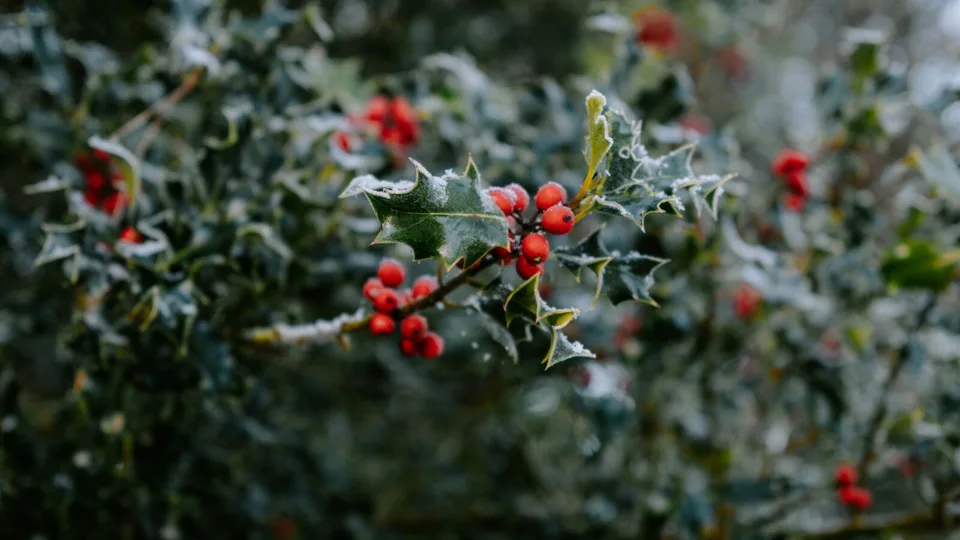
Blackened leaves do not always mean a dead plant: on hollies, sometimes only the leaves die and the plant replaces them in spring [6]. Many tropical and subtropical plants regrow from the roots even when the tops die [4].
Some simply need more time: bigleaf hydrangea may not resume growth until as late as Mother's Day [3]. Tender annuals, tropicals and vegetables are the exception, as they typically do not survive frost injury and will need replacing [5].
What you’ll need
Tools
- Sharp, clean hand pruners
- A watering can or hose
Materials
- Shredded wood or shredded leaves for mulch
- Straw or pine needles
What frost damage looks like
Cold makes buds, flowers and shoots curl, turn brown or black and die, and foliage can look scorched because low temperatures dehydrate plant tissue [1]. The signs differ from plant to plant:
- Soft, non-woody leaves first look water-soaked, then wilt and collapse, and finally turn white, brown or black [5].
- Evergreens such as hollies, laurels and conifers can turn brown to black [6], and the damage sometimes shows only on the windward side [5].
- Bark can crack or split [1]. On boxwood and azalea, bark that is split, cracked or peeling from the trunk disrupts the movement of water to the leaves, and those plants are not expected to recover quickly, if at all [3].
- Dry, burned edges point to desiccation: dry wind and sun pull water from the leaves faster than a cold root system can replace it, from leaf-tip burn in mild cases to totally brown leaves in severe ones [2].
Some damage takes its time. Many plants show nothing until spring, when they come out of dormancy [7].
Which plants are most at risk?
The time of year, the lowest temperature, how long the cold lasts, how fast it drops and the plant itself all decide how bad the damage is [1]. On tropical and subtropical plants, temperatures between 32°F and 50°F (0°C and 10°C) can already cause chilling injury [4].
In western North Carolina, NC State sees cold damage most years on daphne, loropetalum and aucuba, and thin-barked trees such as Japanese maple suffer the worst stem damage [6]. Pots are more exposed too: plants in containers on decks and patios suffer more than the same plants in the ground, because their roots are less insulated [3].
How to check what survived
Step 1 Wait before you judge
Cold damage often looks worse right after a freeze, so wait at least 3–7 days, or longer, before assessing injury [4].
Step 2 Do the scratch test
Scrape the bark lightly with a fingernail and look at the layer just underneath: green tissue means the plant is alive at that point, while black or brown means dead or injured tissue [2]. Branch tips may be damaged while older wood is fine [2], so start at the tip and work down toward the trunk until you find green [8].
Step 3 Try the bend test
A branch that bends with you is still alive and should stay on the plant; a branch that snaps is dead [8].
Step 4 Mulch, water and wait
Good care helps recovery: mulch with 2–4 inches (5.08–10.16 cm) of shredded wood or leaves, straw or pine needles, and water deeply but infrequently so the soil is moist, not soggy or dry [5].
Step 5 Prune in spring, back to green
UF/IFAS Extension in Palm Beach County suggests waiting 2–3 weeks after the last frost or cold event before pruning [8]. Cut just above the living tissue [8], or back to the closest live bud or side branch [5], and never remove more than one-third of a plant's foliage [8].
If more cold arrives after new growth has started, cover the new shoots [2], as explained in our guide on how to protect plants from frost.
Frequently asked questions
Should I cut off the brown leaves now?
Extension offices do not fully agree. UF/IFAS in Miami-Dade County says dead leaves may be removed once they turn brown [4], while UT and UGA Extension suggest leaving damaged leaves and stems in place until new growth begins, because they insulate living tissue [3] [7].
My potted plants froze. Are they worse off?
Often, yes: roots in containers are less insulated than roots in the ground [3]. Water them so that frozen soil can thaw and the plants can rehydrate [2].
When will I know for sure?
Usually in spring. UT Extension suggests waiting until plants leaf out, or fail to leaf out, to see what needs pruning [3].
Sources
- Freezing and Frost — UC Statewide IPM Program · ipm.ucanr.edu, consulted
- Cold Protection of Landscape Plants (ENH1/MG025) — UF/IFAS Extension · ask.ifas.ufl.edu, consulted
- Evaluating Your Lawn and Landscape After the Recent Holiday Freeze — UT Institute of Agriculture · utianews.tennessee.edu, consulted
- Good Strategies for Cold Damage in the Landscape: Recovery, Not Panic — UF/IFAS Extension Miami-Dade County · blogs.ifas.ufl.edu, consulted
- Spring Cold Snaps: How to Handle Your Yard Before and After a Late Frost — Nebraska Extension in Lancaster County · lancaster.unl.edu, consulted
- Plant Health Alert – Cold Damaged Plants — N.C. Cooperative Extension, Henderson County Center · henderson.ces.ncsu.edu, consulted
- Freeze Damage on Plants — UGA Extension Madison County · site.extension.uga.edu, consulted
- Recovering your Landscape after Cold Damage — UF/IFAS Extension Palm Beach County · blogs.ifas.ufl.edu, consulted
Written by Emilio Marruso · last checked