Bittersweet in your wreath? 3 checks to spot the invasive vine
Oriental bittersweet seeds survive in dried wreaths. Three checks to tell it from the native American bittersweet, how to throw a wreath away safely and native alternatives for your decorations.
by Emilio MarrusoPublished
Those cheerful yellow and red berries twisting through a fall wreath are hard to resist, and that is exactly the trouble. Oriental bittersweet, an East Asian vine, has become an aggressive invader of natural areas, and people remain a significant vector in its spread because of its use in wreaths and dried arrangements [2].
Penn State Extension notes that the native American bittersweet is far less common than the invasive one [2]. The good news: three quick checks tell them apart, and a closed bag keeps the seeds from going anywhere once the season is over.
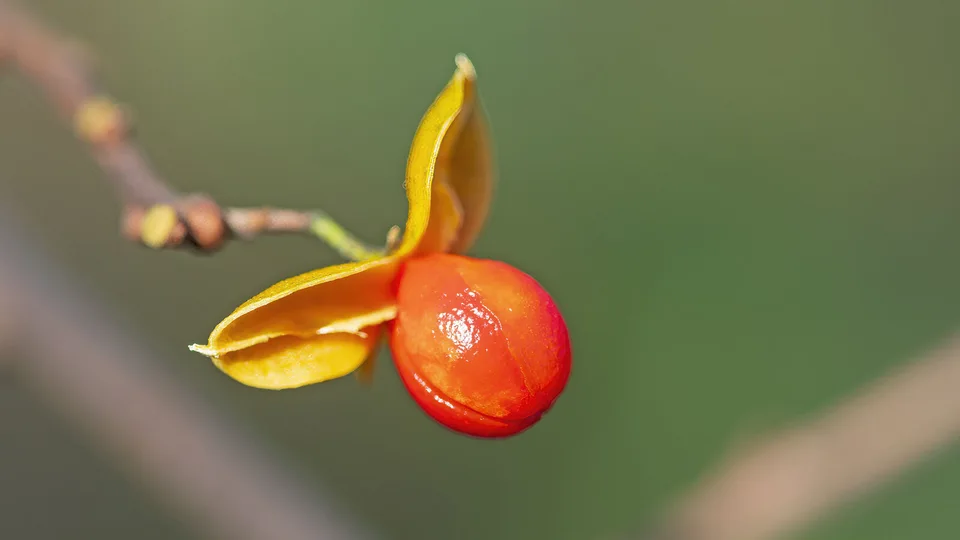
Which bittersweet is it?
Flowers and fruit are the key features that separate the two vines [4], so start there, even on a bare wreath.
Where the berries sit
On Oriental bittersweet, flowers and fruit form in small clusters at the base of each leaf, all along the stem [2]. On American bittersweet they come only from the ends of the branches [2] [4]. On a wreath, look where the leaves used to be: berries tucked along the whole length of a stem belong to the invasive vine.
How many per cluster
The University of Maryland Extension counts 3 to 7 flowers or fruits per cluster on Oriental bittersweet, and more than 7 on the native [4].
The color of the covering and the leaves
On the invasive vine, a yellow skin splits in fall to reveal a bright red center [2]; Maryland Extension calls the coverings orange-yellow [4]. For the native, the sources differ: Penn State and Rutgers describe a bright red covering [2] [7], while NC State describes the outside of the capsule turning orange before it splits to show red seeds [6].
If leaves are still attached, they help. NC State points out that the native's leaves taper to a point, while the invasive's leaf tips are rounded [5], and Penn State calls the native's leaves more football-shaped [2]. Rutgers adds that some invasive leaves are oval with a pointed tip [7], so let the berries have the last word.
How to dispose of a bittersweet wreath
What you’ll need
Tools
- Pruning shears, to cut the wreath down to size
Materials
- A sturdy trash bag that closes tightly
Step 1 Keep it away from the birds
The fruit stays on the stem through winter [2], and birds readily eat it [2]. Do not leave a spent wreath on a fence, a porch rail or a brush pile: Connecticut's DEEP lists disposal outdoors among the ways the vine spreads [8].
Step 2 Bag it and close the bag
Rutgers Cooperative Extension asks you to bag holiday decorations that contain round-leaved bittersweet and put them in the garbage [7]. The Minnesota Department of Agriculture also tells residents to bag the fruit for disposal [3].
Step 3 Skip the compost bin
Rutgers is clear: do not compost the seeds or cuttings [7]. Connecticut's DEEP also advises against composting holiday decorations that contain invasive plants [8].
Step 4 Watch for seedlings next year
If berries did drop, keep an eye on the spot. Maryland Extension suggests removing seedlings as soon as they appear [4], and Rutgers recommends monitoring for new plants for several seasons [7]. Pull young plants early: NC State notes that cutting stimulates the vine to re-sprout and any broken piece of root can grow again [5].
Why a dried wreath can still plant a vine
Oriental bittersweet was introduced from East Asia and marketed for ornamental use in the United States from the mid-1800s [2]. It twines around trees and shrubs, girdling and smothering them [3], and a single vine can reach 60 feet (18.29 m) in length [2].
Connecticut's Department of Energy and Environmental Protection (DEEP) adds that the extra weight on limbs can make them drop, contributing to damage and power outages [8].
The fruit is what makes the vine so popular and so mobile. A typical female plant can produce up to 370 fruits [3]. Birds and other wildlife readily eat them and spread the seeds far and wide [2], and seeds that pass through an animal germinate better than seeds that simply fall to the ground [3].
In a wreath, drying does not stop them: the seeds remain viable and can germinate once the wreath is discarded [2]. Connecticut's DEEP warns that tossing old decorations outdoors or into the compost can spread the vine [8].
The native vine pays a price too. The two species can hybridize [4] [5], and Penn State notes that American bittersweet is listed as rare or vulnerable in several states [2].
Michigan was set to weigh a new listing
On November 11, CBS Detroit reported that the Michigan Commission of Agriculture and Rural Development was scheduled to meet on November 17 in Lansing, with a recommendation on the status of five plants under the Michigan Invasive Species Program on its agenda [1].
Round-leaved bittersweet was among the three plants recommended for restricted status, the list for invasive species that are already established in the state [1]. If the commission advances the recommendations, a 30-day public comment period comes next, and they are also due before the Natural Resources Commission at its December 9 meeting [1].
Other states already regulate it. Minnesota lists it as prohibited, with no transportation, propagation or sale allowed [3], and a 2017 release from Connecticut's DEEP noted that state law there bans moving or selling it, seeds and other reproductive parts included [8].
Native alternatives for your wreath
Rutgers suggests native plants with winter interest for holiday decorations [7], and Connecticut's DEEP names winterberry holly among the alternatives to bittersweet [8].
Winterberry holly
Winterberry has bright red berries that stay on the stem in winter; female plants carry them when a male plant is nearby [7].
American holly
American holly is a holiday classic, with red fruit and spine-tipped leaves [7].
Red osier dogwood
Red osier dogwood has red stems and is often used for winter cuttings [7].
Christmas fern and little bluestem
Christmas fern is an evergreen, clumping fern [7]. Little bluestem turns copper-yellow in fall and persists through winter [7].
American bittersweet from your own garden
NC State notes that cut stems of the native vine dry beautifully for arrangements [6]. With the native listed as rare or vulnerable in several states [2], your own vine is the place to cut from. Berry shrubs left in the yard feed birds all winter: here are plants to leave standing for the birds.
Frequently asked questions
Can I compost a bittersweet wreath once the berries look dry?
No. The seeds remain viable even after drying [2], and Rutgers says not to compost the seeds or cuttings [7].
Sources
- Michigan agriculture officials consider limiting 5 invasive plant species — CBS Detroit (November 11, 2026) · cbsnews.com, consulted
- Oriental Bittersweet: Accurate Identification — Penn State Extension · extension.psu.edu, consulted
- Round leaf bittersweet — Minnesota Department of Agriculture · mda.state.mn.us, consulted
- Oriental Bittersweet — University of Maryland Extension · extension.umd.edu, consulted
- Celastrus orbiculatus — North Carolina Extension Gardener Plant Toolbox, NC State University · plants.ces.ncsu.edu, consulted
- Celastrus scandens — North Carolina Extension Gardener Plant Toolbox, NC State University · plants.ces.ncsu.edu, consulted
- November Invasive Species of the Month: Round-leaved Bittersweet — Rutgers Cooperative Extension, Environmental Stewards · envirostewards.rutgers.edu, consulted
- Consider Alternatives When Decorating this Season; Avoid Using Material from Invasive Plants — Connecticut DEEP (December 8, 2017) · portal.ct.gov, consulted
- American Bittersweet — ASPCA Animal Poison Control · aspca.org, consulted
Written by Emilio Marruso · last checked