Thanksgiving cactus or Christmas cactus? 3 ways to tell them apart
Thanksgiving cactus or Christmas cactus? Check the stem segments, the anthers and the flowers, then give either plant the long, cool nights it needs to bloom again, with extension advice on darkness and temperature.
by Emilio MarrusoPublished
In short:
- The Thanksgiving cactus has 2 to 4 saw-toothed points on each stem segment and yellow anthers; the Christmas cactus has rounded, scalloped segments and purplish-brown anthers [2] [6].
- Both are short-day plants that set buds on long, cool nights: at least 12 hours of darkness, 14 for Clemson [1] [2] [6].
- Night temperatures above 65°F (18.3°C) make blooming unlikely [1].
Thanksgiving week is when one holiday cactus steals the show. The Thanksgiving cactus (Schlumbergera truncata) normally flowers near Thanksgiving, ahead of the Christmas cactus, according to Clemson Extension [2].
It is also the one you are most likely to own: Illinois Extension calls it by far the most commercially available species, often sold this time of year labeled as Christmas cactus [5]. Here is how to tell the two apart in three quick looks, and how to get either one to bloom again next year.
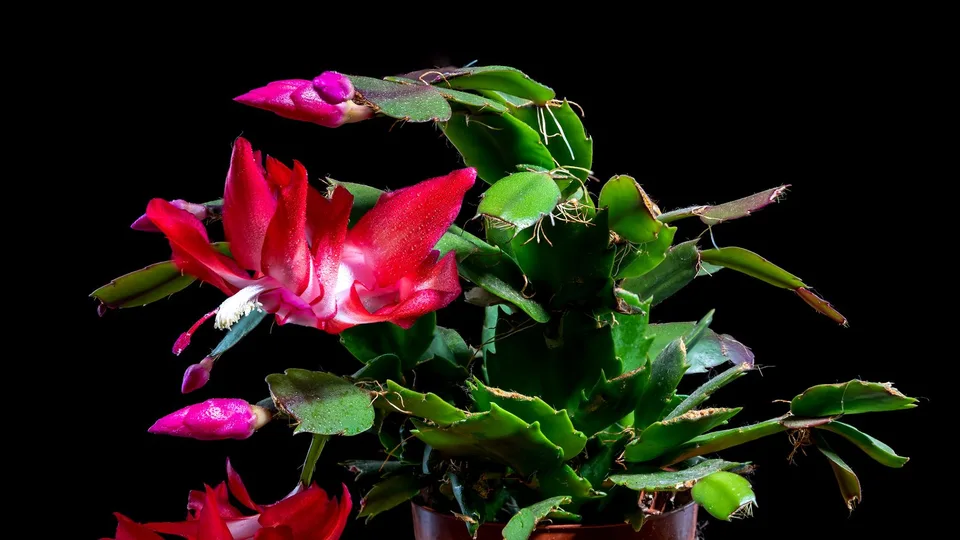
Identify your cactus in 3 checks
Both are Schlumbergera, and growers have crossed them into thousands of cultivars [6], so one plant can show traits of both. Three quick looks settle most cases.
The stem segments
Penn State Extension describes 2 to 4 saw-toothed points along the edges of each flat stem segment on the Thanksgiving cactus, and scalloped, pear-shaped segments on the Christmas cactus [6]. University of Wisconsin–Madison Extension puts it as pointed projections versus rounded, scalloped edges [3].
The anthers
Look inside an open flower: the pollen-bearing anthers are yellow on the Thanksgiving cactus and purplish-brown on the Christmas cactus [2] [6].
The flowers and the calendar
Thanksgiving cactus blooms grow horizontally to the stems, while Christmas cactus blooms droop [6]. S. truncata blooms earlier, closer to Thanksgiving, the Christmas cactus closer to Christmas, and hybrids between the two bloom in between [3]. University of Minnesota Extension adds that the holiday names are only general references to bloom time [1].
| Trait | Thanksgiving cactus | Christmas cactus |
|---|---|---|
| Stem segment edges | 2 to 4 saw-toothed points [2] [6] | Rounded, scalloped [3] [6] |
| Anthers | Yellow [2] [6] | Purplish-brown [2] [6] |
| Flower posture | Horizontal to the stem [6] | Droopy [6] |
| Natural bloom | Closer to Thanksgiving [3] | Closer to Christmas [3] |
Bought in bloom at Christmas and now flowering every November? Wisconsin explains that the plant is simply following the natural day length of your home [3], and that a plant in full bloom at Thanksgiving will be done by Christmas [3]. For flowers at Christmas, it suggests choosing a plant in late November with well-developed buds and no open flowers [3].
Why your cactus is not blooming
The nights are too warm
University of Minnesota Extension says plants are unlikely to bloom with night temperatures above 65°F (18.3°C) [1]. Iowa State University Extension adds that flowers may fail to develop if the plant sits above 70°F (21.1°C) [4]. Illinois Extension notes that temperature is almost as critical as light, in some cases the only driver of bloom [5].
The nights are not really dark
The plant reads the length of the night, so light after sunset counts. Iowa State warns that a Christmas cactus will not bloom properly if it gets artificial light at night in fall [4].
Clemson Extension is even stricter: as little as 2 hours of interrupted lighting will stop bud set, and street lights, car lights or indoor lighting can break the dark period [2]. Illinois suggests keeping the lights off in the plant's room as much as possible from August onward [5].
Roots, water and food are off
Penn State Extension lists root rot from saturated soil, too much fertilizer while buds develop, drought stress and too much light among the reasons a holiday cactus does not bloom [6].
A plant that is short of nutrients may also stay bare: Minnesota suggests a half-strength fertilizer low in nitrogen and high in phosphorus and potassium in the fall [1]. On old plants, fewer flower buds can be one of the first signs that the roots are failing [3].
Compare growing ranges
Extension services give different night temperatures:
| Extension | Night temperature | Detail |
|---|---|---|
| Minnesota | 55–65°F (12.8–18.3°C) | At 60–65°F (15.6–18.3°C), at least 12 hours of complete darkness [1] |
| Clemson | 60–68°F (15.6–20°C), fall growing temperature | As close to 68°F (20°C) as possible for the most flowers [2] |
| Wisconsin | 55–60°F (12.8–15.6°C) | The natural day length is enough [3] |
| Iowa State | 60–65°F (15.6–18.3°C) | Slightly warmer days [4] |
| Illinois | 55–60°F (12.8–15.6°C) | Days at 75–80°F (23.9–26.7°C) [5] |
| Penn State | 60°F (15.6°C) | 68°F (20°C) by day, in winter [6] |
The common thread is clear: the cooler the night, the less the darkness routine matters. Clemson says that plants grown with nights of 50–59°F (10–15°C) set buds regardless of day length [2], and Wisconsin says that above 60°F (15.6°C) the day length needs to be controlled [3]. So you can choose your method: a cool room, a dark routine, or both.
What you’ll need
How to bring the buds back
Step 1 Start in late summer
Iowa State suggests moving the plant in late summer to a cool spot with bright light during the day and no artificial light at night, such as an unused bedroom or a basement [4].
If your cactus summers outdoors, Minnesota suggests leaving it in a protected spot until just before the danger of frost, because the shorter days and cooler nights start the buds [1]. Clemson advises against leaving it outside when temperatures will drop below 50°F (10°C) [2].
Step 2 Give it long, truly dark nights
Aim for at least 12 hours of uninterrupted darkness a day [1] [6], or 14 hours following Clemson [2]. Start in mid-September and keep going for at least 6 weeks [2].
A dark closet overnight, or a cover over the plant, works well [3] [5]. In the morning, bring it back to bright light for the rest of the day [1]: the plant needs bright light to start its buds [2].
Step 3 Keep the nights cool
Find the coolest bright spot in the house: areas near windows and away from heat vents get cooler at night [5]. If you can keep nights at 55°F (12.8°C), Minnesota says the plant can bloom sometimes regardless of the day length [1]. Avoid going too low: at 50°F (10°C) growth slows and buds may drop [2].
Step 4 Water and feed with the buds in mind
Water when the potting mix is dry to the touch, and once buds have set keep it evenly moist so they do not fall [2]. Never leave water standing in the saucer [2].
Clemson suggests stopping fertilizer in late summer for more buds in fall [2], while Minnesota switches to a low-nitrogen formula in fall, for example 0-15-10 [1]. Either way, do not overdo it while the buds develop [6].
Step 5 Leave it in peace once the buds show
Buds normally become visible 3 to 4 weeks after the long nights start, and from then on the day length no longer has any effect [2].
Iowa State advises not moving the plant while the buds develop, and moving it to another room once the first flowers open [4]. If it has to go to a warmer room, Minnesota says to move it as soon as the buds appear [1].
Frequently asked questions
Can it bloom more than once a year?
Yes. Penn State says Thanksgiving and Christmas cacti can bloom more than once a year with the right care: after flowering, water less often and keep giving the plant 12 to 14 hours of darkness [6].
Sources
- Holiday cacti — University of Minnesota Extension · extension.umn.edu, consulted
- Thanksgiving & Christmas Cacti — Clemson Cooperative Extension, Home & Garden Information Center · hgic.clemson.edu, consulted
- Holiday Cactus — University of Wisconsin–Madison Extension · hort.extension.wisc.edu, consulted
- My Christmas cactus doesn't bloom well. Why? — Iowa State University Extension and Outreach · yardandgarden.extension.iastate.edu, consulted
- Brighten your holidays with blooming cacti: a guide to holiday cactus care — University of Illinois Extension · extension.illinois.edu, consulted
- Holiday Cacti Care — Penn State Extension · extension.psu.edu, consulted
Written by Emilio Marruso · last checked