Cellophane bees line nests with a plastic that degrades in months
A ground-nesting bee makes a polyethylene-like polyester that broke down in soil within months, a new PNAS study finds. Here is what it means, and how to make room for ground-nesting bees in your yard.
by Emilio MarrusoPublished
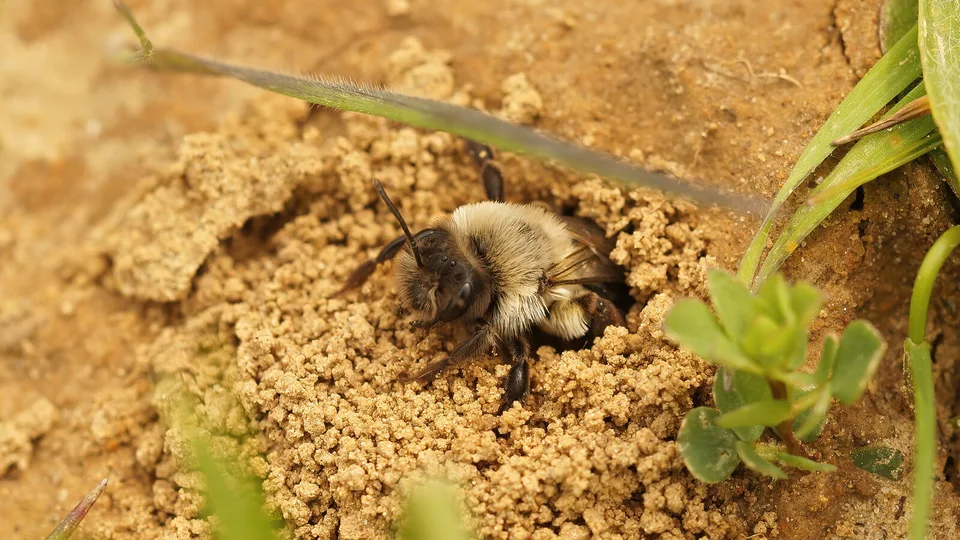
Every spring, small black bees dig tunnels in sunny patches of bare soil and line each nest cell with a thin, clear film that looks a lot like kitchen wrap [5]. A study published on 2 November 2026 in the Proceedings of the National Academy of Sciences shows that this film is a natural polyester very similar to polyethylene, the plastic in milk jugs and single-use food containers, and that it breaks down in ordinary soil within months [1] [2].
- Who
- Virginia Tech, the University of Tennessee and the University of Minnesota; lead author Jonathan Coote [1] [2] [3]
- Bee
- the cellophane bee Colletes inaequalis [2]
- Material
- a cross-linked, semicrystalline polyester that lines the nest cells [2]
- Key result
- the polyester share of the lining fell from 73% to 40% by weight within 4 months in soil [2]
A bee that makes its own plastic
Cellophane bees, also called plasterer or polyester bees, owe their names to the cellophane-like lining that females spread inside their brood cells [5]. Each female digs her own nest, stocks every cell with pollen and nectar, and lays a single egg [5]. These bees have nested in dense groups for decades, yet their polyester does not build up in the soil, a hint that it breaks down quickly [2].
What the researchers found
The team collected nest-cell linings from two sites in Tennessee [1]. The polyester is 60% crystalline, packs its molecules like polyethylene and melts at 167 °F (75 °C) [2]. Linings collected up to 11 months after construction showed clear degradation: the polyester content fell from 73% to 40% by weight within 4 months in ambient soil [2].
That surprised the team, because a semicrystalline structure and cross-links usually make a plastic harder to break down [1]. Esterases, enzymes that cut the bonds holding a polyester together, were active in both new linings and linings aged 4 months, and may speed up the process [2].
Polyethylene is one of the most produced plastics in the world, the researchers note [1]. The goal is not to farm bees, but to understand the chemistry well enough to build the same features into plastics made at scale [1].
How to welcome ground-nesting bees
Cellophane bees have plenty of company underground: according to a USDA research entomologist writing for Utah State University Extension, at least three-fourths of native bee species nest in the ground [6].
Leave some bare, sunny soil
Small patches of well-drained, bare, sunny soil can attract nesting bees [6]. Cellophane bees choose well-drained, often sandy soil with little organic matter, usually where it gets morning sun [5].
Go easy on mulch and fabric
Thick mulches of bark, wood chips or loose gravel are impenetrable for ground-nesting bees, and weed-barrier fabric is as impervious to them as pavement [6]. Beds that are not mulched too thickly can double as nesting ground [6].
Let spring nests be
A nest entrance usually sits in the middle of a small cone of excavated soil [6]. Cellophane bees emerge in spring, and after their spring flight there is no visible activity until the following year [5]. NC State Extension advises living alongside them rather than trying to wipe them out with pesticides, because they are valuable pollinators of spring crops [5].
What the study does not say
The data are thin in places: a nest holds only a few milligrams of lining, some tests on older nests were repeated very few times, and most of the aging data came from a single nesting site [4]. The study covers one bee species in Tennessee soil [1] [2]. It does not prove why the material degrades so fast: enzymes and the structure of the crystals are possible explanations still to be investigated [1] [2]. No bee-inspired plastic is ready for industry yet; the next step is to reproduce the chemistry in a manufactured material [1]. The study gives no gardening advice: the tips above come from Extension services [5] [6].
Frequently asked questions
How fast does the bee plastic break down?
In this study, the polyester share of the nest lining fell from 73% to 40% by weight within 4 months in soil [2].
Are cellophane bees dangerous in the garden?
No: they do not defend their nests, and stepping on one barefoot is the main risk [5].
Will we soon buy plastic made by bees?
No: the researchers want to copy the chemistry in manufactured plastics, not farm bees [1].
Sources
- Bees might solve the biodegradability challenge of plastic — Virginia Tech News, 4 November 2026 · news.vt.edu, consulted
- Coote et al. (2026), Rapid soil degradation of a cross-linked, semicrystalline polyethylene-like polyester produced by Colletes bees — PNAS 123 (46), e2607098123 · doi.org, consulted
- Busy bees produce natural plastics — University of Tennessee, Knoxville, news release on EurekAlert!, 11 November 2026 · eurekalert.org, consulted
- These Bees Make Their Own Plastic, and Their Nests Could Help Us Make Less Lasting Waste — Discover Magazine, 2 November 2026 · discovermagazine.com, consulted
- Colletid Bees (Plasterer Bees, Cellophane Bees, and Polyester Bees) — NC State Extension · content.ces.ncsu.edu, consulted
- Gardening and Landscaping Practices for Nesting Native Bees — Utah State University Extension (James H. Cane, USDA ARS) · extension.usu.edu, consulted
Written by Emilio Marruso · last checked