English ivy draws 22 insects per count in UK survey: skip it in the US
Nine seasons of UK volunteer counts rank ivy first among 14 flowers for insect visits. In the Pacific Northwest, though, English ivy is a regulated noxious weed. Here are the numbers, and native fall flowers to plant instead.
by Emilio MarrusoPublished
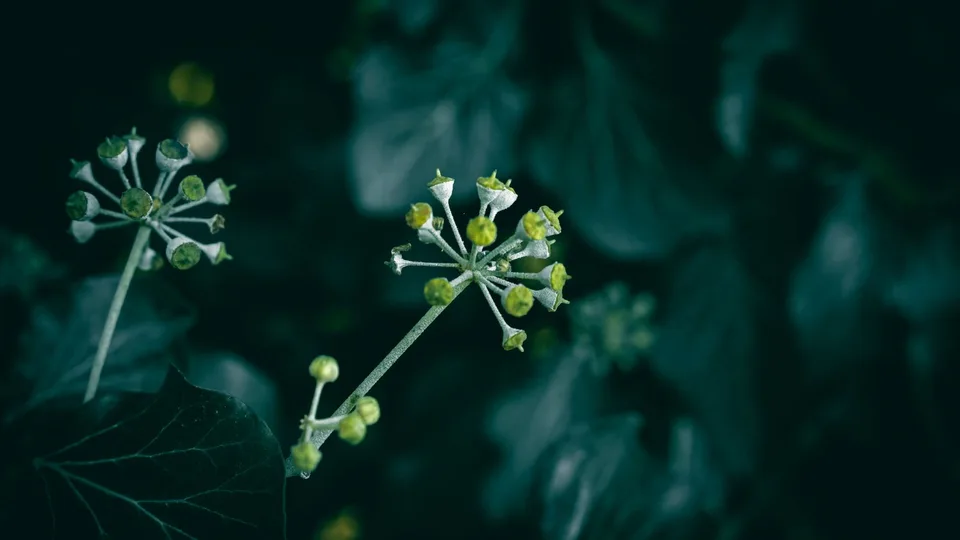
Ivy is the flower British insects crowd onto most. In nine seasons of 10-minute volunteer counts, it averaged 22 insect visitors per count, the highest of 14 target flowers, according to the UK Pollinator Monitoring Scheme Annual Report 2025 from the UK Centre for Ecology & Hydrology (UKCEH) and the Joint Nature Conservation Committee (JNCC) [1]. For American gardeners the result comes with a footnote: in the Pacific Northwest, English ivy is a listed noxious weed [4] [6].
In short: - Ivy averaged 22 insects per 10-minute count, ahead of hogweed at 20 and of bramble, buddleja, knapweeds and thistle at 14 [1]. - Its most common visitors were hoverflies and other flies [1]. - In the US, Washington lists four English ivy cultivars as Class C noxious weeds, and Oregon bans propagating and selling English ivy [4] [6].
- Who
- UK Pollinator Monitoring Scheme, coordinated by UKCEH with JNCC [1]
- Method
- FIT Counts, 10 minutes counting the insects on one flower species in a 19.69 x 19.69 inch (50 x 50 cm) square [1]
- Season
- 1 April to 30 September, 2017 to 2025 [1]
- Whole survey
- 26110 FIT Counts from 3017 recorders since 2017 [1]
- Ivy sample
- 8025 insects in 373 counts [1]
What the volunteers counted
Volunteers pick a patch of flowers, ideally one of the 14 target flowers, and count every visiting insect for 10 minutes [1]. The report's league table gives the average visits per count for each target flower across 2017–2025, from verified raw data rather than modelled counts [1].
Ivy and hogweed remain clear favourites, the report says [1]. For butterflies and moths, buddleja wins: almost four times as many as bramble, thistle or knapweed [1].
The 14 flowers, ranked
| Target flower | Counts | Insects | Report average per count | Insects ÷ counts |
|---|---|---|---|---|
| Ivy | 373 | 8025 | 22 | 21.51 |
| Hogweed | 868 | 17614 | 20 | 20.29 |
| Bramble | 1031 | 14156 | 14 | 13.73 |
| Buddleja | 946 | 12778 | 14 | 13.51 |
| Knapweeds | 1279 | 17450 | 14 | 13.64 |
| Thistle | 1334 | 17361 | 14 | 13.01 |
| Lavender | 1480 | 20062 | 13 | 13.56 |
| Ragwort | 1550 | 18485 | 12 | 11.93 |
| Hawthorn | 444 | 3252 | 7 | 7.32 |
| Heathers | 417 | 2251 | 5 | 5.40 |
| White dead-nettle | 393 | 1929 | 5 | 4.91 |
| White clover | 1306 | 6218 | 5 | 4.76 |
| Dandelion | 1577 | 7448 | 5 | 4.72 |
| Buttercup | 2496 | 12661 | 5 | 5.07 |
The first four columns come from the report [1]; the last is our arithmetic, which matches the report's rounded average for 12 of the 14 flowers (not for thistle and lavender, a gap the report does not explain). Ivy's 373 counts are the smallest sample, 2.41% of the 15494 counts on target flowers, and its average is 4.24 times that of buttercup, the most-surveyed flower.
Why ivy, and why not in an American yard
English ivy flowers only once it climbs, with small greenish-white clusters in the fall, after a juvenile stage that can last 10 years or longer [4]. In the UK, Butterfly Conservation promotes it for Commas, Red Admirals and breeding Holly Blues [1].
The USDA National Invasive Species Information Center lists ivy as an invasive plant, naturalized since the 1870s, that competes with native plants and spreads into tree canopies [3]. The Oregon Department of Agriculture rates English and Atlantic ivy as B-listed weeds: starlings and robins eat the black berries and spread the seeds, and removal in some Oregon parks has cost $3000 per acre ($7413 per hectare) [5]. Oregon's noxious weed quarantine bans propagating, moving or selling both ivies and butterfly bush, except approved sterile butterfly bush varieties [6]. The Washington State Noxious Weed Control Board lists four ivy cultivars, including 'Pittsburgh' and 'Star', as Class C weeds under quarantine [4].
The flowering, climbing stage that UK insects love is the stage that makes berries for birds to carry off. See our pages on English ivy and butterfly bush.
What the report does not say
The averages are raw counts, not corrected for the number of flowers in the square [1]. Ivy has the smallest sample, and counting stops on 30 September [1], while ivy flowers in the fall [4]. Half of the public counts, on average, were made in gardens [1]. The ranking says nothing about trends: hoverflies, among ivy's top visitors, declined by 26% to 37% between 2017 and 2024, according to UKCEH [2]. The report covers UK flowers only: the US guidance above comes from state weed boards and Extension [4] [6] [7]. Another UK finding: honey bees push wild pollinators off flowers.
Frequently asked questions
Which flower did UK pollinators visit most?
Ivy, with an average of 22 insects per 10-minute count [1].
Sources
- UK Pollinator Monitoring Scheme (2026), The UK PoMS Annual Report 2025 — UK Centre for Ecology & Hydrology and Joint Nature Conservation Committee (Table 3, p. 16; Butterfly Conservation section, p. 37) · ukpoms.org.uk, consulted
- New data on insect pollinators shows dramatic decline in hoverflies — UK Centre for Ecology & Hydrology, 25 June 2026 · ceh.ac.uk, consulted
- English Ivy — USDA National Invasive Species Information Center · invasivespeciesinfo.gov, consulted
- English Ivy — Washington State Noxious Weed Control Board · nwcb.wa.gov, consulted
- English ivy and Atlantic ivy weed profile — Oregon Department of Agriculture, Noxious Weed Control Program · oregon.gov, consulted
- Oregon Administrative Rules 603-052-1200, Quarantine; Noxious Weeds — Oregon Department of Agriculture (text via Cornell LII) · law.cornell.edu, consulted
- Goldenrods & asters: Important fall flowers for pollinators — University of Maryland Extension, Maryland Grows, 12 September 2022 · marylandgrows.umd.edu, consulted
Written by Emilio Marruso · last checked