Spotted lanternfly in 179 Massachusetts towns: check for its eggs now
Massachusetts now lists 179 infested communities, Michigan and New Hampshire logged new finds, and the eggs are what survives the winter. Here is a state-by-state table and the Extension way to destroy egg masses.
by Emilio MarrusoPublished
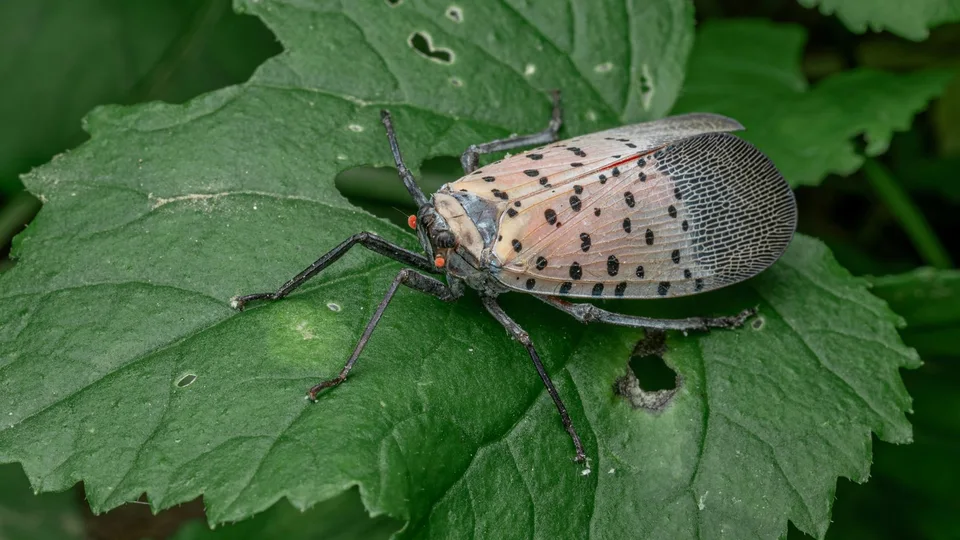
Spotted lanternfly had a busy 2026. The official distribution map of the Massachusetts Department of Agricultural Resources (MDAR) now lists 179 cities and towns with an infestation, 69 of them first found this year [2]. Michigan confirmed a population in Berrien County [3], and New Hampshire confirmed the insect in Salem, after earlier finds only on goods shipped in from infested states [4]. The eggs are what survives the winter, and now is the time to find them [5].
In short: - MDAR's map lists 179 Massachusetts communities with an infestation, 69 of them first found in 2026 [2]. - Michigan (Berrien County, announced September 10) and New Hampshire (Salem, August) logged new finds in 2026 [3] [4]. - Egg masses ride out the winter: scrape them into a bag with rubbing alcohol or hand sanitizer [5].
State by state: what was confirmed and how to report
In Michigan, the Michigan Department of Agriculture and Rural Development (MDARD) and the USDA confirmed the Berrien County population, in a major grape region, though not in a vineyard [3]. In New Hampshire, the NH Bugs site of the University of New Hampshire also reports adults in Atkinson, Hudson, Londonderry, Nashua, Pelham, Plaistow and Windham, with surveys ongoing [4].
| State | Confirmed | When | Agency | How to report |
|---|---|---|---|---|
| Massachusetts | 179 infested communities, 13 with individual finds | Map updated November 9, 2026 | MDAR | Photo and report at mass.gov/slf, only if your town is not yet infested [1] [2] |
| Michigan | Population in Berrien County, 8 counties in all | Announced September 10, 2026 | MDARD with USDA | Photos, date, time and place via the online Eyes in the Field tool, outside those 8 counties [3] |
| New Hampshire | Presence confirmed in Salem, adults in 7 more towns | August 2026, page updated October 22, 2026 | NH Department of Agriculture, Markets and Food | Reporting form at nhbugs.org [4] |
We also tallied the MDAR map by the year each community was first listed as infested [2]:
| Year first found | Communities added | Running total |
|---|---|---|
| 2021 | 1 | 1 |
| 2022 | 3 | 4 |
| 2023 | 8 | 12 |
| 2024 | 33 | 45 |
| 2025 | 65 | 110 |
| 2026 | 69 | 179 |
The last two years account for 134 of the 179 communities, or 74.86%.
Why winter is egg season
Lanternflies lay eggs in the fall and nymphs hatch starting in May, so winter through early spring is the best time to destroy egg masses, says Penn State Extension [5]. MDAR describes them as flat, gray or beige, often like a smear of mud [1]. The USDA Animal and Plant Health Inspection Service (APHIS) warns that they hitchhike on cars, firewood and outdoor gear [6].
Firewood
Buy firewood where you will burn it, or buy certified heat-treated wood before you travel [6].
Cars and patio furniture
Check your vehicle before leaving an infested area, and look over outdoor furniture or camping gear before moving it [1] [6].
Christmas trees
Christmas trees are not a preferred host and the chance of finding an egg mass on one is low, Penn State experts said in 2019; check the tree before buying [7].
What you’ll need
How to destroy an egg mass
Step 1 Press hard
Push the card down until you hear the eggs pop; uncrushed eggs stay viable [5].
Step 2 Scrape into alcohol
Scrape the mass into a bag of hand sanitizer or alcohol so every egg touches the liquid [5].
Step 3 Double-bag and toss
Seal it, put it in a second bag and throw it out with the trash [5]. On hard surfaces, pressure washing works too [6].
What the reports do not say
The MDAR map counts communities, not insects: it does not say how dense each population is [2]. Counts move as surveys continue; ours is the map as read on November 16, 2026. Michigan gives no size for the Berrien County population [3], and the New Hampshire page does not say whether the insect is established there [4]. The APHIS egg advice dates to 2024 [6] and the Christmas tree advice to 2019 [7].
Frequently asked questions
Do spotted lanternflies bite people or pets?
No: they do not bite or sting and pose no direct threat to people or pets [1].
Sources
- State Agricultural Officials Urge Residents to Help Limit Spread of Spotted Lanternfly Across Massachusetts — Massachusetts Department of Agricultural Resources, press release, 9 September 2026 · mass.gov, consulted
- Spotted lanternfly distribution map (Towns_Invasives_SLF2 layer) — Massachusetts Department of Agricultural Resources, data last edited 9 November 2026 · experience.arcgis.com, consulted
- Spotted lanternfly confirmed in Berrien County — Michigan Department of Agriculture and Rural Development, news release, 10 September 2026 · content.govdelivery.com, consulted
- Spotted Lanternfly — NH Bugs, University of New Hampshire with NH Department of Agriculture, Markets and Food, page updated 22 October 2026 · nhbugs.org, consulted
- How To Remove Spotted Lanternfly Eggs — Penn State Extension (Donald Seifrit), video and transcript · extension.psu.edu, consulted
- USDA Asks Residents to Look for Invasive Egg Masses — USDA APHIS, news release, 15 March 2024 · content.govdelivery.com, consulted
- Extension experts: Risk of spotted lanternfly on Christmas trees minimal — Penn State News, 18 November 2019 · psu.edu, consulted
Written by Emilio Marruso · last checked