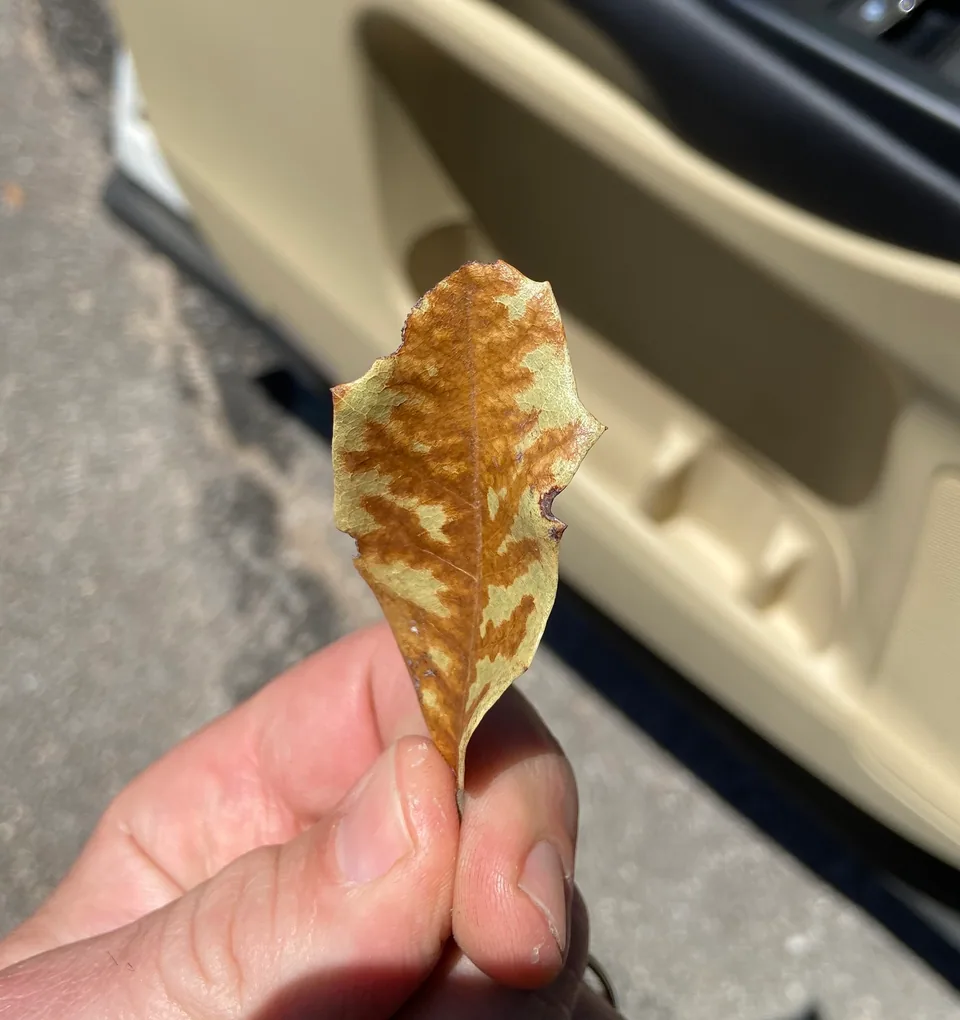
Fungus
Wilt of oak
Bretziella fagacearum
Written by Emilio Marruso
Classification: Ascomycota › Pezizomycotina › Sordariomycetes › Hypocreomycetidae › Microascales › Ceratocystidaceae › Bretziella
Plants it attacks
Plants in our guide where this problem is reported. Open a plant to see the sources.
- Swamp White Oak
Symptom: Highly susceptible to oak wilt.
- Scarlet oak
Symptom: Highly susceptible to oak wilt
- Southern Red Oak
Symptom: Except for oak wilt, no pests or diseases are of major concern; caterpillars can defoliate trees and fall cankerworm has been a problem in some years.
- Shingle Oak
Symptom: Listed as a potential and serious disease problem
- Turkey Oak
Symptom: This tree is highly susceptible to oak wilt
- Bur Oak
Symptom: Oak wilt, anthracnose, oak leaf blister and other fungal diseases are listed
- Water Oak
Symptom: Water oak is susceptible to oak wilt, often with fatal consequences.
- Cherrybark Oak
Symptom: Susceptible to oak wilt; heart rot is greater on poor sites; hispidus canker is common; also wood-boring insects and galls
- Red Oak
Symptom: Susceptible to oak wilt.
- Post Oak
Symptom: The tree occasionally succumbs to chestnut blight and is susceptible to oak wilt.
- Black Oak
Symptom: Susceptible to oak wilt and chlorosis (yellowing of leaves while veins remain green), which can occur when soil is not sufficiently acidic.
- Live Oak
Symptom: A serious fungal disease that can kill infected oak trees within a year or two.
Also reported on: American chestnut, Blackjack Oak, Canyon Live Oak, Chinkapin Oak, Cork Oak, English Oak, Hungarian Oak, Laurel Oak, Nuttall Oak, Pin Oak, Sand Live Oak, Sessile Oak, Shumard Oak, Sweet chestnut, Valley Oak, White Oak, Willow Oak
Remedies
What our plant sheets report, with the outcome checked against official sources. Traditional remedies without an official source are flagged.
Treat
latex paint on fresh pruning cuts Works
How: Only when an oak must be pruned in spring or summer, for example after storm damage: paint the pruning cuts with latex house paint within 15 minutes. The paint can be any color.
Reported for 1 plant: Black Oak
latex paint on pruning cuts Works
How: if an oak must be pruned in spring or summer, paint the cuts within 15 minutes with a latex house paint
Reported for 1 plant: Cherrybark Oak
painting pruning wounds Works
How: Paint cuts and wounds with latex paint; cuts greater than half an inch within a few minutes of pruning.
Reported for 1 plant: Southern Red Oak
prune oak trees from November until mid-March Works
How: Prune from November until mid-March; if wounded in the growing season, treat the wound immediately with acrylic paint.
Reported for 1 plant: Willow Oak
prune only in winter Works
How: Prune oaks in winter (December through February) to reduce the risk of oak wilt infection.
Reported for 1 plant: Post Oak
pruning at the right time Works
How: Avoid pruning or wounding oaks from February through June; the source gives pruning between December 1 and February 1 for Texas.
Reported for 1 plant: Southern Red Oak
latex paint on spring pruning cuts Official source, not independently tested
How: If an oak must be pruned in spring or summer, paint the cuts within 15 minutes with latex house paint.
Reported for 1 plant: Post Oak
remove infected trees and do not stack the wood Official source, not independently tested
How: Remove infected trees as soon as the diagnosis is made; do not stack the wood, since insects in it may carry the fungus to neighboring trees.
Reported for 1 plant: Shumard Oak
removing infected trees Official source, not independently tested
How: Remove infected trees as soon as the diagnosis is made; do not stack the wood.
Reported for 1 plant: Scarlet oak
removing infected trees and trenching Official source, not independently tested
How: Remove infected trees; trenching may be used to prevent root grafting
Reported for 1 plant: Hungarian Oak
compost tea and corn meal soil additives Not proven
How: Soil additives such as compost tea and molasses are sometimes proposed against oak wilt.
Reported for 1 plant: Sand Live Oak
covering fresh wounds with shellac or water-based paint Harmful
How: If you wound an oak during the high-risk season of April-June, cover the wound within 15 minutes with a shellac or water-based spray paint.
Reported for 1 plant: Bur Oak
pruning paint on cuts Harmful
How: apply wound paint in a thin layer immediately after wounding; all cuts greater than 1/2 inch should be painted
Reported for 1 plant: Turkey Oak
1 more remedies are reported in single plant sheets.
Where it is found
Present in 2 countries.
Regulated as a quarantine pest in: Armenia, Canada, Chile, China, Georgia, Iran, Israel, Jordan, Kazakhstan, Moldova, Morocco, Norway, Russia, Serbia, Switzerland, Tunisia, Türkiye, Ukraine, United Kingdom.