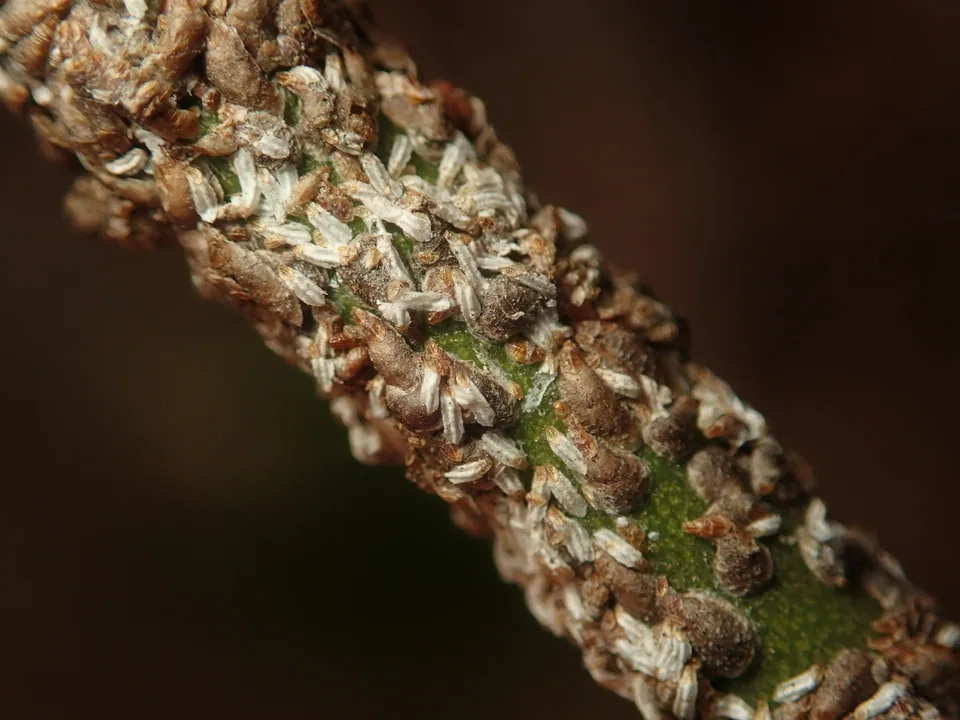
Insect
Euonymus scale
Unaspis euonymi
Written by Emilio Marruso
Classification: Arthropoda › Hexapoda › Insecta › Hemiptera › Sternorrhyncha › Diaspididae › Unaspis
Plants it attacks
Plants in our guide where this problem is reported. Open a plant to see the sources.
- Strawberry Bush
Symptom: Scale insects can be a problem
- Wintercreeper
Symptom: A severe infestation will make the underside of leaves and the entire stem white.
- Japanese Euonymus
Symptom: Stagnated growth or stunting and yellow spots on leaves in moderate infestations
- Japanese Spurge
Symptom: Susceptible to leaf blight, root rot and euonymus scale
Also reported on: Bittersweet, Burning Bush, Spindle Tree, Wahoo
Remedies
What our plant sheets report, with the outcome checked against official sources. Traditional remedies without an official source are flagged.
Treat
horticultural oil spray Works
How: Spray with ultrafine horticultural oil, in mid-April as a dormant treatment or in early June and again in mid-July.
Reported for 4 plants: Bittersweet, Wahoo, Spindle Tree, Japanese Euonymus
insecticidal soap spray Works
How: Spray insecticidal soap in early June and again in mid-July.
Reported for 4 plants: Bittersweet, Strawberry Bush, Wahoo, Japanese Euonymus
horticultural oil Works
How: Apply a 3% to 4% horticultural oil solution (7½ to 10 tablespoons per gallon of water) during winter through to early spring to target overwintering adults and eggs.
Reported for 2 plants: Burning Bush, Wintercreeper
insecticidal soap Works
How: Horticultural oils and insecticidal soaps are the least toxic chemical options, so they may be best to protect beneficial natural enemies.
Reported for 2 plants: Spindle Tree, Wintercreeper
pruning out infested branches Works
How: Prune out heavily infested branches and discard them away from the area immediately.
Reported for 2 plants: Strawberry Bush, Spindle Tree
pruning heavily infested branches Works
How: Prune heavily encrusted branches before crawler emergence to reduce the source population.
Reported for 1 plant: Wintercreeper
removing heavily infested branches Partly works
How: Removal of heavily infested branches will help.
Reported for 1 plant: Wahoo
cutting out infested branches Official source, not independently tested
How: Cut badly infested and injured branches and burn them, where burning is allowed.
Reported for 1 plant: Bittersweet
hand-wiping Official source, not independently tested
How: Hand-wipe to help control small infestations, when practical.
Reported for 1 plant: Burning Bush
hard pruning of infested plants Official source, not independently tested
How: Cut back heavily infested plants almost to the ground so regrowth is easier to monitor.
Reported for 1 plant: Japanese Euonymus
pruning and destroying infested twigs Official source, not independently tested
How: Prune and destroy twigs with isolated heavy infestations.
Reported for 1 plant: Burning Bush
pruning badly infested plants Official source, not independently tested
How: For control of scale, prune badly infested plants.
Reported for 1 plant: Japanese Spurge
scraping or brushing off the scale Not verified
How: In less serious infestations, euonymus scale can be scraped or brushed off, preventing them from reattaching.
Reported for 1 plant: Spindle Tree
1 more remedies are reported in single plant sheets.
Where it is found
Regulated as a quarantine pest in: Egypt.