
How to Grow and Care for Box-leaved barberry
Berberis buxifolia
Written by Emilio Marruso · last checked
Toxic to: People · Why
At a glance
This shrub rewards you with large black berries with a pleasant flavor, tasty enough to eat straight from the branch. It grows in full sun to light shade and asks for little: no regular feeding in reasonably fertile soil, just a layer of compost each spring. You can start it from seed or cuttings, so one plant can become many.
- Sun
Full sun to light shade
- Planting
Plant out seedlings in late spring or early summer, the year after sowing
What the sources say (1)
Planting: Late spring or early summer of the year after sowing (seedlings overwintered in a cold frame)
it is best to leave them in the cold frame for the winter and plant them out in late spring or early summer of the following year
— Magellan Barberry (Berberis buxifolia) — Practical Plants [2] - Feeding
No regular feeding needed; spread 2–3 inches of compost or rotted manure at the base each spring
What the sources say (6)
When: Each spring, as an organic mulch
in containers: In containers , apply a balanced, organic liquid feed in spring and summer
— [6] Spread a 5-7.5cm (2-3in) layer of organic matter, like leaf mould, garden compost or well-rotted manure, around the base of your shrub each spring, being careful not to bank it up against stems to prevent rotting.
— [6] How often: No regular feeding needed in reasonably fertile soil
in containers: In containers , apply a balanced, organic liquid feed in spring and summer
— [6] In the ground, berberis don’t need regular feeding in a reasonably fertile soil.
— [6] Natural fertilizers: 5-7.5 cm [2–3 in] layer of leaf mould, garden compost or well-rotted manure at the base of the shrub each spring
in containers: In containers , apply a balanced, organic liquid feed in spring and summer
— [6] Spread a 5-7.5cm (2-3in) layer of organic matter, like leaf mould, garden compost or well-rotted manure, around the base of your shrub each spring, being careful not to bank it up against stems to prevent rotting.
— [6] - Harvest
Large black berries with a pleasant flavor, eaten fresh off the bush
- Propagation
By seed or cuttings: half-ripe in July–August, mature wood in October–November
What the sources say (3)
Propagation: Seed; half-ripe wood cuttings (July/August); mature wood cuttings (October/November); greenwood and softwood cuttings
Cuttings of half-ripe wood, July/August in a frame.
— Magellan Barberry (Berberis buxifolia) — Practical Plants [2] Cuttings of mature wood of the current season's growth, preferably with a heel, October/November in a frame
— Magellan Barberry (Berberis buxifolia) — Practical Plants [2] Greenwood cuttings, Softwood cuttings
— box leaf barberry - KPU Plant DB [4] - Sowing
Sow the seeds as soon as they are ripe, in a cold frame
What the sources say (1)
Sowing: Seed is best sown as soon as it is ripe, in a cold frame
Seed - best sown as soon as it is ripe in a cold frame, when it should germinate in late winter or early spring
— Magellan Barberry (Berberis buxifolia) — Practical Plants [2] - Safety
Contains berberine: too much can cause vomiting, low blood pressure and a slow heart rate
Overview
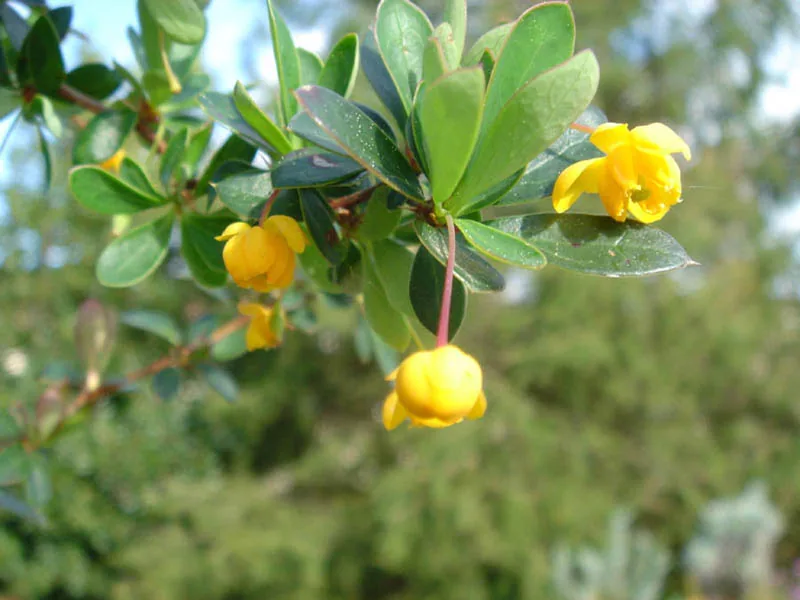
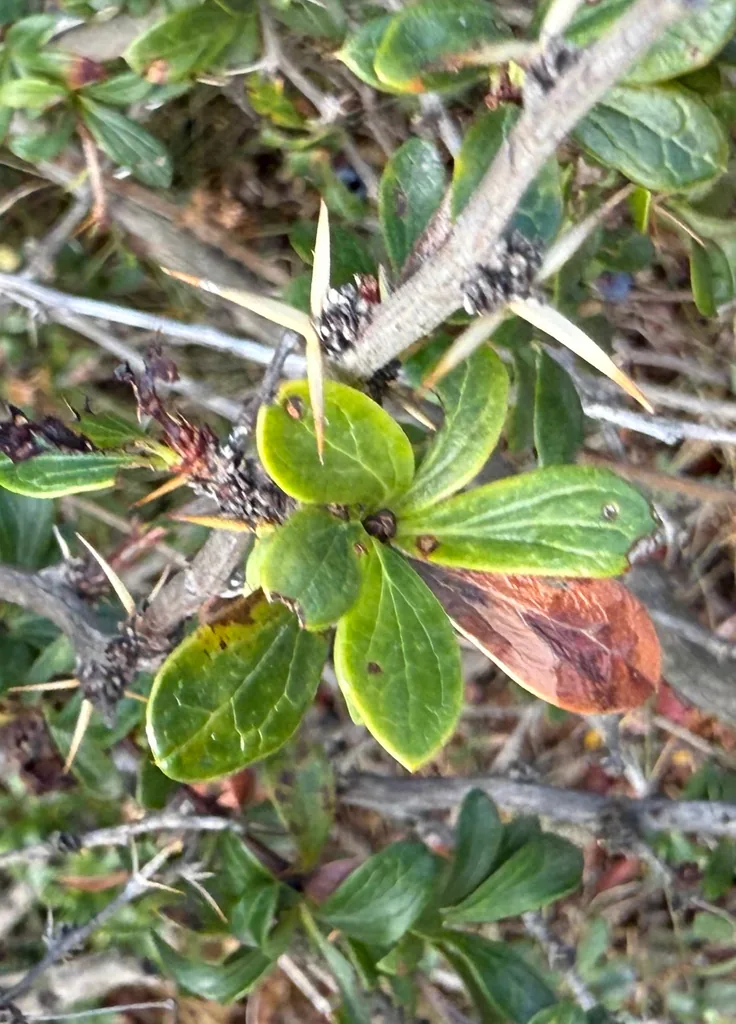
Magellan barberry is an erect, spiny, evergreen shrub that is often grown as an ornamental and used for hedges. [3] It is native to southern Chile and southern Argentina, and its edible fruit is eaten raw or in conserves. [2]
This record is incomplete: the sources we read do not cover every field yet.
Not yet covered by our sources: Watering, Hardiness, warmest zone, Pruning
Box-leaved barberry care
How to water Box-leaved barberry
Not stated in the sources we read.
How much light Box-leaved barberry needs
How much cold Box-leaved barberry can take
Hardiness, coldest zone
The sources give different values depending on region, zone or growing conditions.
What each source says
According to Practical Plants: 5 [winter low −28.9 to −23.3 °C (−20 to −10 °F)]
According to KPU Plant Database: 6 [winter low −23.3 to −17.8 °C (−10 to 0 °F)]
Hardiness, warmest zone
Not stated in the sources we read.
How to propagate Box-leaved barberry
Seed; half-ripe wood cuttings (July/August); mature wood cuttings (October/November); greenwood and softwood cuttings
What the sources say (3)
Cuttings of half-ripe wood, July/August in a frame.Cuttings of mature wood of the current season's growth, preferably with a heel, October/November in a frameGreenwood cuttings, Softwood cuttingsHow to grow Box-leaved barberry
Fertilizing
When
Each spring, as an organic mulch
What each source says
in containers: Spring and summer
What the sources say (2)
in containers: In containers , apply a balanced, organic liquid feed in spring and summerSpread a 5-7.5cm (2-3in) layer of organic matter, like leaf mould, garden compost or well-rotted manure, around the base of your shrub each spring, being careful not to bank it up against stems to prevent rotting.How often
No regular feeding needed in reasonably fertile soil
What each source says
in containers: Through spring and summer
Natural fertilizers
5-7.5 cm [2–3 in] layer of leaf mould, garden compost or well-rotted manure at the base of the shrub each spring
What each source says
in containers: Balanced organic liquid feed
What the sources say (2)
in containers: In containers , apply a balanced, organic liquid feed in spring and summerSpread a 5-7.5cm (2-3in) layer of organic matter, like leaf mould, garden compost or well-rotted manure, around the base of your shrub each spring, being careful not to bank it up against stems to prevent rotting.Remedies
Each remedy shows what official sources say about it; traditional remedies without an official source are marked as such. Harmful ones are listed so you know to avoid them.
Treating the plant
powdery mildew
neem oil spray Official source, not independently tested
do not spray them until evening, so as not to burn the leaves.
— ask.extension.org [7] How: Follow the instructions on the label and do not spray until evening, so as not to burn the leaves.
You can use a fungicide for powdery mildew, or you can use Neem oil. Either way, follow the instructions on the label and do not spray them until evening, so as not to burn the leaves.
— ask.extension.org [7]
aphids
insecticidal soap spray Works
How: A thorough spraying when aphids are first noticed.
A thorough spraying with insecticidal soap or malathion when aphids are first noticed will give control.
— portal.ct.gov [8] What the evidence says A thorough spraying with insecticidal soap or malathion when aphids are first noticed will give control.
— portal.ct.gov [8] dormant horticultural oil spray Works
How: Dormant timing sprays control overwintering insects.
The dormant timing for horticultural oil sprays will control overwintering insects while conserving natural enemies.
— portal.ct.gov [8] What the evidence says The dormant timing for horticultural oil sprays will control overwintering insects while conserving natural enemies.
— portal.ct.gov [8]
barberry webworm
bacillus thuringiensis Official source, not independently tested
How: Apply to young caterpillars.
In the event of an infestation, apply Bacillus thuringiensis var. kurstaki , or spinosad, which are among the compounds registered for control of this pest in Connecticut, to young caterpillars.
— portal.ct.gov [8]
Is Box-leaved barberry poisonous?
Reported by the source, quoted verbatim. This is not medical or veterinary advice: if a person or an animal may have eaten this plant, contact a poison control centre or a veterinarian.
In small quantities berberine has a range of effective medicinal applications but, in excess, can cause vomiting, lowered blood pressure, reduced heart rate, lethargy, and other ill-effects.
[3]- Poisonous parts
All parts of the plant contain the alkaloid berberine - this is most concentrated in the roots, stems and inner bark, and least concentrated in the fruits.
[3]- Toxic principle
All parts of the plant contain the alkaloid berberine - this is most concentrated in the roots, stems and inner bark
[3]- Symptoms
in excess, can cause vomiting, lowered blood pressure, reduced heart rate, lethargy, and other ill-effects.
[3]
Calendar
Sowing
Seed is best sown as soon as it is ripe, in a cold frame
What the sources say (1)
Seed - best sown as soon as it is ripe in a cold frame, when it should germinate in late winter or early springPlanting
Late spring or early summer of the year after sowing (seedlings overwintered in a cold frame)
What the sources say (1)
it is best to leave them in the cold frame for the winter and plant them out in late spring or early summer of the following yearPruning
Not stated in the sources we read.
Months as given by the sources, which are mostly from the United States (northern hemisphere). In the southern hemisphere they shift by about six months.
Edibility
Reported by the source, quoted verbatim. Do not eat a plant on the basis of this page alone: identification mistakes can be dangerous.
Freely borne in Britain. Large and black with a pleasant flavour, they are eaten out of hand
[2]
Indicative values
Values from a secondary source, not checked word for word like the rest of this page. Use them as a starting point.
- Life cycle
- PerennialIndicative value, adapt it to your climate · Secondary source
- Watering
- MinimumIndicative value, adapt it to your climate · Secondary source
- Drought tolerant
- yesIndicative value, adapt it to your climate · Secondary source
- Soil
- Rocky, gravelly, dry, Well-drainedIndicative value, adapt it to your climate · Secondary source
- Soil pH
- 5.5-7.5Indicative value, adapt it to your climate · Secondary source
- Growth rate
- LowIndicative value, adapt it to your climate · Secondary source
- Pruning
- March, April, May, MayIndicative value, adapt it to your climate · Secondary source
- Pests
- Dieback, Fungal leaf spot, Mites, Root rot, Scale insects, Pest resistant, Disease resistant, Deer resistant, Rabbit resistant, Drought resistantIndicative value, adapt it to your climate · Secondary source
Similar plants
- American Barberry Berberis canadensis
- Chinese Barberry Berberis eurybracteata
- Creeping Hollygrape Berberis repens
- Darwin Barberry Berberis darwinii
- Fremont Barberry Berberis fremontii
- Japanese Barberry Berberis thunbergii
- Korean Barberry Berberis koreana
- Mexican Barberry Berberis gracilis
Sources
Every value above is quoted from these documents. Links lead to the original publisher.
- Berberis buxifolia - Trees and Shrubs Online · treesandshrubsonline.org, consulted
- Magellan Barberry (Berberis buxifolia) — Practical Plants · practicalplants.org, consulted
- Berberis microphylla - Useful Temperate Plants · temperate.theferns.info, consulted
- box leaf barberry - KPU Plant DB · plantdatabase.kpu.ca, consulted
- Evergreen Barberries at the Washington Park Arboretum · botanicgardens.uw.edu, consulted
- rhs.org.uk · rhs.org.uk
- ask.extension.org · ask.extension.org
- portal.ct.gov · portal.ct.gov
Written by Emilio Marruso · last checked