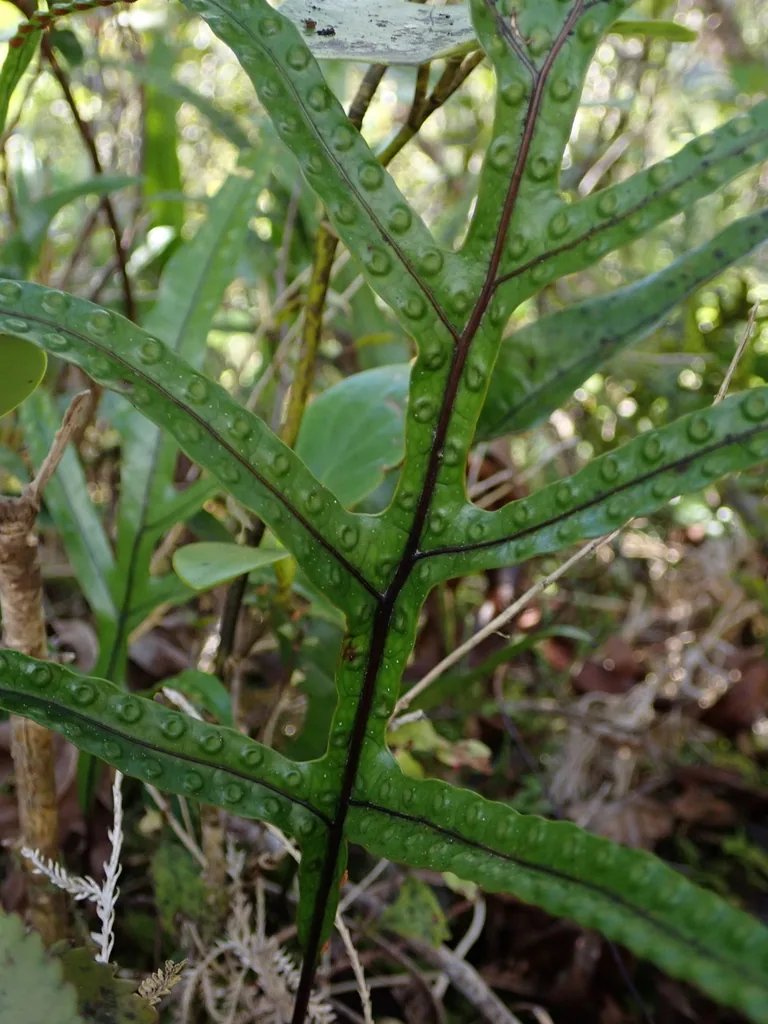
How to Grow and Care for Kangaroo Paw Fern
Phymatosorus diversifolius
Written by Emilio Marruso · last checked
Not toxic to cats and dogs, according to the sources · Sources
At a glance
This perennial fern grows happily indoors or in a container, forming a low carpet of fronds 6–12 inches tall that can spread 3–4 feet wide. It is non-toxic to cats and dogs, so it's a worry-free choice for homes with pets. Just go easy with the watering can and give it well-drained soil, and it will keep growing year after year.
- Water
Don't overwater, and never leave the pot sitting in a saucer of water
What the sources say (1)
Watering notes: Avoid overwatering; do not let the container sit in a saucer of water
Avoid overwatering and do not allow the plant container to sit in a saucer of water.
— Lecanopteris pustulata subp. pustulata (Kangaroo Fern, Kangaroo Foot Fern, Kangaroo Paw Fern) | North Carolina Extension Gardener Plant Toolbox [1] - Cold
Survives winters down to 20 °F (−6.7 °C)
Hardy in average winters · USDA 9a · RHS H4 · Z9
What the sources say (2)
Hardiness, coldest zone: 9a [winter low −6.7 to −3.9 °C (20 to 25 °F)]
USDA Plant Hardiness Zone: 9a, 9b, 10a, 10b, 11a, 11b
— Lecanopteris pustulata subp. pustulata (Kangaroo Fern, Kangaroo Foot Fern, Kangaroo Paw Fern) | North Carolina Extension Gardener Plant Toolbox [1] Hardiness, warmest zone: 11b [winter low 7.2 to 10 °C (45 to 50 °F)]
USDA Plant Hardiness Zone: 9a, 9b, 10a, 10b, 11a, 11b
— Lecanopteris pustulata subp. pustulata (Kangaroo Fern, Kangaroo Foot Fern, Kangaroo Paw Fern) | North Carolina Extension Gardener Plant Toolbox [1] - Soil
Well-drained, slightly acidic soil, pH 5.5–6.5
- Pests
Watch for mealybugs, spider mites and scale; too much water causes root rot
What the sources say (2)
Pests: mealybugs, spider mites, scale insects
Monitor for mealybugs, spider mites, and scale insects. Overwatering or poorly drained soil can cause root rot and other fungal issues.
— Lecanopteris pustulata subp. pustulata (Kangaroo Fern, Kangaroo Foot Fern, Kangaroo Paw Fern) | North Carolina Extension Gardener Plant Toolbox [1] Diseases: root rot, other fungal issues
Monitor for mealybugs, spider mites, and scale insects. Overwatering or poorly drained soil can cause root rot and other fungal issues.
— Lecanopteris pustulata subp. pustulata (Kangaroo Fern, Kangaroo Foot Fern, Kangaroo Paw Fern) | North Carolina Extension Gardener Plant Toolbox [1] - Size
6–12 in tall, spreading 3–4 ft wide
What the sources say (2)
Mature height: 15-30 cm (6-12 in)
The kangaroo paw fern grows 6 to 12 inches tall and 3 to 4 feet wide and has low mounding habit.
— Lecanopteris pustulata subp. pustulata (Kangaroo Fern, Kangaroo Foot Fern, Kangaroo Paw Fern) | North Carolina Extension Gardener Plant Toolbox [1] Mature width: 91-122 cm (3-4 ft)
The kangaroo paw fern grows 6 to 12 inches tall and 3 to 4 feet wide and has low mounding habit.
— Lecanopteris pustulata subp. pustulata (Kangaroo Fern, Kangaroo Foot Fern, Kangaroo Paw Fern) | North Carolina Extension Gardener Plant Toolbox [1] - Propagation
Divide the clump, plant pieces of its creeping roots, or grow it from spores
What the sources say (2)
Propagation: Rhizomatous root cuttings, division and spores
This fern can be propagated by the rhizomatous root cuttings or by spores.
— Lecanopteris pustulata subp. pustulata (Kangaroo Fern, Kangaroo Foot Fern, Kangaroo Paw Fern) | North Carolina Extension Gardener Plant Toolbox [1] You can do so by sowing spores, dividing plants, or transplanting.
— How to Grow and Care for Kangaroo Ferns | Gardener’s Path [4] - Containers
Grows well in pots and indoors
What the sources say (2)
In containers: Yes
either as a container plant or hanging basket.
— Lecanopteris pustulata subp. pustulata (Kangaroo Fern, Kangaroo Foot Fern, Kangaroo Paw Fern) | North Carolina Extension Gardener Plant Toolbox [1] Indoors: Yes
It may be used as a houseplant or groundcover.
— Lecanopteris pustulata subp. pustulata (Kangaroo Fern, Kangaroo Foot Fern, Kangaroo Paw Fern) | North Carolina Extension Gardener Plant Toolbox [1] - Safety
Safe for cats and dogs
Overview
The kangaroo paw fern is an evergreen, rhizomatous creeping fern native to southeast Queensland to southeast Australia, Norfolk Island and New Zealand. [1] It is propagated by rhizomatous root cuttings or by spores. [1]
This record is incomplete: the sources we read do not cover every field yet.
Not yet covered by our sources: Light
Kangaroo Paw Fern care
How to water Kangaroo Paw Fern
Watering
The sources disagree:
Do not allow them to fully dry out between waterings.
[6]
What the sources say (2)
Water the plant when the soil surface begins to dry out.Said moistness is maintained by watering the soil whenever the surface feels dry.Watering notes
Avoid overwatering; do not let the container sit in a saucer of water
What the sources say (1)
Avoid overwatering and do not allow the plant container to sit in a saucer of water.How much light Kangaroo Paw Fern needs
Not stated in the sources we read.
How much cold Kangaroo Paw Fern can take
Hardiness, coldest zone
9a [winter low −6.7 to −3.9 °C (20 to 25 °F)]
What the sources say (1)
USDA Plant Hardiness Zone:
9a, 9b, 10a, 10b, 11a, 11bHardiness, warmest zone
11b [winter low 7.2 to 10 °C (45 to 50 °F)]
What the sources say (1)
USDA Plant Hardiness Zone:
9a, 9b, 10a, 10b, 11a, 11bBest soil for Kangaroo Paw Fern
Soil pH, minimum
5.5
What the sources say (1)
slightly acidic pH of 5.5 to 6.5.Soil pH, maximum
6.5
What the sources say (1)
slightly acidic pH of 5.5 to 6.5.Where to grow Kangaroo Paw Fern
Indoors
Yes
What the sources say (1)
It may be used as a houseplant or groundcover.In containers
Yes
What the sources say (1)
either as a container plant or hanging basket.How to propagate Kangaroo Paw Fern
Rhizomatous root cuttings, division and spores
What the sources say (2)
This fern can be propagated by the rhizomatous root cuttings or by spores.You can do so by sowing spores, dividing plants, or transplanting.How to grow Kangaroo Paw Fern
The plant
Life cycle
perennial
What the sources say (1)
The kangaroo paw fern is an evergreen perennial fern that is an accepted subspecies of the polypody family (Polypodiaceae) and is native to Southeast Queensland to Southeast AustraliaFamily
Polypodiaceae
What the sources say (1)
The kangaroo paw fern is an evergreen perennial fern that is an accepted subspecies of the polypody family (Polypodiaceae) and is native to Southeast Queensland to Southeast AustraliaMature height
15-30 cm (6-12 in)
What the sources say (1)
The kangaroo paw fern grows 6 to 12 inches tall and 3 to 4 feet wide and has low mounding habit.Mature width
91-122 cm (3-4 ft)
What the sources say (1)
The kangaroo paw fern grows 6 to 12 inches tall and 3 to 4 feet wide and has low mounding habit.Pests and diseases
Pests
mealybugs, spider mites, scale insects
What the sources say (1)
Monitor for mealybugs, spider mites, and scale insects. Overwatering or poorly drained soil can cause root rot and other fungal issues.Diseases
root rot, other fungal issues
What the sources say (1)
Monitor for mealybugs, spider mites, and scale insects. Overwatering or poorly drained soil can cause root rot and other fungal issues.Kangaroo Paw Fern pests and problems
Insect pests
Symptom: Mealybugs, spider mites and scale insects.
What to do: Monitor the plant.
What the sources say (1)
Monitor for mealybugs, spider mites, and scale insects.
— Lecanopteris pustulata subp. pustulata (Kangaroo Fern, Kangaroo Foot Fern, Kangaroo Paw Fern) | North Carolina Extension Gardener Plant Toolbox [1] Root rot
Symptom: Root rot and other fungal issues from overwatering or poorly drained soil.
What to do: Avoid overwatering and use well-drained soil.
What the sources say (1)
Overwatering or poorly drained soil can cause root rot and other fungal issues.
— Lecanopteris pustulata subp. pustulata (Kangaroo Fern, Kangaroo Foot Fern, Kangaroo Paw Fern) | North Carolina Extension Gardener Plant Toolbox [1] Browning fern tips
Symptom: Browning of the tips of the fern.
What to do: Provide adequate water and humidity.
What the sources say (1)
Browning of the tips of the fern can be caused by inadequate water or low humidity.
— Lecanopteris pustulata subp. pustulata (Kangaroo Fern, Kangaroo Foot Fern, Kangaroo Paw Fern) | North Carolina Extension Gardener Plant Toolbox [1]
Remedies
Each remedy shows what official sources say about it; traditional remedies without an official source are marked as such. Harmful ones are listed so you know to avoid them.
Treating the plant
aphids
garlic water spray Not verified
Traditional remedy, not verified by an official source.
How: direct sprays of garlic water on the aphids
neem oil Partly works
How: sprayed directly on infested fronds
When sprayed directly on infested fronds, neem oil is also effective.
— How to Grow and Care for Kangaroo Ferns | Gardener’s Path [4] What the evidence says However, neem oil is not effective against every insect and disease, and often must be frequently reapplied to reach the desired outcome.
— extension.unh.edu [7]
spider mites
insecticidal soap Works
Horticultural oil or insecticidal soap (make sure the brand you choose is labeled for use on ferns)
— How to Care for a Kangaroo Fern – A Simple Guide [6] How: direct applications of insecticidal soap
As with aphids and mealybugs, spider mites can be controlled with direct applications of insecticidal soap.
— How to Grow and Care for Kangaroo Ferns | Gardener’s Path [4] What the evidence says For example, insecticidal soap is a safe, effective organic insecticide with minimal environmental impact.
— extension.psu.edu [8]
scale
insecticidal soap Works
How: neem oil, horticultural oil or insecticidal soap, with a brand labeled for use on ferns
neem oil, horticultural oil, or insecticidal soap (make sure the brand is labeled for use on ferns)
— How to Care for a Kangaroo Fern – A Simple Guide [6] What the evidence says For example, insecticidal soap is a safe, effective organic insecticide with minimal environmental impact.
— extension.psu.edu [8]
slugs
hand picking Not verified
Traditional remedy, not verified by an official source.
How: hand pick and dispose of slugs when you see them
beer traps Not verified
Traditional remedy, not verified by an official source.
How: beer traps placed outside and across the entry point
diatomaceous earth barrier Not verified
Traditional remedy, not verified by an official source.
How: diatomaceous earth placed outside and across the entry point
copper tape Not verified
Traditional remedy, not verified by an official source.
How: copper tape wrapped around containers
root rot
trimming rotted roots Not verified
Traditional remedy, not verified by an official source.
How: remove the plant from its container and snip away rotted roots and a proportional amount of shoots
Is Kangaroo Paw Fern poisonous?
Reported by the source, quoted verbatim. This is not medical or veterinary advice: if a person or an animal may have eaten this plant, contact a poison control centre or a veterinarian.
Indicative values
Values from a secondary source, not checked word for word like the rest of this page. Use them as a starting point.
- Light
- part shade, full shadeIndicative value, adapt it to your climate · Secondary source
- Care level
- MediumIndicative value, adapt it to your climate · Secondary source
- Growth rate
- LowIndicative value, adapt it to your climate · Secondary source
- Pruning
- February, MayIndicative value, adapt it to your climate · Secondary source
Similar plants
- Monarch Fern Phymatosorus scolopendria
- Blue Star Fern Phlebodium aureum
- Dainty Rabbits-Foot Fern Davallia fejeensis
- Resurrection Fern Pleopeltis polypodioides
- Staghorn Fern Platycerium bifurcatum
- Appalachian Rockcap Fern Polypodium appalachianum
- Autumn Fern Dryopteris erythrosora
- Braum's Holly Fern Polystichum braunii
Sources
Every value above is quoted from these documents. Links lead to the original publisher.
- Lecanopteris pustulata subp. pustulata (Kangaroo Fern, Kangaroo Foot Fern, Kangaroo Paw Fern) | North Carolina Extension Gardener Plant Toolbox · plants.ces.ncsu.edu, consulted
- Zealandia pustulata subsp. pustulata • New Zealand Plant Conservation Network · nzpcn.org.nz, consulted
- Flora of New Zealand | Taxon Profile | Microsorum pustulatum · nzflora.info, consulted
- How to Grow and Care for Kangaroo Ferns | Gardener’s Path · gardenerspath.com, consulted
- Ferns of Britain and Ireland - Phymatodes diversifolia (Willd.) Pic. Serm. · delta-intkey.com, consulted
- How to Care for a Kangaroo Fern – A Simple Guide · savvygardening.com, consulted
- extension.unh.edu · extension.unh.edu
- extension.psu.edu · extension.psu.edu
Written by Emilio Marruso · last checked