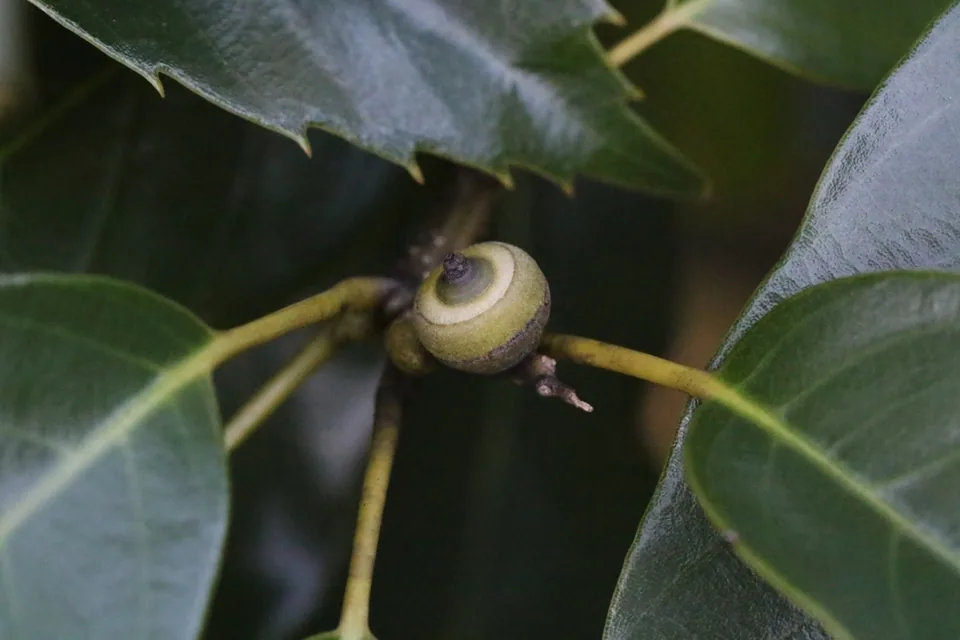
How to Grow and Care for Ring-cup oak
Quercus glauca
Written by Emilio Marruso · last checked
At a glance
This oak loves full light and moist ground, and when it is young it even tolerates a good deal of shade. Its seeds are edible, raw or cooked, and have a sweet taste. You can start it by sowing directly where it will grow, from nursery seedlings, or from cuttings rooted under mist.
- Sun
Full sun; tolerates plenty of shade when young
What the sources say (1)
Light: Full light; tolerates considerable shade when young
Q. glauca can withstand considerable shade up to the pole stage, but thereafter requires complete overhead illumination.
— Quercus glauca [3] - Water
Likes moist ground; not for dry spots
What the sources say (1)
Watering: Moist sites; not for dry sites
The tree prefers moist situations, such as north aspects and the sides of the ravines, and grows well on deep clay loams. It should not be planted on dry sites.
— Quercus glauca [3] - Cold
Survives winters down to 0 °F (−17.8 °C)
Hardy in very cold winters · USDA 7 · RHS H6 · Z7
What the sources say (3)
Hardiness, coldest zone: 7 [winter low −17.8 to −12.2 °C (0 to 10 °F)]
It is one of the hardier ring-cupped oaks (USDA zone 7), though it can be susceptible to late frosts when young.
— Quercus glauca - Trees and Shrubs Online [1] zone 7-8; all types of soils except calcareous ones
— Quercus glauca [2] Hardiness, warmest zone: 8 [winter low −12.2 to −6.7 °C (10 to 20 °F)]
zone 7-8; all types of soils except calcareous ones
— Quercus glauca [2] - Harvest
The acorns are edible raw or cooked and taste sweet
- Propagation
Sow directly, plant nursery seedlings, or root cuttings under mist
Overview
Quercus glauca is a medium-sized broadleaf evergreen tree up to 20 m [65.6 ft]. [3] It prefers moist situations and needs full overhead light after the pole stage. [3] It is often used as a residential shade tree and its seeds are eaten raw or cooked. [3]
This record is incomplete: the sources we read do not cover every field yet.
Not yet covered by our sources: Pruning
Ring-cup oak care
Measurements in square brackets are our conversion into the other unit system; the quoted text is unchanged.
How to water Ring-cup oak
Moist sites; not for dry sites
What the sources say (1)
The tree prefers moist situations, such as north aspects and the sides of the ravines, and grows well on deep clay loams. It should not be planted on dry sites.How much light Ring-cup oak needs
Full light; tolerates considerable shade when young
What the sources say (1)
Q. glauca can withstand considerable shade up to the pole stage, but thereafter requires complete overhead illumination.How much cold Ring-cup oak can take
Hardiness, coldest zone
7 [winter low −17.8 to −12.2 °C (0 to 10 °F)]
Hardiness, warmest zone
8 [winter low −12.2 to −6.7 °C (10 to 20 °F)]
What the sources say (1)
zone 7-8; all types
of soils except calcareous onesHow to propagate Ring-cup oak
Remedies
The sources we checked give no remedies for this plant.
Calendar
Pruning
Not stated in the sources we read.
Months as given by the sources, which are mostly from the United States (northern hemisphere). In the southern hemisphere they shift by about six months.
Edibility
Reported by the source, quoted verbatim. Do not eat a plant on the basis of this page alone: identification mistakes can be dangerous.
Food: Seeds, raw or cooked have a sweet taste.
[3]
Indicative values
Values from a secondary source, not checked word for word like the rest of this page. Use them as a starting point.
- Life cycle
- PerennialIndicative value, adapt it to your climate · Secondary source
- Mature height
- 609.6-914.4 cm (20-30 ft)Indicative value, adapt it to your climate · Secondary source
- Hours of sun
- 4-6 hoursIndicative value, adapt it to your climate · Secondary source
- Drought tolerant
- yesIndicative value, adapt it to your climate · Secondary source
- Soil pH
- 5.5-6.5Indicative value, adapt it to your climate · Secondary source
- Care level
- MediumIndicative value, adapt it to your climate · Secondary source
- Growth rate
- LowIndicative value, adapt it to your climate · Secondary source
- Pruning
- June, July, August, May, August, MayIndicative value, adapt it to your climate · Secondary source
Similar plants
- Black Oak Quercus velutina
- Blackjack Oak Quercus marilandica
- Bluejack Oak Quercus incana
- Bluff Oak Quercus austrina
- Bur Oak Quercus macrocarpa
- Canyon Live Oak Quercus chrysolepis
- Cherrybark Oak Quercus pagoda
- Chestnut Oak Quercus montana
Sources
Every value above is quoted from these documents. Links lead to the original publisher.
- Quercus glauca - Trees and Shrubs Online · treesandshrubsonline.org, consulted
- Quercus glauca · oaksoftheworld.fr, consulted
- Quercus glauca · apps.worldagroforestry.org, consulted
- Quercus glauca Thunb. - AsianFagaceae.com · asianfagaceae.com, consulted
Written by Emilio Marruso · last checked