
How to Grow and Care for Rhododendron dauricum
Rhododendron dauricum
Written by Emilio Marruso · last checked
Toxic to: Cats, Dogs, Horses, People · Why
At a glance
This rhododendron grows happily from partial shade to full sun and can reach 7 ft tall in its native area. Give it cool, moist roots in rich, well-drained soil and a yearly layer of leaf mold. It rarely needs pruning, just a light trim after flowering, and a sheltered spot keeps late frosts away from its flowers and buds.
- Sun
Partial shade to full sun
What the sources say (2)
Light: Partial shade to full sun
Light: Partial shade to full sun. Soil: Humus rich, well-drained, acidic soil.
— Rhododendron dauricum [6] The amount of blossom varies from year to year. It is most abundant in sunny places but on open ground late frost may nip the breaking buds and curb the annual growth.
— Rhododendron dauricum - Dahurian rhododendron | Arboretum Mustila [4] - Water
Keep the roots moist and cool
What the sources say (2)
Watering notes: Keep the root run moist and cool; humus-rich, well-drained soil; top-dress annually with leaf mould
The roots appreciate a moist cool root run and an annual top-dress with leaf mould or similar light, open organic matter.
— A frosty start to the Rhododendron season. – Botanics Stories [2] Light: Partial shade to full sun. Soil: Humus rich, well-drained, acidic soil.
— Rhododendron dauricum [6] - Cold
Survives winters down to −30 °F (−34.4 °C)
Very hardy · USDA 4 · RHS H7 · Z4
What the sources say (2)
Hardiness, coldest zone: 4 [winter low −34.4 to −28.9 °C (−30 to −20 °F)]
Sunset zones: Not listed. USDA zones: 4-8. Heat zones: 8-1.
— Rhododendron dauricum [6] Hardiness, warmest zone: 8 [winter low −12.2 to −6.7 °C (10 to 20 °F)]
Sunset zones: Not listed. USDA zones: 4-8. Heat zones: 8-1.
— Rhododendron dauricum [6] - Soil
Rich, well-drained soil; add a layer of leaf mold on top every year
What the sources say (2)
Watering notes: Keep the root run moist and cool; humus-rich, well-drained soil; top-dress annually with leaf mould
The roots appreciate a moist cool root run and an annual top-dress with leaf mould or similar light, open organic matter.
— A frosty start to the Rhododendron season. – Botanics Stories [2] Light: Partial shade to full sun. Soil: Humus rich, well-drained, acidic soil.
— Rhododendron dauricum [6] - Pruning
Rarely needed: a light trim after flowering
What the sources say (1)
Pruning: After flowering (light pruning; rarely needed)
Pruning Methods: Lightly prune for symmetry after the shrub has finished flowering; rarely needs pruning.
— Rhododendron dauricum [6] - Watch out
Late frosts can ruin flowers and buds: plant it in a sheltered spot
- Size
Up to 7 ft tall in its native area
What the sources say (1)
Mature height: 200 cm [79 in] (two metres) in its area of origin
Found growing through forest margins where it grows to two metres in its area of origin; through eastern and northern Asia.
— A frosty start to the Rhododendron season. – Botanics Stories [2] - Propagation
Seed, cuttings in late summer to fall, layering in fall, or grafting
What the sources say (1)
Propagation: Seed; semi-ripe cuttings in late summer to autumn; layering in fall; grafting in late winter or late summer
Sow ripe seed or seed in early spring. Semi-ripe cuttings in late summer to autumn. Layer in fall. Graft in late winter or late summer.
— Rhododendron dauricum [6] - Sowing
Sow the seeds as soon as they are ripe, or in early spring
What the sources say (1)
Sowing: When ripe, or in early spring
Propagation Methods: Sow ripe seed or seed in early spring. Semi-ripe cuttings in late summer to autumn.
— Rhododendron dauricum [6] - Safety
Harmful to cats, dogs and horses; low risk for people
Overview
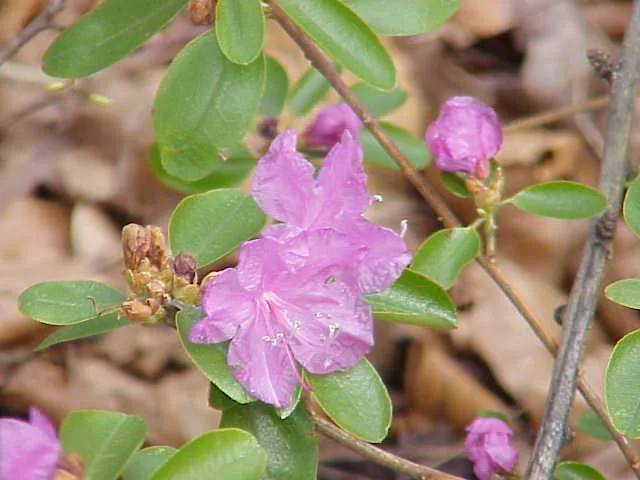
Rhododendron dauricum is a semi-evergreen to deciduous shrub up to about 2 m [6.6 ft], native to East Asia. [4][3] It is one of the earliest rhododendrons to flower, with rosy-purple flowers usually from January, though frost can damage the open flowers. [2] It is very frost hardy, which makes it suitable for cold regions such as much of Scandinavia. [1]
This record is incomplete: the sources we read do not cover every field yet.
Not yet covered by our sources: Watering
Rhododendron dauricum care
Measurements in square brackets are our conversion into the other unit system; the quoted text is unchanged.
How to water Rhododendron dauricum
Watering
Not stated in the sources we read.
Watering notes
Keep the root run moist and cool; humus-rich, well-drained soil; top-dress annually with leaf mould
What the sources say (2)
The roots appreciate a moist cool root run and an annual top-dress with leaf mould or similar light, open organic matter.Light:
Partial shade to full sun.
Soil:
Humus rich, well-drained, acidic soil.How much light Rhododendron dauricum needs
Partial shade to full sun
What the sources say (2)
Light:
Partial shade to full sun.
Soil:
Humus rich, well-drained, acidic soil.The amount of blossom varies from year to year. It is most abundant in sunny places but on open ground late frost may nip the breaking buds and curb the annual growth.How much cold Rhododendron dauricum can take
Hardiness, coldest zone
4 [winter low −34.4 to −28.9 °C (−30 to −20 °F)]
What the sources say (1)
Sunset zones: Not listed.
USDA zones: 4-8.
Heat zones: 8-1.Hardiness, warmest zone
8 [winter low −12.2 to −6.7 °C (10 to 20 °F)]
What the sources say (1)
Sunset zones: Not listed.
USDA zones: 4-8.
Heat zones: 8-1.How to propagate Rhododendron dauricum
Seed; semi-ripe cuttings in late summer to autumn; layering in fall; grafting in late winter or late summer
What the sources say (1)
Sow ripe seed or seed in early spring.
Semi-ripe cuttings in late summer to autumn.
Layer in fall.
Graft in late winter or late summer.How to grow Rhododendron dauricum
The plant
Mature height
200 cm [79 in] (two metres) in its area of origin
What the sources say (1)
Found growing through forest margins where it grows to two metres in its area of origin; through eastern and northern Asia.Rhododendron dauricum pests and problems
Frost damage to flowers and buds
Symptom: Open flowers destroyed by frost; late frosts nip breaking buds on open ground
What to do: Plant in a sheltered spot
What the sources say (3)
However, this hardiness does not apply to the flowers which were decimated by the frosts of last week.
— A frosty start to the Rhododendron season. – Botanics Stories [2] It is most abundant in sunny places but on open ground late frost may nip the breaking buds and curb the annual growth.
— Rhododendron dauricum - Dahurian rhododendron | Arboretum Mustila [4] it is well worth growing in a small group, preferably in some spot sufficiently sheltered to mitigate to some extent the harshness of wind and weather
— Rhododendron dauricum - Trees and Shrubs Online [3]
Remedies
The sources we checked give no remedies for this plant.
Is Rhododendron dauricum toxic to pets?
Reported by the source, quoted verbatim. This is not medical or veterinary advice: if a person or an animal may have eaten this plant, contact a poison control centre or a veterinarian.
Animals
Problems: Poisonous to Humans Problem for Cats Problem for Dogs Problem for Horses
[7]Genus-level warning: refers to the whole genus, not documented for this species
The source flags the risk for this animal but does not explain why.
People
Poisonous to Humans: Poison Severity: Low Poison Symptoms: While the plants are known to contain toxins, ingestion of moderate amounts of azalea (nectar or leaves) poses little toxic hazard.
[7]Genus-level warning: refers to the whole genus, not documented for this species
Calendar
Sowing
When ripe, or in early spring
What the sources say (1)
Propagation Methods:
Sow ripe seed or seed in early spring.
Semi-ripe cuttings in late summer to autumn.Pruning
After flowering (light pruning; rarely needed)
What the sources say (1)
Pruning Methods:
Lightly prune for symmetry after the shrub has finished flowering; rarely needs pruning.Months as given by the sources, which are mostly from the United States (northern hemisphere). In the southern hemisphere they shift by about six months.
Indicative values
Values from a secondary source, not checked word for word like the rest of this page. Use them as a starting point.
- Life cycle
- PerennialIndicative value, adapt it to your climate · Secondary source
- Watering
- AverageIndicative value, adapt it to your climate · Secondary source
- Drought tolerant
- yesIndicative value, adapt it to your climate · Secondary source
- Soil pH
- 4.5-6Indicative value, adapt it to your climate · Secondary source
- Care level
- MediumIndicative value, adapt it to your climate · Secondary source
- Growth rate
- LowIndicative value, adapt it to your climate · Secondary source
Similar plants
- Coastal Azalea Rhododendron atlanticum
- Cumberland Azalea Rhododendron cumberlandense
- Dwarf Purple Rhododendron Rhododendron impeditum
- Early Azalea Rhododendron prinophyllum
- Flame Azalea Rhododendron calendulaceum
- Honeysuckle Azalea Rhododendron luteum
- Piedmont Azalea Rhododendron flammeum
- Piedmont Rhododendron Rhododendron minus
Sources
Every value above is quoted from these documents. Links lead to the original publisher.
- Dahurian rhododendron - Rhododendron dauricum – University of Copenhagen · ign.ku.dk, consulted
- A frosty start to the Rhododendron season. – Botanics Stories · stories.rbge.org.uk, consulted
- Rhododendron dauricum - Trees and Shrubs Online · treesandshrubsonline.org, consulted
- Rhododendron dauricum - Dahurian rhododendron | Arboretum Mustila · mustila.fi, consulted
- Rhododendron Plant Description for dauricum · rhododendron.org, consulted
- Rhododendron dauricum · rainyside.com, consulted
- Rhododendron (Azalea, Rhododendron, Rosebay) | North Carolina Extension Gardener Plant Toolbox · plants.ces.ncsu.edu, consulted
Written by Emilio Marruso · last checked