
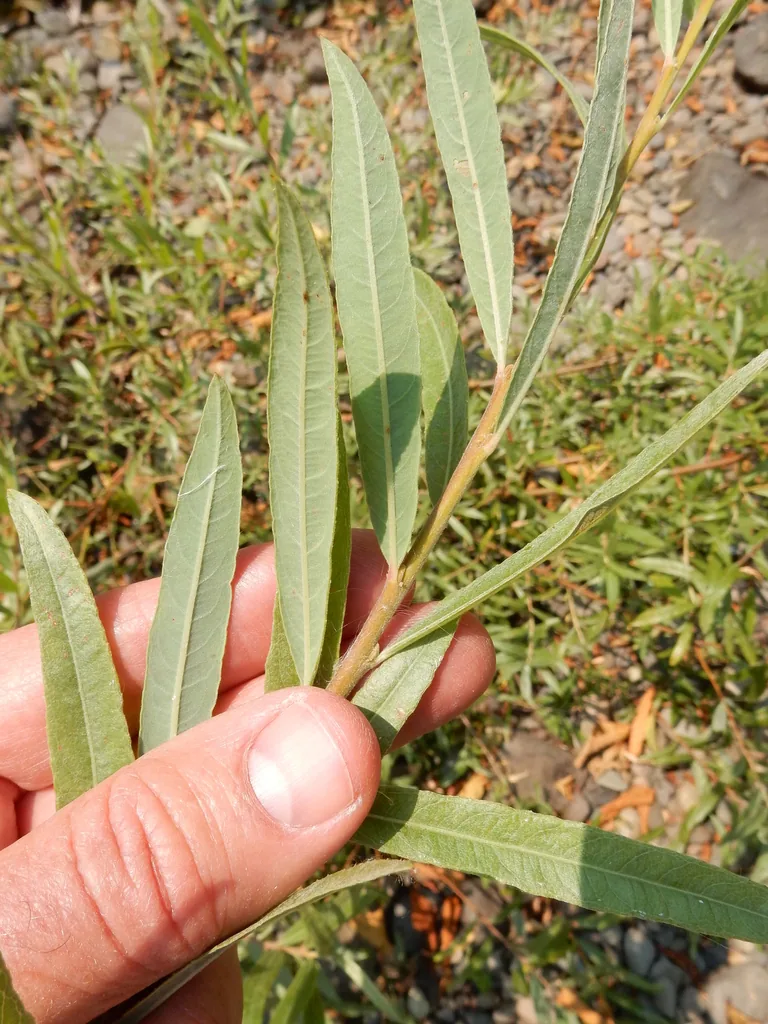

How to Grow and Care for Narrowleaf willow
Salix exigua
Written by Emilio Marruso · last checked
At a glance
This willow is one of the easiest plants to start: cuttings root easily, and early spring is the time to plant them. Give it full to part sun and soil that stays soaking wet, with water close below the surface. It asks for little feeding, just a mulch of compost, and a hard cut to the ground every 5–10 years does it good.
- Sun
Full sun to part sun
What the sources say (2)
Light: Full to part sun
Full to part sun; wet to moderately wet moisture level; sandy or gravelly soil; neutral pH is optimal but will tolerate slightly acid and slightly alkaline pH.
— Salix exigua | Tennessee Smart Yards [5] Light Requirements: - Sun
— Salix exigua (Coyote Willow) – Purdue Arboretum Explorer [3] - Water
Needs soaking-wet soil with water close below to get established
What the sources say (1)
Watering notes: Requires saturated soil conditions (access to a water table) to establish
requires saturated soil conditions (access to a water table) to establish
— Salix exigua | EcoRestore Portal [4] - Planting
Plant cuttings in early spring, while the plant is still dormant
- Feeding
No regular feeding; mulch with compost or well-rotted manure
What the sources say (2)
How often: Not routinely; feed only if the tree shows signs of nutrient deficiency
Most willow trees are robust and vigorous and shouldn’t need feeding unless they are showing signs of nutrient deficiencies
— [8] Natural fertilizers: Mulch the soil beneath the tree with well-rotted organic matter such as garden compost or farmyard manure
Most willow trees are robust and vigorous and shouldn’t need feeding unless they are showing signs of nutrient deficiencies - Mulching around the tree with well-rotted organic matter , such as garden compost or farmyard manure
— [8] - Pruning
Benefits from cutting it right down to the ground every 5–10 years
- Pests
Aphids, scale insects and willow galls; twig cankers and tar spot
What the sources say (2)
Pests: aphids, willow galls, scale insects
Susceptible to twig cankers, tar spot, aphids, willow galls and scale insects.
— Salix exigua | Tennessee Smart Yards [5] Diseases: twig cankers, tar spot
Susceptible to twig cankers, tar spot, aphids, willow galls and scale insects.
— Salix exigua | Tennessee Smart Yards [5] - Watch out
Can spread and turn invasive; its roots seek water and clog septic systems and drains
- Propagation
Cuttings root easily; seeds stay alive only a few days
What the sources say (2)
Propagation: Cuttings (easy); seed (moderately easy, viability lasts only a few days)
Propagation: Easy from cuttings and moderately easy from seed. Seed viability lasts only a few days.
— Salix exigua | Tennessee Smart Yards [5] Vegetative Propagation: Root and twig cuttings (Tannas 1997).
— Plant Description [7]
Overview
Salix exigua is a deciduous shrub that forms thickets of slender stems and spreads by root sprouts. [1] It grows in full to part sun on wet to moderately wet sandy or gravelly soil. [5] It is propagated easily from cuttings and may become weedy. [5]
This record is incomplete: the sources we read do not cover every field yet.
Not yet covered by our sources: Watering, Pruning
Narrowleaf willow care
How to water Narrowleaf willow
Watering
Not stated in the sources we read.
Watering notes
Requires saturated soil conditions (access to a water table) to establish
What the sources say (1)
requires saturated soil conditions (access to a water table) to establishHow much light Narrowleaf willow needs
Full to part sun
What the sources say (2)
Full to part sun; wet to moderately wet moisture level; sandy or gravelly soil; neutral pH is optimal but will tolerate slightly acid and slightly alkaline pH.Light Requirements: - SunHow much cold Narrowleaf willow can take
Hardiness, coldest zone
The sources give different values depending on region, zone or growing conditions.
What each source says
According to Oklahoma State University Extension: 6 [winter low −23.3 to −17.8 °C (−10 to 0 °F)]
According to Purdue Arboretum: 2 [winter low −45.6 to −40 °C (−50 to −40 °F)]
Hardiness, warmest zone
8 [winter low −12.2 to −6.7 °C (10 to 20 °F)]
What the sources say (1)
USDA Cold Hardiness Zone | 6 to 8How to propagate Narrowleaf willow
Cuttings (easy); seed (moderately easy, viability lasts only a few days)
How to grow Narrowleaf willow
The plant
Life cycle
perennial
What the sources say (1)
Plant type: Shrub Lifecycle: Perennial Growing season: NA Cover: NAFamily
Salicaceae
What the sources say (1)
Common Name: Sandbar Willow Species Name: Salix exigua Nutt. Family Name: SalicaceaePests and diseases
Pests
aphids, willow galls, scale insects
What the sources say (1)
Susceptible to twig cankers, tar spot, aphids, willow galls and scale insects.Diseases
twig cankers, tar spot
What the sources say (1)
Susceptible to twig cankers, tar spot, aphids, willow galls and scale insects.Fertilizing
How often
Not routinely; feed only if the tree shows signs of nutrient deficiency
What the sources say (1)
Most willow trees are robust and vigorous and shouldn’t need feeding unless they are showing signs of nutrient deficienciesNatural fertilizers
Mulch the soil beneath the tree with well-rotted organic matter such as garden compost or farmyard manure
What the sources say (1)
Most willow trees are robust and vigorous and shouldn’t need feeding unless they are showing signs of nutrient deficiencies
- Mulching around the tree with well-rotted organic matter , such as garden compost or farmyard manureMineral fertilizers
The sources give different values depending on region, zone or growing conditions.
What each source says
shrub willow grown as a short-rotation bioenergy crop: Few fertilizer inputs; nitrogen fertilizer as needed
What the sources say (1)
shrub willow grown as a short-rotation bioenergy crop: No annual maintenance of the crop should be necessary, and compared to other crops, willow requires few fertilizer inputs, but nitrogen fertilizer can be applied as needed.Narrowleaf willow pests and problems
Weedy spread and clogged drains
Symptom: May become weedy and invasive; water-seeking roots can clog septic systems and storm drains
What to do: Choose the planting site carefully; benefits from a severe cut-back to the ground every 5-10 years
What the sources say (2)
Water-seeking roots can easily clog septic systems and storm drains within an area 2-3 times the shrub’s dripline area.
— Salix exigua | Tennessee Smart Yards [5] Benefits from a severe cut-back to the ground every 5-10 years to rejuvenate the shrub.
— Salix exigua | Tennessee Smart Yards [5]
Remedies
Each remedy shows what official sources say about it; traditional remedies without an official source are marked as such. Harmful ones are listed so you know to avoid them.
Treating the plant
aphids
insecticidal soap spray Partly works
Dormant applications of oil can kill overwintering eggs. Imidacloprid, applied as a systemic to be taken up by the roots will give at least one season of control. Consult the labels for dosage rates and safety precautions.
— portal.ct.gov [10] How: These aphids may be controlled by spraying with insecticidal soap.
These aphids may be controlled by spraying with malathion or insecticidal soap, which are among the compounds registered for use against this pest in Connecticut.
— portal.ct.gov [10] What the evidence says These aphids may be controlled by spraying with malathion or insecticidal soap, which are among the compounds registered for use against this pest in Connecticut.
— portal.ct.gov [10]
tar spot
raking and disposing of fallen leaves Works
How: Raking and disposing of fallen leaves.
Thick, black, raised spots like a blob of tar appear on leaves. Raking and disposing of fallen leaves gives sufficient control.
— portal.ct.gov [10] What the evidence says Raking and disposing of fallen leaves gives sufficient control.
— portal.ct.gov [10]
Getting rid of it
invasive suckering patch
cutting the patch Not verified
Traditional remedy, not verified by an official source.
How: Cut the patch, then revisit it later in the season or the following year to deal with new root suckers.
Calendar
Pruning
Not stated in the sources we read.
Months as given by the sources, which are mostly from the United States (northern hemisphere). In the southern hemisphere they shift by about six months.
Indicative values
Values from a secondary source, not checked word for word like the rest of this page. Use them as a starting point.
- Hours of sun
- 6-8 hoursIndicative value, adapt it to your climate · Secondary source
- Watering
- FrequentIndicative value, adapt it to your climate · Secondary source
- Soil
- SandyIndicative value, adapt it to your climate · Secondary source
- Soil pH
- 5.5-7.5Indicative value, adapt it to your climate · Secondary source
- Care level
- LowIndicative value, adapt it to your climate · Secondary source
- Growth rate
- LowIndicative value, adapt it to your climate · Secondary source
- Pruning
- February, March, April, MayIndicative value, adapt it to your climate · Secondary source
Similar plants
- Black Willow Salix nigra
- Carolina Willow Salix caroliniana
- Japanese Pussy Willow Salix chaenomeloides
- Purple Osier Willow Salix purpurea
- Weeping Willow Salix babylonica
- White Willow Salix alba
- European Pussy Willow Salix caprea
- Silky Willow Salix sericea
Sources
Every value above is quoted from these documents. Links lead to the original publisher.
- Salix exigua - coyote willow | Yavapai County Native and Naturalized Plants · yavapaiplants.extension.arizona.edu, consulted
- Sandbar Willow | Oklahoma State University · extension.okstate.edu, consulted
- Salix exigua (Coyote Willow) – Purdue Arboretum Explorer · arboretum.purdue.edu, consulted
- Salix exigua | EcoRestore Portal · ecorestore.arizona.edu, consulted
- Salix exigua | Tennessee Smart Yards · tnyards.utk.edu, consulted
- NMSU: Selected Plants of Navajo Rangelands · navajorange.nmsu.edu, consulted
- Plant Description · acrre.ualberta.ca, consulted
- rhs.org.uk · rhs.org.uk
- extension.psu.edu · extension.psu.edu
- portal.ct.gov · portal.ct.gov
Written by Emilio Marruso · last checked