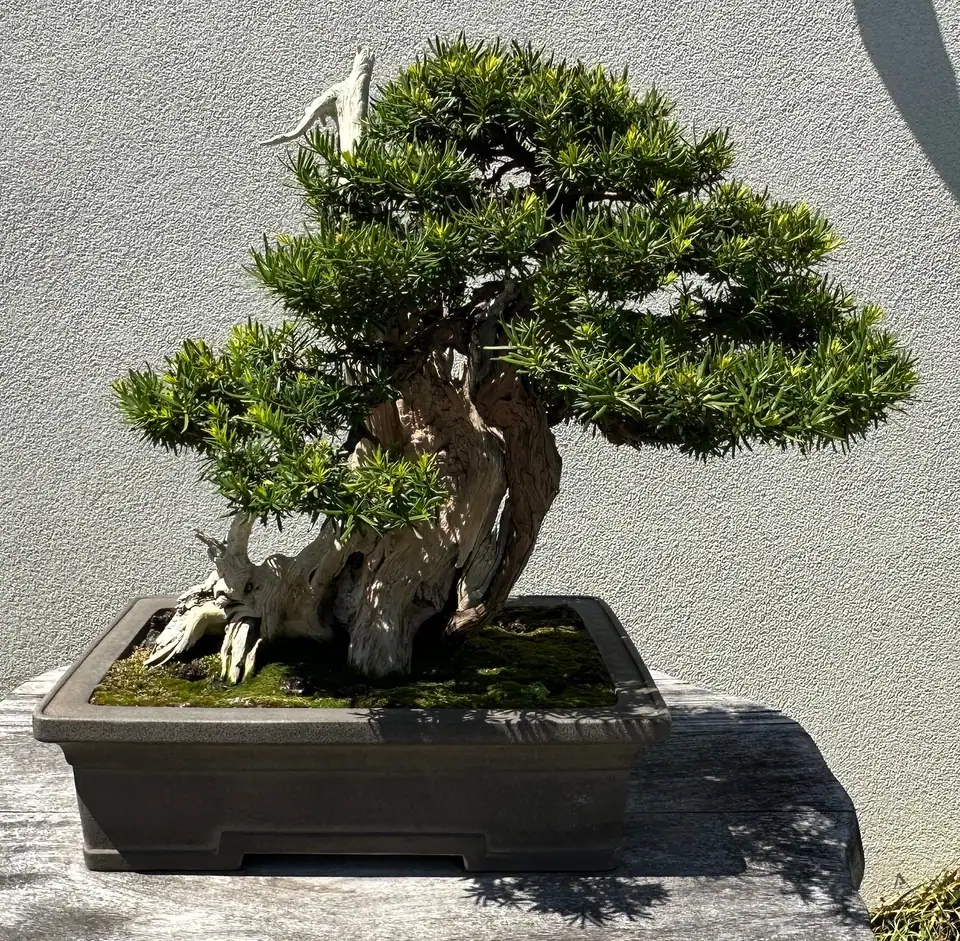

Bonsai care
Japanese yew
Taxus cuspidata
Written by Emilio Marruso
Each step is quoted from bonsai growers, clubs and magazines. Where they disagree we show every school of thought.
Care
Position and light
Tolerates shade and heavy shade; some sun is accepted, full sun or partial shade both tolerated.
- Note
- guida di genere (Taxus), nomina T. cuspidata; Swindon: dappled light in summer, full light in winter
Documented: 2 or more sources
Will tolerate some sun but a shaded position with little direct sunlight is preferred. Will grow happily in quite heavy shade.They are flexible with regard to position and will tolerate full sun or partial shade.Watering
Fleshy roots must not dry out fully and rot if sitting in water.
- Note
- Swindon & District Bonsai Society; guida di genere (Taxus)
To be verified: 1 source
Yew trees have fleshy roots so do not like to dry out totally but also are prone to root rot if they sit in water.Feeding
Schools of thought: the sources disagree, each position is shown with its own sources.
Feed every two weeks in the growing season.
- When
- growing season
- Note
- guida di genere (Taxus), nomina T. cuspidata
To be verified: 1 source
FEEDING: Every two weeks throughout the growing season.Feed all year round, less in the dormant winter months.
- When
- all year round
- Note
- Swindon, guida di genere (Taxus)
To be verified: 1 source
They can also be fed all year round due to being evergreen but reduce the quantity of food during the more dormant period over the winter months.Structural pruning
Structural and hard pruning in autumn and winter before spring.
- When
- autumn and winter before spring
- Note
- guida di genere (Taxus), nomina T. cuspidata
Documented: 2 or more sources
Structure pruning should be done during the autumn and winter months prior to springHard pruning and branch pruning should be carried out in Autumn.Maintenance pruning
Pinch or cut new growth in the growing season; pinch 2 or 3 year old needles in late autumn to push back-budding; do not trim new shoots until after flowering if you want fruit.
- When
- growing season
- Note
- guida di genere (Taxus), nomina T. cuspidata
Documented: 2 or more sources
New growth needs to be plucked out during the growing season.To encourage back-budding, pinch out 2 or 3 year old needles in late-Autumn.New growth can be cut with sharp pruning scissors or pinched by hand to encourage back budding.Wiring
Preferably in autumn and winter before spring, but possible at any time.
- When
- autumn and winter
- Note
- guida di genere (Taxus), nomina T. cuspidata
To be verified: 1 source
wiring also is preferable during this time but actually can be done at any time.When to repot
Schools of thought: the sources disagree, each position is shown with its own sources.
Every 3 to 4 years in spring as new buds extend.
- When
- Spring, as new buds extend
- Note
- guida di genere (Taxus), nomina T. cuspidata
To be verified: 1 source
Yews only need repotting every 3 to 4 years in Spring as new buds extend.August-September gives better results because root growth is strongest.
- When
- August-September
- Note
- guida di genere (Taxus), nomina T. cuspidata; la stessa fonte propone entrambe le epoche
To be verified: 1 source
For better results, repot in August-September as rootgrowth is strongest at this time of year.Repotting soil
Very free-draining, open mix that does not stay cold in winter.
- Note
- guida di genere (Taxus), nomina T. cuspidata
Documented: 2 or more sources
Use a very free draining mix as Yews dislike very wet soils.It should also be a mix that does not remain cold during the winter that offers the fleshy roots a level of protection within the pot.Winter and frost (in a pot)
Schools of thought: the sources disagree, each position is shown with its own sources.
Fully hardy to -10 C, below that give protection.
- Lowest temperature
- -10 °C (14 °F)
- Note
- guida di genere (Taxus), nomina T. cuspidata; la fonte non dice se in vaso
To be verified: 1 source
Fully hardy to -10°C after which some protection should be given.Not frost tolerant in a bonsai pot because the large fleshy roots are vulnerable to frost damage.
- Note
- Swindon; scritto per Taxus baccata, parla di tasso in generale
To be verified: 1 source
they are not frost tolerant as they have large fleshy roots that are vulnerable to frost damage when kept in bonsai pots.Pests and diseases
Resistant to most diseases except root rot; insects: tortrix moth caterpillars and yew scale; also mites and bud galls.
- Note
- guida di genere (Taxus), nomina T. cuspidata
Documented: 2 or more sources
Resistant to almost all diseases except root-rot.Yews as bonsai are prone to scale insect, mites including red spider mite as well as certain galls like the artichoke gall that forms on the buds.Propagation
Semi-ripe cuttings in late summer or early autumn, layering in late spring; air layering in summer also works.
- When
- late-Summer or early-Autumn
- Note
- guida di genere (Taxus), nomina T. cuspidata; Swindon: cuttings in autumn, air layering in summer
Documented: 2 or more sources
Take semi-ripe cuttings in late-Summer or early-Autumn. By layering in late Spring.Another method is via air layering in summer and this is very successfulStyles
Suits all styles except broom, in all sizes.
- Note
- guida di genere (Taxus), nomina T. cuspidata
To be verified: 1 source
STYLING: Suitable for all forms except Broom in all sizes.Remedies
Each remedy shows what official sources say about it; traditional remedies without an official source are marked as such. Harmful ones are listed so you know to avoid them.
Getting rid of it
yew scale insects
pick them off by hand Not verified
Traditional remedy, not verified by an official source.
How: remove galls and pick off scale; pests mostly appear on weaker trees, so keep trees healthy and spaced apart
Sources
Every value above is quoted from these documents. Links lead to the original publisher.
- Taxus/ Yew Bonsai – Bonsai4Me · bonsai4me.com, consulted
- Yew trees as bonsai - Swindon & District Bonsai · swindon-bonsai.co.uk, consulted