

How to Grow and Care for Japanese Yew
Taxus cuspidata
Written by Emilio Marruso · last checked
Toxic to: Cats, Dogs, Horses, People · Why
At a glance
This yew is happy with almost any light: it grows in full sun, dappled sunlight or partial shade, and spreads 5–10 ft wide. Give it well-drained soil, the one thing it truly needs, and plenty of room, 6–12 ft between plants. Just remember that its bark, leaves and seeds are poisonous to people, cats, dogs and horses.
- Sun
Full sun, dappled sunlight or partial shade
What the sources say (1)
Light: Full sun, dappled sunlight, or partial shade
Grow the Japanese yew in full sun, dappled sunlight, or in partial shade.
— Taxus cuspidata (Japanese Yew) | North Carolina Extension Gardener Plant Toolbox [1] - Cold
Survives winters down to −30 °F (−34.4 °C)
Very hardy · USDA 4a · RHS H7 · Z4
What the sources say (2)
Hardiness, coldest zone: 4a [winter low −34.4 to −31.7 °C (−30 to −25 °F)]
USDA Plant Hardiness Zone: 4a, 4b, 5a, 5b, 6a, 6b, 7a, 7b
— Taxus cuspidata (Japanese Yew) | North Carolina Extension Gardener Plant Toolbox [1] Hardiness, warmest zone: 7b [winter low −15 to −12.2 °C (5 to 10 °F)]
USDA Plant Hardiness Zone: 4a, 4b, 5a, 5b, 6a, 6b, 7a, 7b
— Taxus cuspidata (Japanese Yew) | North Carolina Extension Gardener Plant Toolbox [1] - Soil
Well-drained soil is a must: soggy soil rots the roots, especially on young plants
What the sources say (2)
Watering notes: Well-drained soil is essential; poorly drained soils can be very damaging, especially to newly planted yews
Black vine weevil, mites and root rot are problems. Poorly drained soils can be very damaging to yews, especially newly planted ones.
— Japanese Yew (Taxus cuspidata)-Hort Answers - University of Illinois Extension [2] Full sun to fairly deep shade; well-drained soil is essential.
— Japanese Yew (Taxus cuspidata)-Hort Answers - University of Illinois Extension [2] - Spacing
6–12 ft between plants
What the sources say (1)
Spacing: 182.9-365.8 cm (6-12 ft)
Grown as a landscape specimen and pruned regularly the height typically averages around 25 feet. Plant 6 to 12 feet apart.
— Taxus cuspidata (Japanese Yew) | North Carolina Extension Gardener Plant Toolbox [1] - Harvest
Only the red flesh around the seed is edible, in small amounts; the green seed is poisonous
- Pests
Mealybugs, scale, black vine weevils and mites; root rot and twig and needle blight
What the sources say (4)
Pests: mealybugs, scale, weevils (black vine weevil), mites
Insects affecting the plant include mealybugs, scale, and weevils.
— Taxus cuspidata (Japanese Yew) | North Carolina Extension Gardener Plant Toolbox [1] Black vine weevil, mites and root rot are problems.
— Japanese Yew (Taxus cuspidata)-Hort Answers - University of Illinois Extension [2] Diseases: root rot, twig blight, needle blight, Phytophthora canker and basal rot, sooty mold
Root rot can occur when the soil is not properly drained. Twig blight and needle blight can also be a problem.
— Taxus cuspidata (Japanese Yew) | North Carolina Extension Gardener Plant Toolbox [1] Phytophthora Canker, Basal Rot, & Root Rot [Shrubs and Trees] ( Phytophthora spp. [water molds] ) - Sooty Mold ( Numerous genus and species )
— Japanese Yew (Taxus cuspidata)-Hort Answers - University of Illinois Extension [2] - Watch out
In exposed spots the leaves can get winter burn
- Size
5–10 ft wide
What the sources say (1)
Mature width: 152-305 cm (5-10 ft)
Dimensions: Height: 10 ft. 0 in. - 25 ft. 0 in. Width: 5 ft. 0 in. - 10 ft. 0 in.
— Taxus cuspidata (Japanese Yew) | North Carolina Extension Gardener Plant Toolbox [1] - Safety
Bark, leaves and seeds are poisonous to people, cats, dogs and horses, and can be fatal
Overview
Japanese yew is a woody evergreen tree or shrub native to Korea, China, Russia, and Japan, whose foliage and seeds are toxic. [1][2] It grows in full sun to partial shade in well-drained soil and tolerates drought and regular pruning. [1]
This record is incomplete: the sources we read do not cover every field yet.
Not yet covered by our sources: Pruning, Propagation
Japanese Yew care
How to water Japanese Yew
Watering
The sources give different values depending on region, zone or growing conditions.
What each source says
According to NC State Extension: Tolerant of drought
According to University of Illinois Extension: Drought listed as a cause of environmental damage
What the sources say (3)
According to NC State Extension: This yew is tolerant of urban conditions and drought.According to University of Illinois Extension: Environmental Damage
- Drought
- Drowning and EdemaThis yew is tolerant of urban conditions and drought. It is also very cold hardy and easy to maintain.Watering notes
Well-drained soil is essential; poorly drained soils can be very damaging, especially to newly planted yews
What the sources say (2)
Black vine weevil, mites and root rot are problems. Poorly drained soils can be very damaging to yews, especially newly planted ones.Full sun to fairly deep shade; well-drained soil is essential.How much light Japanese Yew needs
Full sun, dappled sunlight, or partial shade
What the sources say (1)
Grow the Japanese yew in full sun, dappled sunlight, or in partial shade.How much cold Japanese Yew can take
Hardiness, coldest zone
4a [winter low −34.4 to −31.7 °C (−30 to −25 °F)]
What the sources say (1)
USDA Plant Hardiness Zone:
4a, 4b, 5a, 5b, 6a, 6b, 7a, 7bHardiness, warmest zone
7b [winter low −15 to −12.2 °C (5 to 10 °F)]
What the sources say (1)
USDA Plant Hardiness Zone:
4a, 4b, 5a, 5b, 6a, 6b, 7a, 7bWhere to grow Japanese Yew
182.9-365.8 cm (6-12 ft)
What the sources say (1)
Grown as a landscape specimen and pruned regularly the height typically averages around 25 feet. Plant 6 to 12 feet apart.How to propagate Japanese Yew
Not stated in the sources we read.
How to grow Japanese Yew
The plant
Family
Taxaceae
What the sources say (1)
The Japanese yew is a woody evergreen tree or shrub in the yew family (Taxaceae).Mature height
Mature width
152-305 cm (5-10 ft)
What the sources say (1)
Dimensions:
Height: 10 ft. 0 in. - 25 ft. 0 in.
Width: 5 ft. 0 in. - 10 ft. 0 in.Pests and diseases
Pests
mealybugs, scale, weevils (black vine weevil), mites
What the sources say (2)
Insects affecting the plant include mealybugs, scale, and weevils.Black vine weevil, mites and root rot are problems.Diseases
root rot, twig blight, needle blight, Phytophthora canker and basal rot, sooty mold
What the sources say (2)
Root rot can occur when the soil is not properly drained. Twig blight and needle blight can also be a problem.Phytophthora Canker, Basal Rot, & Root Rot [Shrubs and Trees] ( Phytophthora spp. [water molds] )
- Sooty Mold ( Numerous genus and species )Fertilizing
When
The sources give different values depending on region, zone or growing conditions.
What each source says
field production: Late February and again in late June
What the sources say (1)
field production: The normal UT Extension recommendation for all shrubs and conifers is no more than 50 pounds of actual nitrogen per acre applied in late Feb and again in late June.How often
The sources give different values depending on region, zone or growing conditions.
What each source says
field production: Twice a year
What the sources say (1)
field production: The normal UT Extension recommendation for all shrubs and conifers is no more than 50 pounds of actual nitrogen per acre applied in late Feb and again in late June.Mineral fertilizers
The sources give different values depending on region, zone or growing conditions.
What each source says
field production: No more than 56 kg [123.5 lb] of actual nitrogen per hectare per application
field production: Lime, phosphate or potash per soil test, broadcast and incorporated before planting
What the sources say (2)
field production: The normal UT Extension recommendation for all shrubs and conifers is no more than 50 pounds of actual nitrogen per acre applied in late Feb and again in late June.field production: Soil test early enough so that any lime, phosphate or potash can be broadcast and incorporated prior to planting.Japanese Yew pests and problems
Winter burn
Symptom: Occurs in locations where the plant is exposed.
What the sources say (1)
Issues with winter burn can occur in locations where the plant is exposed.
— Taxus cuspidata (Japanese Yew) | North Carolina Extension Gardener Plant Toolbox [1] Root rot
Symptom: Occurs when the soil is not properly drained.
What to do: Plant in well-drained soil.
What the sources say (2)
Root rot can occur when the soil is not properly drained.
— Taxus cuspidata (Japanese Yew) | North Carolina Extension Gardener Plant Toolbox [1] Full sun to fairly deep shade; well-drained soil is essential.
— Japanese Yew (Taxus cuspidata)-Hort Answers - University of Illinois Extension [2] Twig blight and needle blight
Symptom: Listed as problems.
What the sources say (1)
Twig blight and needle blight can also be a problem. Insects affecting the plant include mealybugs, scale, and weevils.
— Taxus cuspidata (Japanese Yew) | North Carolina Extension Gardener Plant Toolbox [1] Insect pests
Symptom: Mealybugs, scale, and weevils affect the plant.
What the sources say (1)
Twig blight and needle blight can also be a problem. Insects affecting the plant include mealybugs, scale, and weevils.
— Taxus cuspidata (Japanese Yew) | North Carolina Extension Gardener Plant Toolbox [1]
Remedies
Each remedy shows what official sources say about it; traditional remedies without an official source are marked as such. Harmful ones are listed so you know to avoid them.
Treating the plant
root weevils
beneficial nematodes Works
Insect parasites, such as beneficial nematodes ( Steinernema and Heterorhabditis spp.), can be used, but may not give complete control in home landscapes.
— mortonarb.org [7] How: used as a soil drench in moist soils over 55 F (mid-fall in western Washington); read and follow the label directions
Apply beneficial nematodes which kill weevil larvae. The nematodes are used as a soil drench in moist soils over 55° F (mid-fall in western Washington).
— hortsense.cahnrs.wsu.edu [6] What the evidence says Apply beneficial nematodes which kill weevil larvae. The nematodes are used as a soil drench in moist soils over 55° F (mid-fall in western Washington).
— hortsense.cahnrs.wsu.edu [6] knocking adults off the plant Not verified
Traditional remedy, not verified by an official source.
How: put a white cloth at the base of the plant, gently shake the plant to dislodge the weevils, then move them to a jar of soapy water
sticky cardboard strips on stems Not verified
Traditional remedy, not verified by an official source.
How: affix cardboard strips covered with a sticky substance to the stems and trunks in early spring before adults emerge; remove and destroy trapped weevils
taxus mealybug
pruning out infested branches Official source, not independently tested
How: prune out and destroy infested branches
Prune out and destroy infested branches or throw plant away
— sites.rutgers.edu [8]
Is Japanese Yew toxic to pets?
Reported by the source, quoted verbatim. This is not medical or veterinary advice: if a person or an animal may have eaten this plant, contact a poison control centre or a veterinarian.
Animals
Problems: Poisonous to Humans Problem for Cats Problem for Dogs Problem for Horses
[1]
People
Nervousness, trembling, slow pulse, pupil dilation, difficult breathing, seizures (dogs), abdominal pain, vomiting, diarrhea, weakness, convulsions; may be fatal.
[1]- Poisonous parts
Poison Part: Bark Leaves Seeds
[1]- Toxic principle
Poison Toxic Principle: Alkaloid taxine
[1]- Symptoms
Nervousness, trembling, slow pulse, pupil dilation, difficult breathing, seizures (dogs), abdominal pain, vomiting, diarrhea, weakness, convulsions; may be fatal.
[1]- Severity
Poison Severity: High
[1]
Poison Toxic Principle: Alkaloid taxine Causes Contact Dermatitis: No Poison Part: Bark Leaves Seeds
[1]- Poisonous parts
Poison Part: Bark Leaves Seeds
[1]- Toxic principle
Poison Toxic Principle: Alkaloid taxine
[1]- Symptoms
Nervousness, trembling, slow pulse, pupil dilation, difficult breathing, seizures (dogs), abdominal pain, vomiting, diarrhea, weakness, convulsions; may be fatal.
[1]- Severity
Poison Severity: High
[1]
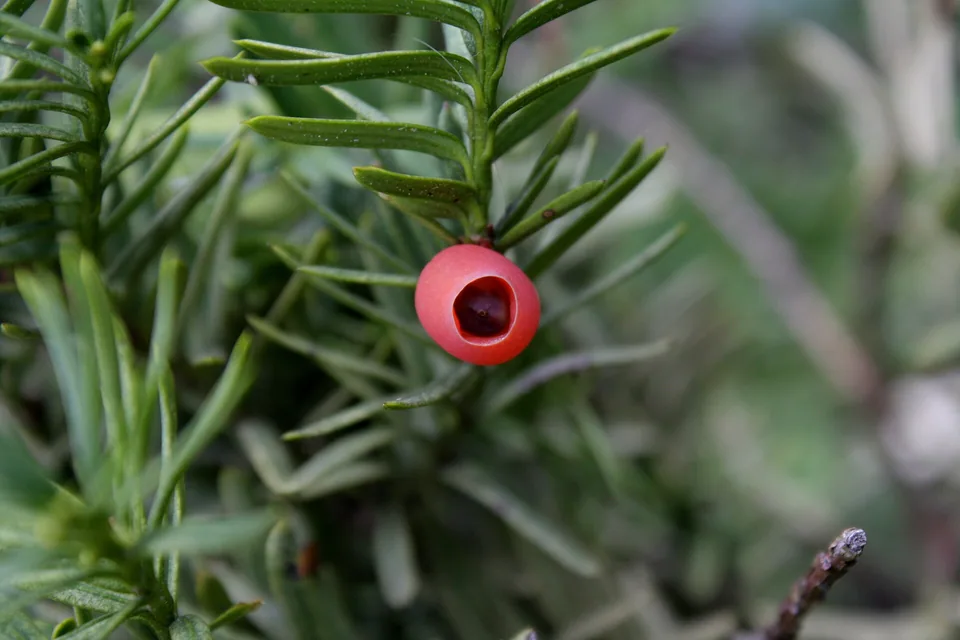
The red arils, in small amounts, are edible. The green seed is toxic.
[1]- Poisonous parts
Poison Part: Bark Leaves Seeds
[1]- Toxic principle
Poison Toxic Principle: Alkaloid taxine
[1]- Symptoms
Nervousness, trembling, slow pulse, pupil dilation, difficult breathing, seizures (dogs), abdominal pain, vomiting, diarrhea, weakness, convulsions; may be fatal.
[1]- Severity
Poison Severity: High
[1]
Evergreen foliage; red fruit on female plants (foliage and the seed within the fruit are both toxic).
[2]
Calendar
Pruning
Not stated in the sources we read.
Months as given by the sources, which are mostly from the United States (northern hemisphere). In the southern hemisphere they shift by about six months.
Edibility
Reported by the source, quoted verbatim. Do not eat a plant on the basis of this page alone: identification mistakes can be dangerous.
The red arils, in small amounts, are edible. The green seed is toxic.
[1]
Indicative values
Values from a secondary source, not checked word for word like the rest of this page. Use them as a starting point.
- Life cycle
- PerennialIndicative value, adapt it to your climate · Secondary source
- Hours of sun
- 2-5 hoursIndicative value, adapt it to your climate · Secondary source
- Drought tolerant
- yesIndicative value, adapt it to your climate · Secondary source
- Soil pH
- 6-6.5Indicative value, adapt it to your climate · Secondary source
- Care level
- ModerateIndicative value, adapt it to your climate · Secondary source
- Growth rate
- LowIndicative value, adapt it to your climate · Secondary source
- Pruning
- March, AprilIndicative value, adapt it to your climate · Secondary source
- Propagation
- Cutting, Layering Propagation, Grafting Propagation, Seed Propagation, Tissue CultureIndicative value, adapt it to your climate · Secondary source
Similar plants
- Chinese Yew Taxus chinensis
- Florida Yew Taxus floridana
- American Yew Taxus canadensis
- Pacific Yew Taxus brevifolia
- English Yew Taxus baccata
- Florida Torreya Torreya taxifolia
- Japanese Nutmeg Tree Torreya nucifera
- Japanese Plum Yew Cephalotaxus harringtonia
Sources
Every value above is quoted from these documents. Links lead to the original publisher.
- Taxus cuspidata (Japanese Yew) | North Carolina Extension Gardener Plant Toolbox · plants.ces.ncsu.edu, consulted
- Japanese Yew (Taxus cuspidata)-Hort Answers - University of Illinois Extension · web.extension.illinois.edu, consulted
- Japanese Yew (Taxus cuspidata) - Selecting Shrubs for Your Home - University of Illinois Extension · web.extension.illinois.edu, consulted
- Taxus (Yew) | North Carolina Extension Gardener Plant Toolbox · plants.ces.ncsu.edu, consulted
- plantsciences.tennessee.edu · plantsciences.tennessee.edu
- hortsense.cahnrs.wsu.edu · hortsense.cahnrs.wsu.edu
- mortonarb.org · mortonarb.org
- sites.rutgers.edu · sites.rutgers.edu
Written by Emilio Marruso · last checked