

How to Grow and Care for English Yew
Taxus baccata
Written by Emilio Marruso · last checked
Toxic to: Dogs, Horses, Cattle, Livestock, People · Why
At a glance
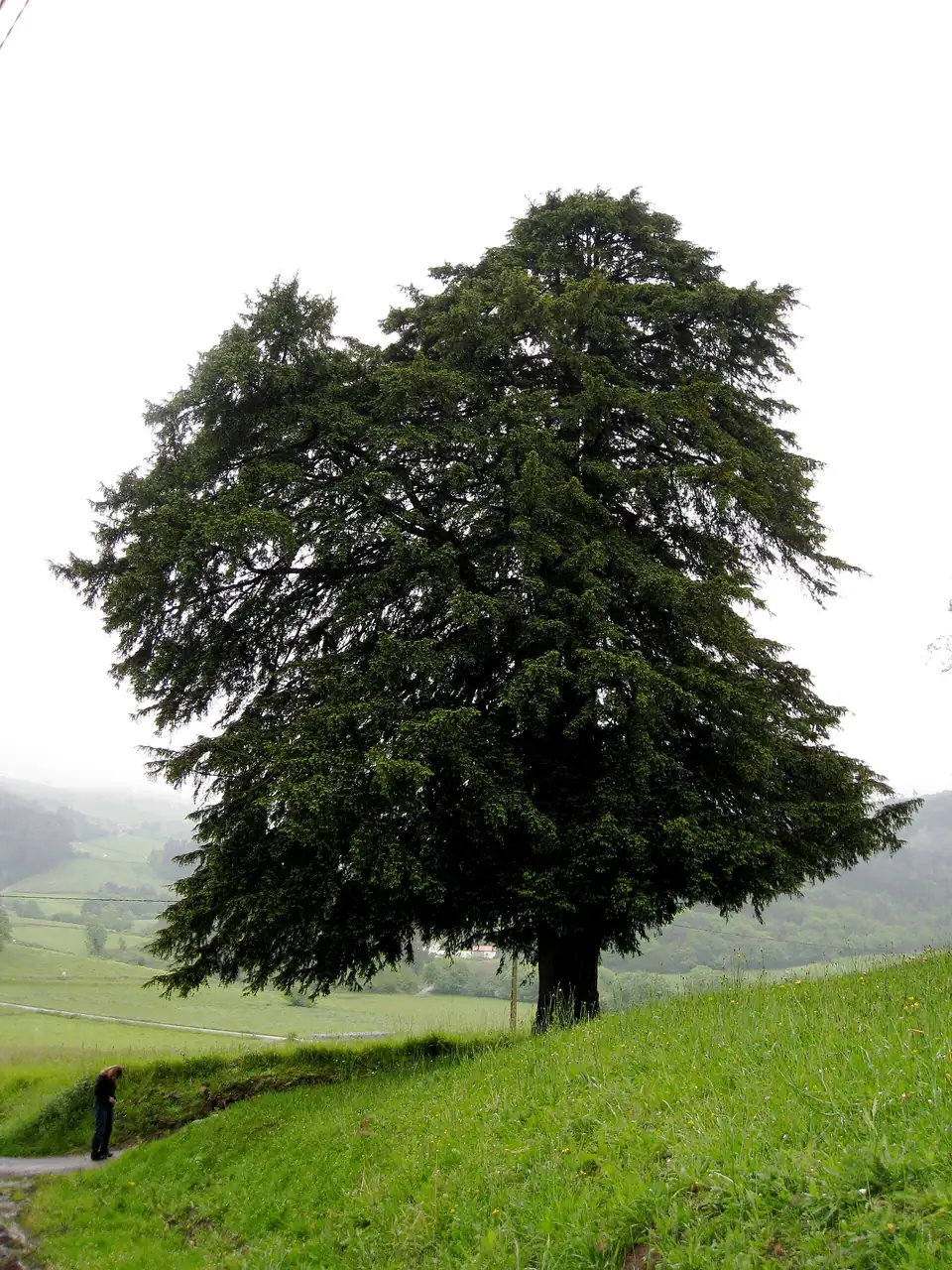
The English yew is a stately evergreen tree that can grow 30–60 ft tall and 15–25 ft wide, happy in full sun or partial shade. Give it moist soil that drains well, and once in the ground it rarely needs feeding. Birds love its fleshy arils, but keep children and pets away: its bark, leaves and seeds are highly poisonous.
- Sun
Full sun to partial shade
What the sources say (1)
Light: Full sun to partial shade
It grows best in full sun or partial shade.
— Taxus baccata (Common Yew, English Yew, European Yew) | North Carolina Extension Gardener Plant Toolbox [1] - Water
Keep the soil moist, but never soggy
What the sources say (2)
Watering: Moist soil with good drainage; intolerant of wet or poorly drained sites
English yew prefers moist, fertile, sandy or loamy soils with a neutral pH. It grows best in full sun or partial shade.
— Taxus baccata (Common Yew, English Yew, European Yew) | North Carolina Extension Gardener Plant Toolbox [1] It is intolerant of wet or poorly drained sites as well as extremely hot or cold temperatures.
— Taxus baccata (Common Yew, English Yew, European Yew) | North Carolina Extension Gardener Plant Toolbox [1] - Soil
Needs soil that drains well; wet spots cause root rot
What the sources say (2)
Watering: Moist soil with good drainage; intolerant of wet or poorly drained sites
English yew prefers moist, fertile, sandy or loamy soils with a neutral pH. It grows best in full sun or partial shade.
— Taxus baccata (Common Yew, English Yew, European Yew) | North Carolina Extension Gardener Plant Toolbox [1] It is intolerant of wet or poorly drained sites as well as extremely hot or cold temperatures.
— Taxus baccata (Common Yew, English Yew, European Yew) | North Carolina Extension Gardener Plant Toolbox [1] - Feeding
In the ground it rarely needs feeding; in pots, feed regularly with a general fertilizer
What the sources say (3)
How often: Not generally needed in the ground
in containers: Plants in containers will benefit from regular feeding, as the nutrients
— [3] Yews are robust plants and don’t generally need additional feeding . However, to boost growth you can apply a general fertiliser,
— [3] Mineral fertilizers: General fertiliser to boost growth
Yews are robust plants and don’t generally need additional feeding . However, to boost growth you can apply a general fertiliser,
— [3] - Pests
Scale, mealybugs, black vine weevils and bagworms; also root rot and winter burn
What the sources say (3)
Pests: mealybugs, scale, pine needle scale, black vine weevils, arborvitae leafminer, bagworms, balsam twig aphid, balsam woolly adelgid, eastern spruce gall adelgid, introduced pine sawfly, juniper webworm, Nantucket pine tip moth, pine bark adelgid, redheaded pine sawfly, spittlebugs, spruce spider mite, white pine aphid
Potential pests include mealybugs, scale, pine needle scale, black vine weevils.
— Taxus baccata (Common Yew, English Yew, European Yew) | North Carolina Extension Gardener Plant Toolbox [1] Also these pests of conifers: Arborvitae leafminer, bagworms, balsam twig aphid balsam woolly adelgid, eastern spruce gall adelgid, introduced pine sawfly, juniper webworm, Nantucket pine tip moth, pine bark adelgid, redheaded pine sawfly, spittlebugs, spruce spider mite, white pine aphid.
— Taxus baccata (Common Yew, English Yew, European Yew) | North Carolina Extension Gardener Plant Toolbox [1] Diseases: root rot, winter burn, twig and needle blights
Root rot, winter burn and twig and needle blights may occur.
— Taxus baccata (Common Yew, English Yew, European Yew) | North Carolina Extension Gardener Plant Toolbox [1] - Size
30–60 ft tall and 15–25 ft wide
What the sources say (2)
Mature height: 914-1829 cm (30-60 ft)
It may reach 30 to 60 feet high and 15 to 25 feet wide.
— Taxus baccata (Common Yew, English Yew, European Yew) | North Carolina Extension Gardener Plant Toolbox [1] Mature width: 457-762 cm (15-25 ft)
It may reach 30 to 60 feet high and 15 to 25 feet wide.
— Taxus baccata (Common Yew, English Yew, European Yew) | North Carolina Extension Gardener Plant Toolbox [1] - Propagation
From stem cuttings, or from seed after 120–365 days of cold and warm treatment
What the sources say (1)
Propagation: Stem cuttings; seed (requires cold-warm stratification of 120 to 365 days)
The preferred method of propagation is stem cuttings as seeds require cold-warm stratification of 120 to 365 days.
— Taxus baccata (Common Yew, English Yew, European Yew) | North Carolina Extension Gardener Plant Toolbox [1] - Safety
Highly poisonous: bark, leaves and seeds can kill people, pets and livestock
Overview
English yew is a large evergreen conifer that grows in full sun or partial shade and prefers moist, well-drained soils. [1] The plant is highly poisonous and can be fatal to humans, domestic animals and livestock. [1] Stem cuttings are the preferred method of propagation. [1]
This record is incomplete: the sources we read do not cover every field yet.
Not yet covered by our sources: Pruning
English Yew care
How to water English Yew
Moist soil with good drainage; intolerant of wet or poorly drained sites
What the sources say (2)
English yew prefers moist, fertile, sandy or loamy soils with a neutral pH. It grows best in full sun or partial shade.It is intolerant of wet or poorly drained sites as well as extremely hot or cold temperatures.How much light English Yew needs
Full sun to partial shade
What the sources say (1)
It grows best in full sun or partial shade.How much cold English Yew can take
Hardiness, coldest zone
The sources give different values depending on region, zone or growing conditions.
What each source says
According to NC State Extension (Taxus baccata): 6a [winter low −23.3 to −20.6 °C (−10 to −5 °F)]
According to NC State Extension (genus Taxus): 4a [winter low −34.4 to −31.7 °C (−30 to −25 °F)]
What the sources say (3)
According to NC State Extension (Taxus baccata): USDA Plant Hardiness Zone:
6a, 6b, 7a, 7bAccording to NC State Extension (genus Taxus): USDA Plant Hardiness Zone:
4a, 4b, 5a, 5b, 6a, 6b, 7a, 7b, 8a, 8bUSDA Plant Hardiness Zone:
6a, 6b, 7a, 7bHardiness, warmest zone
The sources give different values depending on region, zone or growing conditions.
What each source says
According to NC State Extension (Taxus baccata): 7b [winter low −15 to −12.2 °C (5 to 10 °F)]
According to NC State Extension (genus Taxus): 8b [winter low −9.4 to −6.7 °C (15 to 20 °F)]
What the sources say (3)
According to NC State Extension (Taxus baccata): USDA Plant Hardiness Zone:
6a, 6b, 7a, 7bAccording to NC State Extension (genus Taxus): USDA Plant Hardiness Zone:
4a, 4b, 5a, 5b, 6a, 6b, 7a, 7b, 8a, 8bUSDA Plant Hardiness Zone:
6a, 6b, 7a, 7bWhere to grow English Yew
In containers
Under review: our second check questioned this value.
Spacing
Under review: our second check questioned this value.
How to propagate English Yew
Stem cuttings; seed (requires cold-warm stratification of 120 to 365 days)
What the sources say (1)
The preferred method of propagation is stem cuttings as seeds require cold-warm stratification of 120 to 365 days.How to grow English Yew
The plant
Family
Taxaceae (yew family)
What the sources say (1)
English yew is a large, needled, evergreen conifer with a conical or pyramidal shape. It is a tree in the yew family (Taxaceae).Mature height
914-1829 cm (30-60 ft)
What the sources say (1)
It may reach 30 to 60 feet high and 15 to 25 feet wide.Mature width
457-762 cm (15-25 ft)
What the sources say (1)
It may reach 30 to 60 feet high and 15 to 25 feet wide.Pests and diseases
Pests
mealybugs, scale, pine needle scale, black vine weevils, arborvitae leafminer, bagworms, balsam twig aphid, balsam woolly adelgid, eastern spruce gall adelgid, introduced pine sawfly, juniper webworm, Nantucket pine tip moth, pine bark adelgid, redheaded pine sawfly, spittlebugs, spruce spider mite, white pine aphid
What the sources say (2)
Potential pests include mealybugs, scale, pine needle scale, black vine weevils.Also these pests of conifers: Arborvitae leafminer, bagworms, balsam twig aphid balsam woolly adelgid, eastern spruce gall adelgid, introduced pine sawfly, juniper webworm, Nantucket pine tip moth, pine bark adelgid, redheaded pine sawfly, spittlebugs, spruce spider mite, white pine aphid.Diseases
root rot, winter burn, twig and needle blights
What the sources say (1)
Root rot, winter burn and twig and needle blights may occur.Fertilizing
How often
Not generally needed in the ground
What each source says
in containers: Regular feeding
Mineral fertilizers
General fertiliser to boost growth
What the sources say (1)
Yews are robust plants and don’t generally need additional feeding . However, to boost growth you can apply a general fertiliser,English Yew pests and problems
Root rot and fungal diseases
Symptom: Root rot, brown scale and other fungal diseases can occur when proper drainage is not provided.
What to do: Provide proper drainage.
What the sources say (1)
Root rot, brown scale and other fungal diseases can occur when proper drainage is not provided.
— Taxus (Yew) | North Carolina Extension Gardener Plant Toolbox [2] Winter burn and blights
Symptom: Root rot, winter burn and twig and needle blights may occur.
What the sources say (1)
Root rot, winter burn and twig and needle blights may occur.
— Taxus baccata (Common Yew, English Yew, European Yew) | North Carolina Extension Gardener Plant Toolbox [1]
Remedies
Each remedy shows what official sources say about it; traditional remedies without an official source are marked as such. Harmful ones are listed so you know to avoid them.
First aid
First aid: not a substitute for a doctor
yew ingestion
seek immediate medical help, do not induce vomiting Official source, not independently tested
The local poison control center can be reached directly by calling the national toll-free Poison Help hotline (1-800-222-1222) from anywhere in the United States.
— medlineplus.gov [4] How: Seek immediate medical help. DO NOT make a person throw up unless told to do so by poison control or a health care provider.
Seek immediate medical help. DO NOT make a person throw up unless told to do so by poison control or a health care provider.
— medlineplus.gov [4] call poison control Official source, not independently tested
Seek immediate medical help. DO NOT make a person throw up unless told to do so by poison control or a health care provider.
— medlineplus.gov [4] How: The local poison control center can be reached directly by calling the national toll-free Poison Help hotline (1-800-222-1222) from anywhere in the United States. This national hotline will let you talk to experts in poisoning.
The local poison control center can be reached directly by calling the national toll-free Poison Help hotline (1-800-222-1222) from anywhere in the United States.
— medlineplus.gov [4]
Treating the plant
aphids
insecticidal soap spray Works
How: To control aphids on your English yew plants, you can use insecticidal soap or neem oil spray.
Treatment: To control aphids on your English yew plants, you can use insecticidal soap or neem oil spray.
— livetoplant.com [5] What the evidence says insecticidal soap is a safe, effective organic insecticide with minimal environmental impact.
— extension.psu.edu [6] neem oil spray Partly works
Ultimately, pesticides should always be viewed as a last resort.
— extension.unh.edu [7] How: To control aphids on your English yew plants, you can use insecticidal soap or neem oil spray.
Treatment: To control aphids on your English yew plants, you can use insecticidal soap or neem oil spray.
— livetoplant.com [5] What the evidence says Neem is also known to interfere with insect growth and behavior.
— extension.unh.edu [7]
mealybugs
wiping with soapy water Not verified
Traditional remedy, not verified by an official source.
How: Mealybug infestations can be controlled by wiping them off with a damp cloth or cotton swab soaked in soapy water.
rubbing alcohol on cotton ball Not verified
Traditional remedy, not verified by an official source.
How: Hand remove egg masses and adults using a cotton ball soaked in rubbing alcohol.
spider mites
misting foliage with water Not verified
Traditional remedy, not verified by an official source.
How: Regularly misting the foliage of your English yew plants can help reduce their numbers.
caterpillars
hand-picking Works
How: Handpicking caterpillars from your yew plants is an effective way to manage small infestations.
Treatment: Handpicking caterpillars from your yew plants is an effective way to manage small infestations.
— livetoplant.com [5] What the evidence says Many insect and disease issues can be solved in the home garden by hand-picking insects or clipping and disposing of diseased plant parts.
— extension.unh.edu [7]
black vine weevil
hand-picking adults after dusk Works
How: Adults can also be hand-picked after dusk if your populations are low.
Adults can also be hand-picked after dusk if your populations are low.
— horticultureforhomegardeners.ca [8] What the evidence says Many insect and disease issues can be solved in the home garden by hand-picking insects or clipping and disposing of diseased plant parts.
— extension.unh.edu [7]
dog urine damage
spraying with water after urination Not verified
Traditional remedy, not verified by an official source.
How: Spraying the shrub with water right after the animal pees will usually dilute it enough that little to no damage is done.
deicing salt damage
flushing soil with water Works
How: In the spring, when the frost is out of the ground, flush the soil with plenty of water to help get the salt out of the root zone.
In the spring, when the frost is out of the ground, flush the soil with plenty of water to help get the salt out of the root zone.
— horticultureforhomegardeners.ca [8] What the evidence says One remedy to high salt levels in your garden bed is to leach the material out of the top layer of soil with repeated soakings of water.
— extension.illinois.edu [9]
magnesium deficiency
epsom salts Partly works
Have your soil tested as excessive amounts of calcium or potassium in the soil can lock up magnesium.
— horticultureforhomegardeners.ca [8] How: If you need to add magnesium to your soil sources include Dolomitic limestone, Epsom salts (magnesium sulfate), K-MAG (sulfate of potash-magnesia).
If you need to add magnesium to your soil sources include Dolomitic limestone, Epsom salts (magnesium sulfate), K-MAG (sulfate of potash-magnesia).
— horticultureforhomegardeners.ca [8] What the evidence says REALITY: Epsom salts (magnesium sulfate) should only be used if a soil test shows a magnesium deficiency. In most gardens, they can harm plants rather than help them.
— extension.oregonstate.edu [10]
Is English Yew toxic to pets?
Reported by the source, quoted verbatim. This is not medical or veterinary advice: if a person or an animal may have eaten this plant, contact a poison control centre or a veterinarian.
Animals
The plant is highly poisonous and can be fatal to humans, domestic animals, and livestock.
[1]- Poisonous parts
Poison Part: Bark Leaves Seeds Stems Download Print-Friendly
[1]- Toxic principle
taxines, taxiphyllin (a cyanogenic glycoside) Causes Contact Dermatitis:
[1]- Symptoms
Cardiac and respiratory failure and death can occur.
[1]- Severity
Poison Severity: High Poison Symptoms: Symptoms include dry
[1]
Early signs: muscular tremors, dyspnea, seizures in dogs.
[2]- Poisonous parts
Poison Part: Bark Fruits Leaves Seeds Download Print-Friendly
[2]- Toxic principle
Alkaloid taxine Causes Contact Dermatitis: No Poison Part:
[2]- Symptoms
Nervousness, trembling, slow pulse, pupil dilation, seizures (dogs), difficult breathing, abdominal pain, vomiting, diarrhea, weakness, convulsions; may be fatal.
[2]- Severity
Poison Severity: High Poison Symptoms: Nervousness, trembling, slow
[2]
#evergreen tree #heat intolerant #problem for children #problem for horses #poisonous leaves
[1]- Poisonous parts
Poison Part: Bark Leaves Seeds Stems Download Print-Friendly
[1]- Toxic principle
taxines, taxiphyllin (a cyanogenic glycoside) Causes Contact Dermatitis:
[1]- Severity
Poison Severity: High Poison Symptoms: Symptoms include dry
[1]- Severity
The plant is highly poisonous and can be fatal to humans, domestic animals, and livestock.
[1]
#topiary #problem for cattle #poisonous fruits #conifer #showy fruits
[1]- Poisonous parts
Poison Part: Bark Leaves Seeds Stems Download Print-Friendly
[1]- Toxic principle
taxines, taxiphyllin (a cyanogenic glycoside) Causes Contact Dermatitis:
[1]- Severity
Poison Severity: High Poison Symptoms: Symptoms include dry
[1]- Severity
The plant is highly poisonous and can be fatal to humans, domestic animals, and livestock.
[1]
People
If any of the bark, leaves, or seeds of the English Yew are ingested, urgent medical treatment is needed.
[1]- Poisonous parts
Poison Part: Bark Leaves Seeds Stems Download Print-Friendly
[1]- Toxic principle
taxines, taxiphyllin (a cyanogenic glycoside) Causes Contact Dermatitis:
[1]- Symptoms
Symptoms include dry mouth, vomiting, vertigo, abdominal pain, vertigo, difficulty breathing, irregular heart rhythms, low blood pressure, and unconsciousness.
[1]- Severity
Poison Severity: High Poison Symptoms: Symptoms include dry
[1]
Symptoms include dry mouth, vomiting, vertigo, abdominal pain, vertigo, difficulty breathing, irregular heart rhythms, low blood pressure, and unconsciousness.
[1]
Calendar
Pruning
Not stated in the sources we read.
Months as given by the sources, which are mostly from the United States (northern hemisphere). In the southern hemisphere they shift by about six months.
Edibility
Reported by the source, quoted verbatim. Do not eat a plant on the basis of this page alone: identification mistakes can be dangerous.
Birds eat the fleshy arils and disperse the seeds.
[1]
Indicative values
Values from a secondary source, not checked word for word like the rest of this page. Use them as a starting point.
- Life cycle
- PerennialIndicative value, adapt it to your climate · Secondary source
- Drought tolerant
- yesIndicative value, adapt it to your climate · Secondary source
- Soil
- Acidic, Alkaline, Well-drainedIndicative value, adapt it to your climate · Secondary source
- Soil pH
- 6-7.5Indicative value, adapt it to your climate · Secondary source
- Care level
- MediumIndicative value, adapt it to your climate · Secondary source
- Growth rate
- LowIndicative value, adapt it to your climate · Secondary source
- Pruning
- February, March, AprilIndicative value, adapt it to your climate · Secondary source
Similar plants
- Chinese Yew Taxus chinensis
- Florida Yew Taxus floridana
- Japanese Yew Taxus cuspidata
- American Yew Taxus canadensis
- Pacific Yew Taxus brevifolia
- Abies grandis Abies grandis
- Abraham Trachystemon orientalis
- Abyssinian banana Ensete ventricosum
Sources
Every value above is quoted from these documents. Links lead to the original publisher.
- Taxus baccata (Common Yew, English Yew, European Yew) | North Carolina Extension Gardener Plant Toolbox · plants.ces.ncsu.edu, consulted
- Taxus (Yew) | North Carolina Extension Gardener Plant Toolbox · plants.ces.ncsu.edu, consulted
- rhs.org.uk · rhs.org.uk
- medlineplus.gov · medlineplus.gov
- livetoplant.com · livetoplant.com
- extension.psu.edu · extension.psu.edu
- extension.unh.edu · extension.unh.edu
- horticultureforhomegardeners.ca · horticultureforhomegardeners.ca
- extension.illinois.edu · extension.illinois.edu
- extension.oregonstate.edu · extension.oregonstate.edu
Written by Emilio Marruso · last checked