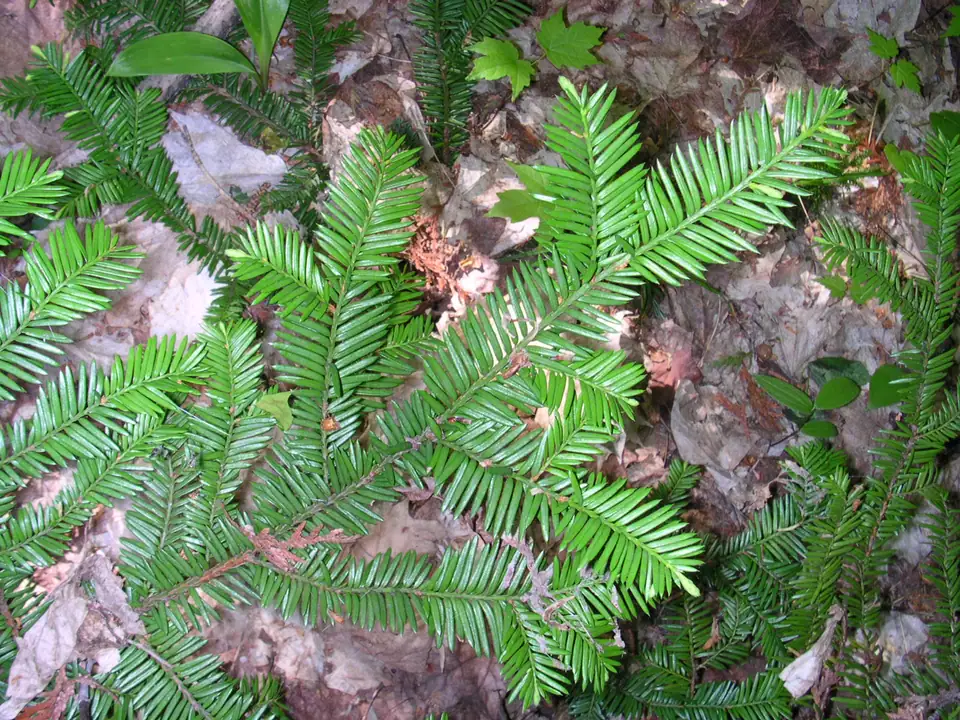


How to Grow and Care for American Yew
Taxus canadensis
Written by Emilio Marruso · last checked
Toxic to: Cats, Dogs, Horses · Why
At a glance
Canada yew is a low, spreading conifer that is happy in partial to deep shade, so it can fill the shady corners of your garden. It stays 3–5 ft tall but spreads 6–8 ft wide, and you can make new plants from stem cuttings in fall or winter. Just keep cats, dogs and horses away from it.
- Sun
Partial to deep shade
What the sources say (1)
Light: Partial to deep shade
The plant grows in partial to deep shade, typically in moist, cool soil
— Taxus canadensis (American Yew, Canada Yew, Canadian Yew, Ground-Hemlock) | North Carolina Extension Gardener Plant Toolbox [1] - Cold
Survives winters down to −40 °F (−40 °C)
Very hardy · USDA 3a · RHS H7 · Z3
What the sources say (2)
Hardiness, coldest zone: 3a [winter low −40 to −37.2 °C (−40 to −35 °F)]
USDA Plant Hardiness Zone: 3a, 3b, 4a, 5a, 5b, 6a, 6b, 7a, 7b
— Taxus canadensis (American Yew, Canada Yew, Canadian Yew, Ground-Hemlock) | North Carolina Extension Gardener Plant Toolbox [1] Hardiness, warmest zone: 7b [winter low −15 to −12.2 °C (5 to 10 °F)]
USDA Plant Hardiness Zone: 3a, 3b, 4a, 5a, 5b, 6a, 6b, 7a, 7b
— Taxus canadensis (American Yew, Canada Yew, Canadian Yew, Ground-Hemlock) | North Carolina Extension Gardener Plant Toolbox [1] - Pests
Insects and spider mites can sometimes damage or even kill it
What the sources say (1)
Pests: insects, spider mites
Confers like the American yew are occasionally damaged or killed by insects and spider mites.
— Taxus canadensis (American Yew, Canada Yew, Canadian Yew, Ground-Hemlock) | North Carolina Extension Gardener Plant Toolbox [1] - Size
3–5 ft tall and 6–8 ft wide
What the sources say (2)
Mature height: 91-152 cm (3-5 ft)
Dimensions: Height: 3 ft. 0 in. - 5 ft. 0 in. Width: 6 ft. 0 in. - 8 ft. 0 in.
— Taxus canadensis (American Yew, Canada Yew, Canadian Yew, Ground-Hemlock) | North Carolina Extension Gardener Plant Toolbox [1] Mature width: 183-244 cm (6-8 ft)
Dimensions: Height: 3 ft. 0 in. - 5 ft. 0 in. Width: 6 ft. 0 in. - 8 ft. 0 in.
— Taxus canadensis (American Yew, Canada Yew, Canadian Yew, Ground-Hemlock) | North Carolina Extension Gardener Plant Toolbox [1] - Propagation
Take stem cuttings, best in fall or winter
What the sources say (1)
Propagation: Stem cuttings, best done in fall or winter
Propagation is by stem cuttings, best done in fall or winter.
— Taxus canadensis (American Yew, Canada Yew, Canadian Yew, Ground-Hemlock) | North Carolina Extension Gardener Plant Toolbox [1] - Safety
Harmful to cats, dogs and horses
Overview
American yew is a low, sprawling evergreen shrub of partial to deep shade. [1] It is propagated by stem cuttings. [1] The source lists it as a problem plant for cats, dogs and horses. [1]
This record is incomplete: the sources we read do not cover every field yet.
Not yet covered by our sources: Watering, Pruning
American Yew care
How to water American Yew
Not stated in the sources we read.
How much light American Yew needs
Partial to deep shade
What the sources say (1)
The plant grows in partial to deep shade, typically in moist, cool soilHow much cold American Yew can take
Hardiness, coldest zone
3a [winter low −40 to −37.2 °C (−40 to −35 °F)]
What the sources say (1)
USDA Plant Hardiness Zone:
3a, 3b, 4a, 5a, 5b, 6a, 6b, 7a, 7bHardiness, warmest zone
7b [winter low −15 to −12.2 °C (5 to 10 °F)]
What the sources say (1)
USDA Plant Hardiness Zone:
3a, 3b, 4a, 5a, 5b, 6a, 6b, 7a, 7bHow to propagate American Yew
Stem cuttings, best done in fall or winter
What the sources say (1)
Propagation is by stem cuttings, best done in fall or winter.How to grow American Yew
The plant
Life cycle
perennial
What the sources say (1)
Plant Type:
Native Plant
Perennial
Shrub
Woody Plant Leaf Characteristics:
Needled EvergreenFamily
Taxaceae
What the sources say (1)
The Canada or American yew is a woody, needled evergreen shrub in the yew family (Taxaceae), native to central and eastern North America.Mature height
91-152 cm (3-5 ft)
What the sources say (1)
Dimensions:
Height: 3 ft. 0 in. - 5 ft. 0 in.
Width: 6 ft. 0 in. - 8 ft. 0 in.Mature width
183-244 cm (6-8 ft)
What the sources say (1)
Dimensions:
Height: 3 ft. 0 in. - 5 ft. 0 in.
Width: 6 ft. 0 in. - 8 ft. 0 in.Pests and diseases
Pests
insects, spider mites
What the sources say (1)
Confers like the American yew are occasionally damaged or killed by insects and spider mites.American Yew pests and problems
Insects and spider mites
Symptom: Conifers like the American yew are occasionally damaged or killed.
What to do: The source refers to its Pests of Conifers page for details.
What the sources say (1)
Confers like the American yew are occasionally damaged or killed by insects and spider mites.
— Taxus canadensis (American Yew, Canada Yew, Canadian Yew, Ground-Hemlock) | North Carolina Extension Gardener Plant Toolbox [1]
Remedies
Each remedy shows what official sources say about it; traditional remedies without an official source are marked as such. Harmful ones are listed so you know to avoid them.
Treating the plant
taxus mealybugs
insecticidal soap spray Works
Read and follow all label directions for any insecticide used.
— portal.ct.gov [3] How: Spray insecticidal soap so it contacts the insect: direct it downward into growing tips and leaf axils as well as upward onto the undersides of needles.
Sprays of insecticidal soap, ultrafine horticultural oil or resmethrin, which are among the compounds registered for control of this pest in Connecticut, are most effective against crawlers.
— portal.ct.gov [3] What the evidence says They can be treated by applying a horticultural oil (active ingredient mineral-based paraffin or olefin) or and insecticidal soap (active ingredient is potassium salts of fatty acids).
— ask.extension.org [4]
black vine weevil
insect pathogenic nematodes in the soil Official source, not independently tested
How: Treat the soil with insect pathogenic nematodes against the root-feeding larvae.
Treating the soil with insect pathogenic nematodes may control the larvae and should be the first line of defense for landscape plantings.
— portal.ct.gov [3]
Is American Yew toxic to pets?
Reported by the source, quoted verbatim. This is not medical or veterinary advice: if a person or an animal may have eaten this plant, contact a poison control centre or a veterinarian.
Problems: Problem for Cats Problem for Dogs Problem for Horses
[1]The source flags the risk for this animal but does not explain why.
Calendar
Pruning
Not stated in the sources we read.
Months as given by the sources, which are mostly from the United States (northern hemisphere). In the southern hemisphere they shift by about six months.
Indicative values
Values from a secondary source, not checked word for word like the rest of this page. Use them as a starting point.
- Watering
- MinimalIndicative value, adapt it to your climate · Secondary source
- Drought tolerant
- yesIndicative value, adapt it to your climate · Secondary source
- Soil
- Sandy, Loamy, ClayIndicative value, adapt it to your climate · Secondary source
- Soil pH
- 5.5-7Indicative value, adapt it to your climate · Secondary source
- Care level
- LowIndicative value, adapt it to your climate · Secondary source
- Growth rate
- LowIndicative value, adapt it to your climate · Secondary source
- Pruning
- February, March, April, June, JulyIndicative value, adapt it to your climate · Secondary source
Similar plants
- Florida Yew Taxus floridana
- Chinese Yew Taxus chinensis
- Japanese Yew Taxus cuspidata
- Pacific Yew Taxus brevifolia
- English Yew Taxus baccata
- Florida Torreya Torreya taxifolia
- Japanese Nutmeg Tree Torreya nucifera
- Japanese Plum Yew Cephalotaxus harringtonia
Sources
Every value above is quoted from these documents. Links lead to the original publisher.
- Taxus canadensis (American Yew, Canada Yew, Canadian Yew, Ground-Hemlock) | North Carolina Extension Gardener Plant Toolbox · plants.ces.ncsu.edu, consulted
- Taxus (Yew) | North Carolina Extension Gardener Plant Toolbox · plants.ces.ncsu.edu, consulted
- portal.ct.gov · portal.ct.gov
- ask.extension.org · ask.extension.org
Written by Emilio Marruso · last checked