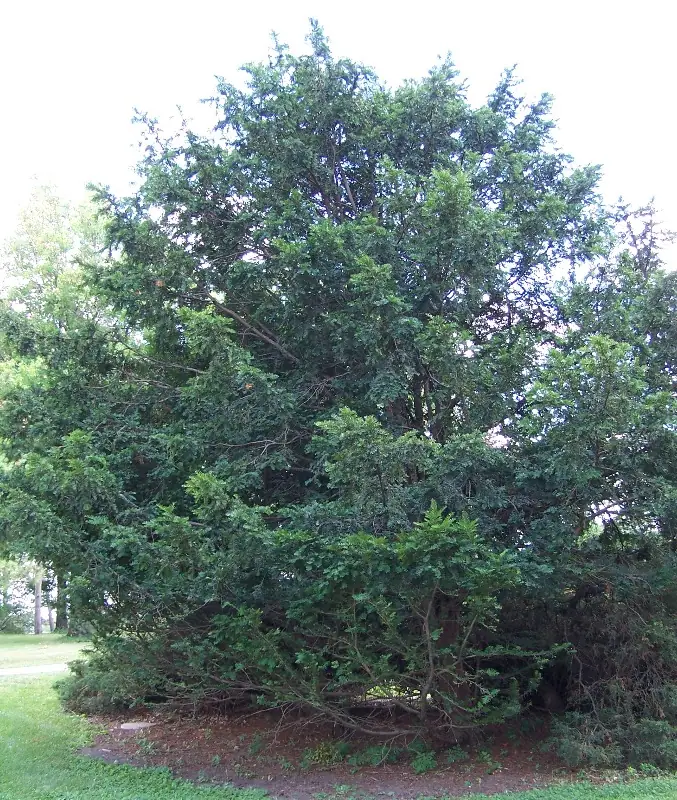

How to Grow and Care for Chinese Yew
Taxus chinensis
Written by Emilio Marruso · last checked
Toxic to: Cats, Dogs, Horses, People · Why
At a glance
Chinese yew is a tough perennial that shrugs off heat and drought and grows happily anywhere from full sun to partial shade. Give it well-drained soil and it fills out to 10 feet tall and 10–15 feet wide, with red fruits that birds love to eat. Just keep children and pets away from it, because the plant is highly poisonous.
- Sun
Full sun to partial shade
What the sources say (1)
Light: Full sun to partial shade
It can be grown in full sun or partial shade and requires sandy or loamy, neutral to acidic soil with good drainage.
— Taxus chinensis (Chinese Yew) | North Carolina Extension Gardener Plant Toolbox [1] - Water
Handles heat and drought; needs soil that drains well
What the sources say (2)
Watering: Tolerant of heat and drought
It is easy to propagate from stem cuttings, responds well to pruning, and is tolerant of heat and drought.
— Taxus chinensis (Chinese Yew) | North Carolina Extension Gardener Plant Toolbox [1] Watering notes: Needs soil with good drainage
It can be grown in full sun or partial shade and requires sandy or loamy, neutral to acidic soil with good drainage.
— Taxus chinensis (Chinese Yew) | North Carolina Extension Gardener Plant Toolbox [1] - Cold
Survives winters down to −15 °F (−26.1 °C)
Very hardy · USDA 5b · RHS H7 · Z5
What the sources say (2)
Hardiness, coldest zone: 5b [winter low −26.1 to −23.3 °C (−15 to −10 °F)]
USDA Plant Hardiness Zone: 5b, 6a, 6b, 7a, 7b
— Taxus chinensis (Chinese Yew) | North Carolina Extension Gardener Plant Toolbox [1] Hardiness, warmest zone: 7b [winter low −15 to −12.2 °C (5 to 10 °F)]
USDA Plant Hardiness Zone: 5b, 6a, 6b, 7a, 7b
— Taxus chinensis (Chinese Yew) | North Carolina Extension Gardener Plant Toolbox [1] - Soil
Well-drained soil, pH up to 8.0
What the sources say (2)
Soil pH, maximum: 8.0
Soil pH: Acid (<6.0) Neutral (6.0-8.0) Soil Drainage: Good Drainage
— Taxus chinensis (Chinese Yew) | North Carolina Extension Gardener Plant Toolbox [1] Watering notes: Needs soil with good drainage
It can be grown in full sun or partial shade and requires sandy or loamy, neutral to acidic soil with good drainage.
— Taxus chinensis (Chinese Yew) | North Carolina Extension Gardener Plant Toolbox [1] - Harvest
Birds eat the red fruits; the seeds, bark and leaves are poisonous
- Pests
Vine weevils, scale insects, mites, leaf blight and root rot
What the sources say (5)
Pests: walnut root lesion nematode, black vine weevil, brown scale, lice, mites
It is a host plant for the walnut root lesion nematode.
— Taxus chinensis (Chinese Yew) | North Carolina Extension Gardener Plant Toolbox [1] Insects such as lice, mites and black vine weevil can cause issues.
— Taxus (Yew) | North Carolina Extension Gardener Plant Toolbox [2] Root rot, brown scale and other fungal diseases can occur when proper drainage is not provided.
— Taxus (Yew) | North Carolina Extension Gardener Plant Toolbox [2] Diseases: leaf blight, root rot, fungal diseases
Leaf blight and fungal diseases can be an issue.
— Taxus chinensis (Chinese Yew) | North Carolina Extension Gardener Plant Toolbox [1] Root rot, brown scale and other fungal diseases can occur when proper drainage is not provided.
— Taxus (Yew) | North Carolina Extension Gardener Plant Toolbox [2] - Size
10 ft tall and 10–15 ft wide
What the sources say (2)
Mature height: 305 cm (10 ft)
Dimensions: Height: 10 ft. 0 in. - 10 ft. 0 in. Width: 10 ft. 0 in. - 15 ft. 0 in.
— Taxus chinensis (Chinese Yew) | North Carolina Extension Gardener Plant Toolbox [1] Mature width: 305-457 cm (10-15 ft)
Dimensions: Height: 10 ft. 0 in. - 10 ft. 0 in. Width: 10 ft. 0 in. - 15 ft. 0 in.
— Taxus chinensis (Chinese Yew) | North Carolina Extension Gardener Plant Toolbox [1] - Propagation
From stem cuttings
What the sources say (2)
Propagation: Stem cutting
Recommended Propagation Strategy: Stem Cutting Country Or Region Of Origin:
— Taxus chinensis (Chinese Yew) | North Carolina Extension Gardener Plant Toolbox [1] It is easy to propagate from stem cuttings, responds well to pruning, and is tolerant of heat and drought.
— Taxus chinensis (Chinese Yew) | North Carolina Extension Gardener Plant Toolbox [1] - Safety
Highly poisonous to people, cats, dogs and horses
Overview
Chinese yew is a woody, needled evergreen tree or shrub grown primarily for its foliage. [1] It grows in full sun or partial shade in well-drained, neutral to acidic soil and propagates from stem cuttings. [1] The plant is rated as high severity poison, with bark, leaves and seeds poisonous. [1]
This record is incomplete: the sources we read do not cover every field yet.
Not yet covered by our sources: Pruning
Chinese Yew care
How to water Chinese Yew
Watering
Tolerant of heat and drought
What the sources say (1)
It is easy to propagate from stem cuttings, responds well to pruning, and is tolerant of heat and drought.Watering notes
Needs soil with good drainage
What the sources say (1)
It can be grown in full sun or partial shade and requires sandy or loamy, neutral to acidic soil with good drainage.How much light Chinese Yew needs
Full sun to partial shade
What the sources say (1)
It can be grown in full sun or partial shade and requires sandy or loamy, neutral to acidic soil with good drainage.How much cold Chinese Yew can take
Hardiness, coldest zone
5b [winter low −26.1 to −23.3 °C (−15 to −10 °F)]
What the sources say (1)
USDA Plant Hardiness Zone:
5b, 6a, 6b, 7a, 7bHardiness, warmest zone
7b [winter low −15 to −12.2 °C (5 to 10 °F)]
What the sources say (1)
USDA Plant Hardiness Zone:
5b, 6a, 6b, 7a, 7bBest soil for Chinese Yew
8.0
What the sources say (1)
Soil pH:
Acid (<6.0)
Neutral (6.0-8.0)
Soil Drainage:
Good DrainageHow to propagate Chinese Yew
Stem cutting
What the sources say (2)
Recommended Propagation Strategy:
Stem Cutting
Country Or Region Of Origin:It is easy to propagate from stem cuttings, responds well to pruning, and is tolerant of heat and drought.How to grow Chinese Yew
The plant
Life cycle
perennial
What the sources say (1)
Life Cycle:
Perennial
Woody
Recommended Propagation Strategy:
Stem CuttingFamily
Taxaceae
What the sources say (1)
Genus:
Taxus
Species:
chinensis
Family:
Taxaceae
Life Cycle:
WoodyMature height
305 cm (10 ft)
What the sources say (1)
Dimensions:
Height: 10 ft. 0 in. - 10 ft. 0 in.
Width: 10 ft. 0 in. - 15 ft. 0 in.Mature width
305-457 cm (10-15 ft)
What the sources say (1)
Dimensions:
Height: 10 ft. 0 in. - 10 ft. 0 in.
Width: 10 ft. 0 in. - 15 ft. 0 in.Pests and diseases
Pests
walnut root lesion nematode, black vine weevil, brown scale, lice, mites
What the sources say (3)
It is a host plant for the walnut root lesion nematode.Insects such as lice, mites and black vine weevil can cause issues.Root rot, brown scale and other fungal diseases can occur when proper drainage is not provided.Diseases
leaf blight, root rot, fungal diseases
What the sources say (2)
Leaf blight and fungal diseases can be an issue.Root rot, brown scale and other fungal diseases can occur when proper drainage is not provided.Chinese Yew pests and problems
Leaf blight and fungal diseases
Symptom: Can be an issue; also a host plant for the walnut root lesion nematode
What to do: No management given in the source
What the sources say (1)
Leaf blight and fungal diseases can be an issue. It is a host plant for the walnut root lesion nematode.
— Taxus chinensis (Chinese Yew) | North Carolina Extension Gardener Plant Toolbox [1]
Remedies
Each remedy shows what official sources say about it; traditional remedies without an official source are marked as such. Harmful ones are listed so you know to avoid them.
First aid
First aid: not a substitute for a doctor
yew poisoning after swallowing
do not induce vomiting Official source, not independently tested
The local poison control center can be reached directly by calling the national toll-free Poison Help hotline (1-800-222-1222) from anywhere in the United States.
— medlineplus.gov [4] How: DO NOT make a person throw up unless told to do so by poison control or a health care provider.
DO NOT make a person throw up unless told to do so by poison control or a health care provider.
— medlineplus.gov [4]
Treating the plant
mealybugs
insecticidal soap or horticultural oil spray Partly works
Read and follow all label directions for any insecticide used.
— portal.ct.gov [6] How: Apply a horticultural oil or insecticidal soap; the spray needs to contact the insect, directed downward into growing tips and leaf axils and upward onto the undersides of needles.
They can be treated by applying a horticultural oil (active ingredient mineral-based paraffin or olefin) or and insecticidal soap (active ingredient is potassium salts of fatty acids).
— ask.extension.org [5] What the evidence says Sprays of insecticidal soap, ultrafine horticultural oil or resmethrin, which are among the compounds registered for control of this pest in Connecticut, are most effective against crawlers.
— portal.ct.gov [6]
soft scale
dormant horticultural oil Works
Read and follow all label directions for any insecticide used.
— portal.ct.gov [6] How: A dormant application of ultrafine horticultural oil controls overwintering nymphs.
A dormant application of ultrafine horticultural oil can be applied to control overwintering nymphs.
— portal.ct.gov [6] What the evidence says A dormant application of ultrafine horticultural oil can be applied to control overwintering nymphs.
— portal.ct.gov [6]
black vine weevil
beneficial nematodes in the soil Partly works
How: Treat the soil with insect pathogenic nematodes to control the larvae.
Treating the soil with insect pathogenic nematodes may control the larvae and should be the first line of defense for landscape plantings.
— portal.ct.gov [6] What the evidence says Treating the soil with insect pathogenic nematodes may control the larvae and should be the first line of defense for landscape plantings.
— portal.ct.gov [6]
root rot
planting in well-drained soil Works
How: Do not plant in soil with poor drainage or in areas that receive drainage from roads.
Do not plant in soil with poor drainage or in areas that receive drainage from roads.
— pnwhandbooks.org [7] What the evidence says Disease management includes practices that minimize wet soil such as selection of an appropriate planting site and use of proper planting practices and cultural practices that maintain plant vigor and stimulate growth.
— portal.ct.gov [6]
Is Chinese Yew toxic to pets?
Reported by the source, quoted verbatim. This is not medical or veterinary advice: if a person or an animal may have eaten this plant, contact a poison control centre or a veterinarian.
Animals
Problems: Poisonous to Humans Problem for Cats Problem for Dogs Problem for Horses
[1]
People
This plant has high severity poison characteristics. See below
[1]- Poisonous parts
Causes Contact Dermatitis: No Poison Part: Bark Leaves Seeds
[1]- Toxic principle
Poison Toxic Principle: Alkaloid taxine Causes Contact Dermatitis:
[1]- Symptoms
Poison Symptoms: Nervousness, trembling, slow pulse, pupil dilation, difficult breathing, seizures (dogs), abdominal pain, vomiting, diarrhea, weakness, convulsions; may be fatal
[1]- Severity
Poisonous to Humans: Poison Severity: High Poison Symptoms: Nervousness,
[1]
Calendar
Pruning
Not stated in the sources we read.
Months as given by the sources, which are mostly from the United States (northern hemisphere). In the southern hemisphere they shift by about six months.
Edibility
Reported by the source, quoted verbatim. Do not eat a plant on the basis of this page alone: identification mistakes can be dangerous.
Similar plants
- Florida Yew Taxus floridana
- Japanese Yew Taxus cuspidata
- American Yew Taxus canadensis
- Pacific Yew Taxus brevifolia
- English Yew Taxus baccata
- Florida Torreya Torreya taxifolia
- Japanese Nutmeg Tree Torreya nucifera
- Japanese Plum Yew Cephalotaxus harringtonia
Sources
Every value above is quoted from these documents. Links lead to the original publisher.
- Taxus chinensis (Chinese Yew) | North Carolina Extension Gardener Plant Toolbox · plants.ces.ncsu.edu, consulted
- Taxus (Yew) | North Carolina Extension Gardener Plant Toolbox · plants.ces.ncsu.edu, consulted
- Yew - Taxus | North Carolina Extension Gardener Plant Toolbox · plants.ces.ncsu.edu, consulted
- medlineplus.gov · medlineplus.gov
- ask.extension.org · ask.extension.org
- portal.ct.gov · portal.ct.gov
- pnwhandbooks.org · pnwhandbooks.org
Written by Emilio Marruso · last checked