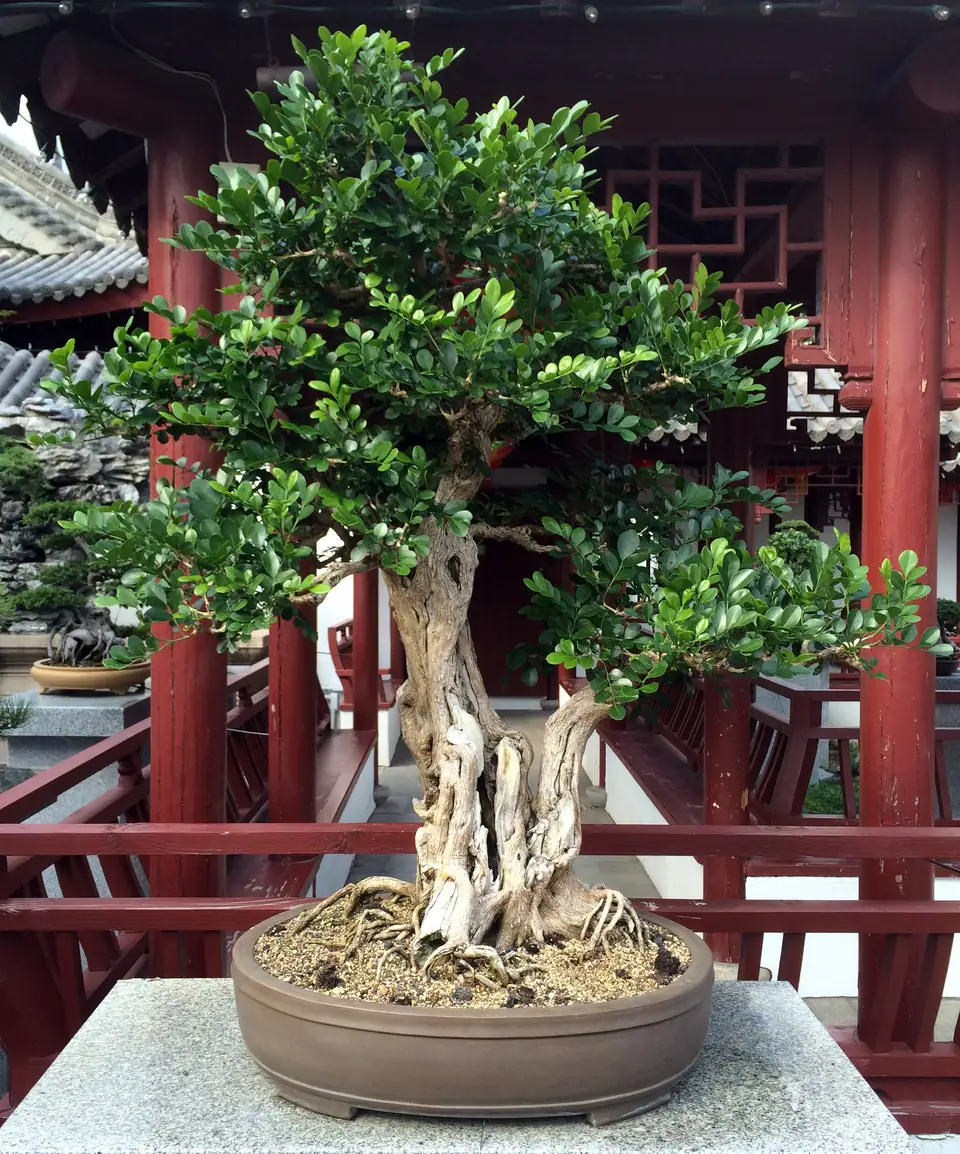

Cuidados del bonsái
orange jasmine
Murraya paniculata
Escrito por Emilio Marruso
Cada paso se cita de cultivadores, clubes y revistas de bonsái. Donde no coinciden mostramos todas las escuelas de pensamiento.
Las indicaciones de cuidado están en inglés por ahora; las citas se mantienen en el idioma de la fuente.
Cuidados
Ubicación y luz
Escuelas de pensamiento: las fuentes no coinciden, cada postura aparece con sus propias fuentes.
Bright light, shaded from midday sun outdoors in summer; filtered sun to moderate shade.
- Cuándo
- summer
- Nota
- Phoenix Bonsai writes for Arizona.
Documentado: 2 fuentes o más
It can be taken outdoors in summer to a place that is shaded from the midday sunLighting : Filtered sun to moderate shade. May be grown indoors.High light, 4 to 6+ hours; full sun outdoors.
Por verificar: 1 fuente
High light: 4 to 6+ hours, full sun outdoors.Riego
Escuelas de pensamiento: las fuentes no coinciden, cada postura aparece con sus propias fuentes.
Plenty of water in the growing season; let the soil dry partly between waterings at other times, especially in cool winter. Avoid spraying.
- Cuándo
- growing season
Por verificar: 1 fuente
During the growing season give the plant plenty of water; at other times let the soil become partially dry between wateringKeep evenly slightly moist: never fully dry, never waterlogged.
Por verificar: 1 fuente
Keep the soil evenly, slightly moist: never let it dry out completely, never waterlogged.Abonado
Feed every two to four weeks in the growing season, less often otherwise.
- Cuándo
- growing season
- Nota
- Intervals differ by source.
Documentado: 2 fuentes o más
Apply a liquid bonsai fertilizer every two weeks during the growing season; every four to six weeks at other times.Every 20-30 days from early spring-midautumn, breaking for a month in midsummer.Poda de mantenimiento
Prune any time of year; cut back to a few leaves. Flowers form at shoot tips in early summer.
- Cuándo
- any time of year
Por verificar: 1 fuente
Branches can be pruned any time of year.Flowers are produced at the tips of the shoots in early summer so plan pruning so that you have flowers if you want them.Alambrado
Wire lignified one-to-two-year-old branches at any time; handle with care, the bark separates easily.
- Cuándo
- anytime after lignified
Por verificar: 1 fuente
can be wired anytime after they have become lignfied.The bark separates easily from the heartwoodCuándo trasplantar
Repot in spring, every two to four years (one guide says every 3 to 5).
- Cuándo
- spring
Documentado: 2 fuentes o más
Repot in the spring every two to four years.Repot and root-prune: April to JuneSustrato del trasplante
Bonsai soil, or loam, peat moss and sand 2:2:1; free-draining.
Por verificar: 1 fuente
Use bonsai soil or a mix of loam, peat moss, and sand at a ratio of 2:2:1.Invierno y heladas (en maceta)
Escuelas de pensamiento: las fuentes no coinciden, cada postura aparece con sus propias fuentes.
Frost-tender: protect below about 7 C.
- Temperatura mínima
- 7.2 °C (45 °F)
- Nota
- 45 F converted; source writes 7 C.
Por verificar: 1 fuente
Frost | None: protect below ~45 °F / 7 °CWinter in a heated room with high humidity.
- Nota
- No winter minimum given; indoor range 61 to 80 F in the same page.
Por verificar: 1 fuente
must be wintered in a heated room where the humidity is high.Plagas y enfermedades
Scale, spider mites in dry conditions; also nematodes, whiteflies, sooty mold.
Documentado: 2 fuentes o más
Orange jasmine is susceptible to scale and may be attacked by spider mites in dry conditions.Pest and diseases: Scales, nematodes, white flies and sooty mold.Propagación
Cuttings root easily in midsummer.
- Cuándo
- mid-summer
Por verificar: 1 fuente
Cuttings root easily in mid-summerEstilos
Informal upright, slanting, semi-cascade, cascade, twin-trunk, clump, group.
Por verificar: 1 fuente
informal upright, slanting, semi-cascade, cascade, twin-trunk, clump, and group.Fuentes
Cada valor anterior se cita de estos documentos. Los enlaces llevan al editor original.
- How to Care for Bonsai: Orange Jasmine (Murraya paniculata) – KarensGardenTips.com · karensgardentips.com, consultado
- Orange Jasmine - Phoenix Bonsai Society · phoenixbonsai.com, consultado
- Orange Jasmine Bonsai Care: Cold Damage, Indoor or Out · bonsaiwonderland.com, consultado