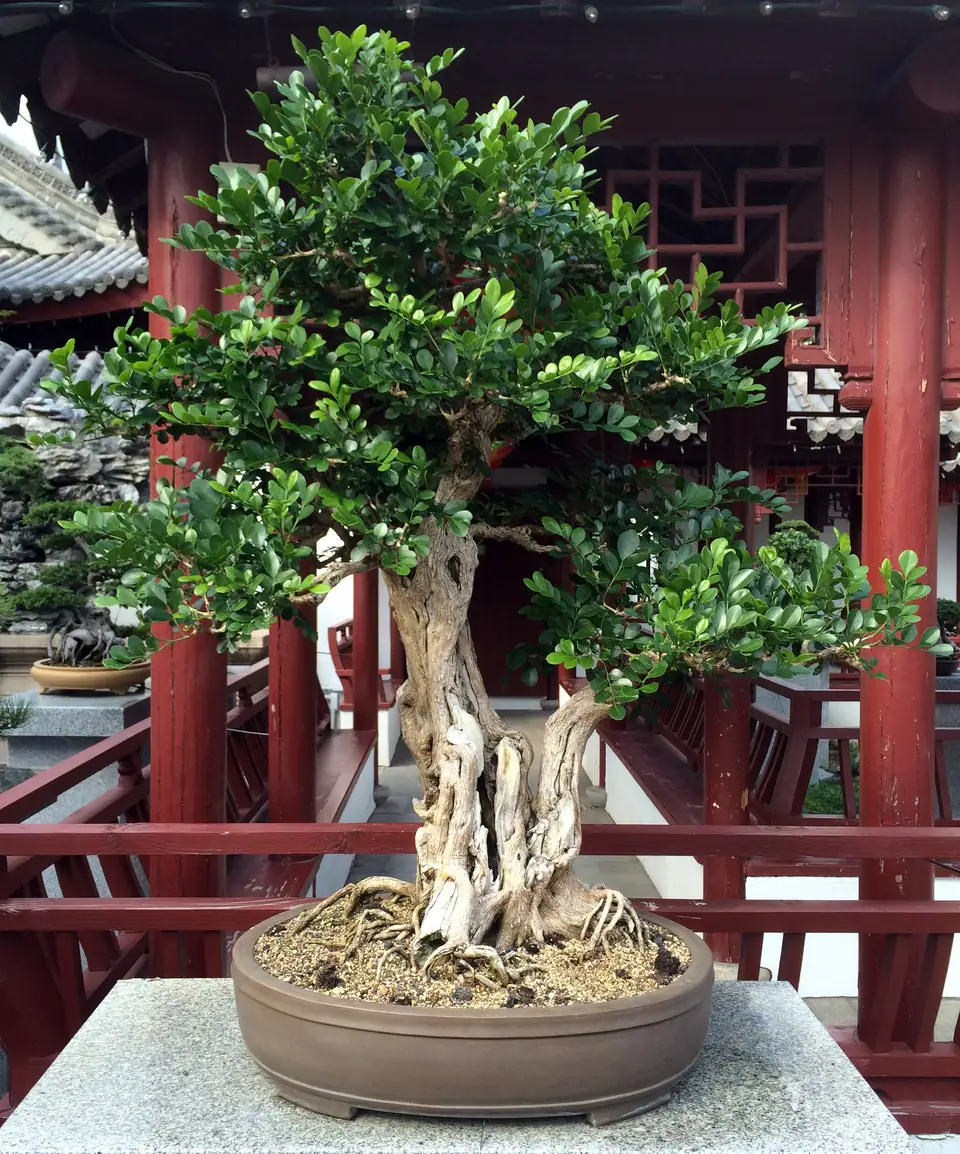

Bonsai care
orange jasmine
Murraya paniculata
Written by Emilio Marruso
Each step is quoted from bonsai growers, clubs and magazines. Where they disagree we show every school of thought.
Care
Position and light
Schools of thought: the sources disagree, each position is shown with its own sources.
Bright light, shaded from midday sun outdoors in summer; filtered sun to moderate shade.
- When
- summer
- Note
- Phoenix Bonsai writes for Arizona.
Documented: 2 or more sources
It can be taken outdoors in summer to a place that is shaded from the midday sunLighting : Filtered sun to moderate shade. May be grown indoors.High light, 4 to 6+ hours; full sun outdoors.
To be verified: 1 source
High light: 4 to 6+ hours, full sun outdoors.Watering
Schools of thought: the sources disagree, each position is shown with its own sources.
Plenty of water in the growing season; let the soil dry partly between waterings at other times, especially in cool winter. Avoid spraying.
- When
- growing season
To be verified: 1 source
During the growing season give the plant plenty of water; at other times let the soil become partially dry between wateringKeep evenly slightly moist: never fully dry, never waterlogged.
To be verified: 1 source
Keep the soil evenly, slightly moist: never let it dry out completely, never waterlogged.Feeding
Feed every two to four weeks in the growing season, less often otherwise.
- When
- growing season
- Note
- Intervals differ by source.
Documented: 2 or more sources
Apply a liquid bonsai fertilizer every two weeks during the growing season; every four to six weeks at other times.Every 20-30 days from early spring-midautumn, breaking for a month in midsummer.Maintenance pruning
Prune any time of year; cut back to a few leaves. Flowers form at shoot tips in early summer.
- When
- any time of year
To be verified: 1 source
Branches can be pruned any time of year.Flowers are produced at the tips of the shoots in early summer so plan pruning so that you have flowers if you want them.Wiring
Wire lignified one-to-two-year-old branches at any time; handle with care, the bark separates easily.
- When
- anytime after lignified
To be verified: 1 source
can be wired anytime after they have become lignfied.The bark separates easily from the heartwoodWhen to repot
Repot in spring, every two to four years (one guide says every 3 to 5).
- When
- spring
Documented: 2 or more sources
Repot in the spring every two to four years.Repot and root-prune: April to JuneRepotting soil
Bonsai soil, or loam, peat moss and sand 2:2:1; free-draining.
To be verified: 1 source
Use bonsai soil or a mix of loam, peat moss, and sand at a ratio of 2:2:1.Winter and frost (in a pot)
Schools of thought: the sources disagree, each position is shown with its own sources.
Frost-tender: protect below about 7 C.
- Lowest temperature
- 7.2 °C (45 °F)
- Note
- 45 F converted; source writes 7 C.
To be verified: 1 source
Frost | None: protect below ~45 °F / 7 °CWinter in a heated room with high humidity.
- Note
- No winter minimum given; indoor range 61 to 80 F in the same page.
To be verified: 1 source
must be wintered in a heated room where the humidity is high.Pests and diseases
Scale, spider mites in dry conditions; also nematodes, whiteflies, sooty mold.
Documented: 2 or more sources
Orange jasmine is susceptible to scale and may be attacked by spider mites in dry conditions.Pest and diseases: Scales, nematodes, white flies and sooty mold.Propagation
Cuttings root easily in midsummer.
- When
- mid-summer
To be verified: 1 source
Cuttings root easily in mid-summerStyles
Informal upright, slanting, semi-cascade, cascade, twin-trunk, clump, group.
To be verified: 1 source
informal upright, slanting, semi-cascade, cascade, twin-trunk, clump, and group.Sources
Every value above is quoted from these documents. Links lead to the original publisher.
- How to Care for Bonsai: Orange Jasmine (Murraya paniculata) – KarensGardenTips.com · karensgardentips.com, consulted
- Orange Jasmine - Phoenix Bonsai Society · phoenixbonsai.com, consulted
- Orange Jasmine Bonsai Care: Cold Damage, Indoor or Out · bonsaiwonderland.com, consulted