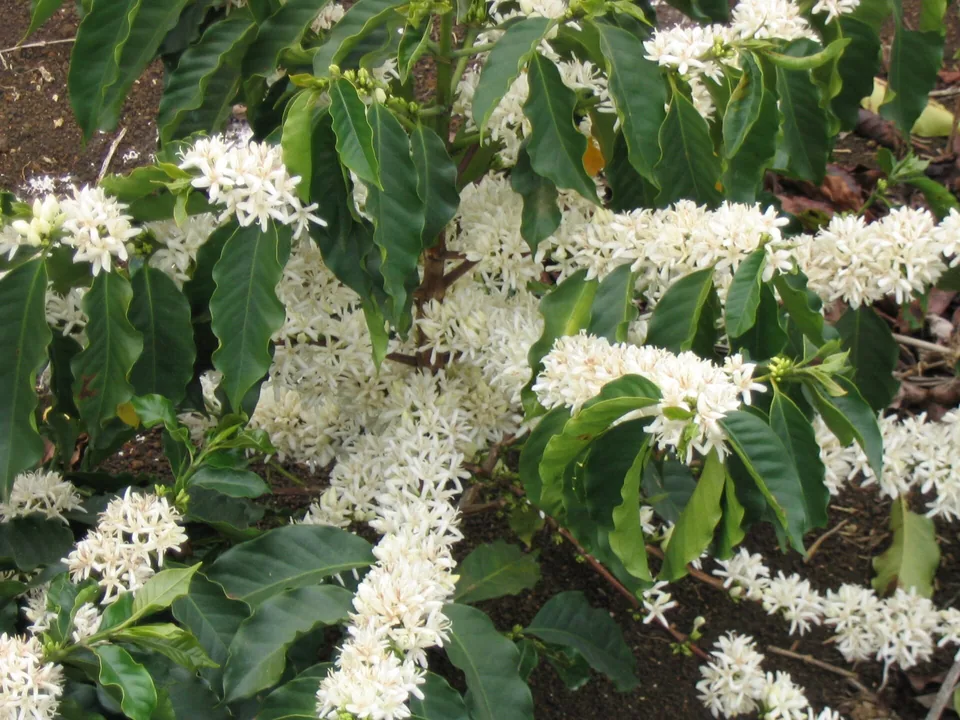


Cómo cultivar y cuidar Cafeto arábico
Coffea arabica
Escrito por Emilio Marruso · última revisión
De un vistazo
El cafeto es una planta perenne que crece a gusto en interior con mucha luz o en maceta. Mantén la tierra húmeda pero nunca encharcada, y un breve periodo seco la animará a florecer. Cuando las cerezas pasen de verde a rojo, recógelas a mano: sus semillas son las que se secan, se tuestan y se muelen para hacer café.
- Sol
Mucha luz en interior; semisombra en el exterior
Qué dicen las fuentes (2)
Luz: Luz brillante en interiores; semisombra en exteriores
It can be grown as a houseplant in temperate climates in well-draining potting soil with bright light and high humidity.
— Coffea arabica (Arabian Coffee, Coffee, Coffee Plant) | North Carolina Extension Gardener Plant Toolbox [1] If taken outdoors, the plant prefers some partial shade.
— Coffea arabica (Arabian Coffee, Coffee, Coffee Plant) | North Carolina Extension Gardener Plant Toolbox [1] - Riego
Mantén la tierra húmeda pero no encharcada; un breve periodo seco la ayuda a florecer
Qué dicen las fuentes (5)
Riego: Mantén la tierra constantemente húmeda pero no empapada
Plant in organically rich-well drained soil, kept consistently moist but not soggy.
— Coffea arabica (Arabian Coffee, Coffee, Coffee Plant) | North Carolina Extension Gardener Plant Toolbox [1] Watering needs to be consistent, comparable to avocado. A dry period is needed to induce blossoming.
— Coffee | Cooperative Extension Ventura County [3] Notas sobre el riego: Se necesita un período seco para inducir la floración; los sistemas de aspersión de césped pueden regar en exceso la planta y causar pudrición de raíces; una ubicación soleada necesita más agua y fertilizante
Watering needs to be consistent, comparable to avocado. A dry period is needed to induce blossoming.
— Coffee | Cooperative Extension Ventura County [3] Lawn sprinkler systems can result in overwatering of the coffee plant, causing root rot.
— Coffee – Gardening Solutions [5] Production will be higher if you grow it in a sunny location, but it will need more water and fertilizer to thrive.
— Coffee – Gardening Solutions [5] - Frío
Aguanta inviernos de hasta −1,1 °C (30 °F)
Semirrústica: inviernos suaves o invernadero sin calefacción · USDA 10a · RHS H3 · Z10
Qué dicen las fuentes (6)
Rusticidad, zona más fría: 10a [mínima invernal de −1,1 a 1,7 °C (de 30 a 35 °F)]
Según NC State Extension: USDA Plant Hardiness Zone: 10a, 10b, 11a, 11b, 12a, 12b
— Coffea arabica (Arabian Coffee, Coffee, Coffee Plant) | North Carolina Extension Gardener Plant Toolbox [1] Según UF/IFAS Gardening Solutions: Coffee will grow best in zones 10B through 11
— Coffee – Gardening Solutions [5] USDA Plant Hardiness Zone: 10a, 10b, 11a, 11b, 12a, 12b
— Coffea arabica (Arabian Coffee, Coffee, Coffee Plant) | North Carolina Extension Gardener Plant Toolbox [1] Rusticidad, zona más cálida: 12b [mínima invernal de 12,8 a 15,6 °C (de 55 a 60 °F)]
Según NC State Extension: USDA Plant Hardiness Zone: 10a, 10b, 11a, 11b, 12a, 12b
— Coffea arabica (Arabian Coffee, Coffee, Coffee Plant) | North Carolina Extension Gardener Plant Toolbox [1] Según UF/IFAS Gardening Solutions: Coffee will grow best in zones 10B through 11
— Coffee – Gardening Solutions [5] USDA Plant Hardiness Zone: 10a, 10b, 11a, 11b, 12a, 12b
— Coffea arabica (Arabian Coffee, Coffee, Coffee Plant) | North Carolina Extension Gardener Plant Toolbox [1] - Suelo
Suelo ácido, pH 4,2–6,0
Qué dicen las fuentes (2)
pH del suelo, mínimo: 4.2
Coffee will succeed on many types of soil but will develop a better root system in deep well-drained soils. A pH of 4.2 to 6 is preferred.
— Coffee | Cooperative Extension Ventura County [3] pH del suelo, máximo: 6.0
Coffee will succeed on many types of soil but will develop a better root system in deep well-drained soils. A pH of 4.2 to 6 is preferred.
— Coffee | Cooperative Extension Ventura County [3] - Distancia
0,9–2,4 m entre plantas
Qué dicen las fuentes (1)
Distancia de plantación: 91.4-243.8 cm (3 a 8 pies entre centros)
Trees are normally planted on 3 to 8 foot centers. Tighter centers are used where intensive pruning is employed.
— Coffee | Cooperative Extension Ventura County [3] - Abonado
Abona en la época de crecimiento; evita abonar mucho el césped cerca o dará menos frutos y peores
Qué dicen las fuentes (2)
Cuándo: Durante la temporada de crecimiento, en interiores o exteriores
Indoors or outdoors, you should fertilize during the growing season.
— Coffea arabica (Arabian Coffee, Coffee, Coffee Plant) | North Carolina Extension Gardener Plant Toolbox [1] Evitar: Fertilización intensa del césped cercano (reduce la calidad y la producción de fruta)
Lawn sprinkler systems can result in overwatering of the coffee plant, causing root rot. Heavy lawn fertilization nearby can reduce fruit quality and production.
— Coffee – Gardening Solutions [5] - Cosecha
Recoge a mano las cerezas cuando pasen de verde a rojo; con sus semillas se hace café
Qué dicen las fuentes (4)
Cosecha: Cuando las cerezas han pasado de verde a rojo; las bayas maduras se recogen a mano a intervalos de varias semanas
Once your coffee cherries have turned from green to red, they are ready to harvest!
— Coffee – Gardening Solutions [5] The highest quality coffee is obtained by hand picking the ripe berries at intervals of several weeks.
— Coffee | Cooperative Extension Ventura County [3] Cómo cosechar: Recoge a mano las bayas maduras (cerezas) una vez que hayan pasado de verde a rojo, en intervalos de varias semanas.
The highest quality coffee is obtained by hand picking the ripe berries at intervals of several weeks.
— Coffee | Cooperative Extension Ventura County [3] Once your coffee cherries have turned from green to red, they are ready to harvest!
— Coffee – Gardening Solutions [5] - Plagas
Cochinillas, cochinilla algodonosa, trips y ácaros; la roya del cafeto no tiene buen remedio
Qué dicen las fuentes (8)
Plagas: cochinillas, cochinillas harinosas, trips, orugas, ácaros, barrenadores del tallo, minadores de hojas, broca del café, escarabajo de la rosa de Fuller, cochinilla verde del café
Coffee plants are susceptible to scale, mealybug, thrips, caterpillars and mites.
— Coffea arabica (Arabian Coffee, Coffee, Coffee Plant) | North Carolina Extension Gardener Plant Toolbox [1] Pest problems you may encounter include stem borers, leaf miners, mealy-bugs, scales and mites.
— Coffee – Gardening Solutions [5] The most important is a borer that attacks the fruit, Stephanoderes hampei , which has spread from Africa to nearly all the coffee producing areas in the world.
— Coffee | Cooperative Extension Ventura County [3] Fuller rose beetle ( Pantomorus cervinus ) has been noted as a coffee pest. Green coffee scale ( Coccus virdis ) is the most serous insect pest in Hawaii and can be easily controlled.
— Coffee | Cooperative Extension Ventura County [3] Enfermedades: roya de la hoja del café, enfermedad del grano del café, estrangulamiento por Fusarium, pudrición de la raíz
prone to the devastating Hemileia vastatrix rust which destroyed coffee industries in Ceylon and India in the 1800
— Coffee | Cooperative Extension Ventura County [3] The Coffee Berry Disease (CBD), Colletotrichum coffeanum , is major though not fatal.
— Coffee | Cooperative Extension Ventura County [3] Another major problem has been Fusarium strangulation encountered after trees suffer frost damage.
— Coffee | Cooperative Extension Ventura County [3] Lawn sprinkler systems can result in overwatering of the coffee plant, causing root rot.
— Coffee – Gardening Solutions [5] - Atención
Los aspersores del césped pueden regarla de más y pudrir las raíces
Qué dicen las fuentes (3)
Notas sobre el riego: Se necesita un período seco para inducir la floración; los sistemas de aspersión de césped pueden regar en exceso la planta y causar pudrición de raíces; una ubicación soleada necesita más agua y fertilizante
Watering needs to be consistent, comparable to avocado. A dry period is needed to induce blossoming.
— Coffee | Cooperative Extension Ventura County [3] Lawn sprinkler systems can result in overwatering of the coffee plant, causing root rot.
— Coffee – Gardening Solutions [5] Production will be higher if you grow it in a sunny location, but it will need more water and fertilizer to thrive.
— Coffee – Gardening Solutions [5] - Tamaño
De 1,8 a 4,6 m de ancho
Qué dicen las fuentes (1)
Anchura adulta: 182.9-457.2 cm (6 a 15 pies)
Dimensions: Height: 6 ft. 0 in. - 15 ft. 0 in. Width: 6 ft. 0 in. - 15 ft. 0 in.
— Coffea arabica (Arabian Coffee, Coffee, Coffee Plant) | North Carolina Extension Gardener Plant Toolbox [1] - Multiplicación
Por semilla, esqueje o injerto
Qué dicen las fuentes (3)
Propagación: Semilla; injerto sobre portainjerto de plántula; esquejes; cultivo de tejidos
Seed has good viability if stored properly and is considered an economical way to obtain trees that are sufficiently if not completely 'true' to the parent(s).
— Coffee | Cooperative Extension Ventura County [3] Clonal reproduction is also done with cuttings. Cuttings are collected from main or upright growing branches to avoid vine-like growth characteristics.
— Coffee | Cooperative Extension Ventura County [3] Tissue culture is also employed to produce clonal stock.
— Coffee | Cooperative Extension Ventura County [3] - Maceta
Crece también en maceta y en interior
Qué dicen las fuentes (2)
En maceta: Sí
#exotic looking #winter interest #tropical feel #container plant #patio #hortcontest #shrub border
— Coffea arabica (Arabian Coffee, Coffee, Coffee Plant) | North Carolina Extension Gardener Plant Toolbox [1] En interior: Sí
It can be grown as a houseplant in temperate climates in well-draining potting soil with bright light and high humidity.
— Coffea arabica (Arabian Coffee, Coffee, Coffee Plant) | North Carolina Extension Gardener Plant Toolbox [1]
Resumen
El café es un pequeño arbusto o árbol de hoja ancha perenne originario de Etiopía, cultivado como planta de interior en climas templados. [1] Necesita un suelo rico y bien drenado que se mantenga constantemente húmedo pero no empapado. [1] Las bayas se recogen cuando pasan de verde a rojo y se procesan para convertirlas en granos de café. [5]
Citado en inglés, como en la fuente.
Cuidados
Riego
Riego
Mantén la tierra constantemente húmeda pero no empapada
Qué dicen las fuentes (2)
Plant in organically rich-well drained soil, kept consistently moist but not soggy.Watering needs to be consistent, comparable to avocado. A dry period is needed to induce blossoming.Notas sobre el riego
Se necesita un período seco para inducir la floración; los sistemas de aspersión de césped pueden regar en exceso la planta y causar pudrición de raíces; una ubicación soleada necesita más agua y fertilizante
Qué dicen las fuentes (3)
Watering needs to be consistent, comparable to avocado. A dry period is needed to induce blossoming.Lawn sprinkler systems can result in overwatering of the coffee plant, causing root rot.Production will be higher if you grow it in a sunny location, but it will need more water and fertilizer to thrive.Luz
Luz brillante en interiores; semisombra en exteriores
Qué dicen las fuentes (2)
It can be grown as a houseplant in temperate climates in well-draining potting soil with bright light and high humidity.If taken outdoors, the plant prefers some partial shade.Clima y frío
Rusticidad, zona más fría
10a [mínima invernal de −1,1 a 1,7 °C (de 30 a 35 °F)]
Lo que dice cada fuente
Según NC State Extension: 10a [mínima invernal de −1,1 a 1,7 °C (de 30 a 35 °F)]
Según UF/IFAS Gardening Solutions: 10b [mínima invernal de 1,7 a 4,4 °C (de 35 a 40 °F)]
Qué dicen las fuentes (3)
Según NC State Extension: USDA Plant Hardiness Zone:
10a, 10b, 11a, 11b, 12a, 12bSegún UF/IFAS Gardening Solutions: Coffee will grow best in zones 10B through 11USDA Plant Hardiness Zone:
10a, 10b, 11a, 11b, 12a, 12bRusticidad, zona más cálida
12b [mínima invernal de 12,8 a 15,6 °C (de 55 a 60 °F)]
Lo que dice cada fuente
Según NC State Extension: 12b [mínima invernal de 12,8 a 15,6 °C (de 55 a 60 °F)]
Según UF/IFAS Gardening Solutions: 11 [mínima invernal de 4,4 a 10 °C (de 40 a 50 °F)]
Qué dicen las fuentes (3)
Según NC State Extension: USDA Plant Hardiness Zone:
10a, 10b, 11a, 11b, 12a, 12bSegún UF/IFAS Gardening Solutions: Coffee will grow best in zones 10B through 11USDA Plant Hardiness Zone:
10a, 10b, 11a, 11b, 12a, 12bSuelo
pH del suelo, mínimo
4.2
Qué dicen las fuentes (1)
Coffee will succeed on many types of soil but will develop a better root system in deep well-drained soils. A pH of 4.2 to 6 is preferred.pH del suelo, máximo
6.0
Qué dicen las fuentes (1)
Coffee will succeed on many types of soil but will develop a better root system in deep well-drained soils. A pH of 4.2 to 6 is preferred.Dónde cultivarla
En interior
Sí
Qué dicen las fuentes (1)
It can be grown as a houseplant in temperate climates in well-draining potting soil with bright light and high humidity.En maceta
Sí
Qué dicen las fuentes (1)
#exotic looking #winter interest #tropical feel #container plant #patio #hortcontest #shrub borderDistancia de plantación
91.4-243.8 cm (3 a 8 pies entre centros)
Qué dicen las fuentes (1)
Trees are normally planted on 3 to 8 foot centers. Tighter centers are used where intensive pruning is employed.Propagación
Semilla; injerto sobre portainjerto de plántula; esquejes; cultivo de tejidos
Qué dicen las fuentes (3)
Seed has good viability if stored properly and is considered an economical way to obtain trees that are sufficiently if not completely 'true' to the parent(s).Clonal reproduction is also done with cuttings. Cuttings are collected from main or upright growing branches to avoid vine-like growth characteristics.Tissue culture is also employed to produce clonal stock.Cultivo
La planta
Ciclo de vida
perenne
Qué dicen las fuentes (1)
Uses (Ethnobotany):
Coffee beans
Life Cycle:
Perennial
Woody
Recommended Propagation Strategy:
SeedFamilia
Rubiaceae
Qué dicen las fuentes (1)
The coffee plant is a small, broadleaf evergreen shrub or small tree in the coffee family (Rubiaceae) with an upright habit.Altura adulta
Anchura adulta
182.9-457.2 cm (6 a 15 pies)
Qué dicen las fuentes (1)
Dimensions:
Height: 6 ft. 0 in. - 15 ft. 0 in.
Width: 6 ft. 0 in. - 15 ft. 0 in.Cosecha y conservación
Cómo cosechar
Recoge a mano las bayas maduras (cerezas) una vez que hayan pasado de verde a rojo, en intervalos de varias semanas.
Conservación
Después del procesamiento, los granos pueden almacenarse por períodos breves o añejarse bajo condiciones cuidadosamente controladas para mejorar el sabor
Qué dicen las fuentes (1)
The beans can now be stored for brief periods or aged under carefully controlled conditions to enhance flavor.Plagas y enfermedades
Plagas
cochinillas, cochinillas harinosas, trips, orugas, ácaros, barrenadores del tallo, minadores de hojas, broca del café, escarabajo de la rosa de Fuller, cochinilla verde del café
Qué dicen las fuentes (4)
Coffee plants are susceptible to scale, mealybug, thrips, caterpillars and mites.Pest problems you may encounter include stem borers, leaf miners, mealy-bugs, scales and mites.The most important is a borer that attacks the fruit, Stephanoderes hampei , which has spread from Africa to nearly all the coffee producing areas in the world.Fuller rose beetle ( Pantomorus cervinus ) has been noted as a coffee pest. Green coffee scale ( Coccus virdis ) is the most serous insect pest in Hawaii and can be easily controlled.Enfermedades
roya de la hoja del café, enfermedad del grano del café, estrangulamiento por Fusarium, pudrición de la raíz
Qué dicen las fuentes (4)
prone to the devastating Hemileia vastatrix rust which destroyed coffee industries in Ceylon and India in the 1800The Coffee Berry Disease (CBD), Colletotrichum coffeanum , is major though not fatal.Another major problem has been Fusarium strangulation encountered after trees suffer frost damage.Lawn sprinkler systems can result in overwatering of the coffee plant, causing root rot.Abonado
Cuándo
Durante la temporada de crecimiento, en interiores o exteriores
Qué dicen las fuentes (1)
Indoors or outdoors, you should fertilize during the growing season.Frecuencia
Las fuentes dan valores distintos según la región, la zona o las condiciones de cultivo.
Lo que dice cada fuente
a pleno sol: Más fertilizante que en semisombra
Qué dicen las fuentes (1)
a pleno sol: Production will be higher if you grow it in a sunny location, but it will need more water and fertilizer to thrive.Abonos minerales
Las fuentes dan valores distintos según la región, la zona o las condiciones de cultivo.
Lo que dice cada fuente
plantaciones tropicales: Responde al nitrógeno y al potasio más elementos menores; se aconseja un análisis foliar en otros lugares
Qué dicen las fuentes (1)
plantaciones tropicales: Coffee responds to nitrogen, potassium, and minor elements in tropical settings. No studies of nutritional needs under California conditions have been made; therefore, a leaf analysis may be prudent.Evitar
Fertilización intensa del césped cercano (reduce la calidad y la producción de fruta)
Qué dicen las fuentes (1)
Lawn sprinkler systems can result in overwatering of the coffee plant, causing root rot. Heavy lawn fertilization nearby can reduce fruit quality and production.Signos de carencia
Clorosis en suelos con pH superior a 7
Qué dicen las fuentes (1)
Coffee will succeed on many types of soil but will develop a better root system in deep well-drained soils. A pH of 4.2 to 6 is preferred. Above 7 chlorosis can be expected.Problemas
Cochinilla, cochinilla harinosa, trips, orugas y ácaros
Síntoma: Las plantas de café son susceptibles a cochinilla, cochinilla harinosa, trips, orugas y ácaros.
Qué dicen las fuentes (1)
Coffee plants are susceptible to scale, mealybug, thrips, caterpillars and mites.
— Coffea arabica (Arabian Coffee, Coffee, Coffee Plant) | North Carolina Extension Gardener Plant Toolbox [1] Caída de hojas en frío
Síntoma: La caída de hojas puede ocurrir a temperaturas por debajo de 55 F.
Qué dicen las fuentes (1)
Plants prefer daytime temperatures of 70 to 80°F and nighttime temperatures of 60 to 65°F. and leaf drop can occur at temperatures below 55°F.
— Coffea arabica (Arabian Coffee, Coffee, Coffee Plant) | North Carolina Extension Gardener Plant Toolbox [1] Pudrición de raíces por exceso de riego
Síntoma: Los sistemas de aspersión de césped pueden provocar un riego excesivo de la planta de café y causar pudrición de raíces.
Qué dicen las fuentes (1)
Lawn sprinkler systems can result in overwatering of the coffee plant, causing root rot.
— Coffee – Gardening Solutions [5] Roya de la hoja del café
Síntoma: La Arábica es propensa a la devastadora roya Hemileia vastatrix.
Qué hacer: No se conoce actualmente un buen control; los cultivadores en áreas infectadas cambiaron a robusta resistente o a cultivares menos susceptibles.
Qué dicen las fuentes (1)
The disease appears to be most devastating at lower elevations. No good control is presently known.
— Coffee | Cooperative Extension Ventura County [3]
Remedios
Cada remedio indica qué dicen las fuentes oficiales; los remedios tradicionales sin fuente oficial aparecen marcados. Los perjudiciales están para que sepas evitarlos.
Cuidar la planta
pulgones
aceite de neem con jabón de lavandería rallado Funciona
Despite these being biological pesticides, it is important to read the directions on the label and wear safety equipment.
— extension.illinois.edu [7] Cómo: Aceite de neem 10 a 20 ml/L, más jabón de lavandería suave y finamente rallado a aproximadamente 7 g/L de agua.
Neem oil 10 to 20 ml/L, plus soft, finely grated laundry soap at about 7 g/L water.
— fao.org [6] Qué dicen las pruebas Neem oil is found in the seeds of the neem tree. The active component found in this biological pesticide reduces insect feeding, interferes with hormones -- making it hard to grow or lay eggs -- and acts as a repellent.
— extension.illinois.edu [7]
broca del café
Retira las cerezas caídas. No verificado
Remedio tradicional, no verificado por una fuente oficial.
Cómo: Mantén el área limpia y retira las cerezas caídas y la fruta que persiste en los arbustos; la fuente reporta un impacto limitado y un posible costo alto.
Calendario
Cosecha
Cuando las cerezas han pasado de verde a rojo; las bayas maduras se recogen a mano a intervalos de varias semanas
Meses tal como los dan las fuentes, en su mayoría de Estados Unidos (hemisferio norte). En el hemisferio sur se desplazan unos seis meses.
Comestibilidad
Según la fuente, citada textualmente. No comas una planta basándote solo en esta página: los errores de identificación pueden ser peligrosos.
Fruits are edible, but seeds are what are usually dried, roasted and ground to make coffee.
[1]
Valores orientativos
Valores de una fuente secundaria, no comprobados palabra por palabra como el resto de esta página. Úselos como punto de partida.
- Horas de sol
- 6-8 horasValor orientativo, adáptalo a tu clima · Fuente secundaria
- Resiste la sequía
- SíValor orientativo, adáptalo a tu clima · Fuente secundaria
- Suelo
- Bien drenadoValor orientativo, adáptalo a tu clima · Fuente secundaria
- Crecimiento
- BajoValor orientativo, adáptalo a tu clima · Fuente secundaria
- Poda
- marzo, abril, mayoValor orientativo, adáptalo a tu clima · Fuente secundaria
Plantas similares
- Azure Bluet Houstonia caerulea
- Aroma de laguna en Cuba Cephalanthus occidentalis
- Chinese Buttonbush Adina rubella
- Coralillo Hamelia patens
- Jazmín de la India Gardenia jasminoides
- Snowrose Serissa japonica
- Summer Bluet Houstonia purpurea
- Fever Tree Pinckneya pubens
Fuentes
Cada valor anterior se cita de estos documentos. Los enlaces llevan al editor original.
- Coffea arabica (Arabian Coffee, Coffee, Coffee Plant) | North Carolina Extension Gardener Plant Toolbox · plants.ces.ncsu.edu, consultado
- Coffee Plant - Coffea arabica | North Carolina Extension Gardener Plant Toolbox · plants.ces.ncsu.edu, consultado
- Coffee | Cooperative Extension Ventura County · ucanr.edu, consultado
- · ask.ifas.ufl.edu, consultado
- Coffee – Gardening Solutions · gardeningsolutions.ifas.ufl.edu, consultado
- fao.org · fao.org
- extension.illinois.edu · extension.illinois.edu
Escrito por Emilio Marruso · última revisión