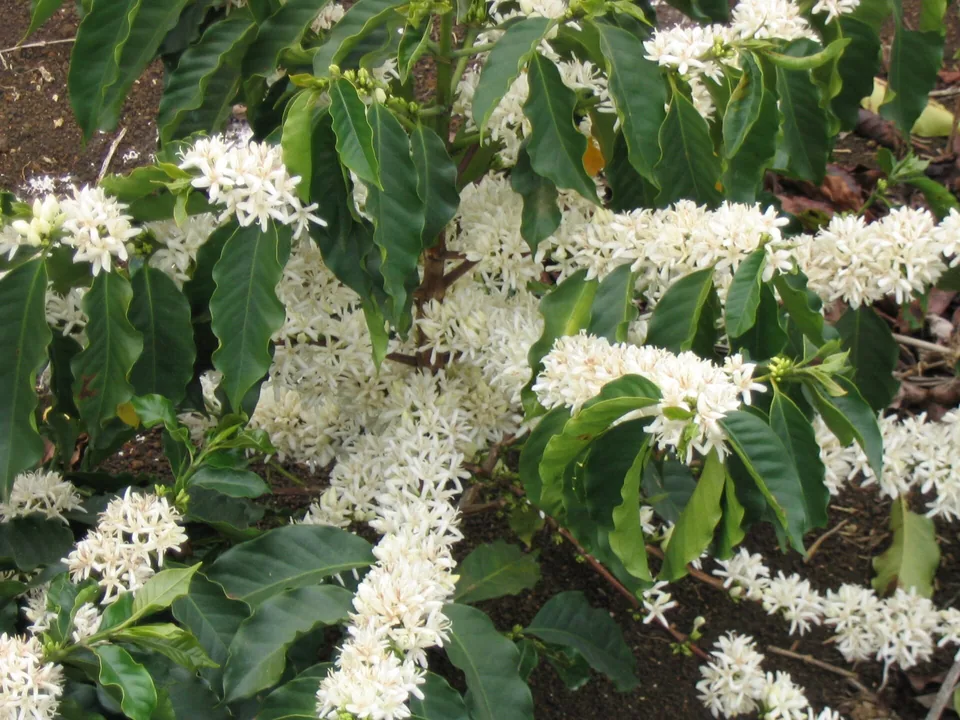


How to Grow and Care for Coffee
Coffea arabica
Written by Emilio Marruso · last checked
At a glance
The coffee plant is a perennial that grows happily indoors in bright light or in a pot. Keep the soil moist but never soggy, and a short dry spell will coax it into bloom. When the cherries turn from green to red, pick them by hand: the seeds inside are what get dried, roasted and ground into coffee.
- Sun
Bright light indoors; partial shade outdoors
What the sources say (2)
Light: Bright light indoors; partial shade outdoors
It can be grown as a houseplant in temperate climates in well-draining potting soil with bright light and high humidity.
— Coffea arabica (Arabian Coffee, Coffee, Coffee Plant) | North Carolina Extension Gardener Plant Toolbox [1] If taken outdoors, the plant prefers some partial shade.
— Coffea arabica (Arabian Coffee, Coffee, Coffee Plant) | North Carolina Extension Gardener Plant Toolbox [1] - Water
Keep moist but not soggy; a short dry spell helps it bloom
What the sources say (5)
Watering: Keep consistently moist but not soggy
Plant in organically rich-well drained soil, kept consistently moist but not soggy.
— Coffea arabica (Arabian Coffee, Coffee, Coffee Plant) | North Carolina Extension Gardener Plant Toolbox [1] Watering needs to be consistent, comparable to avocado. A dry period is needed to induce blossoming.
— Coffee | Cooperative Extension Ventura County [3] Watering notes: A dry period is needed to induce blossoming; lawn sprinkler systems can overwater the plant and cause root rot; a sunny location needs more water and fertilizer
Watering needs to be consistent, comparable to avocado. A dry period is needed to induce blossoming.
— Coffee | Cooperative Extension Ventura County [3] Lawn sprinkler systems can result in overwatering of the coffee plant, causing root rot.
— Coffee – Gardening Solutions [5] Production will be higher if you grow it in a sunny location, but it will need more water and fertilizer to thrive.
— Coffee – Gardening Solutions [5] - Cold
Survives winters down to 30 °F (−1.1 °C)
Half hardy: mild winters or an unheated greenhouse · USDA 10a · RHS H3 · Z10
What the sources say (6)
Hardiness, coldest zone: 10a [winter low −1.1 to 1.7 °C (30 to 35 °F)]
According to NC State Extension: USDA Plant Hardiness Zone: 10a, 10b, 11a, 11b, 12a, 12b
— Coffea arabica (Arabian Coffee, Coffee, Coffee Plant) | North Carolina Extension Gardener Plant Toolbox [1] According to UF/IFAS Gardening Solutions: Coffee will grow best in zones 10B through 11
— Coffee – Gardening Solutions [5] USDA Plant Hardiness Zone: 10a, 10b, 11a, 11b, 12a, 12b
— Coffea arabica (Arabian Coffee, Coffee, Coffee Plant) | North Carolina Extension Gardener Plant Toolbox [1] Hardiness, warmest zone: 12b [winter low 12.8 to 15.6 °C (55 to 60 °F)]
According to NC State Extension: USDA Plant Hardiness Zone: 10a, 10b, 11a, 11b, 12a, 12b
— Coffea arabica (Arabian Coffee, Coffee, Coffee Plant) | North Carolina Extension Gardener Plant Toolbox [1] According to UF/IFAS Gardening Solutions: Coffee will grow best in zones 10B through 11
— Coffee – Gardening Solutions [5] USDA Plant Hardiness Zone: 10a, 10b, 11a, 11b, 12a, 12b
— Coffea arabica (Arabian Coffee, Coffee, Coffee Plant) | North Carolina Extension Gardener Plant Toolbox [1] - Soil
Acidic soil, pH 4.2–6.0
What the sources say (2)
Soil pH, minimum: 4.2
Coffee will succeed on many types of soil but will develop a better root system in deep well-drained soils. A pH of 4.2 to 6 is preferred.
— Coffee | Cooperative Extension Ventura County [3] Soil pH, maximum: 6.0
Coffee will succeed on many types of soil but will develop a better root system in deep well-drained soils. A pH of 4.2 to 6 is preferred.
— Coffee | Cooperative Extension Ventura County [3] - Spacing
3–8 ft between plants
What the sources say (1)
Spacing: 91.4-243.8 cm (3 to 8 feet centers)
Trees are normally planted on 3 to 8 foot centers. Tighter centers are used where intensive pruning is employed.
— Coffee | Cooperative Extension Ventura County [3] - Feeding
Feed during the growing season; keep heavy lawn fertilizer away or you get less, poorer fruit
What the sources say (2)
When: During the growing season, indoors or outdoors
Indoors or outdoors, you should fertilize during the growing season.
— Coffea arabica (Arabian Coffee, Coffee, Coffee Plant) | North Carolina Extension Gardener Plant Toolbox [1] Avoid: Heavy lawn fertilization nearby (reduces fruit quality and production)
Lawn sprinkler systems can result in overwatering of the coffee plant, causing root rot. Heavy lawn fertilization nearby can reduce fruit quality and production.
— Coffee – Gardening Solutions [5] - Harvest
Hand pick the cherries when they turn from green to red; the seeds make coffee
What the sources say (4)
Harvest: When the cherries have turned from green to red; ripe berries are hand picked at intervals of several weeks
Once your coffee cherries have turned from green to red, they are ready to harvest!
— Coffee – Gardening Solutions [5] The highest quality coffee is obtained by hand picking the ripe berries at intervals of several weeks.
— Coffee | Cooperative Extension Ventura County [3] How to harvest: Hand pick the ripe berries (cherries) once they have turned from green to red, at intervals of several weeks
The highest quality coffee is obtained by hand picking the ripe berries at intervals of several weeks.
— Coffee | Cooperative Extension Ventura County [3] Once your coffee cherries have turned from green to red, they are ready to harvest!
— Coffee – Gardening Solutions [5] - Pests
Scale, mealybugs, thrips and mites; coffee leaf rust has no good cure
What the sources say (8)
Pests: scale, mealybugs, thrips, caterpillars, mites, stem borers, leaf miners, coffee berry borer, Fuller rose beetle, green coffee scale
Coffee plants are susceptible to scale, mealybug, thrips, caterpillars and mites.
— Coffea arabica (Arabian Coffee, Coffee, Coffee Plant) | North Carolina Extension Gardener Plant Toolbox [1] Pest problems you may encounter include stem borers, leaf miners, mealy-bugs, scales and mites.
— Coffee – Gardening Solutions [5] The most important is a borer that attacks the fruit, Stephanoderes hampei , which has spread from Africa to nearly all the coffee producing areas in the world.
— Coffee | Cooperative Extension Ventura County [3] Fuller rose beetle ( Pantomorus cervinus ) has been noted as a coffee pest. Green coffee scale ( Coccus virdis ) is the most serous insect pest in Hawaii and can be easily controlled.
— Coffee | Cooperative Extension Ventura County [3] Diseases: coffee leaf rust, coffee berry disease, Fusarium strangulation, root rot
prone to the devastating Hemileia vastatrix rust which destroyed coffee industries in Ceylon and India in the 1800
— Coffee | Cooperative Extension Ventura County [3] The Coffee Berry Disease (CBD), Colletotrichum coffeanum , is major though not fatal.
— Coffee | Cooperative Extension Ventura County [3] Another major problem has been Fusarium strangulation encountered after trees suffer frost damage.
— Coffee | Cooperative Extension Ventura County [3] Lawn sprinkler systems can result in overwatering of the coffee plant, causing root rot.
— Coffee – Gardening Solutions [5] - Watch out
Lawn sprinklers can overwater it and rot the roots
What the sources say (3)
Watering notes: A dry period is needed to induce blossoming; lawn sprinkler systems can overwater the plant and cause root rot; a sunny location needs more water and fertilizer
Watering needs to be consistent, comparable to avocado. A dry period is needed to induce blossoming.
— Coffee | Cooperative Extension Ventura County [3] Lawn sprinkler systems can result in overwatering of the coffee plant, causing root rot.
— Coffee – Gardening Solutions [5] Production will be higher if you grow it in a sunny location, but it will need more water and fertilizer to thrive.
— Coffee – Gardening Solutions [5] - Size
6 to 15 ft wide
What the sources say (1)
Mature width: 182.9-457.2 cm (6 to 15 feet)
Dimensions: Height: 6 ft. 0 in. - 15 ft. 0 in. Width: 6 ft. 0 in. - 15 ft. 0 in.
— Coffea arabica (Arabian Coffee, Coffee, Coffee Plant) | North Carolina Extension Gardener Plant Toolbox [1] - Propagation
From seed, cuttings or grafting
What the sources say (3)
Propagation: Seed; grafting on seedling rootstock; cuttings; tissue culture
Seed has good viability if stored properly and is considered an economical way to obtain trees that are sufficiently if not completely 'true' to the parent(s).
— Coffee | Cooperative Extension Ventura County [3] Clonal reproduction is also done with cuttings. Cuttings are collected from main or upright growing branches to avoid vine-like growth characteristics.
— Coffee | Cooperative Extension Ventura County [3] Tissue culture is also employed to produce clonal stock.
— Coffee | Cooperative Extension Ventura County [3] - Containers
Grows in containers and indoors too
What the sources say (2)
In containers: Yes
#exotic looking #winter interest #tropical feel #container plant #patio #hortcontest #shrub border
— Coffea arabica (Arabian Coffee, Coffee, Coffee Plant) | North Carolina Extension Gardener Plant Toolbox [1] Indoors: Yes
It can be grown as a houseplant in temperate climates in well-draining potting soil with bright light and high humidity.
— Coffea arabica (Arabian Coffee, Coffee, Coffee Plant) | North Carolina Extension Gardener Plant Toolbox [1]
Overview
Coffee is a small broadleaf evergreen shrub or tree native to Ethiopia, grown as a houseplant in temperate climates. [1] It needs rich, well-drained soil kept consistently moist but not soggy. [1] The berries are picked when they turn from green to red and are processed into coffee beans. [5]
Coffee care
How to water Coffee
Watering
Keep consistently moist but not soggy
What the sources say (2)
Plant in organically rich-well drained soil, kept consistently moist but not soggy.Watering needs to be consistent, comparable to avocado. A dry period is needed to induce blossoming.Watering notes
A dry period is needed to induce blossoming; lawn sprinkler systems can overwater the plant and cause root rot; a sunny location needs more water and fertilizer
What the sources say (3)
Watering needs to be consistent, comparable to avocado. A dry period is needed to induce blossoming.Lawn sprinkler systems can result in overwatering of the coffee plant, causing root rot.Production will be higher if you grow it in a sunny location, but it will need more water and fertilizer to thrive.How much light Coffee needs
Bright light indoors; partial shade outdoors
What the sources say (2)
It can be grown as a houseplant in temperate climates in well-draining potting soil with bright light and high humidity.If taken outdoors, the plant prefers some partial shade.How much cold Coffee can take
Hardiness, coldest zone
10a [winter low −1.1 to 1.7 °C (30 to 35 °F)]
What each source says
According to NC State Extension: 10a [winter low −1.1 to 1.7 °C (30 to 35 °F)]
According to UF/IFAS Gardening Solutions: 10b [winter low 1.7 to 4.4 °C (35 to 40 °F)]
What the sources say (3)
According to NC State Extension: USDA Plant Hardiness Zone:
10a, 10b, 11a, 11b, 12a, 12bAccording to UF/IFAS Gardening Solutions: Coffee will grow best in zones 10B through 11USDA Plant Hardiness Zone:
10a, 10b, 11a, 11b, 12a, 12bHardiness, warmest zone
12b [winter low 12.8 to 15.6 °C (55 to 60 °F)]
What each source says
According to NC State Extension: 12b [winter low 12.8 to 15.6 °C (55 to 60 °F)]
According to UF/IFAS Gardening Solutions: 11 [winter low 4.4 to 10 °C (40 to 50 °F)]
What the sources say (3)
According to NC State Extension: USDA Plant Hardiness Zone:
10a, 10b, 11a, 11b, 12a, 12bAccording to UF/IFAS Gardening Solutions: Coffee will grow best in zones 10B through 11USDA Plant Hardiness Zone:
10a, 10b, 11a, 11b, 12a, 12bBest soil for Coffee
Soil pH, minimum
4.2
What the sources say (1)
Coffee will succeed on many types of soil but will develop a better root system in deep well-drained soils. A pH of 4.2 to 6 is preferred.Soil pH, maximum
6.0
What the sources say (1)
Coffee will succeed on many types of soil but will develop a better root system in deep well-drained soils. A pH of 4.2 to 6 is preferred.Where to grow Coffee
Indoors
Yes
What the sources say (1)
It can be grown as a houseplant in temperate climates in well-draining potting soil with bright light and high humidity.In containers
Yes
What the sources say (1)
#exotic looking #winter interest #tropical feel #container plant #patio #hortcontest #shrub borderSpacing
91.4-243.8 cm (3 to 8 feet centers)
What the sources say (1)
Trees are normally planted on 3 to 8 foot centers. Tighter centers are used where intensive pruning is employed.How to propagate Coffee
Seed; grafting on seedling rootstock; cuttings; tissue culture
What the sources say (3)
Seed has good viability if stored properly and is considered an economical way to obtain trees that are sufficiently if not completely 'true' to the parent(s).Clonal reproduction is also done with cuttings. Cuttings are collected from main or upright growing branches to avoid vine-like growth characteristics.Tissue culture is also employed to produce clonal stock.How to grow Coffee
The plant
Life cycle
perennial
What the sources say (1)
Uses (Ethnobotany):
Coffee beans
Life Cycle:
Perennial
Woody
Recommended Propagation Strategy:
SeedFamily
Rubiaceae
What the sources say (1)
The coffee plant is a small, broadleaf evergreen shrub or small tree in the coffee family (Rubiaceae) with an upright habit.Mature height
Mature width
182.9-457.2 cm (6 to 15 feet)
What the sources say (1)
Dimensions:
Height: 6 ft. 0 in. - 15 ft. 0 in.
Width: 6 ft. 0 in. - 15 ft. 0 in.Harvest and storage
How to harvest
Hand pick the ripe berries (cherries) once they have turned from green to red, at intervals of several weeks
Storage
After processing, the beans can be stored for brief periods or aged under carefully controlled conditions to enhance flavor
What the sources say (1)
The beans can now be stored for brief periods or aged under carefully controlled conditions to enhance flavor.Pests and diseases
Pests
scale, mealybugs, thrips, caterpillars, mites, stem borers, leaf miners, coffee berry borer, Fuller rose beetle, green coffee scale
What the sources say (4)
Coffee plants are susceptible to scale, mealybug, thrips, caterpillars and mites.Pest problems you may encounter include stem borers, leaf miners, mealy-bugs, scales and mites.The most important is a borer that attacks the fruit, Stephanoderes hampei , which has spread from Africa to nearly all the coffee producing areas in the world.Fuller rose beetle ( Pantomorus cervinus ) has been noted as a coffee pest. Green coffee scale ( Coccus virdis ) is the most serous insect pest in Hawaii and can be easily controlled.Diseases
coffee leaf rust, coffee berry disease, Fusarium strangulation, root rot
What the sources say (4)
prone to the devastating Hemileia vastatrix rust which destroyed coffee industries in Ceylon and India in the 1800The Coffee Berry Disease (CBD), Colletotrichum coffeanum , is major though not fatal.Another major problem has been Fusarium strangulation encountered after trees suffer frost damage.Lawn sprinkler systems can result in overwatering of the coffee plant, causing root rot.Fertilizing
When
During the growing season, indoors or outdoors
What the sources say (1)
Indoors or outdoors, you should fertilize during the growing season.How often
The sources give different values depending on region, zone or growing conditions.
What each source says
in full sun: More fertilizer than in light shade
What the sources say (1)
in full sun: Production will be higher if you grow it in a sunny location, but it will need more water and fertilizer to thrive.Mineral fertilizers
The sources give different values depending on region, zone or growing conditions.
What each source says
tropical plantings: Responds to nitrogen and potassium plus minor elements; a leaf analysis is advised elsewhere
What the sources say (1)
tropical plantings: Coffee responds to nitrogen, potassium, and minor elements in tropical settings. No studies of nutritional needs under California conditions have been made; therefore, a leaf analysis may be prudent.Avoid
Heavy lawn fertilization nearby (reduces fruit quality and production)
What the sources say (1)
Lawn sprinkler systems can result in overwatering of the coffee plant, causing root rot. Heavy lawn fertilization nearby can reduce fruit quality and production.Signs of deficiency
Chlorosis on soils with pH above 7
What the sources say (1)
Coffee will succeed on many types of soil but will develop a better root system in deep well-drained soils. A pH of 4.2 to 6 is preferred. Above 7 chlorosis can be expected.Coffee pests and problems
Scale, mealybug, thrips, caterpillars and mites
Symptom: Coffee plants are susceptible to scale, mealybug, thrips, caterpillars and mites.
What the sources say (1)
Coffee plants are susceptible to scale, mealybug, thrips, caterpillars and mites.
— Coffea arabica (Arabian Coffee, Coffee, Coffee Plant) | North Carolina Extension Gardener Plant Toolbox [1] Leaf drop in cold
Symptom: Leaf drop can occur at temperatures below 55 F.
What the sources say (1)
Plants prefer daytime temperatures of 70 to 80°F and nighttime temperatures of 60 to 65°F. and leaf drop can occur at temperatures below 55°F.
— Coffea arabica (Arabian Coffee, Coffee, Coffee Plant) | North Carolina Extension Gardener Plant Toolbox [1] Root rot from overwatering
Symptom: Lawn sprinkler systems can result in overwatering of the coffee plant, causing root rot.
What the sources say (1)
Lawn sprinkler systems can result in overwatering of the coffee plant, causing root rot.
— Coffee – Gardening Solutions [5] Coffee leaf rust
Symptom: Arabica is prone to the devastating Hemileia vastatrix rust.
What to do: No good control is presently known; growers in infected areas switched to resistant robusta or less susceptible cultivars.
What the sources say (1)
The disease appears to be most devastating at lower elevations. No good control is presently known.
— Coffee | Cooperative Extension Ventura County [3]
Remedies
Each remedy shows what official sources say about it; traditional remedies without an official source are marked as such. Harmful ones are listed so you know to avoid them.
Treating the plant
aphids
neem oil with grated laundry soap Works
Despite these being biological pesticides, it is important to read the directions on the label and wear safety equipment.
— extension.illinois.edu [7] How: Neem oil 10 to 20 ml/L, plus soft, finely grated laundry soap at about 7 g/L of water.
Neem oil 10 to 20 ml/L, plus soft, finely grated laundry soap at about 7 g/L water.
— fao.org [6] What the evidence says Neem oil is found in the seeds of the neem tree. The active component found in this biological pesticide reduces insect feeding, interferes with hormones -- making it hard to grow or lay eggs -- and acts as a repellent.
— extension.illinois.edu [7]
coffee berry borer
removing dropped cherries Not verified
Traditional remedy, not verified by an official source.
How: Keep the area clean and remove dropped cherries and carry-over fruit from the bushes; the source reports limited impact and a possible high cost.
Calendar
Harvest
When the cherries have turned from green to red; ripe berries are hand picked at intervals of several weeks
Months as given by the sources, which are mostly from the United States (northern hemisphere). In the southern hemisphere they shift by about six months.
Edibility
Reported by the source, quoted verbatim. Do not eat a plant on the basis of this page alone: identification mistakes can be dangerous.
Fruits are edible, but seeds are what are usually dried, roasted and ground to make coffee.
[1]
Indicative values
Values from a secondary source, not checked word for word like the rest of this page. Use them as a starting point.
- Hours of sun
- 6-8 hoursIndicative value, adapt it to your climate · Secondary source
- Drought tolerant
- yesIndicative value, adapt it to your climate · Secondary source
- Soil
- Well-drainedIndicative value, adapt it to your climate · Secondary source
- Growth rate
- LowIndicative value, adapt it to your climate · Secondary source
- Pruning
- March, April, MayIndicative value, adapt it to your climate · Secondary source
Similar plants
- Azure Bluet Houstonia caerulea
- Buttonbush Cephalanthus occidentalis
- Chinese Buttonbush Adina rubella
- Firebush Hamelia patens
- Gardenia Gardenia jasminoides
- Snowrose Serissa japonica
- Summer Bluet Houstonia purpurea
- Fever Tree Pinckneya pubens
Sources
Every value above is quoted from these documents. Links lead to the original publisher.
- Coffea arabica (Arabian Coffee, Coffee, Coffee Plant) | North Carolina Extension Gardener Plant Toolbox · plants.ces.ncsu.edu, consulted
- Coffee Plant - Coffea arabica | North Carolina Extension Gardener Plant Toolbox · plants.ces.ncsu.edu, consulted
- Coffee | Cooperative Extension Ventura County · ucanr.edu, consulted
- · ask.ifas.ufl.edu, consulted
- Coffee – Gardening Solutions · gardeningsolutions.ifas.ufl.edu, consulted
- fao.org · fao.org
- extension.illinois.edu · extension.illinois.edu
Written by Emilio Marruso · last checked