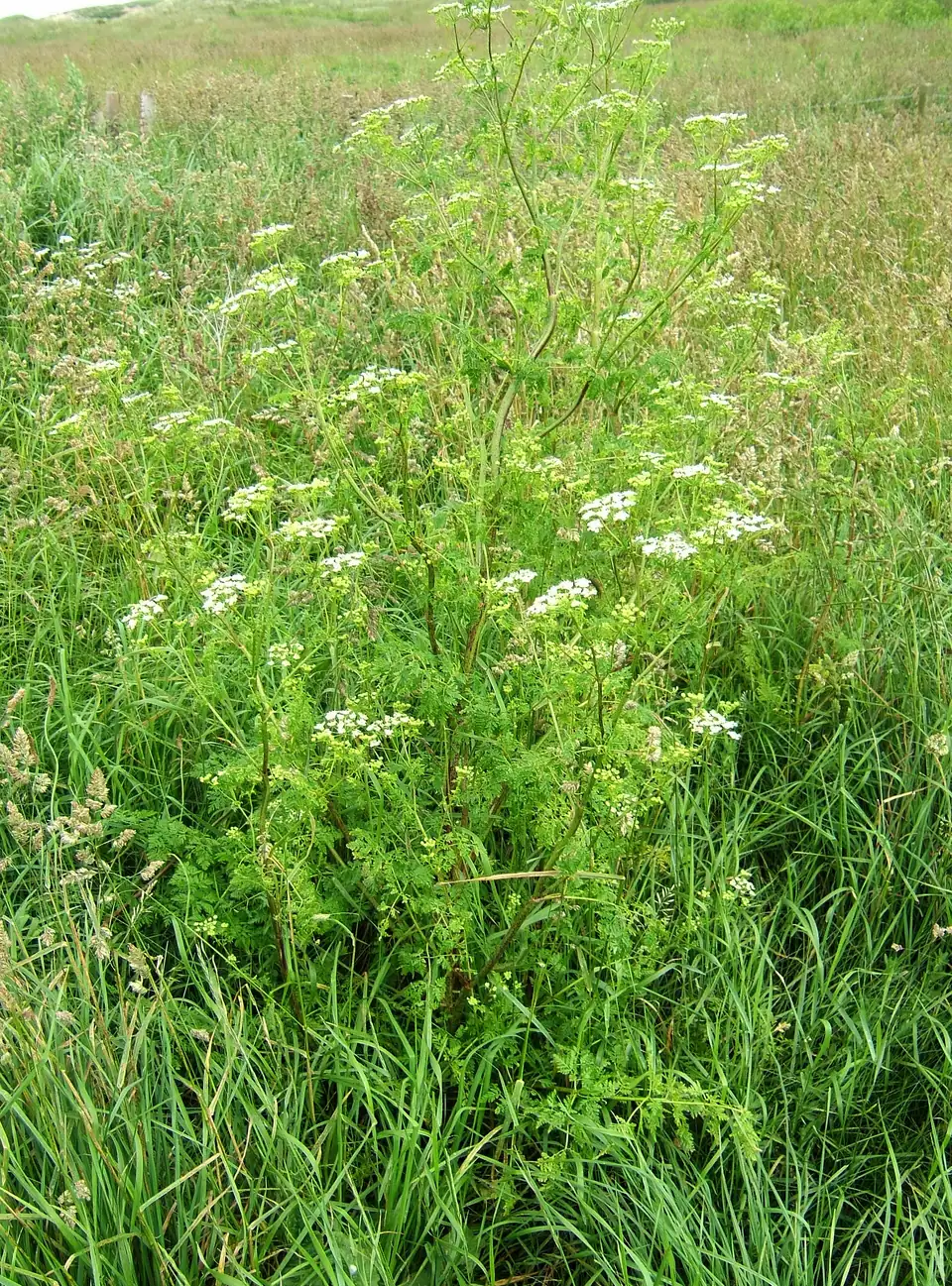


Cómo cultivar y cuidar Cicuta
Conium maculatum
Escrito por Emilio Marruso · última revisión
Tóxica para: Gatos, Perros, Caballos, Ganado vacuno, Ganado, Personas · Por qué
De un vistazo
La cicuta es una bienal que nace de semilla y se extiende 1,2–1,5 m de ancho, a gusto a pleno sol o en semisombra. Pide poco, pero exige respeto: es muy tóxica, puede ser mortal si se ingiere y su savia irrita la piel. Si la cultivas, usa guantes y mantenla lejos de niños, mascotas y caballos.
- Sol
De pleno sol a semisombra
Qué dicen las fuentes (1)
Luz: Pleno sol a semisombra
While it is usually a biennial, in ideal locations – full sun to partial shade and moist soils – it can be perennial.
— Conium maculatum (Deadly Hemlock, Poison Fool's Parsley, Poison Hemlock, Poison Parsley, Spotted Parsley) | North Carolina Extension Gardener Plant Toolbox [1] - Atención
Se comporta como mala hierba; quita las rosetas del primer año, porque la raíz larga cuesta arrancarla después
- Tamaño
Alcanza 1,2–1,5 m de ancho
Qué dicen las fuentes (1)
Anchura adulta: 122-152 cm (4-5 pies)
It grows 6 to 10 feet tall and 4 to 5 feet wide and quickly colonizes an area and displaces native plant species.
— Conium maculatum (Deadly Hemlock, Poison Fool's Parsley, Poison Hemlock, Poison Parsley, Spotted Parsley) | North Carolina Extension Gardener Plant Toolbox [1] - Multiplicación
Se multiplica por semilla y vive dos años
Qué dicen las fuentes (3)
Propagación: Semilla
Poison hemlock is an herbaceous (soft stem) plant that reproduces solely by seeds.
— Poison Hemlock (Conium maculatum) (EBR-57) | University of Maryland Extension [2] Ciclo de vida: bienal
Poison hemlock is an erect biennial (flowering plant that takes two years to complete its life cycle) weed that can grow six to ten feet tall.
— Poison Hemlock (Conium maculatum) (EBR-57) | University of Maryland Extension [2] Life cycle: Biennial
— Poison hemlock (Conium maculatum) | Pesticide Safety Education Program [5] - Seguridad
Puede ser mortal si se ingiere; también daña a gatos, perros y caballos, y su savia irrita la piel
Resumen
La cicuta venenosa es una maleza herbácea bienal de la familia de las zanahorias que es altamente tóxica y puede ser fatal para las personas y el ganado. [1] Se reproduce por semillas, que persisten en el suelo y dificultan su erradicación. [1] Esta planta erguida tiene tallos lisos, huecos y cubiertos de manchas moradas. [4] La tsuga canadiense es un árbol leñoso de hoja perenne y acículas de la familia de las pináceas. [9]
Ver también: Tsuga canadiense (Tsuga canadensis)
Citado en inglés, como en la fuente.
Esta ficha está incompleta: las fuentes consultadas aún no cubren todos los campos.
Aún no cubierto por nuestras fuentes: Rusticidad, zona más fría, Rusticidad, zona más cálida
Cuidados
Luz
Pleno sol a semisombra
Qué dicen las fuentes (1)
While it is usually a biennial, in ideal locations – full sun to partial shade and moist soils – it can be perennial.Clima y frío
Rusticidad, zona más fría
No figura en las fuentes consultadas.
Rusticidad, zona más cálida
No figura en las fuentes consultadas.
Propagación
Semilla
Qué dicen las fuentes (1)
Poison hemlock is an herbaceous (soft stem) plant that reproduces solely by seeds.Cultivo
La planta
Ciclo de vida
bienal
Qué dicen las fuentes (2)
Poison hemlock is an erect biennial (flowering plant that takes two years to complete its life cycle) weed that can grow six to ten feet tall.Life cycle: BiennialFamilia
Apiaceae
Qué dicen las fuentes (2)
Poison hemlock is a biennial, herbaceous weed in the carrot family (Apiaceae).Poison hemlock , Conium maculatum , is a member of the plant family ApiaceaeAltura adulta
Las fuentes no coinciden:
Anchura adulta
122-152 cm (4-5 pies)
Qué dicen las fuentes (1)
It grows 6 to 10 feet tall and 4 to 5 feet wide and quickly colonizes an area and displaces native plant species.Problemas
Eliminación manual de la raíz principal
Síntoma: La raíz principal larga y las raíces fibrosas extensas hacen que la eliminación manual sea difícil; la savia es un irritante de la piel.
Qué hacer: Trata las rosetas del primer año en lugar de la planta madura más grande.
Qué dicen las fuentes (1)
The most effective approach is to treat the 1st year rosettes and not the larger, mature plant.
— Poison Hemlock [3]
Remedios
Cada remedio indica qué dicen las fuentes oficiales; los remedios tradicionales sin fuente oficial aparecen marcados. Los perjudiciales están para que sepas evitarlos.
Primeros auxilios
Primeros auxilios: no sustituyen al médico
ingestión
llama a un proveedor de atención médica o ve a la sala de emergencias Fuente oficial, sin prueba independiente
If you develop symptoms after handling or eating a plant, seek immediate medical attention.
— my.clevelandclinic.org [10] Cómo: si crees que puedes haber ingerido cicuta venenosa accidentalmente, llama a tu proveedor de atención médica de inmediato o ve directamente a la sala de emergencias más cercana
If you think you may have accidentally ingested poison hemlock, you should call your healthcare provider right away or go immediately to the nearest emergency room.
— my.clevelandclinic.org [10]
Cómo eliminarla
malezas
Excava pequeños parches Fuente oficial, sin prueba independiente
Wear a face mask, long sleeves and gloves when handling poison hemlock.
— my.clevelandclinic.org [10] Don't burn plants or plant debris, because burning may release toxins into the air.
— Poison Hemlock / Home and Landscape / UC Statewide IPM Program (UC IPM) [8] Cómo: excavarlo en pequeños parches y retirar las raíces
To get rid of poison hemlock, dig it out in small patches. Make sure to remove the roots.
— my.clevelandclinic.org [10] Arranca a mano con toda la raíz principal. Fuente oficial, sin prueba independiente
Wear gloves to minimize direct contact with the toxic sap.
— Poison Hemlock / Home and Landscape / UC Statewide IPM Program (UC IPM) [8] Don't burn plants or plant debris, because burning may release toxins into the air.
— Poison Hemlock / Home and Landscape / UC Statewide IPM Program (UC IPM) [8] Cómo: eliminación manual para infestaciones pequeñas; retira toda la raíz principal para evitar que vuelva a crecer
Hand removal is recommended for small infestations. When pulling the plants, the entire taproot should be removed to prevent regrowth.
— Poison Hemlock / Home and Landscape / UC Statewide IPM Program (UC IPM) [8] cultivo repetido de plántulas Fuente oficial, sin prueba independiente
Wear gloves to minimize direct contact with the toxic sap.
— Poison Hemlock / Home and Landscape / UC Statewide IPM Program (UC IPM) [8] Cómo: arado o cultivo repetido de plantas recién germinadas
Plowing or repeated cultivation of newly germinated plants will prevent poison hemlock establishment.
— Poison Hemlock / Home and Landscape / UC Statewide IPM Program (UC IPM) [8] siega repetida Fuente oficial, sin prueba independiente
Don’t cut, mow or burn poison hemlock — the seeds can re-sprout and the fumes can be toxic.
— my.clevelandclinic.org [10] Wear gloves to minimize direct contact with the toxic sap.
— Poison Hemlock / Home and Landscape / UC Statewide IPM Program (UC IPM) [8] Cómo: Siega repetidamente después del espigado pero antes de la floración para reducir la producción de semillas
repeated mowing once the plants have bolted but before they have flowered can reduce further seed production
— Poison Hemlock / Home and Landscape / UC Statewide IPM Program (UC IPM) [8] meter las plantas en bolsas para la basura Fuente oficial, sin prueba independiente
Wear a face mask, long sleeves and gloves when handling poison hemlock.
— my.clevelandclinic.org [10] Cómo: Coloca las plantas en bolsas de plástico para basura y ponlas en la basura.
Place the plants in plastic garbage bags and put them in the trash.
— my.clevelandclinic.org [10]
Venenosa para los animales
Según la fuente, citada textualmente. No es un consejo médico ni veterinario: si una persona o un animal pudo haber ingerido esta planta, contacta con un centro de toxicología o con un veterinario.
Animales
Problems: Contact Dermatitis Malodorous Poisonous to Humans Problem for Cats Problem for Dogs Problem for Horses Weedy
[1]La fuente señala el riesgo para este animal pero no explica por qué.
All parts of poison hemlock are toxic to humans and other animals. The roots and seeds contain the highest concentration of alkaloids.
[3]It contains highly poisonous alkaloids toxic to all classes of livestock and humans.
[5]All classes of livestock and wildlife are susceptible to poison hemlock from ingestion, including cattle, horses, pigs, goats, sheep, elk, and turkeys.
[8]- Principio tóxico
Eight known alkaloids contribute to poison hemlock's toxicity.
[8]- Síntomas
Symptoms of poisoning include nervousness, trembling, knuckling at the fetlock joints, ataxia, dilation of the pupils, a weak and slow heartbeat, coma, and eventually death from respiratory paralysis.
[8]- Gravedad
A lethal dose in horses and cattle is as low as 0.25 to 0.5% (fresh plant weight) of the animal's body weight.
[8]
Personas
HIGHLY TOXIC, MAY BE FATAL IF EATEN! Delivery by ingestion. Salivation, vomiting, diarrhea, muscular weakness, paralysis, nervousness, trembling, dilation of pupils, weak pulse, convulsions, coma.
[1]- Partes venenosas
Poison Part: Bark Flowers Fruits Leaves Roots Sap/Juice Seeds Stems
[1]- Principio tóxico
Poison Toxic Principle: Alkaloids coniine and others Causes Contact Dermatitis: Yes
[1]- Síntomas
Salivation, vomiting, diarrhea, muscular weakness, paralysis, nervousness, trembling, dilation of pupils, weak pulse, convulsions, coma.
[1]- Gravedad
Poison Severity: High Poison Symptoms: HIGHLY TOXIC, MAY BE FATAL IF EATEN! Delivery by ingestion.
[1]
All parts of this plant are poisonous and can be fatal to livestock and humans if ingested.
[2]- Principio tóxico
Some humans and animals can experience dermatitis on the skin just by coming into direct contact with this weed due to the potency of the eight alkaloids that contribute to its toxicity.
[2]- Síntomas
Poison hemlock is toxic to humans and to livestock if ingested, by affecting the respiratory, central nervous and reproductive systems.
[2]
Cases of human poisoning are comparatively rare and are generally associated with children using the hollow stems as flutes or adults mistakenly confusing poison hemlock with an edible plant such as parsley, parsnip, or anise.
[8]
Plantas similares
- Angélica Angelica archangelica
- Appalachian Angelica Angelica triquinata
- Asiatic pennywort Centella asiatica
- Bishop's Weed Ammi majus
- Common Hedge Parsley Torilis arvensis
- Perifollo verde Anthriscus sylvestris
- Hinojo Foeniculum vulgare
- Apio de monte Levisticum officinale
Fuentes
Cada valor anterior se cita de estos documentos. Los enlaces llevan al editor original.
- Conium maculatum (Deadly Hemlock, Poison Fool's Parsley, Poison Hemlock, Poison Parsley, Spotted Parsley) | North Carolina Extension Gardener Plant Toolbox · plants.ces.ncsu.edu, consultado
- Poison Hemlock (Conium maculatum) (EBR-57) | University of Maryland Extension · extension.umd.edu, consultado
- Poison Hemlock · extension.psu.edu, consultado
- Poison Hemlock Identification and Management | University of Maryland Extension · extension.umd.edu, consultado
- Poison hemlock (Conium maculatum) | Pesticide Safety Education Program · pested.osu.edu, consultado
- Spotted Parsley - Conium maculatum | North Carolina Extension Gardener Plant Toolbox · plants.ces.ncsu.edu, consultado
- Poison Hemlock - Conium maculatum | North Carolina Extension Gardener Plant Toolbox · plants.ces.ncsu.edu, consultado
- Poison Hemlock / Home and Landscape / UC Statewide IPM Program (UC IPM) · ipm.ucanr.edu, consultado
- NC State Extension Gardener Plant Toolbox — Tsuga canadensis · plants.ces.ncsu.edu, consultado
- my.clevelandclinic.org · my.clevelandclinic.org
Escrito por Emilio Marruso · última revisión