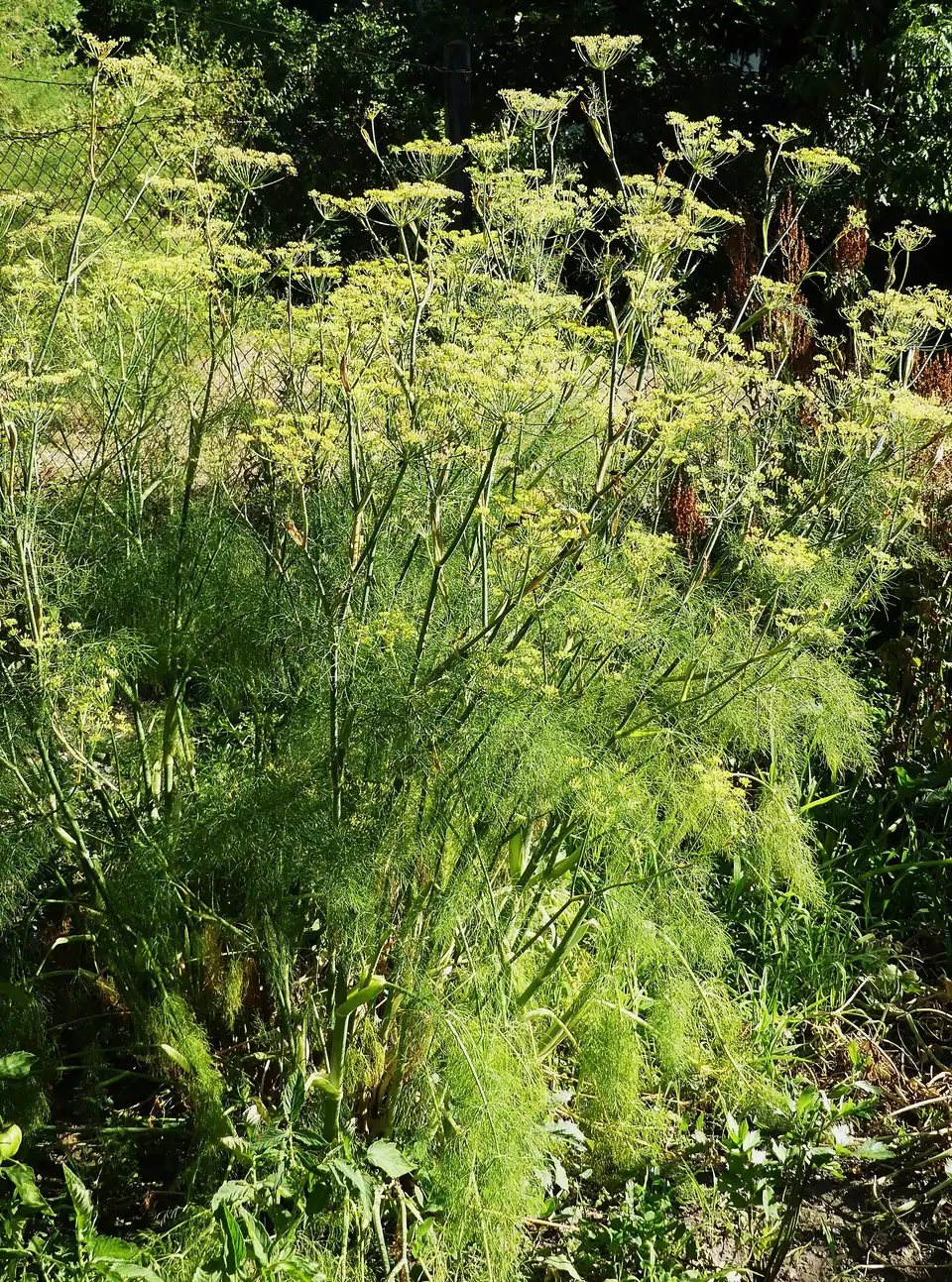


Cómo cultivar y cuidar Hinojo
Foeniculum vulgare
Escrito por Emilio Marruso · última revisión
Tóxica para: Personas · Por qué
De un vistazo
El hinojo te regala tres cosas de una sola planta: hojas y tallos plumosos con un suave sabor anisado, semillas aromáticas para bizcochos y panes y, con el hinojo de Florencia, un bulbo crujiente. Siémbralo a pleno sol después de la última helada y corta hojas toda la temporada. Mantén húmedo el de Florencia y en 3–4 meses tendrás bulbos.
- Sol
Sol pleno
Qué dicen las fuentes (2)
Luz: Pleno sol
Fennel is grown across a wide range of USDA hardiness zones and does best in moist, organically rich, well-drained soils in full sun.
— Foeniculum vulgare (Bronze Fennel, Fennel, Finocchio, Florence Fennel, Sweet Fennel) | North Carolina Extension Gardener Plant Toolbox [1] In early spring when danger of hard frost is over, sow seeds in well-worked, fertile soil in full sun, or midsummer for fall harvest.
— How to grow green fennel (Foeniculum vulgare) | Extension [3] - Riego
2,5–5 cm de agua a la semana; mantén húmedo el de Florencia para que no se agrieten los tallos
Qué dicen las fuentes (9)
Riego: 1 a 2 pulgadas (2.5-5.1 cm) de agua por semana durante toda la temporada de crecimiento según el tipo de suelo; el hinojo común tolera la sequía una vez establecido, el hinojo de Florencia se mantiene uniformemente húmedo
Apply 1 to 2 inches of water per week throughout the growing season depending on soil type.
— How to Grow Fennel in Your Garden | USU [7] Once established common fennel is drought tolerant .
— Fennel, Foeniculum vulgare – Wisconsin Horticulture [2] Keep Florence fennel evenly moist, as dry conditions will promote blooming at the expense of bulb formation.
— Fennel, Foeniculum vulgare – Wisconsin Horticulture [2] Notas sobre el riego: Las fluctuaciones entre suelos secos y húmedos pueden causar que los tallos se partan; la pudrición de la raíz ocurre en suelos muy húmedos o con mal drenaje; el riego por goteo ayuda a mantener el suelo húmedo mientras conserva agua
Fluctuations between dry and wet soils may cause stems to split.
— How to Grow Fennel in Your Garden | USU [7] Fennel has few pest problems other than root rot in very wet soils.
— Fennel, Foeniculum vulgare – Wisconsin Horticulture [2] Drip irrigation helps maintain moist soil conditions while conserving water.
— How to Grow Fennel in Your Garden | USU [7] Sequía: El hinojo común tolera la sequía una vez establecido, más que el hinojo de Florencia; el hinojo de Florencia debe mantenerse uniformemente húmedo, porque el suelo seco favorece el espigamiento a costa del bulbo.
It will tolerate clay and sandy soils and, once established, drought.
— Foeniculum vulgare (Bronze Fennel, Fennel, Finocchio, Florence Fennel, Sweet Fennel) | North Carolina Extension Gardener Plant Toolbox [1] Common fennel is more drought tolerant than Florence fennel, however, allowing common fennel to wilt will negatively affect seed production.
— How to Grow Fennel in Your Garden | USU [7] Keep Florence fennel evenly moist, as dry conditions will promote blooming at the expense of bulb formation.
— Fennel, Foeniculum vulgare – Wisconsin Horticulture [2] - Frío
Aguanta inviernos de hasta −34,4 °C (−30 °F)
Muy rústica · USDA 4a · RHS H7 · Z4
Qué dicen las fuentes (4)
Rusticidad, zona más fría: 4a [mínima invernal de −34,4 a −31,7 °C (de −30 a −25 °F)]
4a, 4b, 5a, 5b, 6a, 6b, 7a, 7b, 8a, 8b, 9a, 9b
— Foeniculum vulgare (Bronze Fennel, Fennel, Finocchio, Florence Fennel, Sweet Fennel) | North Carolina Extension Gardener Plant Toolbox [1] Fennel, Foeniculum vulgare , is a short-lived perennial hardy in zones 4a to 9b, but often grown as an annual in cooler climates .
— Fennel, Foeniculum vulgare – Wisconsin Horticulture [2] Rusticidad, zona más cálida: 9b [mínima invernal de −3,9 a −1,1 °C (de 25 a 30 °F)]
4a, 4b, 5a, 5b, 6a, 6b, 7a, 7b, 8a, 8b, 9a, 9b
— Foeniculum vulgare (Bronze Fennel, Fennel, Finocchio, Florence Fennel, Sweet Fennel) | North Carolina Extension Gardener Plant Toolbox [1] Fennel, Foeniculum vulgare , is a short-lived perennial hardy in zones 4a to 9b, but often grown as an annual in cooler climates .
— Fennel, Foeniculum vulgare – Wisconsin Horticulture [2] - Suelo
Suelo bien drenado, pH 6,5–8,0; el encharcamiento pudre las raíces
Qué dicen las fuentes (4)
pH del suelo, mínimo: 6.5
Florence fennel prefers full sun and loamy soil, rich in organic matter with a pH of 6.5 to 8.
— How to Grow Fennel in Your Garden | USU [7] pH del suelo, máximo: 8.0
Florence fennel prefers full sun and loamy soil, rich in organic matter with a pH of 6.5 to 8.
— How to Grow Fennel in Your Garden | USU [7] Enfermedades: pudrición del tallo y la raíz (en suelos mal drenados o muy húmedos)
No serious insect or disease problems. Stem and root rot can occur in poorly-drained soils and aphids and slugs can be a problem.
— Foeniculum vulgare (Bronze Fennel, Fennel, Finocchio, Florence Fennel, Sweet Fennel) | North Carolina Extension Gardener Plant Toolbox [1] Fennel has few pest problems other than root rot in very wet soils.
— Fennel, Foeniculum vulgare – Wisconsin Horticulture [2] - Abonado
Abona el de Florencia cada 2–3 semanas al formarse el bulbo; mucho nitrógeno lo hace florecer antes
Qué dicen las fuentes (4)
Cuándo: Cuando los bulbos comiencen a desarrollarse (hinojo de Florencia)
When bulbs develop, apply 3 tablespoons of a nitrogen based fertilizer (21-0-0) for every 10 feet of row.
— How to Grow Fennel in Your Garden | USU [7] Frecuencia: Cada 2 a 3 semanas
Fennel is a heavy feeder, so fertilize every 2 to 3 weeks with a balanced fertilizer.
— How to grow green fennel (Foeniculum vulgare) | Extension [3] Evitar: Fertilizantes con alto contenido de nitrógeno, que favorecen el espigamiento
hinojo común: When grown in leaner soils, plants do not grow as tall so often don’t require staking. Soil fertility affects flavor, as well, with better flavor in poor soil.
— Fennel, Foeniculum vulgare – Wisconsin Horticulture [2] To prevent fennel from bolting (going to seed too early), plant it in early spring or late summer to avoid midsummer heat. Use consistent moisture, avoid high-nitrogen fertilizers, and thin seedlings to reduce stress.
— How to Grow Fennel in Your Garden | USU [7] - Cosecha
Corta hojas cuando quieras; saca los bulbos como una pelota de tenis, a 3–4 meses; semillas al ponerse marrones
Qué dicen las fuentes (10)
Cosecha: Durante toda la temporada de crecimiento; las semillas a fines del verano; los bulbos de hinojo de Florencia se desentierran después de 3-4 meses cuando miden 2-3 pulgadas (5.1-7.6 cm) de diámetro
Hinojo herbáceo: Herb fennel can be harvested as needed by cutting away the feathery foliage.
— Fennel | Herbs | Illinois Extension | Illinois [8] Hinojo de Florencia (fuente: Extensión de la Universidad Estatal de Utah): Florence fennel should be harvested when the bulbous base is less than 4 inches across and firm to the touch.
— How to Grow Fennel in Your Garden | USU [7] Hinojo de Florencia (fuente: Extensión de la Universidad de Illinois): Florence fennel can be harvested when the “bulbs” are about the size of tennis balls
— Fennel | Herbs | Illinois Extension | Illinois [8] Semilla (fuente: Extensión de la Universidad Estatal de Utah): To harvest seed, cut the seed heads after they have turned brown and store in a paper bag to allow seeds to fully dry.
— How to Grow Fennel in Your Garden | USU [7] Fennel can be harvested at any time throughout the growing season.
— How to grow green fennel (Foeniculum vulgare) | Extension [3] The stronger tasting fennel seeds can be picked in late summer, and have a flavor like aniseed or licorice.
— How to grow green fennel (Foeniculum vulgare) | Extension [3] Dig these up after 3-4 months when they have reached 2-3” in diameter.
— How to grow green fennel (Foeniculum vulgare) | Extension [3] Cómo cosechar: Hinojo herbáceo: corta el follaje plumoso según sea necesario; para semilla, corta la planta una vez que las cabezas de las flores se vuelven marrones. Hinojo de Florencia: cosecha el bulbo cuando tenga aproximadamente el tamaño de una pelota de tenis (menos de 4 pulgadas [10 cm] de ancho y firme al tacto) desenterrándolo y cortando la raíz y la parte superior.
Herb fennel can be harvested as needed by cutting away the feathery foliage. If seed is desired, allow the plant to flower and when the flower heads turn brown the plant can be cut
— Fennel | Herbs | Illinois Extension | Illinois [8] Florence fennel can be harvested when the “bulbs” are about the size of tennis balls by digging the “bulb” and cutting off the root and cutting back the top.
— Fennel | Herbs | Illinois Extension | Illinois [8] Florence fennel should be harvested when the bulbous base is less than 4 inches across and firm to the touch.
— How to Grow Fennel in Your Garden | USU [7] - Plagas
Pulgones, babosas, trips y orugas de la col; podredumbre de tallo y raíz en suelo encharcado
Qué dicen las fuentes (4)
Plagas: pulgones, babosas, trips, larvas de la polilla de la col
No serious insect or disease problems. Stem and root rot can occur in poorly-drained soils and aphids and slugs can be a problem.
— Foeniculum vulgare (Bronze Fennel, Fennel, Finocchio, Florence Fennel, Sweet Fennel) | North Carolina Extension Gardener Plant Toolbox [1] Insects including aphids, thrips, and cabbage moth larva may cause leaf damage resulting in smaller bulbs.
— How to Grow Fennel in Your Garden | USU [7] Enfermedades: pudrición del tallo y la raíz (en suelos mal drenados o muy húmedos)
No serious insect or disease problems. Stem and root rot can occur in poorly-drained soils and aphids and slugs can be a problem.
— Foeniculum vulgare (Bronze Fennel, Fennel, Finocchio, Florence Fennel, Sweet Fennel) | North Carolina Extension Gardener Plant Toolbox [1] Fennel has few pest problems other than root rot in very wet soils.
— Fennel, Foeniculum vulgare – Wisconsin Horticulture [2] - Atención
Se resiembra sola con facilidad y puede escaparse del huerto; el calor hace florecer antes al de Florencia
Qué dicen las fuentes (2)
Propagación: Semilla (sembrada directamente o iniciada en interiores); se resiembra libremente
Fennel can be grown from seed sown directly in the garden in spring and it freely self-seeds in the garden.
— Foeniculum vulgare (Bronze Fennel, Fennel, Finocchio, Florence Fennel, Sweet Fennel) | North Carolina Extension Gardener Plant Toolbox [1] Fennel is easy to grow from seed either direct sown in the garden or started indoors .
— Fennel, Foeniculum vulgare – Wisconsin Horticulture [2] - Tamaño
De 46 a 99 cm de ancho
Qué dicen las fuentes (1)
Anchura adulta: 46-99 cm (1 pie 6 pulgadas a 3 pies 3 pulgadas)
Dimensions: Height: 4 ft. 0 in. - 6 ft. 0 in. Width: 1 ft. 6 in. - 3 ft. 3 in.
— Foeniculum vulgare (Bronze Fennel, Fennel, Finocchio, Florence Fennel, Sweet Fennel) | North Carolina Extension Gardener Plant Toolbox [1] - Multiplicación
Por semilla, en el sitio o en interior; no le gusta que la trasplanten
Qué dicen las fuentes (5)
Propagación: Semilla (sembrada directamente o iniciada en interiores); se resiembra libremente
Fennel can be grown from seed sown directly in the garden in spring and it freely self-seeds in the garden.
— Foeniculum vulgare (Bronze Fennel, Fennel, Finocchio, Florence Fennel, Sweet Fennel) | North Carolina Extension Gardener Plant Toolbox [1] Fennel is easy to grow from seed either direct sown in the garden or started indoors .
— Fennel, Foeniculum vulgare – Wisconsin Horticulture [2] Sistema radicular: Raíz principal grande, profunda y blanca; por esta razón crece mejor en el suelo que en contenedores y no tolera bien el trasplante.
Fennel can be grown in large containers but typically does better in the ground because of its deep taproot.
— Fennel, Foeniculum vulgare – Wisconsin Horticulture [2] Plants produce a deep, large white tap root.
— Fennel, Foeniculum vulgare – Wisconsin Horticulture [2] It does not transplant well due to its tap root structure.
— Fennel | Herbs | Illinois Extension | Illinois [8] - Siembra
Siembra tras la última helada, a 6 mm de profundidad; nace en 7–30 días con el suelo a 16 °C
Qué dicen las fuentes (11)
Siembra: Después de la última helada en primavera (hinojo herbáceo sembrado directamente en primavera una vez que la helada haya pasado); mediados de verano para una cosecha de otoño de hinojo de Florencia (mediados de junio a julio); se puede iniciar en interiores 4 a 6 semanas antes de la última helada de primavera
Hinojo herbáceo: Herb fennel is best direct sown in the garden in the spring after frost is past.
— Fennel | Herbs | Illinois Extension | Illinois [8] Hinojo de Florencia: Florence fennel is also direct sown into the garden but seeding is best done from mid-June to July.
— Fennel | Herbs | Illinois Extension | Illinois [8] Según University of Wisconsin Extension: Sow seeds about ¼ inch deep after the last frost in spring, or in mid-summer for a fall crop of Florence fennel.
— Fennel, Foeniculum vulgare – Wisconsin Horticulture [2] Según University of New Hampshire Extension: In early spring when danger of hard frost is over, sow seeds in well-worked, fertile soil in full sun, or midsummer for fall harvest.
— How to grow green fennel (Foeniculum vulgare) | Extension [3] after the last frost in spring, or in mid-summer for a fall crop of Florence fennel.
— Fennel, Foeniculum vulgare – Wisconsin Horticulture [2] Florence fennel is also direct sown into the garden but seeding is best done from mid-June to July.
— Fennel | Herbs | Illinois Extension | Illinois [8] Plants can be started indoors 4 to 6 weeks before the last spring frost.
— Fennel, Foeniculum vulgare – Wisconsin Horticulture [2] Profundidad de siembra: 0.6 cm (1/4 de pulgada), hasta 1.3 cm (1/2 pulgada)
Sow seeds about ¼ inch deep after the last frost in spring, or in mid-summer for a fall crop of Florence fennel.
— Fennel, Foeniculum vulgare – Wisconsin Horticulture [2] Plant seeds 1/4 inch deep when soil temperatures are between 50- 75 °F.
— How to Grow Fennel in Your Garden | USU [7] Space seeds 4-5” apart in rows 10- 12” apart and cover seed ¼-1/2” deep.
— How to grow green fennel (Foeniculum vulgare) | Extension [3] Germinación: Temperatura del suelo 16 °C [61 °F]; la semilla germina en 7-30 días, sembrada a 0.6-1.3 cm [0,2–0,5 in] de profundidad.
Planting Depth ¼-1/2 inch Soil Temperature 60℉ Germination 7-30 days Plant Spacing 10-12 inches
— How to grow green fennel (Foeniculum vulgare) | Extension [3] - Maceta
Crece en maceta, pero su raíz profunda va mejor en tierra
Qué dicen las fuentes (4)
En maceta: Sí
Fennel can be grown in large containers but typically does better in the ground because of its deep taproot.
— Fennel, Foeniculum vulgare – Wisconsin Horticulture [2] Sistema radicular: Raíz principal grande, profunda y blanca; por esta razón crece mejor en el suelo que en contenedores y no tolera bien el trasplante.
Fennel can be grown in large containers but typically does better in the ground because of its deep taproot.
— Fennel, Foeniculum vulgare – Wisconsin Horticulture [2] Plants produce a deep, large white tap root.
— Fennel, Foeniculum vulgare – Wisconsin Horticulture [2] It does not transplant well due to its tap root structure.
— Fennel | Herbs | Illinois Extension | Illinois [8] - Seguridad
No es tóxico para gatos, perros ni caballos; la savia puede irritar la piel sensible al sol
Resumen
El hinojo es una hierba perenne, normalmente cultivada como anual, con hojas y flores que tienen un sabor dulce y ligeramente a anís. [1] Se desarrolla mejor a pleno sol y en suelo bien drenado y tolera la sequía una vez establecido. [1] La savia de la planta puede causar irritación en la piel en personas sensibles, especialmente con la luz solar. [2]
Citado en inglés, como en la fuente.
Cuidados
Riego
Riego
1 a 2 pulgadas (2.5-5.1 cm) de agua por semana durante toda la temporada de crecimiento según el tipo de suelo; el hinojo común tolera la sequía una vez establecido, el hinojo de Florencia se mantiene uniformemente húmedo
Qué dicen las fuentes (3)
Apply 1 to 2 inches of water per week throughout the growing season depending on soil type.Once established common fennel is drought tolerant .Keep Florence fennel evenly moist, as dry conditions will promote blooming at the expense of bulb formation.Notas sobre el riego
Las fluctuaciones entre suelos secos y húmedos pueden causar que los tallos se partan; la pudrición de la raíz ocurre en suelos muy húmedos o con mal drenaje; el riego por goteo ayuda a mantener el suelo húmedo mientras conserva agua
Qué dicen las fuentes (3)
Fluctuations between dry and wet soils may cause stems to split.Fennel has few pest problems other than root rot in very wet soils.Drip irrigation helps maintain moist soil conditions while conserving water.Luz
Pleno sol
Qué dicen las fuentes (2)
Fennel is grown across a wide range of USDA hardiness zones and does best in moist, organically rich, well-drained soils in full sun.In early spring when danger of hard frost is over, sow seeds in well-worked, fertile soil in full sun, or midsummer for fall harvest.Clima y frío
Rusticidad, zona más fría
4a [mínima invernal de −34,4 a −31,7 °C (de −30 a −25 °F)]
Qué dicen las fuentes (2)
4a, 4b, 5a, 5b, 6a, 6b, 7a, 7b, 8a, 8b, 9a, 9bFennel, Foeniculum vulgare , is a short-lived perennial hardy in zones 4a to 9b, but often grown as an annual in cooler climates .Rusticidad, zona más cálida
9b [mínima invernal de −3,9 a −1,1 °C (de 25 a 30 °F)]
Qué dicen las fuentes (2)
4a, 4b, 5a, 5b, 6a, 6b, 7a, 7b, 8a, 8b, 9a, 9bFennel, Foeniculum vulgare , is a short-lived perennial hardy in zones 4a to 9b, but often grown as an annual in cooler climates .Suelo
pH del suelo, mínimo
6.5
Qué dicen las fuentes (1)
Florence fennel prefers full sun and loamy soil, rich in organic matter with a pH of 6.5 to 8.pH del suelo, máximo
8.0
Qué dicen las fuentes (1)
Florence fennel prefers full sun and loamy soil, rich in organic matter with a pH of 6.5 to 8.Dónde cultivarla
En maceta
Sí
Qué dicen las fuentes (1)
Fennel can be grown in large containers but typically does better in the ground because of its deep taproot.Distancia de plantación
Las fuentes dan valores distintos según la región, la zona o las condiciones de cultivo.
Lo que dice cada fuente
Según University of New Hampshire Extension: 25.4-30.5 cm (10-12 pulgadas) de separación (plántulas aclaradas)
Hinojo de Florencia (fuente: Extensión de la Universidad Estatal de Utah): 20.3-30.5 cm (8-12 pulgadas) de separación después de que comienza el engrosamiento
Según University of Wisconsin Extension: 10.2-15.2 cm (4-6 pulgadas) de separación (siembra directa, aclarado)
Qué dicen las fuentes (3)
Según University of New Hampshire Extension: Carefully thin when seedlings are about 1” tall, to stand 10-12” apart so bulbs have room to grow and mature.Hinojo de Florencia (fuente: Extensión de la Universidad Estatal de Utah): After plants begin to bulb, thin Florence fennel to 8-12 inches apart.Según University of Wisconsin Extension: Thin plants to 4 to 6 inches apart when they reach 1 to 2 inches tall when direct sown.Propagación
Semilla (sembrada directamente o iniciada en interiores); se resiembra libremente
Qué dicen las fuentes (2)
Fennel can be grown from seed sown directly in the garden in spring and it freely self-seeds in the garden.Fennel is easy to grow from seed either direct sown in the garden or started indoors .Cultivo
La planta
Ciclo de vida
perenne (de vida corta; a menudo se cultiva como anual)
Qué dicen las fuentes (2)
Fennel is an evergreen, herbaceous perennial, normally grown as an annual, with flowers and leaves that have a sweet, mildly anise or licorice flavor.Fennel, Foeniculum vulgare , is a short-lived perennial hardy in zones 4a to 9b, but often grown as an annual in cooler climatesFamilia
Apiaceae
Qué dicen las fuentes (2)
Genus: Foeniculum Species: vulgare Family: Apiaceae Uses (Ethnobotany): Shoots can be used to make a yellow dye.Native to southern Europe along the Mediterranean Sea, this plant in the carrot family (Apiaceae) has sweetly aromatic foliage and flavor similar to anise.Altura adulta
Anchura adulta
46-99 cm (1 pie 6 pulgadas a 3 pies 3 pulgadas)
Qué dicen las fuentes (1)
Dimensions: Height: 4 ft. 0 in. - 6 ft. 0 in. Width: 1 ft. 6 in. - 3 ft. 3 in.Siembra y crecimiento
Días de germinación
Las fuentes no coinciden:
Seed typically germinates in 1 to 2 weeks. Thin plants to 4 to 6 inches apart when they reach 1 to 2 inches tall when direct sown.
[2]Profile Planting Depth ¼-1/2 inch Soil Temperature 60℉ Germination 7-30 days Plant Spacing 10-12 inches
[3]Space seeds 4-6 inches apart in the row with rows 18 inches apart. Seeds usually germinate in 7- 10 days.
[7]
Profundidad de siembra
0.6 cm (1/4 de pulgada), hasta 1.3 cm (1/2 pulgada)
Qué dicen las fuentes (3)
Sow seeds about ¼ inch deep after the last frost in spring, or in mid-summer for a fall crop of Florence fennel.Plant seeds 1/4 inch deep when soil temperatures are between 50- 75 °F.Space seeds 4-5” apart in rows 10- 12” apart and cover seed ¼-1/2” deep.Distancia entre hileras
Cosecha y conservación
Cómo cosechar
Hinojo herbáceo: corta el follaje plumoso según sea necesario; para semilla, corta la planta una vez que las cabezas de las flores se vuelven marrones. Hinojo de Florencia: cosecha el bulbo cuando tenga aproximadamente el tamaño de una pelota de tenis (menos de 4 pulgadas [10 cm] de ancho y firme al tacto) desenterrándolo y cortando la raíz y la parte superior.
Qué dicen las fuentes (3)
Herb fennel can be harvested as needed by cutting away the feathery foliage. If seed is desired, allow the plant to flower and when the flower heads turn brown the plant can be cutFlorence fennel can be harvested when the “bulbs” are about the size of tennis balls by digging the “bulb” and cutting off the root and cutting back the top.Florence fennel should be harvested when the bulbous base is less than 4 inches across and firm to the touch.Conservación
Los bulbos de hinojo de Florencia se conservan durante varias semanas en un lugar fresco; la semilla seca se almacena en un recipiente a prueba de humedad.
Guardar semillas
Corta las cabezas de las semillas después de que se hayan vuelto marrones, ponlas en una bolsa de papel (colgada en un área fresca y bien ventilada) para que las semillas se sequen por completo y caigan en la bolsa, luego limpia y almacena las semillas secas en un recipiente a prueba de humedad.
Qué dicen las fuentes (2)
To harvest seed, cut the seed heads after they have turned brown and store in a paper bag to allow seeds to fully dry. Store the dried seeds in a moisture proof container.place in a paper bag and hung in a cool, well-ventilated area to dry. Seeds will drop down into the bag and can then be cleaned and stored.Plagas y enfermedades
Plagas
pulgones, babosas, trips, larvas de la polilla de la col
Qué dicen las fuentes (2)
No serious insect or disease problems. Stem and root rot can occur in poorly-drained soils and aphids and slugs can be a problem.Insects including aphids, thrips, and cabbage moth larva may cause leaf damage resulting in smaller bulbs.Enfermedades
pudrición del tallo y la raíz (en suelos mal drenados o muy húmedos)
Qué dicen las fuentes (2)
No serious insect or disease problems. Stem and root rot can occur in poorly-drained soils and aphids and slugs can be a problem.Fennel has few pest problems other than root rot in very wet soils.Abonado
Cuándo
Cuando los bulbos comiencen a desarrollarse (hinojo de Florencia)
Qué dicen las fuentes (1)
When bulbs develop, apply 3 tablespoons of a nitrogen based fertilizer (21-0-0) for every 10 feet of row.Frecuencia
Cada 2 a 3 semanas
Qué dicen las fuentes (1)
Fennel is a heavy feeder, so fertilize every 2 to 3 weeks with a balanced fertilizer.Abonos naturales
Compost; antes de plantar no más de 2.54 cm [1 in] de materia orgánica bien compostada por 9.29 m²
Qué dicen las fuentes (2)
Most soils in Utah are suitable for growing fennel but plants benefit from added compost.If you fertilize with compost, apply no more than 1 inch of wellcomposted organic matter per 100 square feet of garden area.Abonos minerales
Fertilizante equilibrado; cuando los bulbos se desarrollen, fertilizante nitrogenado 21-0-0 a 44.4 mL por 3.05 m [10 ft] de hilera; fósforo y potasio solo según lo indique el análisis del suelo
Qué dicen las fuentes (2)
Fennel is a heavy feeder, so fertilize every 2 to 3 weeks with a balanced fertilizer.When bulbs develop, apply 3 tablespoons of a nitrogen based fertilizer (21-0-0) for every 10 feet of row. Fennel requires moderate amounts of nitrogen but has low phosphorus and potassium requirements.Evitar
Fertilizantes con alto contenido de nitrógeno, que favorecen el espigamiento
Lo que dice cada fuente
hinojo común: Suelo rico: las plantas crecen más altas y el sabor es mejor en suelo pobre
Qué dicen las fuentes (2)
hinojo común: When grown in leaner soils, plants do not grow as tall so often don’t require staking. Soil fertility affects flavor, as well, with better flavor in poor soil.To prevent fennel from bolting (going to seed too early), plant it in early spring or late summer to avoid midsummer heat. Use consistent moisture, avoid high-nitrogen fertilizers, and thin seedlings to reduce stress.Signos de carencia
Bulbos pequeños en plantas con estrés por nutrientes (hinojo de Florencia)
Qué dicen las fuentes (1)
Plants maturing during summer heat generally do not develop well. Plants that are water or nutrient stressed produce small bulbous bases as well.Distancias
Entre plantas
Las fuentes dan valores distintos según la región, la zona o las condiciones de cultivo.
Lo que dice cada fuente
siembra directa, aclareo: Aclara a 10-15 cm [3,9–5,9 in] de distancia cuando las plántulas tengan 2.5-5 cm [1–2 in] de altura
hinojo verde, espaciamiento final: Aclara a 25-30 cm [10–12 in] de distancia para que los bulbos tengan espacio para crecer
El hinojo de Florencia, después de que comienza a formar el bulbo: Aclara a 20-30 cm [8–12 in] de distancia
siembra: Semillas a 10-15 cm [3,9–5,9 in] de distancia en la hilera
Qué dicen las fuentes (4)
siembra directa, aclareo: Thin plants to 4 to 6 inches apart when they reach 1 to 2 inches tall when direct sown.hinojo verde, espaciamiento final: Carefully thin when seedlings are about 1” tall, to stand 10-12” apart so bulbs have room to grow and mature.El hinojo de Florencia, después de que comienza a formar el bulbo: After plants begin to bulb, thin Florence fennel to 8-12 inches apart.siembra: Space seeds 4-6 inches apart in the row with rows 18 inches apart.Entre hileras
Las fuentes dan valores distintos según la región, la zona o las condiciones de cultivo.
Lo que dice cada fuente
hinojo verde: 25-30 cm [10–12 in] entre hileras
hinojo en el jardín (Utah): 46 cm [18 in] entre hileras
Qué dicen las fuentes (2)
hinojo verde: Space seeds 4-5” apart in rows 10- 12” apart and cover seed ¼-1/2” deep.hinojo en el jardín (Utah): Space seeds 4-6 inches apart in the row with rows 18 inches apart.Raíces
Sistema radicular
Raíz principal grande, profunda y blanca; por esta razón crece mejor en el suelo que en contenedores y no tolera bien el trasplante.
Qué dicen las fuentes (3)
Fennel can be grown in large containers but typically does better in the ground because of its deep taproot.Plants produce a deep, large white tap root.It does not transplant well due to its tap root structure.Propagación
Germinación
Temperatura del suelo 16 °C [61 °F]; la semilla germina en 7-30 días, sembrada a 0.6-1.3 cm [0,2–0,5 in] de profundidad.
Qué dicen las fuentes (1)
Planting Depth ¼-1/2 inch Soil Temperature 60℉ Germination 7-30 days Plant Spacing 10-12 inchesTras la cosecha
Conservación
Los bulbos se conservan durante varias semanas en un lugar fresco; la semilla seca se guarda en un recipiente hermético a la humedad.
Calor y sequía
Calor
El hinojo de Florencia crece mejor en temperaturas frescas: en clima caluroso se vuelve leñoso y puede espigarse, y los veranos calurosos con días largos aceleran el espigamiento; las plantas que maduran en el calor del verano se desarrollan mal.
Qué dicen las fuentes (3)
Florence fennel grows best in cooler temperatures, becomes woody and may bolt when temperatures become hot.Hot summer temperatures and long days accelerate bolting so select newer “slow bolting” varieties.Plants maturing during summer heat generally do not develop well.Sequía
El hinojo común tolera la sequía una vez establecido, más que el hinojo de Florencia; el hinojo de Florencia debe mantenerse uniformemente húmedo, porque el suelo seco favorece el espigamiento a costa del bulbo.
Qué dicen las fuentes (3)
It will tolerate clay and sandy soils and, once established, drought.Common fennel is more drought tolerant than Florence fennel, however, allowing common fennel to wilt will negatively affect seed production.Keep Florence fennel evenly moist, as dry conditions will promote blooming at the expense of bulb formation.Problemas
Espigado
Síntoma: El hinojo de Florencia florece temprano cuando el crecimiento se ve estresado por falta de agua o daño a las plantas o raíces; las temperaturas cálidas del verano y los días largos lo aceleran.
Qué hacer: Elige variedades más nuevas de espigado lento.
Qué dicen las fuentes (1)
Florence fennel is susceptible to bolting if growth is stressed by lack of water or damage occurs to plants or roots.
— How to Grow Fennel in Your Garden | USU [7] Rajadura del tallo
Síntoma: Los tallos se rajan cuando el suelo fluctúa entre seco y húmedo.
Qué hacer: Riega el hinojo de Florencia regularmente y no permitas que el suelo se seque entre los riegos.
Qué dicen las fuentes (1)
Water Florence fennel regularly and do not allow the soil to dry out between irrigation events.
— How to Grow Fennel in Your Garden | USU [7] Pulgones y trips
Síntoma: Los insectos, incluidos pulgones, trips y larvas de la polilla de la col, pueden causar daño en las hojas, lo que resulta en bulbos más pequeños.
Qué hacer: El control de insectos se logra mejor mediante la aplicación adecuada de jabones insecticidas u otros insecticidas apropiados.
Qué dicen las fuentes (1)
Insects including aphids, thrips, and cabbage moth larva may cause leaf damage resulting in smaller bulbs.
— How to Grow Fennel in Your Garden | USU [7] Pudrición del tallo y la raíz
Síntoma: La pudrición del tallo y la raíz puede ocurrir en suelos con mal drenaje.
Qué dicen las fuentes (1)
Stem and root rot can occur in poorly-drained soils and aphids and slugs can be a problem.
— Foeniculum vulgare (Bronze Fennel, Fennel, Finocchio, Florence Fennel, Sweet Fennel) | North Carolina Extension Gardener Plant Toolbox [1] Siembra espontánea no deseada
Síntoma: Las plantas se auto-siembran libremente y han escapado de los jardines y se han naturalizado.
Qué hacer: Retira las flores y los tallos gastados antes de que se produzcan semillas.
Qué dicen las fuentes (1)
Fennel plants are know to have escaped gardens and naturalized.
— Foeniculum vulgare (Bronze Fennel, Fennel, Finocchio, Florence Fennel, Sweet Fennel) | North Carolina Extension Gardener Plant Toolbox [1]
Remedios
Cada remedio indica qué dicen las fuentes oficiales; los remedios tradicionales sin fuente oficial aparecen marcados. Los perjudiciales están para que sepas evitarlos.
Cuidar la planta
pulgones
spray de jabón insecticida Funciona
spraying home remedies that contain dish detergent on plants on a sunny day can injure the plant, essentially burning it.
— extension.psu.edu [10] Most dish soaps are not naturally occurring substances nor are they biodegradable. They can contain detergents and degreasers that are harmful to groundwater and aquatic and soil organisms.
— ucanr.edu [11] Cómo: Las aplicaciones de jabón insecticida controlarán suficientemente la población de pulgones; solo las infestaciones severas de pulgones justifican el control con insecticida.
Only severe infestations of aphids warrant control with insecticide. Usually applications of insecticidal soap or strong jets of water will control the aphid population sufficiently.
— gardeningknowhow.com [9] Qué dicen las pruebas Control of insects is best achieved through proper application of insecticidal soaps or other appropriate insecticides. Always apply insecticides according to label directions.
— How to Grow Fennel in Your Garden | USU [7] fuerte chorro de agua No verificado
Remedio tradicional, no verificado por una fuente oficial.
Cómo: Una corriente fuerte de agua de la manguera desaloja los pulgones de la planta; repite cada pocos días para mantenerlos bajo control.
spray de aceite de neem Funciona en parte
Cómo: Mezcla 1-2 cucharaditas de aceite de neem con unas gotas de jabón suave y 1 litro de agua; rocía por la mañana temprano o por la tarde.
Mix 1–2 teaspoons of neem oil with a few drops of mild soap and 1 liter of water.
— dailyzerna.com [12] Qué dicen las pruebas However, neem oil is not effective against every insect and disease, and often must be frequently reapplied to reach the desired outcome.
— extension.unh.edu [13]
orugas
recogida manual No verificado
Remedio tradicional, no verificado por una fuente oficial.
Cómo: Retira las orugas o escarabajos a mano y tíralos en un cubo con agua jabonosa.
gusanos cortadores
collar de plántula No verificado
Remedio tradicional, no verificado por una fuente oficial.
Cómo: Usa un collar de plástico o papel de aluminio ajustado alrededor del tallo de la plántula y empujado 3 pulgadas (8 cm) hacia el suelo para proteger las plantas jóvenes.
tierra de diatomeas No verificado
Remedio tradicional, no verificado por una fuente oficial.
Cómo: Recoge las larvas a mano después del anochecer y esparce tierra de diatomeas alrededor de la base de las plantas.
nematodos agalladores
solarización del suelo No verificado
Remedio tradicional, no verificado por una fuente oficial.
Cómo: Si se sabe que hay nematodos presentes en el suelo, solariza el suelo para reducir la población y también los patógenos que pueden causar enfermedades del hinojo.
auto-siembra no deseada
Quita las flores marchitas. Funciona
Cómo: Retira las flores y los tallos gastados antes de que se produzcan semillas.
To prevent an unwanted spread of this plant through self-seeding, you should remove spent flowers and stems before seed is produced.
— Foeniculum vulgare (Bronze Fennel, Fennel, Finocchio, Florence Fennel, Sweet Fennel) | North Carolina Extension Gardener Plant Toolbox [1] Qué dicen las pruebas In cooler climates it is better behaved and rarely escapes cultivation. Deadhead the plants to prevent unwanted reseeding, if desired
— Fennel, Foeniculum vulgare – Wisconsin Horticulture [2]
Cómo eliminarla
infestación de hinojo silvestre
cubierta de plástico negro Funciona en parte
Cómo: Recorta el hinojo lo más que puedas, retira todo el material y compóstalo, luego cúbrelo con plástico asegurado con grapas; retira cualquier brote que aparezca, asegura la barrera de nuevo y espera.
Even in a tricky place like under a fence, plastic can be used to eradicate fennel organically.
— sfbaygardening.com [14] Qué dicen las pruebas Be cautious about the weed barrier material used because items such as plastic shower curtains or old tarps are good barriers but can be difficult to work with later when it is time to rework the site.
— extension.usu.edu [15] Arranca los brotes nuevos. Funciona
Cómo: El método de cubierta se encarga de las plantas viejas pero no detiene los brotes nuevos: sácalos del suelo en cuanto los veas.
While this method will take care of those old-growth fennel monsters, it does not stop new sprouts. Be sure to tear those invasive jerk babies out of the ground as soon as you see them.
— sfbaygardening.com [14] Qué dicen las pruebas Regularly pulling, hoeing or mowing weeds and encouraging grass to grow and out-compete the weeds is an excellent solution.
— extension.usu.edu [15]
Toxicidad
Según la fuente, citada textualmente. No es un consejo médico ni veterinario: si una persona o un animal pudo haber ingerido esta planta, contacta con un centro de toxicología o con un veterinario.
Animales
non-toxic for cats #non-toxic for horses #non-toxic for dogs
[1]La fuente señala el riesgo para este animal pero no explica por qué.
Personas
Calendario
Siembra
Después de la última helada en primavera (hinojo herbáceo sembrado directamente en primavera una vez que la helada haya pasado); mediados de verano para una cosecha de otoño de hinojo de Florencia (mediados de junio a julio); se puede iniciar en interiores 4 a 6 semanas antes de la última helada de primavera
Lo que dice cada fuente
Hinojo herbáceo: Siembra directa en primavera después de que la helada haya pasado
Hinojo de Florencia: Desde mediados de junio hasta julio
Según University of Wisconsin Extension: Después de la última helada en primavera, o a mediados del verano para una cosecha de otoño de hinojo de Florencia
Según University of New Hampshire Extension: A principios de primavera cuando el peligro de heladas fuertes haya pasado, o a mediados del verano para la cosecha de otoño
Qué dicen las fuentes (7)
Hinojo herbáceo: Herb fennel is best direct sown in the garden in the spring after frost is past.Hinojo de Florencia: Florence fennel is also direct sown into the garden but seeding is best done from mid-June to July.Según University of Wisconsin Extension: Sow seeds about ¼ inch deep after the last frost in spring, or in mid-summer for a fall crop of Florence fennel.Según University of New Hampshire Extension: In early spring when danger of hard frost is over, sow seeds in well-worked, fertile soil in full sun, or midsummer for fall harvest.after the last frost in spring, or in mid-summer for a fall crop of Florence fennel.Florence fennel is also direct sown into the garden but seeding is best done from mid-June to July.Plants can be started indoors 4 to 6 weeks before the last spring frost.Plantación
Las fuentes no coinciden:
Cosecha
Durante toda la temporada de crecimiento; las semillas a fines del verano; los bulbos de hinojo de Florencia se desentierran después de 3-4 meses cuando miden 2-3 pulgadas (5.1-7.6 cm) de diámetro
Lo que dice cada fuente
Hinojo herbáceo: Según sea necesario, cortando el follaje plumoso
Hinojo de Florencia (fuente: Extensión de la Universidad Estatal de Utah): Cuando la base bulbosa mide menos de 10.2 cm (4 pulgadas) de ancho y es firme al tacto
Hinojo de Florencia (fuente: Extensión de la Universidad de Illinois): Cuando los bulbos tienen aproximadamente el tamaño de pelotas de tenis
Semilla (fuente: Extensión de la Universidad Estatal de Utah): Después de que las cabezas de las semillas se hayan vuelto marrones
Qué dicen las fuentes (7)
Hinojo herbáceo: Herb fennel can be harvested as needed by cutting away the feathery foliage.Hinojo de Florencia (fuente: Extensión de la Universidad Estatal de Utah): Florence fennel should be harvested when the bulbous base is less than 4 inches across and firm to the touch.Hinojo de Florencia (fuente: Extensión de la Universidad de Illinois): Florence fennel can be harvested when the “bulbs” are about the size of tennis ballsSemilla (fuente: Extensión de la Universidad Estatal de Utah): To harvest seed, cut the seed heads after they have turned brown and store in a paper bag to allow seeds to fully dry.Fennel can be harvested at any time throughout the growing season.The stronger tasting fennel seeds can be picked in late summer, and have a flavor like aniseed or licorice.Dig these up after 3-4 months when they have reached 2-3” in diameter.Poda
En revisión: nuestro segundo control cuestionó este valor.
Meses tal como los dan las fuentes, en su mayoría de Estados Unidos (hemisferio norte). En el hemisferio sur se desplazan unos seis meses.
Respecto a las heladas
Estimación menos precisa: no hay ninguna estación meteorológica a menos de 300 km.
Busca las fechas de heladas por código postal o ciudad
Siembra en interior: de 4 a 6 semanas antes de la última helada
Plants can be started indoors 4 to 6 weeks before the last spring frost.
— Fennel, Foeniculum vulgare – Wisconsin Horticulture [2] Siembra al aire libre: hacia la última helada
Sow seeds about ¼ inch deep after the last frost in spring, or in mid-summer for a fall crop of Florence fennel.
— Fennel, Foeniculum vulgare – Wisconsin Horticulture [2]
Cuenta desde las fechas medias de las heladas de tu zona.
Comestibilidad
Según la fuente, citada textualmente. No comas una planta basándote solo en esta página: los errores de identificación pueden ser peligrosos.
Both the leaves and the stems are edible, with a light anise flavor.
[2]The aromatic seeds are also put to use in cakes and breads.
[1]Florence fennel (also called bulbing fennel) is grown for its crisp, edible bulb and thick stalks, while common fennel is typically grown for its aromatic leaves and seeds.
[7]
Valores orientativos
Valores de una fuente secundaria, no comprobados palabra por palabra como el resto de esta página. Úselos como punto de partida.
- Horas de sol
- 6-8 horasValor orientativo, adáptalo a tu clima · Fuente secundaria
- Resiste la sequía
- SíValor orientativo, adáptalo a tu clima · Fuente secundaria
- Suelo
- Bien drenadoValor orientativo, adáptalo a tu clima · Fuente secundaria
- Nivel de cuidado
- MedioValor orientativo, adáptalo a tu clima · Fuente secundaria
- Crecimiento
- AltaValor orientativo, adáptalo a tu clima · Fuente secundaria
Plantas similares
- Foeniculum piperitum Foeniculum piperitum
- Apio caballar Smyrnium olusatrum
- Cardo amatista Eryngium amethystinum
- Angélica Angelica archangelica
- Anís Pimpinella anisum
- Appalachian Angelica Angelica triquinata
- Asiatic pennywort Centella asiatica
- Bishop's Weed Ammi majus
Fuentes
Cada valor anterior se cita de estos documentos. Los enlaces llevan al editor original.
- Foeniculum vulgare (Bronze Fennel, Fennel, Finocchio, Florence Fennel, Sweet Fennel) | North Carolina Extension Gardener Plant Toolbox · plants.ces.ncsu.edu, consultado
- Fennel, Foeniculum vulgare – Wisconsin Horticulture · hort.extension.wisc.edu, consultado
- How to grow green fennel (Foeniculum vulgare) | Extension · extension.unh.edu, consultado
- Common Fennel (Foeniculum vulgare) | WSU Extension Publications | Washington State University · pubs.extension.wsu.edu, consultado
- Florence Fennel - Foeniculum vulgare | North Carolina Extension Gardener Plant Toolbox · plants.ces.ncsu.edu, consultado
- Finocchio - Foeniculum vulgare | North Carolina Extension Gardener Plant Toolbox · plants.ces.ncsu.edu, consultado
- How to Grow Fennel in Your Garden | USU · extension.usu.edu, consultado
- Fennel | Herbs | Illinois Extension | Illinois · extension.illinois.edu, consultado
- gardeningknowhow.com · gardeningknowhow.com
- extension.psu.edu · extension.psu.edu
- ucanr.edu · ucanr.edu
- dailyzerna.com · dailyzerna.com
- extension.unh.edu · extension.unh.edu
- sfbaygardening.com · sfbaygardening.com
- extension.usu.edu · extension.usu.edu
Escrito por Emilio Marruso · última revisión