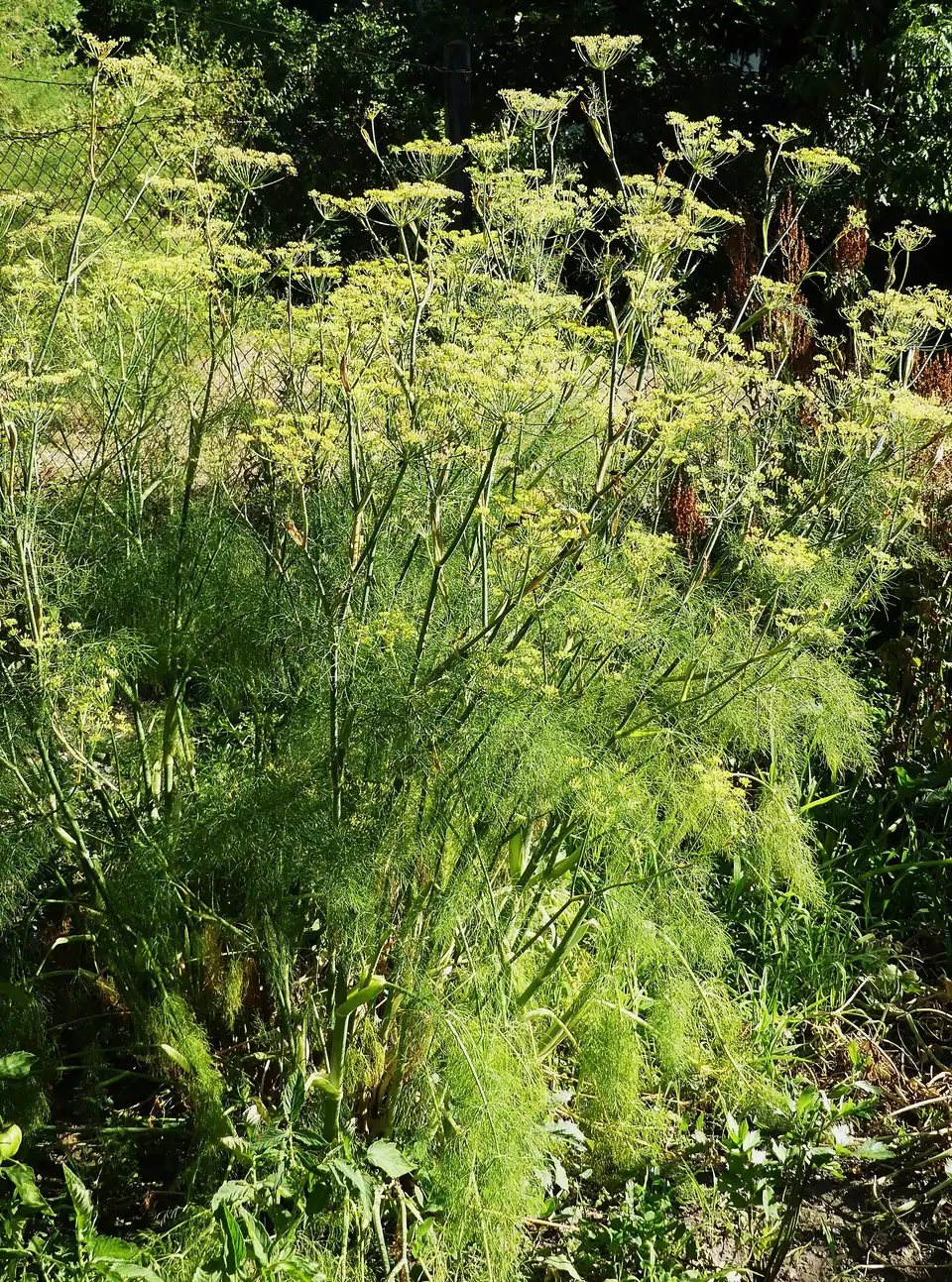


How to Grow and Care for Fennel
Foeniculum vulgare
Written by Emilio Marruso · last checked
Toxic to: People · Why
At a glance
Fennel gives you three treats from one plant: feathery leaves and stems with a light anise flavor, aromatic seeds for cakes and breads, and, with Florence fennel, a crisp edible bulb. Sow it in full sun after the last frost and cut the leaves all season long. Keep Florence fennel evenly moist, and in 3–4 months the bulbs are ready.
- Sun
Full sun
What the sources say (2)
Light: Full sun
Fennel is grown across a wide range of USDA hardiness zones and does best in moist, organically rich, well-drained soils in full sun.
— Foeniculum vulgare (Bronze Fennel, Fennel, Finocchio, Florence Fennel, Sweet Fennel) | North Carolina Extension Gardener Plant Toolbox [1] In early spring when danger of hard frost is over, sow seeds in well-worked, fertile soil in full sun, or midsummer for fall harvest.
— How to grow green fennel (Foeniculum vulgare) | Extension [3] - Water
1–2 inches of water a week; keep Florence fennel evenly moist so stems don't split
What the sources say (9)
Watering: 1 to 2 inches (2.5-5.1 cm) of water per week throughout the growing season depending on soil type; common fennel is drought tolerant once established, Florence fennel is kept evenly moist
Apply 1 to 2 inches of water per week throughout the growing season depending on soil type.
— How to Grow Fennel in Your Garden | USU [7] Once established common fennel is drought tolerant .
— Fennel, Foeniculum vulgare – Wisconsin Horticulture [2] Keep Florence fennel evenly moist, as dry conditions will promote blooming at the expense of bulb formation.
— Fennel, Foeniculum vulgare – Wisconsin Horticulture [2] Watering notes: Fluctuations between dry and wet soils may cause stems to split; root rot occurs in very wet or poorly drained soils; drip irrigation helps maintain moist soil while conserving water
Fluctuations between dry and wet soils may cause stems to split.
— How to Grow Fennel in Your Garden | USU [7] Fennel has few pest problems other than root rot in very wet soils.
— Fennel, Foeniculum vulgare – Wisconsin Horticulture [2] Drip irrigation helps maintain moist soil conditions while conserving water.
— How to Grow Fennel in Your Garden | USU [7] Drought: Common fennel is drought tolerant once established, more than Florence fennel; Florence fennel must be kept evenly moist, because dry soil promotes bolting at the expense of the bulb.
It will tolerate clay and sandy soils and, once established, drought.
— Foeniculum vulgare (Bronze Fennel, Fennel, Finocchio, Florence Fennel, Sweet Fennel) | North Carolina Extension Gardener Plant Toolbox [1] Common fennel is more drought tolerant than Florence fennel, however, allowing common fennel to wilt will negatively affect seed production.
— How to Grow Fennel in Your Garden | USU [7] Keep Florence fennel evenly moist, as dry conditions will promote blooming at the expense of bulb formation.
— Fennel, Foeniculum vulgare – Wisconsin Horticulture [2] - Cold
Survives winters down to −30 °F (−34.4 °C)
Very hardy · USDA 4a · RHS H7 · Z4
What the sources say (4)
Hardiness, coldest zone: 4a [winter low −34.4 to −31.7 °C (−30 to −25 °F)]
4a, 4b, 5a, 5b, 6a, 6b, 7a, 7b, 8a, 8b, 9a, 9b
— Foeniculum vulgare (Bronze Fennel, Fennel, Finocchio, Florence Fennel, Sweet Fennel) | North Carolina Extension Gardener Plant Toolbox [1] Fennel, Foeniculum vulgare , is a short-lived perennial hardy in zones 4a to 9b, but often grown as an annual in cooler climates .
— Fennel, Foeniculum vulgare – Wisconsin Horticulture [2] Hardiness, warmest zone: 9b [winter low −3.9 to −1.1 °C (25 to 30 °F)]
4a, 4b, 5a, 5b, 6a, 6b, 7a, 7b, 8a, 8b, 9a, 9b
— Foeniculum vulgare (Bronze Fennel, Fennel, Finocchio, Florence Fennel, Sweet Fennel) | North Carolina Extension Gardener Plant Toolbox [1] Fennel, Foeniculum vulgare , is a short-lived perennial hardy in zones 4a to 9b, but often grown as an annual in cooler climates .
— Fennel, Foeniculum vulgare – Wisconsin Horticulture [2] - Soil
Well-drained soil, pH 6.5–8.0; soggy soil rots the roots
What the sources say (4)
Soil pH, minimum: 6.5
Florence fennel prefers full sun and loamy soil, rich in organic matter with a pH of 6.5 to 8.
— How to Grow Fennel in Your Garden | USU [7] Soil pH, maximum: 8.0
Florence fennel prefers full sun and loamy soil, rich in organic matter with a pH of 6.5 to 8.
— How to Grow Fennel in Your Garden | USU [7] Diseases: stem and root rot (in poorly drained or very wet soils)
No serious insect or disease problems. Stem and root rot can occur in poorly-drained soils and aphids and slugs can be a problem.
— Foeniculum vulgare (Bronze Fennel, Fennel, Finocchio, Florence Fennel, Sweet Fennel) | North Carolina Extension Gardener Plant Toolbox [1] Fennel has few pest problems other than root rot in very wet soils.
— Fennel, Foeniculum vulgare – Wisconsin Horticulture [2] - Feeding
Feed Florence fennel every 2–3 weeks once bulbs form; too much nitrogen makes it flower early
What the sources say (4)
When: When bulbs begin to develop (Florence fennel)
When bulbs develop, apply 3 tablespoons of a nitrogen based fertilizer (21-0-0) for every 10 feet of row.
— How to Grow Fennel in Your Garden | USU [7] How often: Every 2 to 3 weeks
Fennel is a heavy feeder, so fertilize every 2 to 3 weeks with a balanced fertilizer.
— How to grow green fennel (Foeniculum vulgare) | Extension [3] Avoid: High-nitrogen fertilizers, which favor bolting
common fennel: When grown in leaner soils, plants do not grow as tall so often don’t require staking. Soil fertility affects flavor, as well, with better flavor in poor soil.
— Fennel, Foeniculum vulgare – Wisconsin Horticulture [2] To prevent fennel from bolting (going to seed too early), plant it in early spring or late summer to avoid midsummer heat. Use consistent moisture, avoid high-nitrogen fertilizers, and thin seedlings to reduce stress.
— How to Grow Fennel in Your Garden | USU [7] - Harvest
Cut leaves as needed; dig Florence bulbs at tennis-ball size, 3–4 months; seeds once heads turn brown
What the sources say (10)
Harvest: Throughout the growing season; seeds in late summer; Florence fennel bulbs dug after 3-4 months when 2-3 in (5.1-7.6 cm) in diameter
Herb fennel: Herb fennel can be harvested as needed by cutting away the feathery foliage.
— Fennel | Herbs | Illinois Extension | Illinois [8] Florence fennel (fonte: Utah State University Extension): Florence fennel should be harvested when the bulbous base is less than 4 inches across and firm to the touch.
— How to Grow Fennel in Your Garden | USU [7] Florence fennel (fonte: University of Illinois Extension): Florence fennel can be harvested when the “bulbs” are about the size of tennis balls
— Fennel | Herbs | Illinois Extension | Illinois [8] Seed (fonte: Utah State University Extension): To harvest seed, cut the seed heads after they have turned brown and store in a paper bag to allow seeds to fully dry.
— How to Grow Fennel in Your Garden | USU [7] Fennel can be harvested at any time throughout the growing season.
— How to grow green fennel (Foeniculum vulgare) | Extension [3] The stronger tasting fennel seeds can be picked in late summer, and have a flavor like aniseed or licorice.
— How to grow green fennel (Foeniculum vulgare) | Extension [3] Dig these up after 3-4 months when they have reached 2-3” in diameter.
— How to grow green fennel (Foeniculum vulgare) | Extension [3] How to harvest: Herb fennel: cut the feathery foliage as needed; for seed, cut the plant once the flower heads turn brown. Florence fennel: harvest the bulb when it is about the size of a tennis ball (less than 4 inches [10 cm] across and firm to the touch) by digging it and cutting off the root and the top.
Herb fennel can be harvested as needed by cutting away the feathery foliage. If seed is desired, allow the plant to flower and when the flower heads turn brown the plant can be cut
— Fennel | Herbs | Illinois Extension | Illinois [8] Florence fennel can be harvested when the “bulbs” are about the size of tennis balls by digging the “bulb” and cutting off the root and cutting back the top.
— Fennel | Herbs | Illinois Extension | Illinois [8] Florence fennel should be harvested when the bulbous base is less than 4 inches across and firm to the touch.
— How to Grow Fennel in Your Garden | USU [7] - Pests
Aphids, slugs, thrips and cabbage moth caterpillars; stem and root rot in wet soil
What the sources say (4)
Pests: aphids, slugs, thrips, cabbage moth larvae
No serious insect or disease problems. Stem and root rot can occur in poorly-drained soils and aphids and slugs can be a problem.
— Foeniculum vulgare (Bronze Fennel, Fennel, Finocchio, Florence Fennel, Sweet Fennel) | North Carolina Extension Gardener Plant Toolbox [1] Insects including aphids, thrips, and cabbage moth larva may cause leaf damage resulting in smaller bulbs.
— How to Grow Fennel in Your Garden | USU [7] Diseases: stem and root rot (in poorly drained or very wet soils)
No serious insect or disease problems. Stem and root rot can occur in poorly-drained soils and aphids and slugs can be a problem.
— Foeniculum vulgare (Bronze Fennel, Fennel, Finocchio, Florence Fennel, Sweet Fennel) | North Carolina Extension Gardener Plant Toolbox [1] Fennel has few pest problems other than root rot in very wet soils.
— Fennel, Foeniculum vulgare – Wisconsin Horticulture [2] - Watch out
It seeds itself freely and can escape the garden; hot, long days make Florence fennel flower early
What the sources say (2)
Propagation: Seed (direct sown or started indoors); self-seeds freely
Fennel can be grown from seed sown directly in the garden in spring and it freely self-seeds in the garden.
— Foeniculum vulgare (Bronze Fennel, Fennel, Finocchio, Florence Fennel, Sweet Fennel) | North Carolina Extension Gardener Plant Toolbox [1] Fennel is easy to grow from seed either direct sown in the garden or started indoors .
— Fennel, Foeniculum vulgare – Wisconsin Horticulture [2] - Size
18 in to 3 ft 3 in wide
What the sources say (1)
Mature width: 46-99 cm (1 ft 6 in to 3 ft 3 in)
Dimensions: Height: 4 ft. 0 in. - 6 ft. 0 in. Width: 1 ft. 6 in. - 3 ft. 3 in.
— Foeniculum vulgare (Bronze Fennel, Fennel, Finocchio, Florence Fennel, Sweet Fennel) | North Carolina Extension Gardener Plant Toolbox [1] - Propagation
By seed, sown in place or started indoors; it doesn't like being transplanted
What the sources say (5)
Propagation: Seed (direct sown or started indoors); self-seeds freely
Fennel can be grown from seed sown directly in the garden in spring and it freely self-seeds in the garden.
— Foeniculum vulgare (Bronze Fennel, Fennel, Finocchio, Florence Fennel, Sweet Fennel) | North Carolina Extension Gardener Plant Toolbox [1] Fennel is easy to grow from seed either direct sown in the garden or started indoors .
— Fennel, Foeniculum vulgare – Wisconsin Horticulture [2] Root system: Deep, large white taproot; for this reason it does better in the ground than in containers and does not transplant well.
Fennel can be grown in large containers but typically does better in the ground because of its deep taproot.
— Fennel, Foeniculum vulgare – Wisconsin Horticulture [2] Plants produce a deep, large white tap root.
— Fennel, Foeniculum vulgare – Wisconsin Horticulture [2] It does not transplant well due to its tap root structure.
— Fennel | Herbs | Illinois Extension | Illinois [8] - Sowing
Sow after the last frost, 1/4 inch deep; sprouts in 7–30 days in 61 °F (16 °C) soil
What the sources say (11)
Sowing: After the last frost in spring (herb fennel direct sown in spring once frost is past); mid-summer for a fall crop of Florence fennel (mid-June to July); can be started indoors 4 to 6 weeks before the last spring frost
Herb fennel: Herb fennel is best direct sown in the garden in the spring after frost is past.
— Fennel | Herbs | Illinois Extension | Illinois [8] Florence fennel: Florence fennel is also direct sown into the garden but seeding is best done from mid-June to July.
— Fennel | Herbs | Illinois Extension | Illinois [8] According to University of Wisconsin Extension: Sow seeds about ¼ inch deep after the last frost in spring, or in mid-summer for a fall crop of Florence fennel.
— Fennel, Foeniculum vulgare – Wisconsin Horticulture [2] According to University of New Hampshire Extension: In early spring when danger of hard frost is over, sow seeds in well-worked, fertile soil in full sun, or midsummer for fall harvest.
— How to grow green fennel (Foeniculum vulgare) | Extension [3] after the last frost in spring, or in mid-summer for a fall crop of Florence fennel.
— Fennel, Foeniculum vulgare – Wisconsin Horticulture [2] Florence fennel is also direct sown into the garden but seeding is best done from mid-June to July.
— Fennel | Herbs | Illinois Extension | Illinois [8] Plants can be started indoors 4 to 6 weeks before the last spring frost.
— Fennel, Foeniculum vulgare – Wisconsin Horticulture [2] Sowing depth: 0.6 cm (1/4 inch), up to 1.3 cm (1/2 inch)
Sow seeds about ¼ inch deep after the last frost in spring, or in mid-summer for a fall crop of Florence fennel.
— Fennel, Foeniculum vulgare – Wisconsin Horticulture [2] Plant seeds 1/4 inch deep when soil temperatures are between 50- 75 °F.
— How to Grow Fennel in Your Garden | USU [7] Space seeds 4-5” apart in rows 10- 12” apart and cover seed ¼-1/2” deep.
— How to grow green fennel (Foeniculum vulgare) | Extension [3] Germination: Soil temperature 16 °C [61 °F]; seed germinates in 7-30 days, sown 0.6-1.3 cm [0.2–0.5 in] deep.
Planting Depth ¼-1/2 inch Soil Temperature 60℉ Germination 7-30 days Plant Spacing 10-12 inches
— How to grow green fennel (Foeniculum vulgare) | Extension [3] - Containers
Grows in containers, but its deep taproot does better in the ground
What the sources say (4)
In containers: Yes
Fennel can be grown in large containers but typically does better in the ground because of its deep taproot.
— Fennel, Foeniculum vulgare – Wisconsin Horticulture [2] Root system: Deep, large white taproot; for this reason it does better in the ground than in containers and does not transplant well.
Fennel can be grown in large containers but typically does better in the ground because of its deep taproot.
— Fennel, Foeniculum vulgare – Wisconsin Horticulture [2] Plants produce a deep, large white tap root.
— Fennel, Foeniculum vulgare – Wisconsin Horticulture [2] It does not transplant well due to its tap root structure.
— Fennel | Herbs | Illinois Extension | Illinois [8] - Safety
Safe for cats, dogs and horses; the sap can irritate sensitive skin in sunlight
Overview
Fennel is an herbaceous perennial, normally grown as an annual, with leaves and flowers that have a sweet, mildly anise flavor. [1] It does best in full sun and well-drained soil and tolerates drought once established. [1] The plant sap can cause skin irritation in sensitive individuals, especially in sunlight. [2]
Fennel care
How to water Fennel
Watering
1 to 2 inches (2.5-5.1 cm) of water per week throughout the growing season depending on soil type; common fennel is drought tolerant once established, Florence fennel is kept evenly moist
What the sources say (3)
Apply 1 to 2 inches of water per week throughout the growing season depending on soil type.Once established common fennel is drought tolerant .Keep Florence fennel evenly moist, as dry conditions will promote blooming at the expense of bulb formation.Watering notes
Fluctuations between dry and wet soils may cause stems to split; root rot occurs in very wet or poorly drained soils; drip irrigation helps maintain moist soil while conserving water
What the sources say (3)
Fluctuations between dry and wet soils may cause stems to split.Fennel has few pest problems other than root rot in very wet soils.Drip irrigation helps maintain moist soil conditions while conserving water.How much light Fennel needs
Full sun
What the sources say (2)
Fennel is grown across a wide range of USDA hardiness zones and does best in moist, organically rich, well-drained soils in full sun.In early spring when danger of hard frost is over, sow seeds in well-worked, fertile soil in full sun, or midsummer for fall harvest.How much cold Fennel can take
Hardiness, coldest zone
4a [winter low −34.4 to −31.7 °C (−30 to −25 °F)]
What the sources say (2)
4a, 4b, 5a, 5b, 6a, 6b, 7a, 7b, 8a, 8b, 9a, 9bFennel, Foeniculum vulgare , is a short-lived perennial hardy in zones 4a to 9b, but often grown as an annual in cooler climates .Hardiness, warmest zone
9b [winter low −3.9 to −1.1 °C (25 to 30 °F)]
What the sources say (2)
4a, 4b, 5a, 5b, 6a, 6b, 7a, 7b, 8a, 8b, 9a, 9bFennel, Foeniculum vulgare , is a short-lived perennial hardy in zones 4a to 9b, but often grown as an annual in cooler climates .Best soil for Fennel
Soil pH, minimum
6.5
What the sources say (1)
Florence fennel prefers full sun and loamy soil, rich in organic matter with a pH of 6.5 to 8.Soil pH, maximum
8.0
What the sources say (1)
Florence fennel prefers full sun and loamy soil, rich in organic matter with a pH of 6.5 to 8.Where to grow Fennel
In containers
Yes
What the sources say (1)
Fennel can be grown in large containers but typically does better in the ground because of its deep taproot.Spacing
The sources give different values depending on region, zone or growing conditions.
What each source says
According to University of New Hampshire Extension: 25.4-30.5 cm (10-12 in) apart (seedlings thinned)
Florence fennel (fonte: Utah State University Extension): 20.3-30.5 cm (8-12 in) apart after bulbing begins
According to University of Wisconsin Extension: 10.2-15.2 cm (4-6 in) apart (direct sown, thinned)
What the sources say (3)
According to University of New Hampshire Extension: Carefully thin when seedlings are about 1” tall, to stand 10-12” apart so bulbs have room to grow and mature.Florence fennel (fonte: Utah State University Extension): After plants begin to bulb, thin Florence fennel to 8-12 inches apart.According to University of Wisconsin Extension: Thin plants to 4 to 6 inches apart when they reach 1 to 2 inches tall when direct sown.How to propagate Fennel
Seed (direct sown or started indoors); self-seeds freely
What the sources say (2)
Fennel can be grown from seed sown directly in the garden in spring and it freely self-seeds in the garden.Fennel is easy to grow from seed either direct sown in the garden or started indoors .How to grow Fennel
The plant
Life cycle
perennial (short-lived; often grown as an annual)
What the sources say (2)
Fennel is an evergreen, herbaceous perennial, normally grown as an annual, with flowers and leaves that have a sweet, mildly anise or licorice flavor.Fennel, Foeniculum vulgare , is a short-lived perennial hardy in zones 4a to 9b, but often grown as an annual in cooler climatesFamily
Apiaceae
What the sources say (2)
Genus: Foeniculum Species: vulgare Family: Apiaceae Uses (Ethnobotany): Shoots can be used to make a yellow dye.Native to southern Europe along the Mediterranean Sea, this plant in the carrot family (Apiaceae) has sweetly aromatic foliage and flavor similar to anise.Mature height
Mature width
46-99 cm (1 ft 6 in to 3 ft 3 in)
What the sources say (1)
Dimensions: Height: 4 ft. 0 in. - 6 ft. 0 in. Width: 1 ft. 6 in. - 3 ft. 3 in.Sowing and growth
Days to germination
The sources disagree:
Seed typically germinates in 1 to 2 weeks. Thin plants to 4 to 6 inches apart when they reach 1 to 2 inches tall when direct sown.
[2]Profile Planting Depth ¼-1/2 inch Soil Temperature 60℉ Germination 7-30 days Plant Spacing 10-12 inches
[3]Space seeds 4-6 inches apart in the row with rows 18 inches apart. Seeds usually germinate in 7- 10 days.
[7]
Sowing depth
0.6 cm (1/4 inch), up to 1.3 cm (1/2 inch)
What the sources say (3)
Sow seeds about ¼ inch deep after the last frost in spring, or in mid-summer for a fall crop of Florence fennel.Plant seeds 1/4 inch deep when soil temperatures are between 50- 75 °F.Space seeds 4-5” apart in rows 10- 12” apart and cover seed ¼-1/2” deep.Row spacing
Harvest and storage
How to harvest
Herb fennel: cut the feathery foliage as needed; for seed, cut the plant once the flower heads turn brown. Florence fennel: harvest the bulb when it is about the size of a tennis ball (less than 4 inches [10 cm] across and firm to the touch) by digging it and cutting off the root and the top.
What the sources say (3)
Herb fennel can be harvested as needed by cutting away the feathery foliage. If seed is desired, allow the plant to flower and when the flower heads turn brown the plant can be cutFlorence fennel can be harvested when the “bulbs” are about the size of tennis balls by digging the “bulb” and cutting off the root and cutting back the top.Florence fennel should be harvested when the bulbous base is less than 4 inches across and firm to the touch.Storage
Florence fennel bulbs keep for several weeks in a cool location; dried seed is stored in a moisture-proof container.
Saving seeds
Cut the seed heads after they have turned brown, put them in a paper bag (hung in a cool, well-ventilated area) so the seeds dry fully and drop into the bag, then clean and store the dried seeds in a moisture-proof container.
What the sources say (2)
To harvest seed, cut the seed heads after they have turned brown and store in a paper bag to allow seeds to fully dry. Store the dried seeds in a moisture proof container.place in a paper bag and hung in a cool, well-ventilated area to dry. Seeds will drop down into the bag and can then be cleaned and stored.Pests and diseases
Pests
aphids, slugs, thrips, cabbage moth larvae
What the sources say (2)
No serious insect or disease problems. Stem and root rot can occur in poorly-drained soils and aphids and slugs can be a problem.Insects including aphids, thrips, and cabbage moth larva may cause leaf damage resulting in smaller bulbs.Diseases
stem and root rot (in poorly drained or very wet soils)
What the sources say (2)
No serious insect or disease problems. Stem and root rot can occur in poorly-drained soils and aphids and slugs can be a problem.Fennel has few pest problems other than root rot in very wet soils.Fertilizing
When
When bulbs begin to develop (Florence fennel)
What the sources say (1)
When bulbs develop, apply 3 tablespoons of a nitrogen based fertilizer (21-0-0) for every 10 feet of row.How often
Every 2 to 3 weeks
What the sources say (1)
Fennel is a heavy feeder, so fertilize every 2 to 3 weeks with a balanced fertilizer.Natural fertilizers
Compost; before planting no more than 2.54 cm [1 in] of well-composted organic matter per 9.29 m²
What the sources say (2)
Most soils in Utah are suitable for growing fennel but plants benefit from added compost.If you fertilize with compost, apply no more than 1 inch of wellcomposted organic matter per 100 square feet of garden area.Mineral fertilizers
Balanced fertilizer; when bulbs develop, nitrogen fertilizer 21-0-0 at 44.4 mL per 3.05 m [10 ft] of row; phosphorus and potassium only as the soil test indicates
What the sources say (2)
Fennel is a heavy feeder, so fertilize every 2 to 3 weeks with a balanced fertilizer.When bulbs develop, apply 3 tablespoons of a nitrogen based fertilizer (21-0-0) for every 10 feet of row. Fennel requires moderate amounts of nitrogen but has low phosphorus and potassium requirements.Avoid
High-nitrogen fertilizers, which favor bolting
What each source says
common fennel: Rich soil: plants grow taller and flavor is better in poor soil
What the sources say (2)
common fennel: When grown in leaner soils, plants do not grow as tall so often don’t require staking. Soil fertility affects flavor, as well, with better flavor in poor soil.To prevent fennel from bolting (going to seed too early), plant it in early spring or late summer to avoid midsummer heat. Use consistent moisture, avoid high-nitrogen fertilizers, and thin seedlings to reduce stress.Signs of deficiency
Small bulbs on nutrient-stressed plants (Florence fennel)
What the sources say (1)
Plants maturing during summer heat generally do not develop well. Plants that are water or nutrient stressed produce small bulbous bases as well.Spacing
Between plants
The sources give different values depending on region, zone or growing conditions.
What each source says
direct sown, thinning: Thin to 10-15 cm [3.9–5.9 in] apart when seedlings are 2.5-5 cm [1–2 in] tall
green fennel, final spacing: Thin to 25-30 cm [10–12 in] apart so bulbs have room to grow
Florence fennel, after bulbing starts: Thin to 20-30 cm [8–12 in] apart
sowing: Seeds 10-15 cm [3.9–5.9 in] apart in the row
What the sources say (4)
direct sown, thinning: Thin plants to 4 to 6 inches apart when they reach 1 to 2 inches tall when direct sown.green fennel, final spacing: Carefully thin when seedlings are about 1” tall, to stand 10-12” apart so bulbs have room to grow and mature.Florence fennel, after bulbing starts: After plants begin to bulb, thin Florence fennel to 8-12 inches apart.sowing: Space seeds 4-6 inches apart in the row with rows 18 inches apart.Between rows
The sources give different values depending on region, zone or growing conditions.
What each source says
green fennel: 25-30 cm [10–12 in] between rows
fennel in the garden (Utah): 46 cm [18 in] between rows
What the sources say (2)
green fennel: Space seeds 4-5” apart in rows 10- 12” apart and cover seed ¼-1/2” deep.fennel in the garden (Utah): Space seeds 4-6 inches apart in the row with rows 18 inches apart.Roots
Root system
Deep, large white taproot; for this reason it does better in the ground than in containers and does not transplant well.
What the sources say (3)
Fennel can be grown in large containers but typically does better in the ground because of its deep taproot.Plants produce a deep, large white tap root.It does not transplant well due to its tap root structure.Propagation
Germination
Soil temperature 16 °C [61 °F]; seed germinates in 7-30 days, sown 0.6-1.3 cm [0.2–0.5 in] deep.
What the sources say (1)
Planting Depth ¼-1/2 inch Soil Temperature 60℉ Germination 7-30 days Plant Spacing 10-12 inchesAfter harvest
Storage
Bulbs keep for several weeks in a cool place; dried seed is stored in a moisture-proof container.
Heat and drought
Heat
Florence fennel grows best in cool temperatures: in hot weather it becomes woody and may bolt, and hot summers with long days accelerate bolting; plants maturing in summer heat develop poorly.
What the sources say (3)
Florence fennel grows best in cooler temperatures, becomes woody and may bolt when temperatures become hot.Hot summer temperatures and long days accelerate bolting so select newer “slow bolting” varieties.Plants maturing during summer heat generally do not develop well.Drought
Common fennel is drought tolerant once established, more than Florence fennel; Florence fennel must be kept evenly moist, because dry soil promotes bolting at the expense of the bulb.
What the sources say (3)
It will tolerate clay and sandy soils and, once established, drought.Common fennel is more drought tolerant than Florence fennel, however, allowing common fennel to wilt will negatively affect seed production.Keep Florence fennel evenly moist, as dry conditions will promote blooming at the expense of bulb formation.Fennel pests and problems
Bolting
Symptom: Florence fennel flowers early when growth is stressed by lack of water or damage to plants or roots; hot summer temperatures and long days accelerate it.
What to do: Select newer slow bolting varieties.
What the sources say (1)
Florence fennel is susceptible to bolting if growth is stressed by lack of water or damage occurs to plants or roots.
— How to Grow Fennel in Your Garden | USU [7] Stem splitting
Symptom: Stems split when soil fluctuates between dry and wet.
What to do: Water Florence fennel regularly and do not allow the soil to dry out between irrigation events.
What the sources say (1)
Water Florence fennel regularly and do not allow the soil to dry out between irrigation events.
— How to Grow Fennel in Your Garden | USU [7] Aphids and thrips
Symptom: Insects including aphids, thrips, and cabbage moth larva may cause leaf damage resulting in smaller bulbs.
What to do: Control of insects is best achieved through proper application of insecticidal soaps or other appropriate insecticides.
What the sources say (1)
Insects including aphids, thrips, and cabbage moth larva may cause leaf damage resulting in smaller bulbs.
— How to Grow Fennel in Your Garden | USU [7] Stem and root rot
Symptom: Stem and root rot can occur in poorly-drained soils.
What the sources say (1)
Stem and root rot can occur in poorly-drained soils and aphids and slugs can be a problem.
— Foeniculum vulgare (Bronze Fennel, Fennel, Finocchio, Florence Fennel, Sweet Fennel) | North Carolina Extension Gardener Plant Toolbox [1] Unwanted self-seeding
Symptom: Plants freely self-seed and have escaped gardens and naturalized.
What to do: Remove spent flowers and stems before seed is produced.
What the sources say (1)
Fennel plants are know to have escaped gardens and naturalized.
— Foeniculum vulgare (Bronze Fennel, Fennel, Finocchio, Florence Fennel, Sweet Fennel) | North Carolina Extension Gardener Plant Toolbox [1]
Remedies
Each remedy shows what official sources say about it; traditional remedies without an official source are marked as such. Harmful ones are listed so you know to avoid them.
Treating the plant
aphids
insecticidal soap spray Works
spraying home remedies that contain dish detergent on plants on a sunny day can injure the plant, essentially burning it.
— extension.psu.edu [10] Most dish soaps are not naturally occurring substances nor are they biodegradable. They can contain detergents and degreasers that are harmful to groundwater and aquatic and soil organisms.
— ucanr.edu [11] How: Applications of insecticidal soap will control the aphid population sufficiently; only severe infestations of aphids warrant control with insecticide.
Only severe infestations of aphids warrant control with insecticide. Usually applications of insecticidal soap or strong jets of water will control the aphid population sufficiently.
— gardeningknowhow.com [9] What the evidence says Control of insects is best achieved through proper application of insecticidal soaps or other appropriate insecticides. Always apply insecticides according to label directions.
— How to Grow Fennel in Your Garden | USU [7] strong jet of water Not verified
Traditional remedy, not verified by an official source.
How: A strong stream of water from the hose knocks aphids off the plant; repeat every few days to keep them under control.
neem oil spray Partly works
How: Mix 1-2 teaspoons of neem oil with a few drops of mild soap and 1 liter of water; spray in the early morning or evening.
Mix 1–2 teaspoons of neem oil with a few drops of mild soap and 1 liter of water.
— dailyzerna.com [12] What the evidence says However, neem oil is not effective against every insect and disease, and often must be frequently reapplied to reach the desired outcome.
— extension.unh.edu [13]
caterpillars
hand-picking Not verified
Traditional remedy, not verified by an official source.
How: Remove caterpillars or beetles by hand and drop them in a bucket of soapy water.
cutworms
seedling collar Not verified
Traditional remedy, not verified by an official source.
How: Use a plastic or foil collar fitted around the seedling stem and pushed down 3 inches (8 cm) into the soil to protect young plants.
diatomaceous earth Not verified
Traditional remedy, not verified by an official source.
How: Hand pick larvae after dark and spread diatomaceous earth around the base of plants.
root-knot nematodes
soil solarization Not verified
Traditional remedy, not verified by an official source.
How: If nematodes are known to be present in the soil, solarize the soil to reduce the population as well as pathogens which may cause fennel disease.
unwanted self-seeding
deadhead Works
How: Remove spent flowers and stems before seed is produced.
To prevent an unwanted spread of this plant through self-seeding, you should remove spent flowers and stems before seed is produced.
— Foeniculum vulgare (Bronze Fennel, Fennel, Finocchio, Florence Fennel, Sweet Fennel) | North Carolina Extension Gardener Plant Toolbox [1] What the evidence says In cooler climates it is better behaved and rarely escapes cultivation. Deadhead the plants to prevent unwanted reseeding, if desired
— Fennel, Foeniculum vulgare – Wisconsin Horticulture [2]
Getting rid of it
wild fennel infestation
black plastic cover Partly works
How: Trim the fennel down as far as you can go, removing all the material and composting it, then cover it with plastic secured with staples; remove any shoots that pop up, secure the barrier again, and wait.
Even in a tricky place like under a fence, plastic can be used to eradicate fennel organically.
— sfbaygardening.com [14] What the evidence says Be cautious about the weed barrier material used because items such as plastic shower curtains or old tarps are good barriers but can be difficult to work with later when it is time to rework the site.
— extension.usu.edu [15] pulling new sprouts Works
How: The cover method takes care of old plants but does not stop new sprouts: pull them out of the ground as soon as you see them.
While this method will take care of those old-growth fennel monsters, it does not stop new sprouts. Be sure to tear those invasive jerk babies out of the ground as soon as you see them.
— sfbaygardening.com [14] What the evidence says Regularly pulling, hoeing or mowing weeds and encouraging grass to grow and out-compete the weeds is an excellent solution.
— extension.usu.edu [15]
Is Fennel poisonous?
Reported by the source, quoted verbatim. This is not medical or veterinary advice: if a person or an animal may have eaten this plant, contact a poison control centre or a veterinarian.
Animals
non-toxic for cats #non-toxic for horses #non-toxic for dogs
[1]The source flags the risk for this animal but does not explain why.
People
Calendar
Sowing
After the last frost in spring (herb fennel direct sown in spring once frost is past); mid-summer for a fall crop of Florence fennel (mid-June to July); can be started indoors 4 to 6 weeks before the last spring frost
What each source says
Herb fennel: Direct sown in spring after frost is past
Florence fennel: Mid-June to July
According to University of Wisconsin Extension: After the last frost in spring, or in mid-summer for a fall crop of Florence fennel
According to University of New Hampshire Extension: Early spring when danger of hard frost is over, or midsummer for fall harvest
What the sources say (7)
Herb fennel: Herb fennel is best direct sown in the garden in the spring after frost is past.Florence fennel: Florence fennel is also direct sown into the garden but seeding is best done from mid-June to July.According to University of Wisconsin Extension: Sow seeds about ¼ inch deep after the last frost in spring, or in mid-summer for a fall crop of Florence fennel.According to University of New Hampshire Extension: In early spring when danger of hard frost is over, sow seeds in well-worked, fertile soil in full sun, or midsummer for fall harvest.after the last frost in spring, or in mid-summer for a fall crop of Florence fennel.Florence fennel is also direct sown into the garden but seeding is best done from mid-June to July.Plants can be started indoors 4 to 6 weeks before the last spring frost.Planting
The sources disagree:
Harvest
Throughout the growing season; seeds in late summer; Florence fennel bulbs dug after 3-4 months when 2-3 in (5.1-7.6 cm) in diameter
What each source says
Herb fennel: As needed, by cutting away the feathery foliage
Florence fennel (fonte: Utah State University Extension): When the bulbous base is less than 10.2 cm (4 in) across and firm to the touch
Florence fennel (fonte: University of Illinois Extension): When the bulbs are about the size of tennis balls
Seed (fonte: Utah State University Extension): After the seed heads have turned brown
What the sources say (7)
Herb fennel: Herb fennel can be harvested as needed by cutting away the feathery foliage.Florence fennel (fonte: Utah State University Extension): Florence fennel should be harvested when the bulbous base is less than 4 inches across and firm to the touch.Florence fennel (fonte: University of Illinois Extension): Florence fennel can be harvested when the “bulbs” are about the size of tennis ballsSeed (fonte: Utah State University Extension): To harvest seed, cut the seed heads after they have turned brown and store in a paper bag to allow seeds to fully dry.Fennel can be harvested at any time throughout the growing season.The stronger tasting fennel seeds can be picked in late summer, and have a flavor like aniseed or licorice.Dig these up after 3-4 months when they have reached 2-3” in diameter.Pruning
Under review: our second check questioned this value.
Months as given by the sources, which are mostly from the United States (northern hemisphere). In the southern hemisphere they shift by about six months.
Relative to frost
Less precise estimate: there is no weather station within 300 km.
Find frost dates by ZIP code or city
Sow indoors: 4 to 6 weeks before the last frost
Plants can be started indoors 4 to 6 weeks before the last spring frost.
— Fennel, Foeniculum vulgare – Wisconsin Horticulture [2] Sow outdoors: around the last frost
Sow seeds about ¼ inch deep after the last frost in spring, or in mid-summer for a fall crop of Florence fennel.
— Fennel, Foeniculum vulgare – Wisconsin Horticulture [2]
Count from the average frost dates where you live.
Edibility
Reported by the source, quoted verbatim. Do not eat a plant on the basis of this page alone: identification mistakes can be dangerous.
Both the leaves and the stems are edible, with a light anise flavor.
[2]The aromatic seeds are also put to use in cakes and breads.
[1]Florence fennel (also called bulbing fennel) is grown for its crisp, edible bulb and thick stalks, while common fennel is typically grown for its aromatic leaves and seeds.
[7]
Indicative values
Values from a secondary source, not checked word for word like the rest of this page. Use them as a starting point.
- Hours of sun
- 6-8 hoursIndicative value, adapt it to your climate · Secondary source
- Drought tolerant
- yesIndicative value, adapt it to your climate · Secondary source
- Soil
- Well-drainedIndicative value, adapt it to your climate · Secondary source
- Care level
- MediumIndicative value, adapt it to your climate · Secondary source
- Growth rate
- HighIndicative value, adapt it to your climate · Secondary source
Similar plants
- Foeniculum piperitum Foeniculum piperitum
- Alexanders Smyrnium olusatrum
- Amethyst eryngo Eryngium amethystinum
- Angelica Angelica archangelica
- Anise burnet saxifrage Pimpinella anisum
- Appalachian Angelica Angelica triquinata
- Asiatic pennywort Centella asiatica
- Bishop's Weed Ammi majus
Sources
Every value above is quoted from these documents. Links lead to the original publisher.
- Foeniculum vulgare (Bronze Fennel, Fennel, Finocchio, Florence Fennel, Sweet Fennel) | North Carolina Extension Gardener Plant Toolbox · plants.ces.ncsu.edu, consulted
- Fennel, Foeniculum vulgare – Wisconsin Horticulture · hort.extension.wisc.edu, consulted
- How to grow green fennel (Foeniculum vulgare) | Extension · extension.unh.edu, consulted
- Common Fennel (Foeniculum vulgare) | WSU Extension Publications | Washington State University · pubs.extension.wsu.edu, consulted
- Florence Fennel - Foeniculum vulgare | North Carolina Extension Gardener Plant Toolbox · plants.ces.ncsu.edu, consulted
- Finocchio - Foeniculum vulgare | North Carolina Extension Gardener Plant Toolbox · plants.ces.ncsu.edu, consulted
- How to Grow Fennel in Your Garden | USU · extension.usu.edu, consulted
- Fennel | Herbs | Illinois Extension | Illinois · extension.illinois.edu, consulted
- gardeningknowhow.com · gardeningknowhow.com
- extension.psu.edu · extension.psu.edu
- ucanr.edu · ucanr.edu
- dailyzerna.com · dailyzerna.com
- extension.unh.edu · extension.unh.edu
- sfbaygardening.com · sfbaygardening.com
- extension.usu.edu · extension.usu.edu
Written by Emilio Marruso · last checked