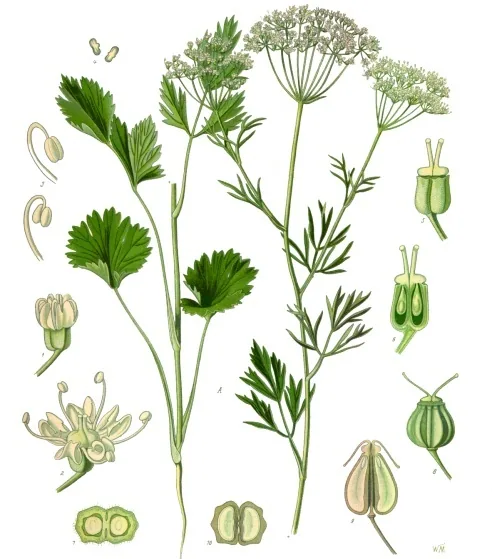

How to Grow and Care for Anise burnet saxifrage
Pimpinella anisum
Written by Emilio Marruso · last checked
At a glance
Anise is a sunny little annual that gives you two treats from one plant. Crush its seeds to season cakes, cookies, bread, pastries, fruit dishes and cheeses, and use the leaves to garnish dishes or add them to soups, sauces and salads. Give it full sun and start it from seed.
- Sun
Full sun
What the sources say (1)
Light: Full sun
Full sun (6 or more hours of direct sunlight a day)
— Pimpinella anisum (Anise, Aniseed) | North Carolina Extension Gardener Plant Toolbox [1] - Harvest
Crushed seeds flavor cakes, cookies and bread; leaves go in soups, sauces and salads
- Propagation
Grow it from seed
What the sources say (1)
Propagation: Seed
Recommended Propagation Strategy: Seed Country Or Region Of Origin: Egypt, middle east
— Pimpinella anisum (Anise, Aniseed) | North Carolina Extension Gardener Plant Toolbox [1]
Overview
Anise is an annual herb in the parsley family used as a flavoring. [1] It is propagated by seed. [1]
This record is incomplete: the sources we read do not cover every field yet.
Not yet covered by our sources: Watering, Sowing / Planting, Harvest
Anise burnet saxifrage care
How to water Anise burnet saxifrage
Not stated in the sources we read.
How much light Anise burnet saxifrage needs
Full sun
What the sources say (1)
Full sun (6 or more hours of direct sunlight a day)How to propagate Anise burnet saxifrage
Seed
What the sources say (1)
Recommended Propagation Strategy:
Seed
Country Or Region Of Origin:
Egypt, middle eastHow to grow Anise burnet saxifrage
The plant
Life cycle
annual
What the sources say (1)
Family:
Apiaceae
Uses (Ethnobotany):
Flavoring, seasoning
Life Cycle:
AnnualFamily
Apiaceae
What the sources say (1)
Genus:
Pimpinella
Species:
anisum
Family:
Apiaceae
Uses (Ethnobotany):
Flavoring, seasoningRemedies
Each remedy shows what official sources say about it; traditional remedies without an official source are marked as such. Harmful ones are listed so you know to avoid them.
Treating the plant
aphids
strong jet of water Official source, not independently tested
How: Sturdy plants can be sprayed with a strong jet of water to knock aphids from the leaves.
sturdy plants can be sprayed with a strong jet of water to knock aphids from leaves
— plantvillage.psu.edu [3] pruning out infested shoots Official source, not independently tested
How: If the aphid population is limited to a few leaves or shoots, the infestation can be pruned out.
If aphid population is limited to just a few leaves or shoots then the infestation can be pruned out to provide control
— plantvillage.psu.edu [3] insecticidal soap Works
always check the labels of the products for specific usage guidelines prior to use
— plantvillage.psu.edu [3] How: Insecticidal soaps or oils such as neem or canola oil are described as usually the best method of control; check the product label for usage guidelines.
insecticidal soaps or oils such as neem or canola oil are usually the best method of control; always check the labels of the products for specific usage guidelines prior to use
— plantvillage.psu.edu [3] What the evidence says For example, insecticidal soap is a safe, effective organic insecticide with minimal environmental impact.
— extension.psu.edu [4] neem oil Works
Despite these being biological pesticides, it is important to read the directions on the label and wear safety equipment.
— extension.illinois.edu [5] How: Neem or canola oil are named among the oils usually considered the best method of control; check the product label for usage guidelines.
insecticidal soaps or oils such as neem or canola oil are usually the best method of control; always check the labels of the products for specific usage guidelines prior to use
— plantvillage.psu.edu [3] What the evidence says Neem oil is found in the seeds of the neem tree. The active component found in this biological pesticide reduces insect feeding, interferes with hormones -- making it hard to grow or lay eggs -- and acts as a repellent.
— extension.illinois.edu [5]
cutworms
collars around the stems Official source, not independently tested
How: Plastic or foil collars fitted around the stems, covering the bottom 3 inches above the soil line and reaching a couple of inches into the soil, prevent larvae severing plants.
plastic or foil collars fitted around plant stems to cover the bottom 3 inches above the soil line and extending a couple of inches into the soil can prevent larvae severing plants
— plantvillage.psu.edu [3] hand-picking larvae after dark Official source, not independently tested
How: Pick the larvae off by hand after dark.
can prevent larvae severing plants; hand-pick larvae after dark; spread diatomaceous earth around the base of the plants
— plantvillage.psu.edu [3] diatomaceous earth barrier Official source, not independently tested
How: Spread diatomaceous earth around the base of the plants: it creates a sharp barrier that cuts the insects if they try to crawl over it.
spread diatomaceous earth around the base of the plants (this creates a sharp barrier that will cut the insects if they try and crawl over it)
— plantvillage.psu.edu [3]
alternaria blight
hot water seed treatment Official source, not independently tested
How: Treat seeds with hot water before planting, keep plants well watered, and remove and destroy the plant if the disease appears.
Treat seeds with hot water prior to planting; prevent disease by keeping plants well watered; if disease emerges remove and destroy plant
— plantvillage.psu.edu [3]
Calendar
Sowing
Not stated in the sources we read.
Planting
Not stated in the sources we read.
Harvest
Not stated in the sources we read.
Months as given by the sources, which are mostly from the United States (northern hemisphere). In the southern hemisphere they shift by about six months.
Edibility
Reported by the source, quoted verbatim. Do not eat a plant on the basis of this page alone: identification mistakes can be dangerous.
Similar plants
- Alexanders Smyrnium olusatrum
- Angelica Angelica archangelica
- Asiatic pennywort Centella asiatica
- Caraway Carum carvi
- Coriander Coriandrum sativum
- Cow Parsley Anthriscus sylvestris
- Cumin Cuminum cyminum
- Fennel Foeniculum vulgare
Sources
Every value above is quoted from these documents. Links lead to the original publisher.
- Pimpinella anisum (Anise, Aniseed) | North Carolina Extension Gardener Plant Toolbox · plants.ces.ncsu.edu, consulted
- Anise hyssop, Agastache foeniculum – Wisconsin Horticulture · hort.extension.wisc.edu, consulted
- plantvillage.psu.edu · plantvillage.psu.edu
- extension.psu.edu · extension.psu.edu
- extension.illinois.edu · extension.illinois.edu
Written by Emilio Marruso · last checked