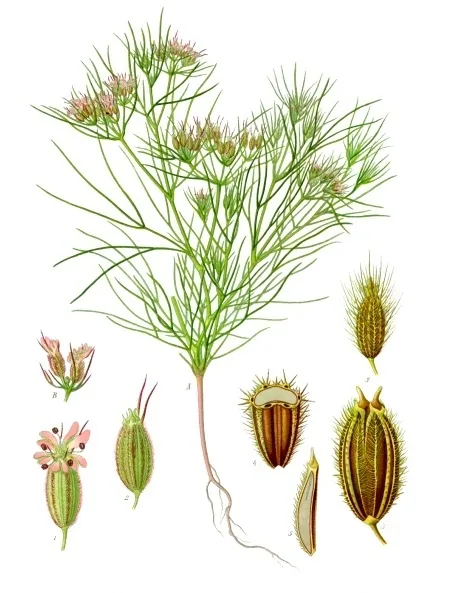


How to Grow and Care for Cumin
Cuminum cyminum
Written by Emilio Marruso · last checked
At a glance
Cumin lets you grow a popular spice in your own garden: its seeds flavor stews, whole or ground. Give it full sun, at least 6 hours a day, and 120 days of frost-free weather from planting to harvest. Start the seeds indoors 6 to 8 weeks before the last frost, then cut the stems once the flower clusters turn dry and brown.
- Sun
Full sun: at least 6 hours a day
What the sources say (1)
Light: Full sun (6 or more hours of direct sunlight a day)
Light: Full sun (6 or more hours of direct sunlight a day)
— Cuminum cyminum (Cumin, Cummin, Jeera) | North Carolina Extension Gardener Plant Toolbox [1] - Water
Let the soil get almost dry, then soak it well
What the sources say (1)
Watering: Water regularly, allowing soil to go almost dry between waterings, then soak thoroughly
Water the plants regularly, allowing soil to go almost dry between watering, then soak thoroughly.
— Cuminum cyminum (Cumin, Cummin, Jeera) | North Carolina Extension Gardener Plant Toolbox [1] - Cold
Survives winters down to −20 °F (−28.9 °C)
Very hardy · USDA 5a · RHS H7 · Z5
What the sources say (2)
Hardiness, coldest zone: 5a [winter low −28.9 to −26.1 °C (−20 to −15 °F)]
Available Space To Plant: Less than 12 inches NC Region: Coastal Mountains Piedmont USDA Plant Hardiness Zone: 5a, 5b, 6a, 6b, 7a, 7b, 8a, 8b, 9a, 9b, 10a, 10b
— Cuminum cyminum (Cumin, Cummin, Jeera) | North Carolina Extension Gardener Plant Toolbox [1] Hardiness, warmest zone: 10b [winter low 1.7 to 4.4 °C (35 to 40 °F)]
Available Space To Plant: Less than 12 inches NC Region: Coastal Mountains Piedmont USDA Plant Hardiness Zone: 5a, 5b, 6a, 6b, 7a, 7b, 8a, 8b, 9a, 9b, 10a, 10b
— Cuminum cyminum (Cumin, Cummin, Jeera) | North Carolina Extension Gardener Plant Toolbox [1] - Spacing
4–8 in between plants
What the sources say (1)
Spacing: 10.2-20.3 cm (4 to 8 in)
Plant a group of 4 seeds at a depth of 1/4", every 4 to 8 inches.
— Cuminum cyminum (Cumin, Cummin, Jeera) | North Carolina Extension Gardener Plant Toolbox [1] - Harvest
Cut the stems near the ground when the flower clusters are dry and brown; the seeds spice up stews
What the sources say (3)
Harvest: After the flower clusters are dry and turn brown; needs 120 days of frost-free weather from planting to harvesting
Harvest cumin by cutting stems containing clusters close to the ground after the flower clusters are dry and turn brown.
— Cuminum cyminum (Cumin, Cummin, Jeera) | North Carolina Extension Gardener Plant Toolbox [1] needs 120 days of frost-free weather from planting to harvesting
— Cuminum cyminum (Cumin, Cummin, Jeera) | North Carolina Extension Gardener Plant Toolbox [1] How to harvest: Cut the stems bearing the seed clusters close to the ground once the flower clusters are dry and turn brown.
Harvest cumin by cutting stems containing clusters close to the ground after the flower clusters are dry and turn brown.
— Cuminum cyminum (Cumin, Cummin, Jeera) | North Carolina Extension Gardener Plant Toolbox [1] - Pests
Aphids, fusarium wilt, alternaria blight and powdery mildew
What the sources say (2)
Pests: aphids
Diseases, Pests, and Other Plant Problems: Aphids, fusarium wilt, alternaria blight, and powdery mildew cause problems.
— Cuminum cyminum (Cumin, Cummin, Jeera) | North Carolina Extension Gardener Plant Toolbox [1] Diseases: fusarium wilt, alternaria blight, powdery mildew
Diseases, Pests, and Other Plant Problems: Aphids, fusarium wilt, alternaria blight, and powdery mildew cause problems.
— Cuminum cyminum (Cumin, Cummin, Jeera) | North Carolina Extension Gardener Plant Toolbox [1] - Propagation
Grows from seed
What the sources say (1)
Propagation: Seed
Recommended Propagation Strategy: Seed Country Or Region Of Origin: Mediterranean into India.
— Cuminum cyminum (Cumin, Cummin, Jeera) | North Carolina Extension Gardener Plant Toolbox [1] - Sowing
Sow indoors 6–8 weeks before the last frost, or outside 1–2 weeks after; 1/4 inch deep, sprouts in 7–14 days
What the sources say (3)
Sowing: Start seeds indoors 6 to 8 weeks before the average last frost date, or start outside 1 to 2 weeks after the average last frost date
Start seeds indoors 6 to 8 weeks before the average last frost date, or start outside 1 to 2 weeks after the average last frost date.
— Cuminum cyminum (Cumin, Cummin, Jeera) | North Carolina Extension Gardener Plant Toolbox [1] Sowing depth: 0.6 cm (1/4 in)
Plant a group of 4 seeds at a depth of 1/4", every 4 to 8 inches. Seeds should germinate in 7 to 14 days.
— Cuminum cyminum (Cumin, Cummin, Jeera) | North Carolina Extension Gardener Plant Toolbox [1] Days to germination: 7 to 14 days
Plant a group of 4 seeds at a depth of 1/4", every 4 to 8 inches. Seeds should germinate in 7 to 14 days.
— Cuminum cyminum (Cumin, Cummin, Jeera) | North Carolina Extension Gardener Plant Toolbox [1] - Containers
Grows in containers too
What the sources say (1)
In containers: Yes
Landscape Location: Container Small Space Landscape Theme: Asian Garden
— Cuminum cyminum (Cumin, Cummin, Jeera) | North Carolina Extension Gardener Plant Toolbox [1]
Overview
Cumin is an annual herb grown to harvest the cumin seed, which is used as a spice. [1] It is frost tender and needs full sun, with water given regularly and the soil allowed to go almost dry between waterings. [1]
Cumin care
How to water Cumin
Water regularly, allowing soil to go almost dry between waterings, then soak thoroughly
What the sources say (1)
Water the plants regularly, allowing soil to go almost dry between watering, then soak thoroughly.How much light Cumin needs
Full sun (6 or more hours of direct sunlight a day)
What the sources say (1)
Light:
Full sun (6 or more hours of direct sunlight a day)How much cold Cumin can take
Hardiness, coldest zone
5a [winter low −28.9 to −26.1 °C (−20 to −15 °F)]
What the sources say (1)
Available Space To Plant:
Less than 12 inches
NC Region:
Coastal
Mountains
Piedmont
USDA Plant Hardiness Zone:
5a, 5b, 6a, 6b, 7a, 7b, 8a, 8b, 9a, 9b, 10a, 10bHardiness, warmest zone
10b [winter low 1.7 to 4.4 °C (35 to 40 °F)]
What the sources say (1)
Available Space To Plant:
Less than 12 inches
NC Region:
Coastal
Mountains
Piedmont
USDA Plant Hardiness Zone:
5a, 5b, 6a, 6b, 7a, 7b, 8a, 8b, 9a, 9b, 10a, 10bWhere to grow Cumin
In containers
Yes
What the sources say (1)
Landscape Location:
Container
Small Space
Landscape Theme:
Asian GardenSpacing
10.2-20.3 cm (4 to 8 in)
What the sources say (1)
Plant a group of 4 seeds at a depth of 1/4", every 4 to 8 inches.How to propagate Cumin
Seed
What the sources say (1)
Recommended Propagation Strategy:
Seed
Country Or Region Of Origin:
Mediterranean into India.How to grow Cumin
The plant
Life cycle
annual
What the sources say (1)
Cumin is an annual herb grown to harvest the cumin seed, which is commonly used as a spice in Asian, Mexican, Indian, and Middle Eastern recipes.Family
Apiaceae
What the sources say (1)
Genus: Cuminum Species: cyminum Family: Apiaceae Uses (Ethnobotany): The oil from cumin is used in fragrances, cosmetics, and essential oils.Sowing and growth
Days to germination
7 to 14 days
What the sources say (1)
Plant a group of 4 seeds at a depth of 1/4", every 4 to 8 inches. Seeds should germinate in 7 to 14 days.Sowing depth
0.6 cm (1/4 in)
What the sources say (1)
Plant a group of 4 seeds at a depth of 1/4", every 4 to 8 inches. Seeds should germinate in 7 to 14 days.Days to maturity
120 days of frost-free weather from planting to harvest
What the sources say (1)
It is vulnerable to frost, and needs 120 days of frost-free weather from planting to harvesting.Harvest and storage
How to harvest
Cut the stems bearing the seed clusters close to the ground once the flower clusters are dry and turn brown.
What the sources say (1)
Harvest cumin by cutting stems containing clusters close to the ground after the flower clusters are dry and turn brown.Saving seeds
Place the clusters in a paper bag and hang it upside down in a dark warm place until completely dry, then thrash the bag to release the seeds; alternatively rub the seed pods together.
What the sources say (1)
Place clusters into a paper bag, hang upside down in a dark warm area, and let dry completely. After they are dry, thrash the paper bag to release the seeds. Alternately, rub the seed pods together to release the seed.Pests and diseases
Pests
aphids
What the sources say (1)
Diseases, Pests, and Other Plant Problems: Aphids, fusarium wilt, alternaria blight, and powdery mildew cause problems.Diseases
fusarium wilt, alternaria blight, powdery mildew
What the sources say (1)
Diseases, Pests, and Other Plant Problems: Aphids, fusarium wilt, alternaria blight, and powdery mildew cause problems.Cumin pests and problems
Pests and diseases
Symptom: Aphids, fusarium wilt, alternaria blight and powdery mildew are listed as problems.
What the sources say (1)
Diseases, Pests, and Other Plant Problems: Aphids, fusarium wilt, alternaria blight, and powdery mildew cause problems.
— Cuminum cyminum (Cumin, Cummin, Jeera) | North Carolina Extension Gardener Plant Toolbox [1]
Remedies
Each remedy shows what official sources say about it; traditional remedies without an official source are marked as such. Harmful ones are listed so you know to avoid them.
Treating the plant
aphids
strong water spray Not verified
Traditional remedy, not verified by an official source.
How: Spray the plants with a strong blast of water from the hose, on a warm sunny day so the plants can dry afterwards.
insecticidal soap Works
How: Applied to more serious aphid infestations.
To treat more serious cases, you may apply an insecticidal soap.
— gardenerspath.com [3] What the evidence says For example, insecticidal soap is a safe, effective organic insecticide with minimal environmental impact.
— extension.psu.edu [4] dish soap solution Harmful
For example, spraying home remedies that contain dish detergent on plants on a sunny day can injure the plant, essentially burning it.
— extension.psu.edu [5] How: A solution of water mixed with a small amount of dish soap; dilute 1 gallon of lukewarm water with 4 to 5 tablespoons of soap.
A solution of water mixed with a small amount of dish soap often does the trick. You can dilute 1 gallon of lukewarm water with 4 to 5 tablespoons of soap.
— gardenerspath.com [3] What the evidence says For example, spraying home remedies that contain dish detergent on plants on a sunny day can injure the plant, essentially burning it.
— extension.psu.edu [5] onions or garlic planted around the crop Not verified
Traditional remedy, not verified by an official source.
How: Place onions or garlic around the plants as a natural deterrent.
powdery mildew
neem oil Partly works
Despite these being biological pesticides, it is important to read the directions on the label and wear safety equipment.
— extension.illinois.edu [7] How: Applied to prevent the disease from spreading.
You can apply neem oil to prevent it from spreading.
— gardenerspath.com [3] What the evidence says However, neem oil is not effective against every insect and disease, and often must be frequently reapplied to reach the desired outcome.
— extension.unh.edu [6] baking soda, oil and soap spray Not verified
Traditional remedy, not verified by an official source.
For example, spraying home remedies that contain dish detergent on plants on a sunny day can injure the plant, essentially burning it.
— extension.psu.edu [5] How: One tablespoon of baking soda, one teaspoon of horticultural oil and one teaspoon of liquid dish soap in a gallon of water; spray as a preventative treatment or in the early stages of the disease.
fusarium wilt
removing and destroying infected plants Not verified
Traditional remedy, not verified by an official source.
How: Remove affected plants from the soil and destroy them; do not compost them, as that spreads the disease.
Calendar
Sowing
Start seeds indoors 6 to 8 weeks before the average last frost date, or start outside 1 to 2 weeks after the average last frost date
What the sources say (1)
Start seeds indoors 6 to 8 weeks before the average last frost date, or start outside 1 to 2 weeks after the average last frost date.Harvest
After the flower clusters are dry and turn brown; needs 120 days of frost-free weather from planting to harvesting
What the sources say (2)
Harvest cumin by cutting stems containing clusters close to the ground after the flower clusters are dry and turn brown.needs 120 days of frost-free weather from planting to harvestingMonths as given by the sources, which are mostly from the United States (northern hemisphere). In the southern hemisphere they shift by about six months.
Relative to frost
Less precise estimate: there is no weather station within 300 km.
Find frost dates by ZIP code or city
Sow indoors: 6 to 8 weeks before the last frost
Start seeds indoors 6 to 8 weeks before the average last frost date, or start outside 1 to 2 weeks after the average last frost date.
— Cuminum cyminum (Cumin, Cummin, Jeera) | North Carolina Extension Gardener Plant Toolbox [1] Sow outdoors: 1 to 2 weeks after the last frost
Start seeds indoors 6 to 8 weeks before the average last frost date, or start outside 1 to 2 weeks after the average last frost date.
— Cuminum cyminum (Cumin, Cummin, Jeera) | North Carolina Extension Gardener Plant Toolbox [1]
Count from the average frost dates where you live.
Edibility
Reported by the source, quoted verbatim. Do not eat a plant on the basis of this page alone: identification mistakes can be dangerous.
The cumin seed is a popular spice used either whole or ground in flavoring in stews
[1]
Similar plants
- Alexanders Smyrnium olusatrum
- Angelica Angelica archangelica
- Anise burnet saxifrage Pimpinella anisum
- Caraway Carum carvi
- Coriander Coriandrum sativum
- Fennel Foeniculum vulgare
- Garden lovage Levisticum officinale
- Great pignut Bunium bulbocastanum
Sources
Every value above is quoted from these documents. Links lead to the original publisher.
- Cuminum cyminum (Cumin, Cummin, Jeera) | North Carolina Extension Gardener Plant Toolbox · plants.ces.ncsu.edu, consulted
- Cummin - Cuminum cyminum | North Carolina Extension Gardener Plant Toolbox · plants.ces.ncsu.edu, consulted
- gardenerspath.com · gardenerspath.com
- extension.psu.edu · extension.psu.edu
- extension.psu.edu · extension.psu.edu
- extension.unh.edu · extension.unh.edu
- extension.illinois.edu · extension.illinois.edu
Written by Emilio Marruso · last checked