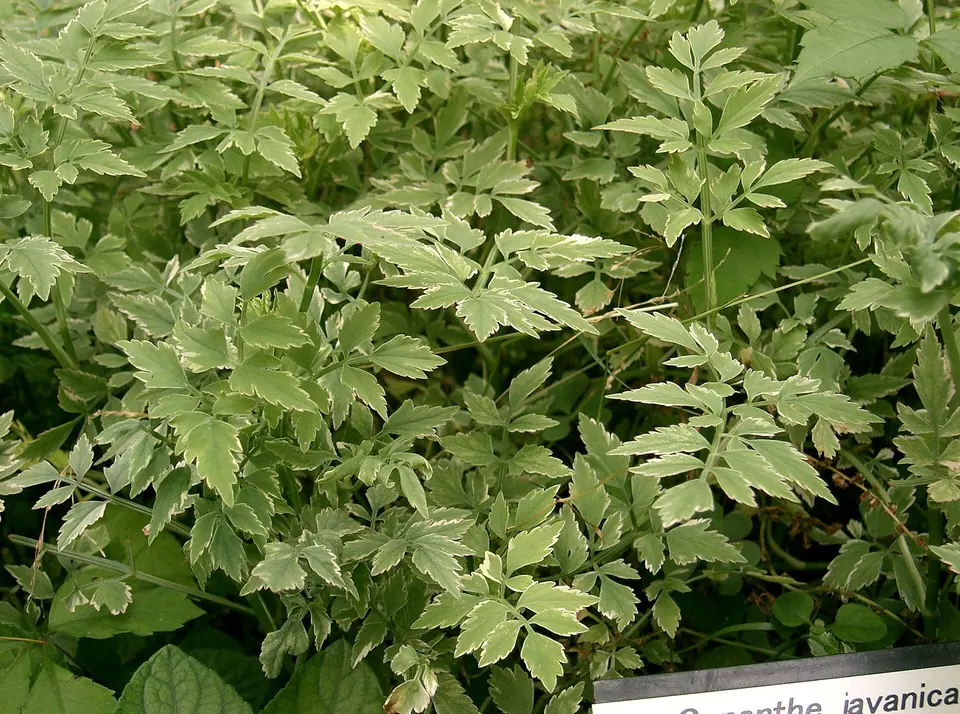

Cómo cultivar y cuidar Java waterdropwort
Oenanthe javanica
Escrito por Emilio Marruso · última revisión
De un vistazo
Esta planta perenne adora el agua: dale tierra siempre mojada o agua poco profunda y tolera incluso las inundaciones. Sus hojas y tallos tiernos se comen crudos en ensalada, como el perejil, o cocinados un momento, y puedes cortar los tallos con hojas cada 2–3 semanas. Los brotes tiernos que salen en invierno son los mejores, y crece también en maceta.
- Riego
Mantén la tierra siempre mojada o en agua poco profunda; tolera las inundaciones
Qué dicen las fuentes (5)
Riego: Suelo constantemente húmedo o agua poco profunda
Requires a wet fertile soil or shallow water and a sunny position
— Oenanthe javanica - Useful Temperate Plants [1] Light Preference | Semi-Shade | Water Preference | Lots of Water
— NParks | Oenanthe javanica [7] Light full sun Shade tolerance no shade Water aquatic Hardiness Zone 10+
— Water Dropwort (Oenanthe javanica) — Practical Plants [8] - Frío
Aguanta inviernos de hasta −1,1 °C (30 °F)
Semirrústica: inviernos suaves o invernadero sin calefacción · USDA 10 · RHS H3 · Z10
Qué dicen las fuentes (1)
Rusticidad, zona más fría: 10 [mínima invernal de −1,1 a 4,4 °C (de 30 a 40 °F)]
Water aquatic Hardiness Zone 10+ Soil textures sandy, loamy, clay
— Water Dropwort (Oenanthe javanica) — Practical Plants [8] - Distancia
23 cm entre plantas
Qué dicen las fuentes (2)
Distancia de plantación: 22.9 cm (9 pulgadas)
Siembra de prueba en Florida (Belle Glade), suelo de turba inundado: In a test planting at Belle Glade in December 1977, sprigs were set out 9 inches apart in a concrete tank of flooded muck soil.
— HS682 [6] In a test planting at Belle Glade in December 1977, sprigs were set out 9 inches apart in a concrete tank of flooded muck soil.
— HS682 [6] - Plantación
Planta de finales de primavera a verano
Qué dicen las fuentes (5)
Plantación: Desde fines de primavera hasta verano
Según Practical Plants (seedlings): When they are large enough to handle, prick the seedlings out into individual pots and plant them out in the summer.
— Water Dropwort (Oenanthe javanica) — Practical Plants [8] Según Practical Plants (small divisions): grow them on in light shade in a cold frame until they are well established before planting them out in late spring or early summer.
— Water Dropwort (Oenanthe javanica) — Practical Plants [8] Prueba de plantación en Florida (Belle Glade): In a test planting at Belle Glade in December 1977, sprigs were set out 9 inches apart in a concrete tank of flooded muck soil.
— HS682 [6] When they are large enough to handle, prick the seedlings out into individual pots and plant them out in the summer.
— Water Dropwort (Oenanthe javanica) — Practical Plants [8] grow them on in light shade in a cold frame until they are well established before planting them out in late spring or early summer.
— Water Dropwort (Oenanthe javanica) — Practical Plants [8] - Cosecha
Corta los tallos con hojas cada 2–3 semanas; come hojas y tallos tiernos crudos o poco cocinados
Qué dicen las fuentes (4)
Cosecha: Los tallos con hojas se cortan cada 2-3 semanas; los brotes jóvenes que brotan en invierno son los mejores
Prueba de plantación en Florida (Belle Glade): Several cuttings of leafy stalks were made periodically every 2 or 3 weeks.
— HS682 [6] Según Practical Plants: The young shoots that sprout from the root in winter are best [2] [9] .
— Water Dropwort (Oenanthe javanica) — Practical Plants [8] Several cuttings of leafy stalks were made periodically every 2 or 3 weeks.
— HS682 [6] The young shoots that sprout from the root in winter are best [2] [9] .
— Water Dropwort (Oenanthe javanica) — Practical Plants [8] - Atención
Se extiende rápido con estolones y trozos de tallo; las silvestres de hoja roja se confunden con parientes tóxicos
- Multiplicación
Esquejes de tallo, división en primavera o acodo
Qué dicen las fuentes (3)
Propagación: Esquejes de tallo; división en primavera; acodo; semilla (germinación errática)
O. javanica are most commonly propagated from stem cuttings, which when rooted, go on to establish quickly when transplanted into moist soil. It may also be propagated from seed, although germination has been observed to be erratic.
— NParks | Oenanthe javanica [7] Division in spring [9] . Large divisions can be planted out direct into their permanent positions.
— Water Dropwort (Oenanthe javanica) — Practical Plants [8] Propagated by stem cutting and planting in muddy soil with abundant moisture.
— Oenanthe javanica (Blume.) DC. (Apiaceae) | Japan International Research Center for Agricultural Sciences | JIRCAS [3] - Siembra
Siembra en primavera en cajonera fría; las semillas germinan de forma irregular
Qué dicen las fuentes (4)
Siembra: Primavera, en un marco frío
Seed - sow spring in a cold frame. Germination is erratic [9] .
— Water Dropwort (Oenanthe javanica) — Practical Plants [8] Propagación: Esquejes de tallo; división en primavera; acodo; semilla (germinación errática)
O. javanica are most commonly propagated from stem cuttings, which when rooted, go on to establish quickly when transplanted into moist soil. It may also be propagated from seed, although germination has been observed to be erratic.
— NParks | Oenanthe javanica [7] Division in spring [9] . Large divisions can be planted out direct into their permanent positions.
— Water Dropwort (Oenanthe javanica) — Practical Plants [8] Propagated by stem cutting and planting in muddy soil with abundant moisture.
— Oenanthe javanica (Blume.) DC. (Apiaceae) | Japan International Research Center for Agricultural Sciences | JIRCAS [3] - Maceta
Crece también en maceta
Qué dicen las fuentes (1)
En maceta: Sí
Landscape Uses | Riverine, Aquarium / Aquascape, Container Planting | Thematic Landscaping | Water Garden
— NParks | Oenanthe javanica [7]
Resumen
El apio de agua es una hierba acuática perenne que se extiende mediante estolones rastreros y es una verdura de hoja tradicional en el este y el sudeste de Asia. [6][7] Necesita suelo fértil y húmedo o agua poco profunda. [1] Fuera de su área nativa se trata como una planta invasora que puede obstruir humedales y arroyos. [4][2]
Citado en inglés, como en la fuente.
Cuidados
Riego
Riego
Suelo constantemente húmedo o agua poco profunda
Qué dicen las fuentes (3)
Requires a wet fertile soil or shallow water and a sunny positionLight Preference
| Semi-Shade
| Water Preference
| Lots of WaterLight
full sun
Shade tolerance
no shade
Water
aquatic
Hardiness
Zone 10+Luz
Las fuentes dan valores distintos según la región, la zona o las condiciones de cultivo.
Lo que dice cada fuente
Según InfoFlora: Sol o semisombra
Según NParks: Semisombra
Según JIRCAS: Pleno sol
Qué dicen las fuentes (6)
Según InfoFlora: Cresce preferibilmente in siti soleggiati o in penombra e non ha una preferenza particolare per il tipo di terrenoSegún NParks: O. javanica thrives in warm wet areas although it is a cool-season plant. Semi-shade conditions are also preferred.Según JIRCAS: Grows in marshy areas under full sun. Commonly grown in backyard gardens.Cresce preferibilmente in siti soleggiati o in penombra e non ha una preferenza particolare per il tipo di terrenoO. javanica thrives in warm wet areas although it is a cool-season plant. Semi-shade conditions are also preferred.Grows in marshy areas under full sun. Commonly grown in backyard gardens.Clima y frío
10 [mínima invernal de −1,1 a 4,4 °C (de 30 a 40 °F)]
Qué dicen las fuentes (1)
Water
aquatic
Hardiness
Zone 10+
Soil textures
sandy, loamy, claySuelo
pH del suelo, mínimo
Las fuentes dan valores distintos según la región, la zona o las condiciones de cultivo.
Lo que dice cada fuente
Según Useful Temperate Plants (optimal 5.5): 4.5
Según FAO EcoCrop (optimal 5.5): 4.5
Según InfoFlora: 5
Qué dicen las fuentes (5)
Según Useful Temperate Plants (optimal 5.5): Prefers a pH in the range 5.5 - 6.5, tolerating 4.5 - 7Según FAO EcoCrop (optimal 5.5): Soil PH | 5.5 | 6.5 | 4.5 | 7 | Soil drainageSegún InfoFlora: in quanto può crescere in sedimenti che vanno dal sabbioso all'argilloso (Minnesota Department of Natural Resources, 2025). Tollera livelli di pH da 5 a 8Prefers a pH in the range 5.5 - 6.5, tolerating 4.5 - 7Soil PH | 5.5 | 6.5 | 4.5 | 7 | Soil drainagepH del suelo, máximo
Las fuentes dan valores distintos según la región, la zona o las condiciones de cultivo.
Lo que dice cada fuente
Según Useful Temperate Plants (optimal 6.5): 7
Según FAO EcoCrop (optimal 6.5): 7
Según InfoFlora: 8
Qué dicen las fuentes (5)
Según Useful Temperate Plants (optimal 6.5): Prefers a pH in the range 5.5 - 6.5, tolerating 4.5 - 7Según FAO EcoCrop (optimal 6.5): Soil PH | 5.5 | 6.5 | 4.5 | 7 | Soil drainageSegún InfoFlora: in quanto può crescere in sedimenti che vanno dal sabbioso all'argilloso (Minnesota Department of Natural Resources, 2025). Tollera livelli di pH da 5 a 8Prefers a pH in the range 5.5 - 6.5, tolerating 4.5 - 7Soil PH | 5.5 | 6.5 | 4.5 | 7 | Soil drainageDónde cultivarla
En maceta
Sí
Qué dicen las fuentes (1)
Landscape Uses
| Riverine, Aquarium / Aquascape, Container Planting
| Thematic Landscaping
| Water GardenDistancia de plantación
22.9 cm (9 pulgadas)
Lo que dice cada fuente
Siembra de prueba en Florida (Belle Glade), suelo de turba inundado: 22.9 cm (9 pulgadas)
Qué dicen las fuentes (2)
Siembra de prueba en Florida (Belle Glade), suelo de turba inundado: In a test planting at Belle Glade in December 1977, sprigs were set out 9 inches apart in a concrete tank of flooded muck soil.In a test planting at Belle Glade in December 1977, sprigs were set out 9 inches apart in a concrete tank of flooded muck soil.Propagación
Esquejes de tallo; división en primavera; acodo; semilla (germinación errática)
Qué dicen las fuentes (3)
O. javanica are most commonly propagated from stem cuttings, which when rooted, go on to establish quickly when transplanted into moist soil. It may also be propagated from seed, although germination has been observed to be erratic.Division in spring [9] . Large divisions can be planted out direct into their permanent positions.Propagated by stem cutting and planting in muddy soil with abundant moisture.Cultivo
La planta
Ciclo de vida
perenne
Qué dicen las fuentes (1)
Caratteristiche morfologiche - Pianta erbacea acquatica e perenne; - Fusti: cilindrici, striati, cavi, lunghi 10-120 cm, da prostrati ad ascendenti, glabriFamilia
Apiaceae
Qué dicen las fuentes (1)
Specie con messa in commercio vietata (OEDA, allegato 2.2) Finocchio acquatico di Giava (Apiacee) Oenanthe javanica DC. (Apiaceae)Propagación
Esquejes
Las fuentes dan valores distintos según la región, la zona o las condiciones de cultivo.
Lo que dice cada fuente
cultivar 'Flamingo': Esquejes de madera blanda en primavera
Qué dicen las fuentes (1)
cultivar 'Flamingo': Propagate by division , in late spring as growth begins, or by softwood cuttings in springProblemas
Propagación invasiva
Síntoma: Se extiende rápidamente mediante estolones y fragmentos de tallo que enraízan en suelo húmedo
Qué hacer: Corta las cabezas florales antes de la fructificación y desecha el material cortado adecuadamente; arranca poblaciones pequeñas recogiendo todas las raíces y fragmentos de tallo
Qué dicen las fuentes (2)
Tagliare le infiorescenze prima della fruttificazione; - Smaltire correttamente i frutti e il materiale tagliato.
— 1 [2] Pulling small populations may work if all roots and stem fragments are collected and disposed of.
— Java Waterdropwort or Vietnamese parsley | (Oenanthe javanica) | Wisconsin DNR [4] Manto denso
Síntoma: La plantación se vuelve un manto denso después de varios cortes
Qué hacer: Retira los brotes y las raíces junto con las partes superiores
Qué dicen las fuentes (1)
There was a tendency for the planting to become densely matted after several cuttings, indicating a need to remove shoots and roots along with the tops.
— HS682 [6] Confusión con parientes venenosos
Síntoma: Las formas silvestres de hojas rojas se confunden fácilmente con especies venenosas relacionadas
Qué dicen las fuentes (1)
Red-leaved forms exist in the wild, which are easily confused with poisonous related species.
— NParks | Oenanthe javanica [7]
Remedios
Cada remedio indica qué dicen las fuentes oficiales; los remedios tradicionales sin fuente oficial aparecen marcados. Los perjudiciales están para que sepas evitarlos.
Cómo eliminarla
propagación invasiva
Arranca a mano con todos los fragmentos. Funciona en parte
Cómo: Arranca las plantas a mano, recogiendo cada tallo y fragmento de raíz; continúa con eliminaciones repetidas durante el año, ya que los fragmentos pequeños vuelven a brotar.
Secondo le esperienze sul campo di Mangili et al. (2018) in canali del Cantone Ticino, l'estirpazione manuale potrebbe avere successo se si raccolgono tutti i frammenti di fusto e radici.
— 1 [2] Qué dicen las pruebas Pulling small populations may work if all roots and stem fragments are collected and disposed of.
— Java Waterdropwort or Vietnamese parsley | (Oenanthe javanica) | Wisconsin DNR [4] Corta o siega No demostrado
Cómo: La siega de la planta a lo largo de las orillas no da resultado porque fragmenta los tallos y la corriente los arrastra río abajo.
Lo sfalcio della pianta lungo le rive si rivela inefficace, poiché frammenta i fusti, facilitando ulteriormente la sua diffusione a valle tramite la corrente
— 1 [2] Qué dicen las pruebas Cutting is unlikely to be effective and may contribute to the spread of this plant as it can take root from stem fragments that contain nodes.
— Java Waterdropwort or Vietnamese parsley | (Oenanthe javanica) | Wisconsin DNR [4] Corta las cabezas de las flores antes de que den fruto. Funciona en parte
Piccole quantità possono essere incenerite con i rifiuti dome-stici, mentre quantità maggiori possono essere eliminate in un impianto di compostaggio professionale. Evitare lo smaltimento con il compostaggio domestico;
— 1 [2] Cómo: Corta las cabezas de las flores antes de que se formen los frutos y desecha los frutos y el material cortado de manera adecuada.
Tagliare le infiorescenze prima della fruttificazione; - Smaltire correttamente i frutti e il materiale tagliato.
— 1 [2] Qué dicen las pruebas they form small oval seeds at the top of the flowering stalks. Controlling the seed heads will not prevent this plant from spreading.
— Java Waterdropwort or Vietnamese parsley | (Oenanthe javanica) | Wisconsin DNR [4] red de malla fina aguas abajo No verificado
Remedio tradicional, no verificado por una fuente oficial.
Cómo: En canales o agua corriente, coloca redes de malla fina (malla menor de 1x1 cm) aguas abajo del sitio de trabajo para atrapar los fragmentos que escapen.
secado al sol de las plantas arrancadas No verificado
Remedio tradicional, no verificado por una fuente oficial.
smaltire unicamente nei rifiuti solidi urbani, in impianti professionali di compostaggio o di fermentazione e di incenerimento dei rifiuti, IN NESSUN CASO nel compostaggio in giardino
— 1 [2] Cómo: Deja el material arrancado en el sitio a pleno sol, sin que toque el suelo, para secarlo y reducir su volumen y peso antes de desecharlo.
arado profundo y apisonado No verificado
Remedio tradicional, no verificado por una fuente oficial.
Cómo: A gran escala, el arado profundo y el apisonado (trabajar el suelo bajo inundación superficial) dieron buenos resultados en los arrozales, pero es demasiado invasivo para la mayoría de los otros sitios.
Calendario
Siembra
Primavera, en un marco frío
Qué dicen las fuentes (1)
Seed - sow spring in a cold frame. Germination is erratic [9] .Plantación
Desde fines de primavera hasta verano
Lo que dice cada fuente
Según Practical Plants (seedlings): Verano
Según Practical Plants (small divisions): Finales de primavera o principios de verano
Prueba de plantación en Florida (Belle Glade): Diciembre
Qué dicen las fuentes (5)
Según Practical Plants (seedlings): When they are large enough to handle, prick the seedlings out into individual pots and plant them out in the summer.Según Practical Plants (small divisions): grow them on in light shade in a cold frame until they are well established before planting them out in late spring or early summer.Prueba de plantación en Florida (Belle Glade): In a test planting at Belle Glade in December 1977, sprigs were set out 9 inches apart in a concrete tank of flooded muck soil.When they are large enough to handle, prick the seedlings out into individual pots and plant them out in the summer.grow them on in light shade in a cold frame until they are well established before planting them out in late spring or early summer.Cosecha
Los tallos con hojas se cortan cada 2-3 semanas; los brotes jóvenes que brotan en invierno son los mejores
Lo que dice cada fuente
Prueba de plantación en Florida (Belle Glade): Cada 2-3 semanas
Según Practical Plants: Brotes jóvenes en invierno
Qué dicen las fuentes (4)
Prueba de plantación en Florida (Belle Glade): Several cuttings of leafy stalks were made periodically every 2 or 3 weeks.Según Practical Plants: The young shoots that sprout from the root in winter are best [2] [9] .Several cuttings of leafy stalks were made periodically every 2 or 3 weeks.The young shoots that sprout from the root in winter are best [2] [9] .Meses tal como los dan las fuentes, en su mayoría de Estados Unidos (hemisferio norte). En el hemisferio sur se desplazan unos seis meses.
Comestibilidad
Según la fuente, citada textualmente. No comas una planta basándote solo en esta página: los errores de identificación pueden ser peligrosos.
Its leaves and young stems may be used raw or cooked briefly.
[7]The tops are eaten raw in salads or as a garnish similar to parsley. The young stems and leaves are also steamed with rice, or boiled and chopped as greens.
[6]Young shoots are eaten fresh as a side dish. Contains 91.6 g water, 1.1 g protein
[3]Root - cooked. Highly esteemed in Japan [2] , the roots can grow up to 30cm long in water [6] .
[8]
Plantas similares
- Apio caballar Smyrnium olusatrum
- Cardo amatista Eryngium amethystinum
- Angélica Angelica archangelica
- Anís Pimpinella anisum
- Appalachian Angelica Angelica triquinata
- Asiatic pennywort Centella asiatica
- Bishop's goutweed Aegopodium podagraria
- Bishop's Weed Ammi majus
Fuentes
Cada valor anterior se cita de estos documentos. Los enlaces llevan al editor original.
- Oenanthe javanica - Useful Temperate Plants · temperate.theferns.info, consultado
- 1 · infoflora.ch, consultado
- Oenanthe javanica (Blume.) DC. (Apiaceae) | Japan International Research Center for Agricultural Sciences | JIRCAS · jircas.go.jp, consultado
- Java Waterdropwort or Vietnamese parsley | (Oenanthe javanica) | Wisconsin DNR · dnr.wisconsin.gov, consultado
- Data sheet · ecocrop.apps.fao.org, consultado
- HS682 · growables.org, consultado
- NParks | Oenanthe javanica · nparks.gov.sg, consultado
- Water Dropwort (Oenanthe javanica) — Practical Plants · practicalplants.org, consultado
- rhs.org.uk · rhs.org.uk
Escrito por Emilio Marruso · última revisión