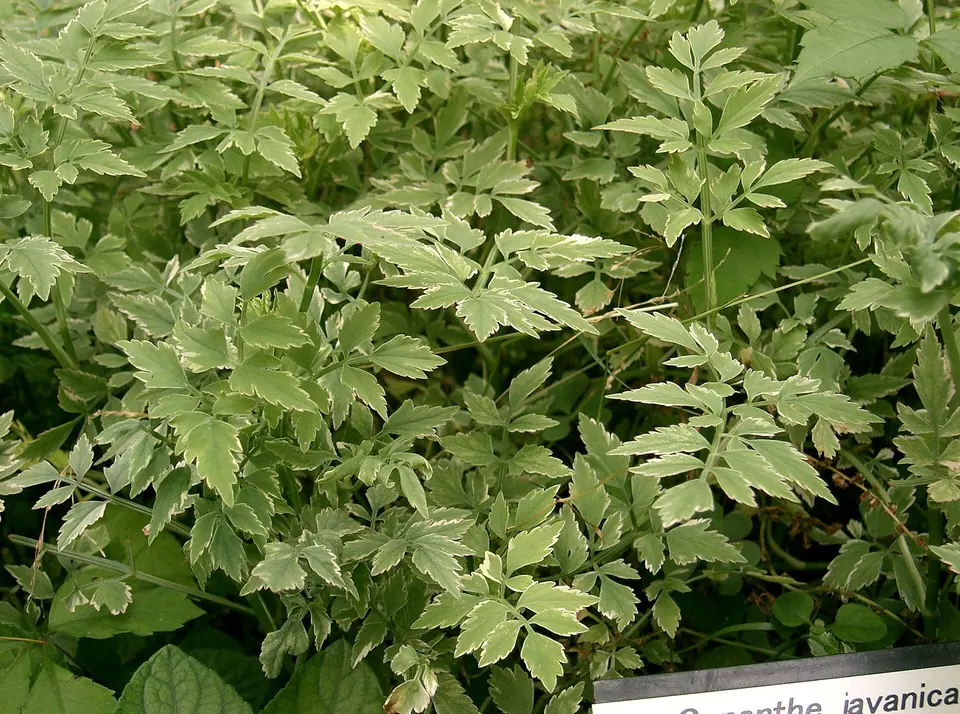

How to Grow and Care for Java waterdropwort
Oenanthe javanica
Written by Emilio Marruso · last checked
At a glance
This perennial loves wet feet: give it constantly wet soil or shallow water and it happily tolerates flooding. Its leaves and young stems are eaten raw in salads like parsley or cooked briefly, and you can cut the leafy stalks every 2–3 weeks. Young shoots sprouting in winter are the best, and it even grows in containers.
- Water
Keep the soil constantly wet or in shallow water; it tolerates flooding
What the sources say (5)
Watering: Constantly wet soil or shallow water
Requires a wet fertile soil or shallow water and a sunny position
— Oenanthe javanica - Useful Temperate Plants [1] Light Preference | Semi-Shade | Water Preference | Lots of Water
— NParks | Oenanthe javanica [7] Light full sun Shade tolerance no shade Water aquatic Hardiness Zone 10+
— Water Dropwort (Oenanthe javanica) — Practical Plants [8] - Cold
Survives winters down to 30 °F (−1.1 °C)
Half hardy: mild winters or an unheated greenhouse · USDA 10 · RHS H3 · Z10
What the sources say (1)
Hardiness, coldest zone: 10 [winter low −1.1 to 4.4 °C (30 to 40 °F)]
Water aquatic Hardiness Zone 10+ Soil textures sandy, loamy, clay
— Water Dropwort (Oenanthe javanica) — Practical Plants [8] - Spacing
9 in between plants
What the sources say (2)
Spacing: 22.9 cm (9 in)
Florida test planting (Belle Glade), flooded muck soil: In a test planting at Belle Glade in December 1977, sprigs were set out 9 inches apart in a concrete tank of flooded muck soil.
— HS682 [6] In a test planting at Belle Glade in December 1977, sprigs were set out 9 inches apart in a concrete tank of flooded muck soil.
— HS682 [6] - Planting
Plant from late spring to summer
What the sources say (5)
Planting: Late spring to summer
According to Practical Plants (seedlings): When they are large enough to handle, prick the seedlings out into individual pots and plant them out in the summer.
— Water Dropwort (Oenanthe javanica) — Practical Plants [8] According to Practical Plants (small divisions): grow them on in light shade in a cold frame until they are well established before planting them out in late spring or early summer.
— Water Dropwort (Oenanthe javanica) — Practical Plants [8] Florida test planting (Belle Glade): In a test planting at Belle Glade in December 1977, sprigs were set out 9 inches apart in a concrete tank of flooded muck soil.
— HS682 [6] When they are large enough to handle, prick the seedlings out into individual pots and plant them out in the summer.
— Water Dropwort (Oenanthe javanica) — Practical Plants [8] grow them on in light shade in a cold frame until they are well established before planting them out in late spring or early summer.
— Water Dropwort (Oenanthe javanica) — Practical Plants [8] - Harvest
Cut leafy stalks every 2–3 weeks; eat leaves and young stems raw or briefly cooked
What the sources say (4)
Harvest: Leafy stalks cut every 2-3 weeks; young shoots sprouting in winter are best
Florida test planting (Belle Glade): Several cuttings of leafy stalks were made periodically every 2 or 3 weeks.
— HS682 [6] According to Practical Plants: The young shoots that sprout from the root in winter are best [2] [9] .
— Water Dropwort (Oenanthe javanica) — Practical Plants [8] Several cuttings of leafy stalks were made periodically every 2 or 3 weeks.
— HS682 [6] The young shoots that sprout from the root in winter are best [2] [9] .
— Water Dropwort (Oenanthe javanica) — Practical Plants [8] - Watch out
Spreads fast by runners and stem bits; red-leaved wild forms look like poisonous relatives
- Propagation
Stem cuttings, division in spring, or layering
What the sources say (3)
Propagation: Stem cuttings; division in spring; layering; seed (erratic germination)
O. javanica are most commonly propagated from stem cuttings, which when rooted, go on to establish quickly when transplanted into moist soil. It may also be propagated from seed, although germination has been observed to be erratic.
— NParks | Oenanthe javanica [7] Division in spring [9] . Large divisions can be planted out direct into their permanent positions.
— Water Dropwort (Oenanthe javanica) — Practical Plants [8] Propagated by stem cutting and planting in muddy soil with abundant moisture.
— Oenanthe javanica (Blume.) DC. (Apiaceae) | Japan International Research Center for Agricultural Sciences | JIRCAS [3] - Sowing
Sow in spring in a cold frame; seeds sprout unevenly
What the sources say (4)
Sowing: Spring, in a cold frame
Seed - sow spring in a cold frame. Germination is erratic [9] .
— Water Dropwort (Oenanthe javanica) — Practical Plants [8] Propagation: Stem cuttings; division in spring; layering; seed (erratic germination)
O. javanica are most commonly propagated from stem cuttings, which when rooted, go on to establish quickly when transplanted into moist soil. It may also be propagated from seed, although germination has been observed to be erratic.
— NParks | Oenanthe javanica [7] Division in spring [9] . Large divisions can be planted out direct into their permanent positions.
— Water Dropwort (Oenanthe javanica) — Practical Plants [8] Propagated by stem cutting and planting in muddy soil with abundant moisture.
— Oenanthe javanica (Blume.) DC. (Apiaceae) | Japan International Research Center for Agricultural Sciences | JIRCAS [3] - Containers
Grows in containers too
What the sources say (1)
In containers: Yes
Landscape Uses | Riverine, Aquarium / Aquascape, Container Planting | Thematic Landscaping | Water Garden
— NParks | Oenanthe javanica [7]
Overview
Water celery is a perennial aquatic herb that spreads by creeping stolons and is a traditional leafy vegetable in East and Southeast Asia. [6][7] It needs wet, fertile soil or shallow water. [1] Outside its native range it is treated as an invasive plant that can choke wetlands and streams. [4][2]
Java waterdropwort care
How to water Java waterdropwort
Watering
Constantly wet soil or shallow water
What the sources say (3)
Requires a wet fertile soil or shallow water and a sunny positionLight Preference
| Semi-Shade
| Water Preference
| Lots of WaterLight
full sun
Shade tolerance
no shade
Water
aquatic
Hardiness
Zone 10+How much light Java waterdropwort needs
The sources give different values depending on region, zone or growing conditions.
What each source says
According to InfoFlora: Sun or partial shade
According to NParks: Semi-shade
According to JIRCAS: Full sun
What the sources say (6)
According to InfoFlora: Cresce preferibilmente in siti soleggiati o in penombra e non ha una preferenza particolare per il tipo di terrenoAccording to NParks: O. javanica thrives in warm wet areas although it is a cool-season plant. Semi-shade conditions are also preferred.According to JIRCAS: Grows in marshy areas under full sun. Commonly grown in backyard gardens.Cresce preferibilmente in siti soleggiati o in penombra e non ha una preferenza particolare per il tipo di terrenoO. javanica thrives in warm wet areas although it is a cool-season plant. Semi-shade conditions are also preferred.Grows in marshy areas under full sun. Commonly grown in backyard gardens.How much cold Java waterdropwort can take
10 [winter low −1.1 to 4.4 °C (30 to 40 °F)]
What the sources say (1)
Water
aquatic
Hardiness
Zone 10+
Soil textures
sandy, loamy, clayBest soil for Java waterdropwort
Soil pH, minimum
The sources give different values depending on region, zone or growing conditions.
What each source says
According to Useful Temperate Plants (optimal 5.5): 4.5
According to FAO EcoCrop (optimal 5.5): 4.5
According to InfoFlora: 5
What the sources say (5)
According to Useful Temperate Plants (optimal 5.5): Prefers a pH in the range 5.5 - 6.5, tolerating 4.5 - 7According to FAO EcoCrop (optimal 5.5): Soil PH | 5.5 | 6.5 | 4.5 | 7 | Soil drainageAccording to InfoFlora: in quanto può crescere in sedimenti che vanno dal sabbioso all'argilloso (Minnesota Department of Natural Resources, 2025). Tollera livelli di pH da 5 a 8Prefers a pH in the range 5.5 - 6.5, tolerating 4.5 - 7Soil PH | 5.5 | 6.5 | 4.5 | 7 | Soil drainageSoil pH, maximum
The sources give different values depending on region, zone or growing conditions.
What each source says
According to Useful Temperate Plants (optimal 6.5): 7
According to FAO EcoCrop (optimal 6.5): 7
According to InfoFlora: 8
What the sources say (5)
According to Useful Temperate Plants (optimal 6.5): Prefers a pH in the range 5.5 - 6.5, tolerating 4.5 - 7According to FAO EcoCrop (optimal 6.5): Soil PH | 5.5 | 6.5 | 4.5 | 7 | Soil drainageAccording to InfoFlora: in quanto può crescere in sedimenti che vanno dal sabbioso all'argilloso (Minnesota Department of Natural Resources, 2025). Tollera livelli di pH da 5 a 8Prefers a pH in the range 5.5 - 6.5, tolerating 4.5 - 7Soil PH | 5.5 | 6.5 | 4.5 | 7 | Soil drainageWhere to grow Java waterdropwort
In containers
Yes
What the sources say (1)
Landscape Uses
| Riverine, Aquarium / Aquascape, Container Planting
| Thematic Landscaping
| Water GardenSpacing
22.9 cm (9 in)
What each source says
Florida test planting (Belle Glade), flooded muck soil: 22.9 cm (9 in)
What the sources say (2)
Florida test planting (Belle Glade), flooded muck soil: In a test planting at Belle Glade in December 1977, sprigs were set out 9 inches apart in a concrete tank of flooded muck soil.In a test planting at Belle Glade in December 1977, sprigs were set out 9 inches apart in a concrete tank of flooded muck soil.How to propagate Java waterdropwort
Stem cuttings; division in spring; layering; seed (erratic germination)
What the sources say (3)
O. javanica are most commonly propagated from stem cuttings, which when rooted, go on to establish quickly when transplanted into moist soil. It may also be propagated from seed, although germination has been observed to be erratic.Division in spring [9] . Large divisions can be planted out direct into their permanent positions.Propagated by stem cutting and planting in muddy soil with abundant moisture.How to grow Java waterdropwort
The plant
Life cycle
perennial
What the sources say (1)
Caratteristiche morfologiche - Pianta erbacea acquatica e perenne; - Fusti: cilindrici, striati, cavi, lunghi 10-120 cm, da prostrati ad ascendenti, glabriFamily
Apiaceae
What the sources say (1)
Specie con messa in commercio vietata (OEDA, allegato 2.2) Finocchio acquatico di Giava (Apiacee) Oenanthe javanica DC. (Apiaceae)Propagation
Cuttings
The sources give different values depending on region, zone or growing conditions.
What each source says
cultivar 'Flamingo': Softwood cuttings in spring
What the sources say (1)
cultivar 'Flamingo': Propagate by division , in late spring as growth begins, or by softwood cuttings in springJava waterdropwort pests and problems
Invasive spread
Symptom: Spreads rapidly by runners and stem fragments that root in wet soil
What to do: Cut flower heads before fruiting and dispose of cut material properly; pull small populations collecting all roots and stem fragments
What the sources say (2)
Tagliare le infiorescenze prima della fruttificazione; - Smaltire correttamente i frutti e il materiale tagliato.
— 1 [2] Pulling small populations may work if all roots and stem fragments are collected and disposed of.
— Java Waterdropwort or Vietnamese parsley | (Oenanthe javanica) | Wisconsin DNR [4] Dense matting
Symptom: Planting becomes densely matted after several cuttings
What to do: Remove shoots and roots along with the tops
What the sources say (1)
There was a tendency for the planting to become densely matted after several cuttings, indicating a need to remove shoots and roots along with the tops.
— HS682 [6] Confusion with poisonous relatives
Symptom: Red-leaved wild forms are easily confused with poisonous related species
What the sources say (1)
Red-leaved forms exist in the wild, which are easily confused with poisonous related species.
— NParks | Oenanthe javanica [7]
Remedies
Each remedy shows what official sources say about it; traditional remedies without an official source are marked as such. Harmful ones are listed so you know to avoid them.
Getting rid of it
invasive spread
hand pulling with all fragments Partly works
How: Pull the plants by hand, collecting every stem and root fragment; follow up with repeated removals through the year, since small fragments sprout again.
Secondo le esperienze sul campo di Mangili et al. (2018) in canali del Cantone Ticino, l'estirpazione manuale potrebbe avere successo se si raccolgono tutti i frammenti di fusto e radici.
— 1 [2] What the evidence says Pulling small populations may work if all roots and stem fragments are collected and disposed of.
— Java Waterdropwort or Vietnamese parsley | (Oenanthe javanica) | Wisconsin DNR [4] mowing or cutting Not proven
How: Mowing the plant along banks is ineffective: it fragments the stems and the current carries them downstream.
Lo sfalcio della pianta lungo le rive si rivela inefficace, poiché frammenta i fusti, facilitando ulteriormente la sua diffusione a valle tramite la corrente
— 1 [2] What the evidence says Cutting is unlikely to be effective and may contribute to the spread of this plant as it can take root from stem fragments that contain nodes.
— Java Waterdropwort or Vietnamese parsley | (Oenanthe javanica) | Wisconsin DNR [4] cutting flower heads before fruiting Partly works
Piccole quantità possono essere incenerite con i rifiuti dome-stici, mentre quantità maggiori possono essere eliminate in un impianto di compostaggio professionale. Evitare lo smaltimento con il compostaggio domestico;
— 1 [2] How: Cut the flower heads before the fruits form and dispose of fruits and cut material properly.
Tagliare le infiorescenze prima della fruttificazione; - Smaltire correttamente i frutti e il materiale tagliato.
— 1 [2] What the evidence says they form small oval seeds at the top of the flowering stalks. Controlling the seed heads will not prevent this plant from spreading.
— Java Waterdropwort or Vietnamese parsley | (Oenanthe javanica) | Wisconsin DNR [4] fine-mesh net downstream Not verified
Traditional remedy, not verified by an official source.
How: In canals or flowing water, place fine-mesh nets (mesh under 1x1 cm) downstream of the work site to catch the fragments that escape.
sun-drying pulled plants Not verified
Traditional remedy, not verified by an official source.
smaltire unicamente nei rifiuti solidi urbani, in impianti professionali di compostaggio o di fermentazione e di incenerimento dei rifiuti, IN NESSUN CASO nel compostaggio in giardino
— 1 [2] How: Leave the pulled material on site in full sun, not touching the soil, to dry it and reduce its volume and weight before disposal.
deep ploughing and puddling Not verified
Traditional remedy, not verified by an official source.
How: On a large scale, deep ploughing and puddling (working the soil under shallow flooding) gave good results in rice paddies, but is too invasive for most other sites.
Calendar
Sowing
Spring, in a cold frame
What the sources say (1)
Seed - sow spring in a cold frame. Germination is erratic [9] .Planting
Late spring to summer
What each source says
According to Practical Plants (seedlings): Summer
According to Practical Plants (small divisions): Late spring or early summer
Florida test planting (Belle Glade): December
What the sources say (5)
According to Practical Plants (seedlings): When they are large enough to handle, prick the seedlings out into individual pots and plant them out in the summer.According to Practical Plants (small divisions): grow them on in light shade in a cold frame until they are well established before planting them out in late spring or early summer.Florida test planting (Belle Glade): In a test planting at Belle Glade in December 1977, sprigs were set out 9 inches apart in a concrete tank of flooded muck soil.When they are large enough to handle, prick the seedlings out into individual pots and plant them out in the summer.grow them on in light shade in a cold frame until they are well established before planting them out in late spring or early summer.Harvest
Leafy stalks cut every 2-3 weeks; young shoots sprouting in winter are best
What each source says
Florida test planting (Belle Glade): Every 2-3 weeks
According to Practical Plants: Young shoots in winter
What the sources say (4)
Florida test planting (Belle Glade): Several cuttings of leafy stalks were made periodically every 2 or 3 weeks.According to Practical Plants: The young shoots that sprout from the root in winter are best [2] [9] .Several cuttings of leafy stalks were made periodically every 2 or 3 weeks.The young shoots that sprout from the root in winter are best [2] [9] .Months as given by the sources, which are mostly from the United States (northern hemisphere). In the southern hemisphere they shift by about six months.
Edibility
Reported by the source, quoted verbatim. Do not eat a plant on the basis of this page alone: identification mistakes can be dangerous.
Its leaves and young stems may be used raw or cooked briefly.
[7]The tops are eaten raw in salads or as a garnish similar to parsley. The young stems and leaves are also steamed with rice, or boiled and chopped as greens.
[6]Young shoots are eaten fresh as a side dish. Contains 91.6 g water, 1.1 g protein
[3]Root - cooked. Highly esteemed in Japan [2] , the roots can grow up to 30cm long in water [6] .
[8]
Similar plants
- Alexanders Smyrnium olusatrum
- Amethyst eryngo Eryngium amethystinum
- Angelica Angelica archangelica
- Anise burnet saxifrage Pimpinella anisum
- Appalachian Angelica Angelica triquinata
- Asiatic pennywort Centella asiatica
- Bishop's goutweed Aegopodium podagraria
- Bishop's Weed Ammi majus
Sources
Every value above is quoted from these documents. Links lead to the original publisher.
- Oenanthe javanica - Useful Temperate Plants · temperate.theferns.info, consulted
- 1 · infoflora.ch, consulted
- Oenanthe javanica (Blume.) DC. (Apiaceae) | Japan International Research Center for Agricultural Sciences | JIRCAS · jircas.go.jp, consulted
- Java Waterdropwort or Vietnamese parsley | (Oenanthe javanica) | Wisconsin DNR · dnr.wisconsin.gov, consulted
- Data sheet · ecocrop.apps.fao.org, consulted
- HS682 · growables.org, consulted
- NParks | Oenanthe javanica · nparks.gov.sg, consulted
- Water Dropwort (Oenanthe javanica) — Practical Plants · practicalplants.org, consulted
- rhs.org.uk · rhs.org.uk
Written by Emilio Marruso · last checked