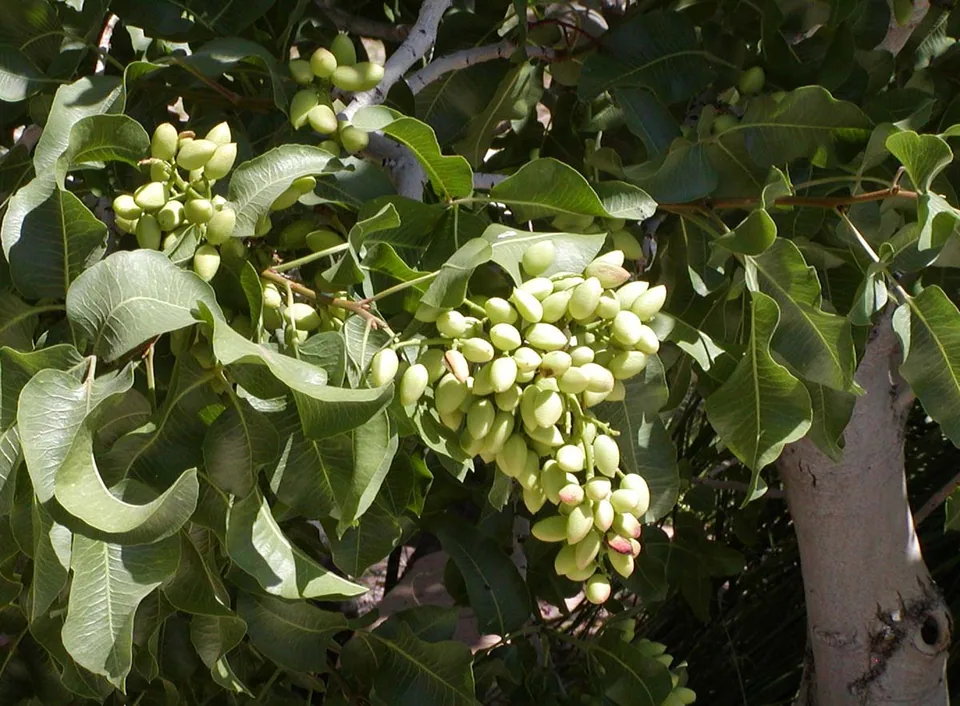
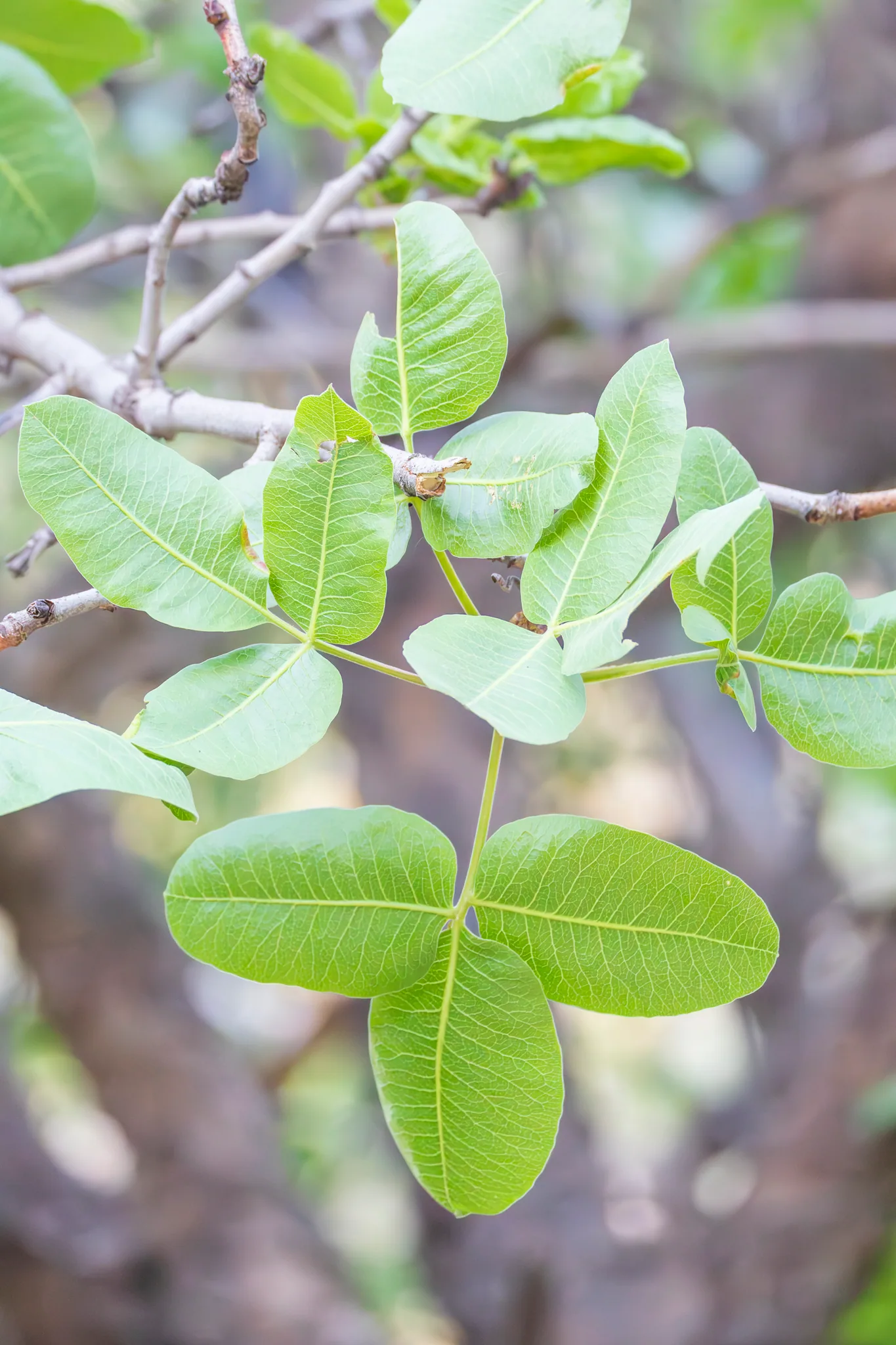

Cómo cultivar y cuidar Pistacho
Pistacia vera
Escrito por Emilio Marruso · última revisión
De un vistazo
De todos sus parientes cercanos, el pistachero es el único con frutos comestibles, y aguanta bien la sequía. Plántalo en primavera, evita que el agua se encharque junto a las raíces y, a los 4–5 años del injerto, empezará a dar fruto, con cosecha de finales de agosto a principios de septiembre. Pon un árbol macho por cada 8 a 10 hembras: el viento lleva el polen.
- Riego
Aguanta la sequía; mantén la tierra húmeda a finales de invierno, en primavera y a principios de verano
Qué dicen las fuentes (1)
Riego: Tolerante a la sequía; se necesita humedad adecuada del suelo a fines del invierno, en primavera y a principios del verano para la producción comercial de cultivos
Pistachios are drought tolerant, but for commercial crop production there must be adequate soil moisture during late winter, spring and early summer.
— Growing Pistachios in New Mexico | New Mexico State University - BE BOLD. Shape the Future. [1] - Distancia
De 5,2 a 6,1 m entre árboles en todas direcciones
Qué dicen las fuentes (3)
Distancia de plantación: 518 x 518 cm (17 x 17 pies) a 610 x 610 cm (20 x 20 pies)
Nuevo México: Tree spacing in New Mexico varies mostly from 17 feet by 17 feet to 20 feet by 20 feet
— Growing Pistachios in New Mexico | New Mexico State University - BE BOLD. Shape the Future. [1] Tree spacing in New Mexico varies mostly from 17 feet by 17 feet to 20 feet by 20 feet
— Growing Pistachios in New Mexico | New Mexico State University - BE BOLD. Shape the Future. [1] Distancia entre hileras: 732 cm (24 pies), árboles separados 12 pies en la hilera
A good planting system seems to be spacing the trees 12 feet apart in rows spaced 24 feet apart.
— Growing Pistachios in New Mexico | New Mexico State University - BE BOLD. Shape the Future. [1] - Plantación
Planta árboles jóvenes en maceta en primavera
Qué dicen las fuentes (1)
Plantación: Primavera (plántulas en contenedor)
It is a common practice to plant containerized seedlings in the spring and bud them in July or August with current year budwood.
— Growing Pistachios in New Mexico | New Mexico State University - BE BOLD. Shape the Future. [1] - Abonado
Nitrógeno dos veces al año, en marzo y junio; nada el año de plantación ni después de junio
Qué dicen las fuentes (6)
Cuándo: Nitrógeno dividido en dos: la mitad antes del primer riego, la mitad en junio; ninguno en el año de plantación
Nitrogen fertilizer should be broadcast and split in two rates; apply half before the first irrigation and the second half in June.
— Growing Pistachios in New Mexico | New Mexico State University - BE BOLD. Shape the Future. [1] Do not apply nitrogen fertilizer the year trees are planted. Apply one pound of ammonium sulfate per tree during the second year.
— Growing Pistachios in New Mexico | New Mexico State University - BE BOLD. Shape the Future. [1] Frecuencia: Nitrógeno dos veces al año (marzo y junio); elementos menores una vez al mes de abril a julio
Apply one pound of ammonium sulfate per tree during the second year. Split the rate in two parts, applying half a pound in March and half a pound in June.
— Growing Pistachios in New Mexico | New Mexico State University - BE BOLD. Shape the Future. [1] Pistachio trees need to be sprayed with minor elements, about three to four applications per year, one application a month from April to July.
— Growing Pistachios in New Mexico | New Mexico State University - BE BOLD. Shape the Future. [1] Evitar: Nitrógeno en el año de plantación; nitrógeno después de junio, que impulsa el crecimiento tardío y retrasa la dormancia
Never apply nitrogen after June to prevent vigorous growth that may delay tree dormancy. Trees can be affected by early freezes if they are not fully dormant.
— Growing Pistachios in New Mexico | New Mexico State University - BE BOLD. Shape the Future. [1] Do not apply nitrogen fertilizer the year trees are planted.
— Growing Pistachios in New Mexico | New Mexico State University - BE BOLD. Shape the Future. [1] - Poda
Poda en invierno cada 3–4 años, antes del año de poca cosecha; fructifica en la madera del año anterior
Qué dicen las fuentes (4)
Poda: Invierno, antes del año de baja producción (poda de recorte de copa)
This type of pruning should be done in the winter before the off year of production to minimize yield loss.
— Growing Pistachios in New Mexico | New Mexico State University - BE BOLD. Shape the Future. [1] Cuándo podar: Árboles en producción: en invierno antes del año de baja producción, cada 3 a 4 años; los árboles jóvenes se podan con pellizcos en verano y recorte en invierno.
This type of pruning should be done in the winter before the off year of production to minimize yield loss.
— Growing Pistachios in New Mexico | New Mexico State University - BE BOLD. Shape the Future. [1] Because pruning stimulates new fruit wood, a bearing and mature pistachio tree must be pruned every 3 to 4 years, even if it takes a few years for the pruned tree to out-yield the unpruned tree.
— Growing Pistachios in New Mexico | New Mexico State University - BE BOLD. Shape the Future. [1] Madera que florece: Florece en madera vieja (el crecimiento del año anterior)
Apically dominant vegetative growth • Bears crop on year old wood • Alternate bearing scion
— [4] - Cosecha
De finales de agosto a principios de septiembre, cuando la piel se separa de la cáscara; sécalos bien
Qué dicen las fuentes (4)
Cosecha: Desde fines de agosto hasta principios de septiembre
Depending on the season, the last irrigation is usually done the first or second half of August, and harvest starts in late August to early September.
— Growing Pistachios in New Mexico | New Mexico State University - BE BOLD. Shape the Future. [1] Cómo cosechar: Cosecha cuando la cáscara se separa fácilmente de la nuez (madurez fisiológica); principalmente mediante sacudido mecánico
Pistachio nuts are physiologically mature when the hull separates easily from the shell.
— Growing Pistachios in New Mexico | New Mexico State University - BE BOLD. Shape the Future. [1] Pistachio trees are shaken like pecan trees to harvest pistachio nuts.
— Growing Pistachios in New Mexico | New Mexico State University - BE BOLD. Shape the Future. [1] Conservación: Seca las nueces hasta que queden quebradizas (aproximadamente 5% de humedad) antes de almacenarlas
They must, however, be brittle dry (about 5% moisture) before storage.
— Growing Pistachios in New Mexico | New Mexico State University - BE BOLD. Shape the Future. [1] - Polinización
Hay árboles macho y hembra: uno macho por cada 8–10 hembras; el viento lleva el polen
Qué dicen las fuentes (4)
Cuajado: Dioicas: flores masculinas y femeninas en plantas separadas.
The pistachio is a dioecious tree, meaning male and female flowers are produced on separate trees.
— Growing Pistachios in New Mexico | New Mexico State University - BE BOLD. Shape the Future. [1] Qué necesita: Un árbol macho (polinizador) por cada 8 a 10 árboles hembra.
One male (pollinator) tree for 8 to 10 female trees (producer) is recommended.
— Growing Pistachios in New Mexico | New Mexico State University - BE BOLD. Shape the Future. [1] Lo transportan: Viento
Pollination is carried out by wind only; therefore, mild winds during pollen shed would help.
— Growing Pistachios in New Mexico | New Mexico State University - BE BOLD. Shape the Future. [1] Female flowers do not have nectar petals that could attract bees for insect pollination.
— Growing Pistachios in New Mexico | New Mexico State University - BE BOLD. Shape the Future. [1] - Plagas
Chinches, orugas y ácaros; verticilosis y podredumbre de raíz y de cuello
Qué dicen las fuentes (6)
Plagas: chinche apestosa, chinche de patas con hojas, gusano de la naranja, ácaro plano de los cítricos
Besides the stinkbug and leaf-footed plant bug, no other insect problems have been reported yet in New Mexico pistachio orchards.
— Growing Pistachios in New Mexico | New Mexico State University - BE BOLD. Shape the Future. [1] The navel orange worm ( Amyelois transitella ) is considered the pistachio’s major insect problem in California.
— Growing Pistachios in New Mexico | New Mexico State University - BE BOLD. Shape the Future. [1] The citrus-flat mite ( Brevipalpus lewisi ) has been identified as the mite affecting pistachio orchards in California.
— Growing Pistachios in New Mexico | New Mexico State University - BE BOLD. Shape the Future. [1] Enfermedades: Marchitez por Verticillium, pudrición de raíz por algodón, pudrición de corona
Verticillium wilt ( Verticillum dahliae ) has been affecting pistachio orchards in California for years.
— Growing Pistachios in New Mexico | New Mexico State University - BE BOLD. Shape the Future. [1] Cotton root rot 1 ( Phymatotrichum omnivorum ) is not widely present in California crops much less in pistachio orchards.
— Growing Pistachios in New Mexico | New Mexico State University - BE BOLD. Shape the Future. [1] Crown rot ( Phytophtora parasitica ) attacks pistachio trees situated in poorly drained wet areas.
— Growing Pistachios in New Mexico | New Mexico State University - BE BOLD. Shape the Future. [1] - Atención
No soporta el encharcamiento: no dejes que el agua se acumule junto al árbol
Qué dicen las fuentes (1)
Notas sobre el riego: No tolera los pies mojados; evita que el agua se acumule alrededor de los árboles
Pistachios do not tolerate wet feet. Avoid ponding water around the trees.
— Growing Pistachios in New Mexico | New Mexico State University - BE BOLD. Shape the Future. [1] - Tamaño
De 6,1 a 9,1 m de alto
Qué dicen las fuentes (1)
Altura adulta: 610-914 cm (20-30 pies)
Pistachio trees are long-lived, tap-rooted and can grow to 20-30 feet tall.
— Growing Pistachios in New Mexico | New Mexico State University - BE BOLD. Shape the Future. [1] - Multiplicación
Sobre todo por injerto de yema sobre patrón; también por semilla estratificada
Qué dicen las fuentes (2)
Propagación: Injerto en T sobre portainjerto (método más común); siembra después de la estratificación
T-budding is the most common propagation method. Buds usually are placed on the windward side.
— Growing Pistachios in New Mexico | New Mexico State University - BE BOLD. Shape the Future. [1] Seeds need to be stratified to make them germinate.
— Growing Pistachios in New Mexico | New Mexico State University - BE BOLD. Shape the Future. [1]
Resumen
El pistachero (Pistacia vera) es la única especie de Pistacia que se cultiva comercialmente por su fruto. [1] El árbol es tolerante a la sequía pero no tolera el suelo encharcado. [1]
Citado en inglés, como en la fuente.
Esta ficha está incompleta: las fuentes consultadas aún no cubren todos los campos.
Aún no cubierto por nuestras fuentes: Luz
Cuidados
Riego
Riego
Tolerante a la sequía; se necesita humedad adecuada del suelo a fines del invierno, en primavera y a principios del verano para la producción comercial de cultivos
Qué dicen las fuentes (1)
Pistachios are drought tolerant, but for commercial crop production there must be adequate soil moisture during late winter, spring and early summer.Notas sobre el riego
No tolera los pies mojados; evita que el agua se acumule alrededor de los árboles
Qué dicen las fuentes (1)
Pistachios do not tolerate wet feet. Avoid ponding water around the trees.Luz
No figura en las fuentes consultadas.
Dónde cultivarla
518 x 518 cm (17 x 17 pies) a 610 x 610 cm (20 x 20 pies)
Lo que dice cada fuente
Nuevo México: 518 x 518 cm (17 x 17 pies) a 610 x 610 cm (20 x 20 pies)
Qué dicen las fuentes (2)
Nuevo México: Tree spacing in New Mexico varies mostly from 17 feet by 17 feet to 20 feet by 20 feetTree spacing in New Mexico varies mostly from 17 feet by 17 feet to 20 feet by 20 feetPropagación
Injerto en T sobre portainjerto (método más común); siembra después de la estratificación
Qué dicen las fuentes (2)
T-budding is the most common propagation method. Buds usually are placed on the windward side.Seeds need to be stratified to make them germinate.Cultivo
La planta
Altura adulta
610-914 cm (20-30 pies)
Qué dicen las fuentes (1)
Pistachio trees are long-lived, tap-rooted and can grow to 20-30 feet tall.Años hasta el primer fruto
4-5 años después del injerto
Qué dicen las fuentes (1)
Pistachio trees begin bearing the fourth or fifth year after budding.Siembra y crecimiento
Distancia entre hileras
732 cm (24 pies), árboles separados 12 pies en la hilera
Qué dicen las fuentes (1)
A good planting system seems to be spacing the trees 12 feet apart in rows spaced 24 feet apart.Cosecha y conservación
Cómo cosechar
Cosecha cuando la cáscara se separa fácilmente de la nuez (madurez fisiológica); principalmente mediante sacudido mecánico
Qué dicen las fuentes (2)
Pistachio nuts are physiologically mature when the hull separates easily from the shell.Pistachio trees are shaken like pecan trees to harvest pistachio nuts.Conservación
Seca las nueces hasta que queden quebradizas (aproximadamente 5% de humedad) antes de almacenarlas
Qué dicen las fuentes (1)
They must, however, be brittle dry (about 5% moisture) before storage.Plagas y enfermedades
Plagas
chinche apestosa, chinche de patas con hojas, gusano de la naranja, ácaro plano de los cítricos
Qué dicen las fuentes (3)
Besides the stinkbug and leaf-footed plant bug, no other insect problems have been reported yet in New Mexico pistachio orchards.The navel orange worm ( Amyelois transitella ) is considered the pistachio’s major insect problem in California.The citrus-flat mite ( Brevipalpus lewisi ) has been identified as the mite affecting pistachio orchards in California.Enfermedades
Marchitez por Verticillium, pudrición de raíz por algodón, pudrición de corona
Qué dicen las fuentes (3)
Verticillium wilt ( Verticillum dahliae ) has been affecting pistachio orchards in California for years.Cotton root rot 1 ( Phymatotrichum omnivorum ) is not widely present in California crops much less in pistachio orchards.Crown rot ( Phytophtora parasitica ) attacks pistachio trees situated in poorly drained wet areas.Abonado
Cuándo
Nitrógeno dividido en dos: la mitad antes del primer riego, la mitad en junio; ninguno en el año de plantación
Qué dicen las fuentes (2)
Nitrogen fertilizer should be broadcast and split in two rates; apply half before the first irrigation and the second half in June.Do not apply nitrogen fertilizer the year trees are planted. Apply one pound of ammonium sulfate per tree during the second year.Frecuencia
Nitrógeno dos veces al año (marzo y junio); elementos menores una vez al mes de abril a julio
Qué dicen las fuentes (2)
Apply one pound of ammonium sulfate per tree during the second year. Split the rate in two parts, applying half a pound in March and half a pound in June.Pistachio trees need to be sprayed with minor elements, about three to four applications per year, one application a month from April to July.Abonos minerales
Sulfato de amonio como fuente de nitrógeno; cloruro de potasio y fertilizantes fosforados en huertos establecidos
Lo que dice cada fuente
segundo año: 454 g de sulfato de amonio por árbol, dividido: 227 g en marzo y 227 g en junio
tercer año, árboles en crecimiento activo: 454 g de sulfato de amonio en marzo y 454 g en junio
a partir del cuarto año: 22.7–45.4 g de nitrógeno real (227–454 g de sulfato de amonio) por cada 2.54 cm [1 in] de diámetro del tronco
huertos establecidos, árboles poco vigorosos: Cloruro de potasio, 908 g–1.82 kg [4 lb] por árbol
huertos establecidos sin riego por goteo: Fosfato monoamónico
Qué dicen las fuentes (7)
segundo año: Apply one pound of ammonium sulfate per tree during the second year. Split the rate in two parts, applying half a pound in March and half a pound in June.tercer año, árboles en crecimiento activo: During the third year, and if trees are actively growing, apply 1 pound of ammonium sulfate in March and 1 pound of ammonium sulfate in June.a partir del cuarto año: In subsequent years apply 1/10 to 1/20 of a pound of actual nitrogen (1/2 to 1 lb. of ammonium sulfate) per inch of trunk diameter.huertos establecidos, árboles poco vigorosos: In established orchards, 2–4 lbs of potassium chloride per tree has helped unthrifty trees grow better.huertos establecidos sin riego por goteo: For established orchards without drip irrigation, apply monoammonium phosphate (MAP) at the rate of 100 lbs per acre.In subsequent years apply 1/10 to 1/20 of a pound of actual nitrogen (1/2 to 1 lb. of ammonium sulfate) per inch of trunk diameter.In established orchards, 2–4 lbs of potassium chloride per tree has helped unthrifty trees grow better.Microelementos
Boro, cobre y zinc (sobre todo boro), pulverizados tres o cuatro veces al año, mensualmente de abril a julio
Qué dicen las fuentes (1)
Pistachio trees need to be sprayed with minor elements, about three to four applications per year, one application a month from April to July. Emphasis should be given to boron, copper and zinc, especially boron.Evitar
Nitrógeno en el año de plantación; nitrógeno después de junio, que impulsa el crecimiento tardío y retrasa la dormancia
Qué dicen las fuentes (2)
Never apply nitrogen after June to prevent vigorous growth that may delay tree dormancy. Trees can be affected by early freezes if they are not fully dormant.Do not apply nitrogen fertilizer the year trees are planted.Signos de carencia
Hoja arrugada: relacionada con la deficiencia de boro
Qué dicen las fuentes (1)
Crinkle leaf symptom is usually linked to boron deficiency and is becoming common in pistachio orchards.Polinización
Cuajado
Dioicas: flores masculinas y femeninas en plantas separadas.
Qué dicen las fuentes (1)
The pistachio is a dioecious tree, meaning male and female flowers are produced on separate trees.Qué necesita
Un árbol macho (polinizador) por cada 8 a 10 árboles hembra.
Qué dicen las fuentes (1)
One male (pollinator) tree for 8 to 10 female trees (producer) is recommended.Lo transportan
Viento
Qué dicen las fuentes (2)
Pollination is carried out by wind only; therefore, mild winds during pollen shed would help.Female flowers do not have nectar petals that could attract bees for insect pollination.Poda
Madera que florece
Florece en madera vieja (el crecimiento del año anterior)
Qué dicen las fuentes (1)
Apically dominant vegetative growth • Bears crop on year old wood • Alternate bearing scionCuándo podar
Árboles en producción: en invierno antes del año de baja producción, cada 3 a 4 años; los árboles jóvenes se podan con pellizcos en verano y recorte en invierno.
Qué dicen las fuentes (2)
This type of pruning should be done in the winter before the off year of production to minimize yield loss.Because pruning stimulates new fruit wood, a bearing and mature pistachio tree must be pruned every 3 to 4 years, even if it takes a few years for the pruned tree to out-yield the unpruned tree.Poda drástica
El despunte severo (cortes en ramas de más de 2.5 cm [1 in]) produce brotes más numerosos y largos al año siguiente, pero los árboles podados severamente tardan 4 años en superar en rendimiento a los no podados.
Qué dicen las fuentes (2)
Severely pruned trees (cutting branches more than 1 inch in diameter) produce more and longer shoots the year after pruning.However, it takes about 4 years for severely pruned trees to out-yield the unpruned trees.Despunte
Durante el entrenamiento, pellizca la yema terminal de los brotes nuevos en verano, cuando alcancen 1.4 a 1.5 m [4,6–5 ft], para que crezcan las yemas laterales.
Qué dicen las fuentes (2)
Two main pruning cuts are done to train pistachio trees: Pinching, which means eliminating only the terminal (end) bud of new shoots, and cutting or heading backWhen the new shoot reaches about 4-1/2 to 5 feet, new shoots should be pinched in the summer to cause growth of lateral buds.Frío invernal
Horas de frío
Las fuentes dan valores distintos según la región, la zona o las condiciones de cultivo.
Lo que dice cada fuente
cultivar 'Kerman': 850 horas
Qué dicen las fuentes (1)
cultivar 'Kerman': University of California research and field observation suggests the pistachio cultivar, Kerman, requires about 850 hours below 450F for complete rest satisfaction.Remedios
Cada remedio indica qué dicen las fuentes oficiales; los remedios tradicionales sin fuente oficial aparecen marcados. Los perjudiciales están para que sepas evitarlos.
Cuidar la planta
marchitez por verticillium
solarización del suelo con plástico transparente Funciona en parte
Soil solarization is expensive, but may be worth the cost in mature orchards where many trees are showing symptoms of disease.
— pubs.nmsu.edu [6] Cómo: La aplicación de un plástico después del riego elevará la temperatura del suelo, reduciendo el inóculo del suelo (microesclerocios e hifas).
Tarping applied after irrigation will raise the soil temperature, reducing soil inoculum (microsclerotia and hyphae).
— pubs.nmsu.edu [6] Qué dicen las pruebas In established orchards in growing regions with high summer temperatures, soil solarization may help to reduce the disease’s severity.
— pubs.nmsu.edu [6]
oruga de la polilla del oeste
rociado con bacillus thuringiensis Fuente oficial, sin prueba independiente
Cómo: Los rociados de Bacillus thuringiensis o la formulación orgánica de spinosad son aceptables para su uso en un huerto de manejo orgánico.
Sprays of Bacillus thuringiensis or the organic formulation of spinosad are acceptable for use in an organically managed orchard.
— ipm.ucanr.edu [7]
daño por mordeduras de conejos
cercas o protectores de tronco No verificado
Remedio tradicional, no verificado por una fuente oficial.
Cómo: Prevén el daño con cercas o protectores de tronco.
daño por pájaros
mallas y eliminación de áreas de descanso No verificado
Remedio tradicional, no verificado por una fuente oficial.
Cómo: Elimina las áreas de descanso, como montones de maleza, y usa mallas para proteger los cultivos.
ardillas terrestres
eliminación de montones de maleza, tocones y escombros No verificado
Remedio tradicional, no verificado por una fuente oficial.
Cómo: Para desalentar a las ardillas terrestres de hacer madrigueras cerca del jardín, elimina los montones de maleza, los tocones de árboles y los escombros.
Calendario
Primavera (plántulas en contenedor)
Qué dicen las fuentes (1)
It is a common practice to plant containerized seedlings in the spring and bud them in July or August with current year budwood.Desde fines de agosto hasta principios de septiembre
Qué dicen las fuentes (1)
Depending on the season, the last irrigation is usually done the first or second half of August, and harvest starts in late August to early September.Invierno, antes del año de baja producción (poda de recorte de copa)
Qué dicen las fuentes (1)
This type of pruning should be done in the winter before the off year of production to minimize yield loss.Meses tal como los dan las fuentes, en su mayoría de Estados Unidos (hemisferio norte). En el hemisferio sur se desplazan unos seis meses.
Comestibilidad
Según la fuente, citada textualmente. No comas una planta basándote solo en esta página: los errores de identificación pueden ser peligrosos.
Pistachio (Pistacia vera L.) is the only species within the genus Pistacia with edible fruit.
[2]
Plantas similares
- Cornicabra Pistacia terebinthus
- Pistacho chino Pistacia chinensis
- Lentisco Pistacia lentiscus
- Afghan Cherry Prunus jacquemontii
- Alaska blueberry Vaccinium ovalifolium
- Algerita Mahonia trifoliolata
- Guillomo nevado Amelanchier laevis
- Castaño estadounidense Castanea dentata
Fuentes
Cada valor anterior se cita de estos documentos. Los enlaces llevan al editor original.
- Growing Pistachios in New Mexico | New Mexico State University - BE BOLD. Shape the Future. · pubs.nmsu.edu, consultado
- Pistachio · iris.unict.it, consultado
- 15 November 2026 · iris.unito.it, consultado
- louiseferguson.ucdavis.edu · louiseferguson.ucdavis.edu
- ccfruitandnuts.ucanr.edu · ccfruitandnuts.ucanr.edu
- pubs.nmsu.edu · pubs.nmsu.edu
- ipm.ucanr.edu · ipm.ucanr.edu
Escrito por Emilio Marruso · última revisión