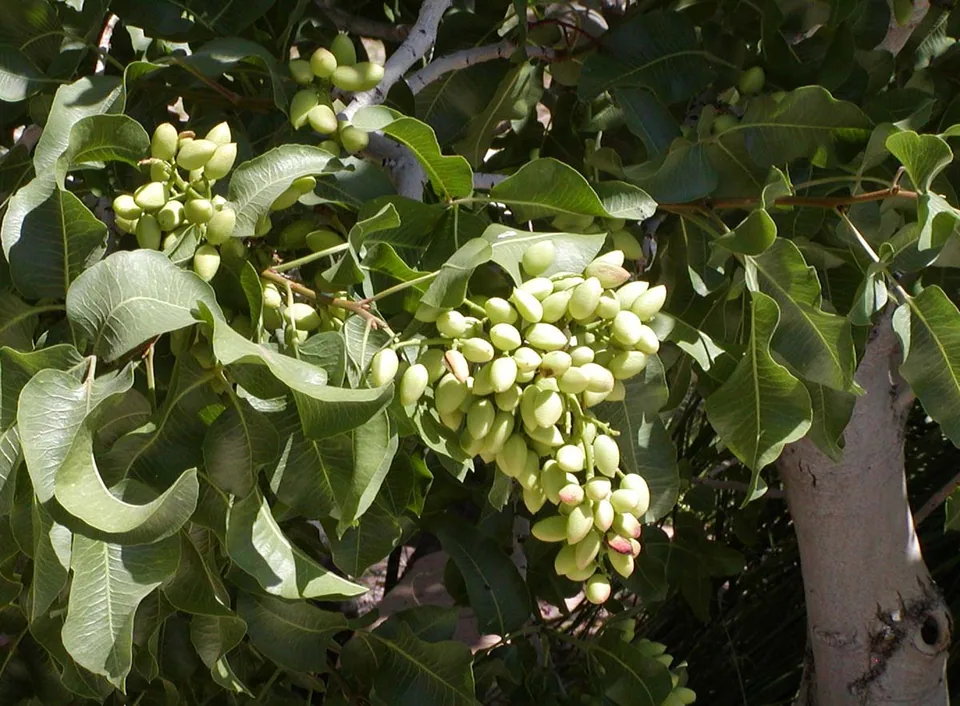
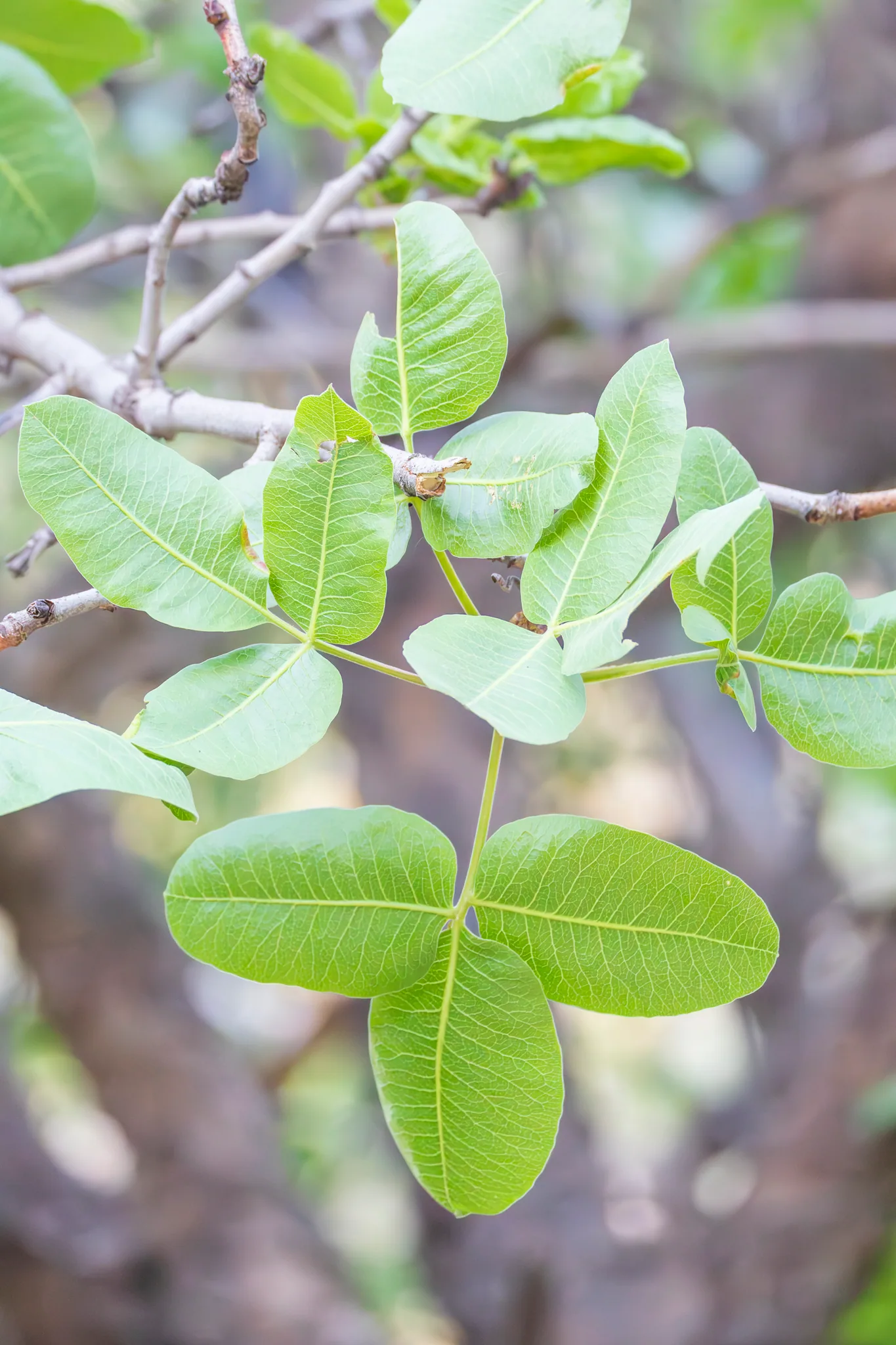

How to Grow and Care for Pistachio
Pistacia vera
Written by Emilio Marruso · last checked
At a glance
Of all its close relatives, the pistachio is the only one with edible nuts, and it handles drought with ease. Plant it in spring, keep water from pooling around the roots, and from 4–5 years after budding it starts to bear, with harvest from late August to early September. Plant one male tree for every 8 to 10 females: the wind carries the pollen.
- Water
Handles drought; keep the soil moist in late winter, spring and early summer for a good crop
What the sources say (1)
Watering: Drought tolerant; adequate soil moisture is needed in late winter, spring and early summer for commercial crop production
Pistachios are drought tolerant, but for commercial crop production there must be adequate soil moisture during late winter, spring and early summer.
— Growing Pistachios in New Mexico | New Mexico State University - BE BOLD. Shape the Future. [1] - Spacing
17 to 20 ft between trees in every direction
What the sources say (3)
Spacing: 518 x 518 cm (17 x 17 ft) to 610 x 610 cm (20 x 20 ft)
New Mexico: Tree spacing in New Mexico varies mostly from 17 feet by 17 feet to 20 feet by 20 feet
— Growing Pistachios in New Mexico | New Mexico State University - BE BOLD. Shape the Future. [1] Tree spacing in New Mexico varies mostly from 17 feet by 17 feet to 20 feet by 20 feet
— Growing Pistachios in New Mexico | New Mexico State University - BE BOLD. Shape the Future. [1] Row spacing: 732 cm (24 ft), trees 12 ft apart in the row
A good planting system seems to be spacing the trees 12 feet apart in rows spaced 24 feet apart.
— Growing Pistachios in New Mexico | New Mexico State University - BE BOLD. Shape the Future. [1] - Planting
Plant young potted trees in spring
What the sources say (1)
Planting: Spring (containerized seedlings)
It is a common practice to plant containerized seedlings in the spring and bud them in July or August with current year budwood.
— Growing Pistachios in New Mexico | New Mexico State University - BE BOLD. Shape the Future. [1] - Feeding
Nitrogen twice a year, March and June; none in the planting year or after June
What the sources say (6)
When: Nitrogen split in two: half before the first irrigation, half in June; none in the planting year
Nitrogen fertilizer should be broadcast and split in two rates; apply half before the first irrigation and the second half in June.
— Growing Pistachios in New Mexico | New Mexico State University - BE BOLD. Shape the Future. [1] Do not apply nitrogen fertilizer the year trees are planted. Apply one pound of ammonium sulfate per tree during the second year.
— Growing Pistachios in New Mexico | New Mexico State University - BE BOLD. Shape the Future. [1] How often: Nitrogen twice a year (March and June); minor elements once a month from April to July
Apply one pound of ammonium sulfate per tree during the second year. Split the rate in two parts, applying half a pound in March and half a pound in June.
— Growing Pistachios in New Mexico | New Mexico State University - BE BOLD. Shape the Future. [1] Pistachio trees need to be sprayed with minor elements, about three to four applications per year, one application a month from April to July.
— Growing Pistachios in New Mexico | New Mexico State University - BE BOLD. Shape the Future. [1] Avoid: Nitrogen in the planting year; nitrogen after June, which drives late growth and delays dormancy
Never apply nitrogen after June to prevent vigorous growth that may delay tree dormancy. Trees can be affected by early freezes if they are not fully dormant.
— Growing Pistachios in New Mexico | New Mexico State University - BE BOLD. Shape the Future. [1] Do not apply nitrogen fertilizer the year trees are planted.
— Growing Pistachios in New Mexico | New Mexico State University - BE BOLD. Shape the Future. [1] - Pruning
Prune in winter every 3–4 years, before the light-crop year; it fruits on last year's wood
What the sources say (4)
Pruning: Winter, before the off year of production (heading-back pruning)
This type of pruning should be done in the winter before the off year of production to minimize yield loss.
— Growing Pistachios in New Mexico | New Mexico State University - BE BOLD. Shape the Future. [1] When to prune: Bearing trees: in winter before the off year, every 3 to 4 years; young trees are trained with summer pinching and winter heading back.
This type of pruning should be done in the winter before the off year of production to minimize yield loss.
— Growing Pistachios in New Mexico | New Mexico State University - BE BOLD. Shape the Future. [1] Because pruning stimulates new fruit wood, a bearing and mature pistachio tree must be pruned every 3 to 4 years, even if it takes a few years for the pruned tree to out-yield the unpruned tree.
— Growing Pistachios in New Mexico | New Mexico State University - BE BOLD. Shape the Future. [1] Flowering wood: Flowers on old wood (last year's growth)
Apically dominant vegetative growth • Bears crop on year old wood • Alternate bearing scion
— [4] - Harvest
Late August to early September, when the hull slips off the shell; dry the nuts well
What the sources say (4)
Harvest: Late August to early September
Depending on the season, the last irrigation is usually done the first or second half of August, and harvest starts in late August to early September.
— Growing Pistachios in New Mexico | New Mexico State University - BE BOLD. Shape the Future. [1] How to harvest: Harvest when the hull separates easily from the shell (physiological maturity); mostly by mechanical shaking
Pistachio nuts are physiologically mature when the hull separates easily from the shell.
— Growing Pistachios in New Mexico | New Mexico State University - BE BOLD. Shape the Future. [1] Pistachio trees are shaken like pecan trees to harvest pistachio nuts.
— Growing Pistachios in New Mexico | New Mexico State University - BE BOLD. Shape the Future. [1] Storage: Dry the nuts until brittle dry (about 5% moisture) before storage
They must, however, be brittle dry (about 5% moisture) before storage.
— Growing Pistachios in New Mexico | New Mexico State University - BE BOLD. Shape the Future. [1] - Pollination
Separate male and female trees: one male for every 8–10 females; the wind does the rest
What the sources say (4)
Fruit set: Dioecious: male and female flowers on separate plants
The pistachio is a dioecious tree, meaning male and female flowers are produced on separate trees.
— Growing Pistachios in New Mexico | New Mexico State University - BE BOLD. Shape the Future. [1] What it needs: One male (pollinator) tree for 8 to 10 female trees.
One male (pollinator) tree for 8 to 10 female trees (producer) is recommended.
— Growing Pistachios in New Mexico | New Mexico State University - BE BOLD. Shape the Future. [1] Carried by: Wind
Pollination is carried out by wind only; therefore, mild winds during pollen shed would help.
— Growing Pistachios in New Mexico | New Mexico State University - BE BOLD. Shape the Future. [1] Female flowers do not have nectar petals that could attract bees for insect pollination.
— Growing Pistachios in New Mexico | New Mexico State University - BE BOLD. Shape the Future. [1] - Pests
Stink bugs, navel orangeworm and mites; wilt and root and crown rot
What the sources say (6)
Pests: stinkbug, leaf-footed plant bug, navel orangeworm, citrus flat mite
Besides the stinkbug and leaf-footed plant bug, no other insect problems have been reported yet in New Mexico pistachio orchards.
— Growing Pistachios in New Mexico | New Mexico State University - BE BOLD. Shape the Future. [1] The navel orange worm ( Amyelois transitella ) is considered the pistachio’s major insect problem in California.
— Growing Pistachios in New Mexico | New Mexico State University - BE BOLD. Shape the Future. [1] The citrus-flat mite ( Brevipalpus lewisi ) has been identified as the mite affecting pistachio orchards in California.
— Growing Pistachios in New Mexico | New Mexico State University - BE BOLD. Shape the Future. [1] Diseases: Verticillium wilt, cotton root rot, crown rot
Verticillium wilt ( Verticillum dahliae ) has been affecting pistachio orchards in California for years.
— Growing Pistachios in New Mexico | New Mexico State University - BE BOLD. Shape the Future. [1] Cotton root rot 1 ( Phymatotrichum omnivorum ) is not widely present in California crops much less in pistachio orchards.
— Growing Pistachios in New Mexico | New Mexico State University - BE BOLD. Shape the Future. [1] Crown rot ( Phytophtora parasitica ) attacks pistachio trees situated in poorly drained wet areas.
— Growing Pistachios in New Mexico | New Mexico State University - BE BOLD. Shape the Future. [1] - Watch out
Hates wet feet: never let water pool around the tree
What the sources say (1)
Watering notes: Does not tolerate wet feet; avoid ponding water around the trees
Pistachios do not tolerate wet feet. Avoid ponding water around the trees.
— Growing Pistachios in New Mexico | New Mexico State University - BE BOLD. Shape the Future. [1] - Size
20 to 30 ft tall
What the sources say (1)
Mature height: 610-914 cm (20-30 ft)
Pistachio trees are long-lived, tap-rooted and can grow to 20-30 feet tall.
— Growing Pistachios in New Mexico | New Mexico State University - BE BOLD. Shape the Future. [1] - Propagation
Mostly by budding onto a rootstock; also from seed after stratification
What the sources say (2)
Propagation: T-budding onto rootstock (most common method); seed after stratification
T-budding is the most common propagation method. Buds usually are placed on the windward side.
— Growing Pistachios in New Mexico | New Mexico State University - BE BOLD. Shape the Future. [1] Seeds need to be stratified to make them germinate.
— Growing Pistachios in New Mexico | New Mexico State University - BE BOLD. Shape the Future. [1]
Overview
Pistachio (Pistacia vera) is the only Pistacia species grown commercially for its fruit. [1] The tree is drought tolerant but does not tolerate waterlogged soil. [1]
This record is incomplete: the sources we read do not cover every field yet.
Not yet covered by our sources: Light
Pistachio care
How to water Pistachio
Watering
Drought tolerant; adequate soil moisture is needed in late winter, spring and early summer for commercial crop production
What the sources say (1)
Pistachios are drought tolerant, but for commercial crop production there must be adequate soil moisture during late winter, spring and early summer.Watering notes
Does not tolerate wet feet; avoid ponding water around the trees
What the sources say (1)
Pistachios do not tolerate wet feet. Avoid ponding water around the trees.How much light Pistachio needs
Not stated in the sources we read.
Where to grow Pistachio
518 x 518 cm (17 x 17 ft) to 610 x 610 cm (20 x 20 ft)
What each source says
New Mexico: 518 x 518 cm (17 x 17 ft) to 610 x 610 cm (20 x 20 ft)
What the sources say (2)
New Mexico: Tree spacing in New Mexico varies mostly from 17 feet by 17 feet to 20 feet by 20 feetTree spacing in New Mexico varies mostly from 17 feet by 17 feet to 20 feet by 20 feetHow to propagate Pistachio
T-budding onto rootstock (most common method); seed after stratification
What the sources say (2)
T-budding is the most common propagation method. Buds usually are placed on the windward side.Seeds need to be stratified to make them germinate.How to grow Pistachio
The plant
Mature height
610-914 cm (20-30 ft)
What the sources say (1)
Pistachio trees are long-lived, tap-rooted and can grow to 20-30 feet tall.Years to first fruit
4-5 years after budding
What the sources say (1)
Pistachio trees begin bearing the fourth or fifth year after budding.Sowing and growth
Row spacing
732 cm (24 ft), trees 12 ft apart in the row
What the sources say (1)
A good planting system seems to be spacing the trees 12 feet apart in rows spaced 24 feet apart.Harvest and storage
How to harvest
Harvest when the hull separates easily from the shell (physiological maturity); mostly by mechanical shaking
What the sources say (2)
Pistachio nuts are physiologically mature when the hull separates easily from the shell.Pistachio trees are shaken like pecan trees to harvest pistachio nuts.Storage
Dry the nuts until brittle dry (about 5% moisture) before storage
What the sources say (1)
They must, however, be brittle dry (about 5% moisture) before storage.Pests and diseases
Pests
stinkbug, leaf-footed plant bug, navel orangeworm, citrus flat mite
What the sources say (3)
Besides the stinkbug and leaf-footed plant bug, no other insect problems have been reported yet in New Mexico pistachio orchards.The navel orange worm ( Amyelois transitella ) is considered the pistachio’s major insect problem in California.The citrus-flat mite ( Brevipalpus lewisi ) has been identified as the mite affecting pistachio orchards in California.Diseases
Verticillium wilt, cotton root rot, crown rot
What the sources say (3)
Verticillium wilt ( Verticillum dahliae ) has been affecting pistachio orchards in California for years.Cotton root rot 1 ( Phymatotrichum omnivorum ) is not widely present in California crops much less in pistachio orchards.Crown rot ( Phytophtora parasitica ) attacks pistachio trees situated in poorly drained wet areas.Fertilizing
When
Nitrogen split in two: half before the first irrigation, half in June; none in the planting year
What the sources say (2)
Nitrogen fertilizer should be broadcast and split in two rates; apply half before the first irrigation and the second half in June.Do not apply nitrogen fertilizer the year trees are planted. Apply one pound of ammonium sulfate per tree during the second year.How often
Nitrogen twice a year (March and June); minor elements once a month from April to July
What the sources say (2)
Apply one pound of ammonium sulfate per tree during the second year. Split the rate in two parts, applying half a pound in March and half a pound in June.Pistachio trees need to be sprayed with minor elements, about three to four applications per year, one application a month from April to July.Mineral fertilizers
Ammonium sulfate as nitrogen source; potassium chloride and phosphorus fertilizers in established orchards
What each source says
second year: 454 g of ammonium sulfate per tree, split: 227 g in March and 227 g in June
third year, trees actively growing: 454 g of ammonium sulfate in March and 454 g in June
from the fourth year: 22.7–45.4 g of actual nitrogen (227–454 g of ammonium sulfate) per 2.54 cm [1 in] of trunk diameter
established orchards, unthrifty trees: Potassium chloride, 908 g–1.82 kg [4 lb] per tree
established orchards without drip irrigation: Monoammonium phosphate
What the sources say (7)
second year: Apply one pound of ammonium sulfate per tree during the second year. Split the rate in two parts, applying half a pound in March and half a pound in June.third year, trees actively growing: During the third year, and if trees are actively growing, apply 1 pound of ammonium sulfate in March and 1 pound of ammonium sulfate in June.from the fourth year: In subsequent years apply 1/10 to 1/20 of a pound of actual nitrogen (1/2 to 1 lb. of ammonium sulfate) per inch of trunk diameter.established orchards, unthrifty trees: In established orchards, 2–4 lbs of potassium chloride per tree has helped unthrifty trees grow better.established orchards without drip irrigation: For established orchards without drip irrigation, apply monoammonium phosphate (MAP) at the rate of 100 lbs per acre.In subsequent years apply 1/10 to 1/20 of a pound of actual nitrogen (1/2 to 1 lb. of ammonium sulfate) per inch of trunk diameter.In established orchards, 2–4 lbs of potassium chloride per tree has helped unthrifty trees grow better.Micronutrients
Boron, copper and zinc (above all boron), sprayed three to four times a year, monthly from April to July
What the sources say (1)
Pistachio trees need to be sprayed with minor elements, about three to four applications per year, one application a month from April to July. Emphasis should be given to boron, copper and zinc, especially boron.Avoid
Nitrogen in the planting year; nitrogen after June, which drives late growth and delays dormancy
What the sources say (2)
Never apply nitrogen after June to prevent vigorous growth that may delay tree dormancy. Trees can be affected by early freezes if they are not fully dormant.Do not apply nitrogen fertilizer the year trees are planted.Signs of deficiency
Crinkle leaf: linked to boron deficiency
What the sources say (1)
Crinkle leaf symptom is usually linked to boron deficiency and is becoming common in pistachio orchards.Pollination
Fruit set
Dioecious: male and female flowers on separate plants
What the sources say (1)
The pistachio is a dioecious tree, meaning male and female flowers are produced on separate trees.What it needs
One male (pollinator) tree for 8 to 10 female trees.
What the sources say (1)
One male (pollinator) tree for 8 to 10 female trees (producer) is recommended.Carried by
Wind
What the sources say (2)
Pollination is carried out by wind only; therefore, mild winds during pollen shed would help.Female flowers do not have nectar petals that could attract bees for insect pollination.Pruning
Flowering wood
Flowers on old wood (last year's growth)
What the sources say (1)
Apically dominant vegetative growth • Bears crop on year old wood • Alternate bearing scionWhen to prune
Bearing trees: in winter before the off year, every 3 to 4 years; young trees are trained with summer pinching and winter heading back.
What the sources say (2)
This type of pruning should be done in the winter before the off year of production to minimize yield loss.Because pruning stimulates new fruit wood, a bearing and mature pistachio tree must be pruned every 3 to 4 years, even if it takes a few years for the pruned tree to out-yield the unpruned tree.Hard pruning
Severe heading back (cuts on branches over 2.5 cm [1 in]) gives more and longer shoots the next year, but severely pruned trees take 4 years to out-yield unpruned ones.
What the sources say (2)
Severely pruned trees (cutting branches more than 1 inch in diameter) produce more and longer shoots the year after pruning.However, it takes about 4 years for severely pruned trees to out-yield the unpruned trees.Pinching
During training, pinch the terminal bud of new shoots in summer, when they reach 1.4 to 1.5 m [4.6–5 ft], to make the lateral buds grow.
What the sources say (2)
Two main pruning cuts are done to train pistachio trees: Pinching, which means eliminating only the terminal (end) bud of new shoots, and cutting or heading backWhen the new shoot reaches about 4-1/2 to 5 feet, new shoots should be pinched in the summer to cause growth of lateral buds.Winter chill
Chill hours
The sources give different values depending on region, zone or growing conditions.
What each source says
cultivar 'Kerman': 850 hours
What the sources say (1)
cultivar 'Kerman': University of California research and field observation suggests the pistachio cultivar, Kerman, requires about 850 hours below 450F for complete rest satisfaction.Remedies
Each remedy shows what official sources say about it; traditional remedies without an official source are marked as such. Harmful ones are listed so you know to avoid them.
Treating the plant
verticillium wilt
soil solarization with clear plastic Partly works
Soil solarization is expensive, but may be worth the cost in mature orchards where many trees are showing symptoms of disease.
— pubs.nmsu.edu [6] How: Tarping applied after irrigation will raise the soil temperature, reducing soil inoculum (microsclerotia and hyphae).
Tarping applied after irrigation will raise the soil temperature, reducing soil inoculum (microsclerotia and hyphae).
— pubs.nmsu.edu [6] What the evidence says In established orchards in growing regions with high summer temperatures, soil solarization may help to reduce the disease’s severity.
— pubs.nmsu.edu [6]
western tussock moth
bacillus thuringiensis spray Official source, not independently tested
How: Sprays of Bacillus thuringiensis or the organic formulation of spinosad are acceptable for use in an organically managed orchard.
Sprays of Bacillus thuringiensis or the organic formulation of spinosad are acceptable for use in an organically managed orchard.
— ipm.ucanr.edu [7]
rabbit bark damage
fencing or trunk guards Not verified
Traditional remedy, not verified by an official source.
How: Prevent damage with fencing or trunk guards.
bird damage
netting and removing roosting areas Not verified
Traditional remedy, not verified by an official source.
How: Remove roosting areas such as brush piles and use netting to protect crops.
ground squirrels
removing brush piles, stumps and debris Not verified
Traditional remedy, not verified by an official source.
How: To discourage ground squirrels from making burrows near the garden, remove brush piles, tree stumps and debris.
Calendar
Spring (containerized seedlings)
What the sources say (1)
It is a common practice to plant containerized seedlings in the spring and bud them in July or August with current year budwood.Late August to early September
What the sources say (1)
Depending on the season, the last irrigation is usually done the first or second half of August, and harvest starts in late August to early September.Winter, before the off year of production (heading-back pruning)
What the sources say (1)
This type of pruning should be done in the winter before the off year of production to minimize yield loss.Months as given by the sources, which are mostly from the United States (northern hemisphere). In the southern hemisphere they shift by about six months.
Edibility
Reported by the source, quoted verbatim. Do not eat a plant on the basis of this page alone: identification mistakes can be dangerous.
Pistachio (Pistacia vera L.) is the only species within the genus Pistacia with edible fruit.
[2]
Similar plants
- Terebinth Pistacia terebinthus
- Chinese Pistache Pistacia chinensis
- Lentisk Pistacia lentiscus
- Afghan Cherry Prunus jacquemontii
- Alaska blueberry Vaccinium ovalifolium
- Algerita Mahonia trifoliolata
- Allegheny Serviceberry Amelanchier laevis
- American chestnut Castanea dentata
Sources
Every value above is quoted from these documents. Links lead to the original publisher.
- Growing Pistachios in New Mexico | New Mexico State University - BE BOLD. Shape the Future. · pubs.nmsu.edu, consulted
- Pistachio · iris.unict.it, consulted
- 15 November 2026 · iris.unito.it, consulted
- louiseferguson.ucdavis.edu · louiseferguson.ucdavis.edu
- ccfruitandnuts.ucanr.edu · ccfruitandnuts.ucanr.edu
- pubs.nmsu.edu · pubs.nmsu.edu
- ipm.ucanr.edu · ipm.ucanr.edu
Written by Emilio Marruso · last checked