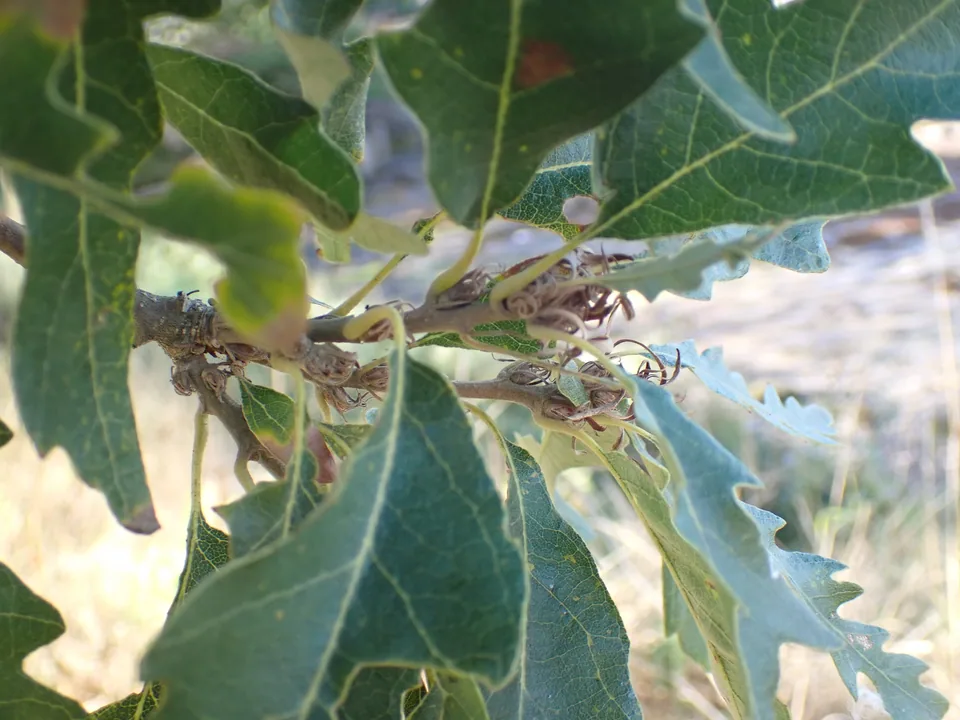
Cómo cultivar y cuidar Roble cabelludo
Quercus cerris
Escrito por Emilio Marruso · última revisión
Tóxica para: Personas · Por qué
De un vistazo
El roble de Turquía es un árbol amplio y generoso que puede alcanzar 9–15 m de ancho, y crece feliz a pleno sol o en semisombra. Puedes cultivar el tuyo a partir de una sola bellota: siémbrala en cuanto esté madura. Sus bellotas cocinadas incluso se comen, y secas se muelen en una harina para espesar guisos o hacer pan.
- Sol
De pleno sol a semisombra
- Frío
Aguanta inviernos de hasta −23,3 °C (−10 °F)
Muy rústica · USDA 6a · RHS H7 · Z6
Qué dicen las fuentes (2)
Rusticidad, zona más fría: 6a [mínima invernal de −23,3 a −20,6 °C (de −10 a −5 °F)]
USDA hardiness zones: 6A through 7B (Fig. 2) Origin: not native to North America
— ENH-702 [6] Rusticidad, zona más cálida: 7b [mínima invernal de −15 a −12,2 °C (de 5 a 10 °F)]
USDA hardiness zones: 6A through 7B (Fig. 2) Origin: not native to North America
— ENH-702 [6] - Cosecha
Bellotas de hasta 2,5 cm, se comen cocinadas; secas y molidas, espesan guisos o se usan para hacer pan
- Tamaño
Un árbol grande: 9–15 m de ancho
Qué dicen las fuentes (1)
Anchura adulta: 914-1524 cm (30-50 pies)
Height: 30 to 50 feet Spread: 30 to 50 feet
— ENH-702 [6] - Multiplicación
Se multiplica a partir de sus bellotas
Qué dicen las fuentes (2)
Propagación: Semilla (bellotas)
Seed - it quickly loses viability if it is allowed to dry out. It can be stored moist and cool overwinter
— Turkey Oak (Quercus cerris) — Practical Plants [4] It might make a good street tree for southern cities. Propagation is by seed. Pests and Diseases No pests
— ENH-702 [6] - Siembra
Siembra las bellotas en cuanto estén maduras
Qué dicen las fuentes (1)
Siembra: Tan pronto como la semilla esté madura
is best sown as soon as it is ripe in an outdoor seed bed, though it must be protected from mice, squirrels etc.
— Turkey Oak (Quercus cerris) — Practical Plants [4] - Seguridad
Poco tóxico: las bellotas son tan amargas que nadie come muchas
Resumen
El roble turco es un árbol caducifolio nativo del sur de Europa y Asia Menor. [1] Crece a pleno sol o semisombra y tolera casi cualquier suelo, excepto los húmedos. [6] Se planta ornamentalmente en parques, zonas urbanas y jardines grandes. [2]
Citado en inglés, como en la fuente.
Esta ficha está incompleta: las fuentes consultadas aún no cubren todos los campos.
Aún no cubierto por nuestras fuentes: Riego, Poda
Cuidados
Riego
No figura en las fuentes consultadas.
Luz
Clima y frío
Rusticidad, zona más fría
6a [mínima invernal de −23,3 a −20,6 °C (de −10 a −5 °F)]
Qué dicen las fuentes (1)
USDA hardiness zones: 6A through 7B (Fig. 2) Origin: not native to North AmericaRusticidad, zona más cálida
7b [mínima invernal de −15 a −12,2 °C (de 5 a 10 °F)]
Qué dicen las fuentes (1)
USDA hardiness zones: 6A through 7B (Fig. 2) Origin: not native to North AmericaPropagación
Semilla (bellotas)
Qué dicen las fuentes (2)
Seed - it quickly loses viability if it is allowed to dry out. It can be stored moist and cool overwinterIt might make a good street tree for southern cities. Propagation is by seed. Pests and Diseases No pestsCultivo
Remedios
Las fuentes consultadas no dan remedios para esta planta.
Toxicidad
Según la fuente, citada textualmente. No es un consejo médico ni veterinario: si una persona o un animal pudo haber ingerido esta planta, contacta con un centro de toxicología o con un veterinario.
Tannins are only of low toxicity and, because of their bitter taste and astringency, are unlikely to be eaten in large quantities.
[3]- Partes venenosas
All parts of the plant contain tannins. Whilst tannins are found in many foods
[3]- Principio tóxico
Tannins are only of low toxicity and, because of their bitter taste and astringency, are unlikely to be eaten in large quantities.
[3]- Síntomas
if they are taken in excess, they can cause stomach pains; constipation followed by bloody diarrhoea: excessive thirst; and excessive urination
[3]
Calendario
Siembra
Tan pronto como la semilla esté madura
Qué dicen las fuentes (1)
is best sown as soon as it is ripe in an outdoor seed bed, though it must be protected from mice, squirrels etc.Poda
No figura en las fuentes consultadas.
Meses tal como los dan las fuentes, en su mayoría de Estados Unidos (hemisferio norte). En el hemisferio sur se desplazan unos seis meses.
Comestibilidad
Según la fuente, citada textualmente. No comas una planta basándote solo en esta página: los errores de identificación pueden ser peligrosos.
Seed - cooked. Up to 2.5cm long. It can be dried, ground into a powder and used as a thickening in stews etc or mixed with cereals for making bread
[4]
Valores orientativos
Valores de una fuente secundaria, no comprobados palabra por palabra como el resto de esta página. Úselos como punto de partida.
- Ciclo de vida
- PerenneValor orientativo, adáptalo a tu clima · Fuente secundaria
- Altura adulta
- 1219.2-1828.8 cm (40-60 pies)Valor orientativo, adáptalo a tu clima · Fuente secundaria
- Riego
- MínimoValor orientativo, adáptalo a tu clima · Fuente secundaria
- pH del suelo
- 5.5-7.5Valor orientativo, adáptalo a tu clima · Fuente secundaria
- Crecimiento
- BajoValor orientativo, adáptalo a tu clima · Fuente secundaria
- Poda
- Febrero, marzo, abril, mayoValor orientativo, adáptalo a tu clima · Fuente secundaria
Plantas similares
- Quercitrón Quercus velutina
- Blackjack Oak Quercus marilandica
- Bluejack Oak Quercus incana
- Bluff Oak Quercus austrina
- O Roble bur Quercus macrocarpa
- Encino roble Quercus chrysolepis
- Cherrybark Oak Quercus pagoda
- Chestnut Oak Quercus montana
Fuentes
Cada valor anterior se cita de estos documentos. Los enlaces llevan al editor original.
- Quercus cerris · forest.jrc.ec.europa.eu, consultado
- Quercus cerris - EUFORGEN European forest genetic resources programme · euforgen.org, consultado
- Quercus cerris - Useful Temperate Plants · temperate.theferns.info, consultado
- Turkey Oak (Quercus cerris) — Practical Plants · practicalplants.org, consultado
- Quercus cerris - Trees and Shrubs Online · treesandshrubsonline.org, consultado
- ENH-702 · edis.ifas.ufl.edu, consultado
- Turkey oak (Quercus cer- · euforgen.org, consultado
Escrito por Emilio Marruso · última revisión