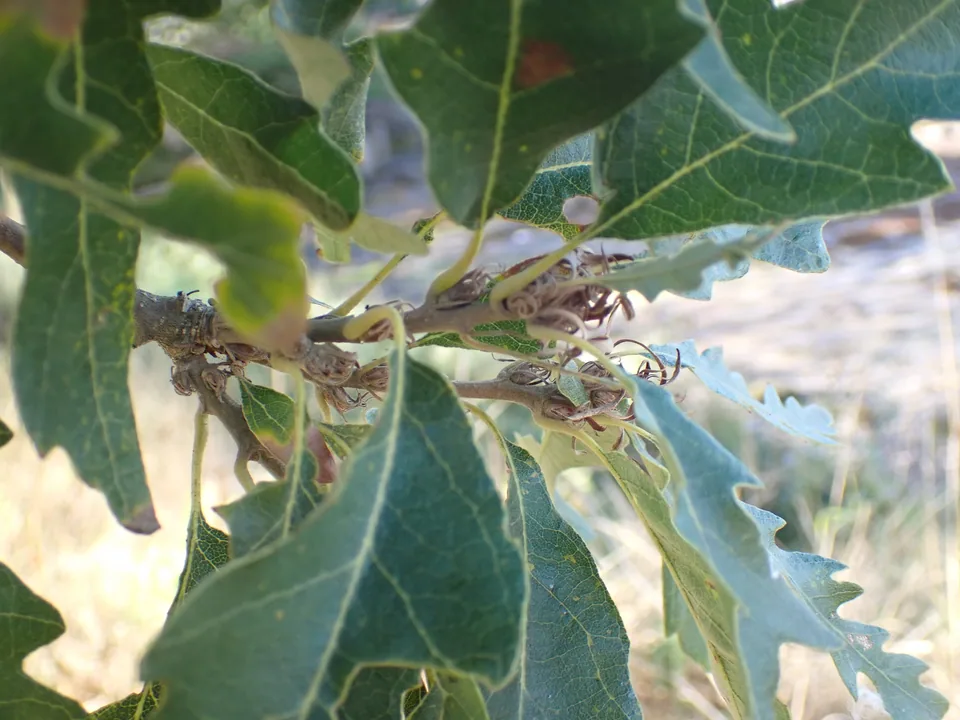
How to Grow and Care for Turkey Oak
Quercus cerris
Written by Emilio Marruso · last checked
Toxic to: People · Why
At a glance
Turkey oak is a generous, wide tree that can spread 30–50 feet, happy in full sun or partial shade. You can grow your very own from a single acorn: just sow it as soon as it is ripe. Its cooked acorns are even edible, and once dried they can be ground into a flour for thickening stews or baking bread.
- Sun
Full sun to partial shade
- Cold
Survives winters down to −10 °F (−23.3 °C)
Very hardy · USDA 6a · RHS H7 · Z6
What the sources say (2)
Hardiness, coldest zone: 6a [winter low −23.3 to −20.6 °C (−10 to −5 °F)]
USDA hardiness zones: 6A through 7B (Fig. 2) Origin: not native to North America
— ENH-702 [6] Hardiness, warmest zone: 7b [winter low −15 to −12.2 °C (5 to 10 °F)]
USDA hardiness zones: 6A through 7B (Fig. 2) Origin: not native to North America
— ENH-702 [6] - Harvest
Acorns up to 1 inch long, eaten cooked; dried and ground, they thicken stews or go into bread
- Size
A big tree: 30–50 ft wide
What the sources say (1)
Mature width: 914-1524 cm (30-50 ft)
Height: 30 to 50 feet Spread: 30 to 50 feet
— ENH-702 [6] - Propagation
Grows from its acorns
What the sources say (2)
Propagation: Seed (acorns)
Seed - it quickly loses viability if it is allowed to dry out. It can be stored moist and cool overwinter
— Turkey Oak (Quercus cerris) — Practical Plants [4] It might make a good street tree for southern cities. Propagation is by seed. Pests and Diseases No pests
— ENH-702 [6] - Sowing
Sow the acorns as soon as they are ripe
What the sources say (1)
Sowing: As soon as the seed is ripe
is best sown as soon as it is ripe in an outdoor seed bed, though it must be protected from mice, squirrels etc.
— Turkey Oak (Quercus cerris) — Practical Plants [4] - Safety
Low toxicity: the acorns are so bitter that nobody eats many
Overview
Turkey oak is a deciduous tree native to southern Europe and Asia Minor. [1] It grows in full sun or partial shade and tolerates almost any soil except wet ones. [6] It is planted ornamentally in parks, urban areas, and large gardens. [2]
This record is incomplete: the sources we read do not cover every field yet.
Not yet covered by our sources: Watering, Pruning
Turkey Oak care
How to water Turkey Oak
Not stated in the sources we read.
How much light Turkey Oak needs
How much cold Turkey Oak can take
Hardiness, coldest zone
6a [winter low −23.3 to −20.6 °C (−10 to −5 °F)]
What the sources say (1)
USDA hardiness zones: 6A through 7B (Fig. 2) Origin: not native to North AmericaHardiness, warmest zone
7b [winter low −15 to −12.2 °C (5 to 10 °F)]
What the sources say (1)
USDA hardiness zones: 6A through 7B (Fig. 2) Origin: not native to North AmericaHow to propagate Turkey Oak
Seed (acorns)
How to grow Turkey Oak
Remedies
The sources we checked give no remedies for this plant.
Is Turkey Oak poisonous?
Reported by the source, quoted verbatim. This is not medical or veterinary advice: if a person or an animal may have eaten this plant, contact a poison control centre or a veterinarian.
Tannins are only of low toxicity and, because of their bitter taste and astringency, are unlikely to be eaten in large quantities.
[3]- Poisonous parts
All parts of the plant contain tannins. Whilst tannins are found in many foods
[3]- Toxic principle
Tannins are only of low toxicity and, because of their bitter taste and astringency, are unlikely to be eaten in large quantities.
[3]- Symptoms
if they are taken in excess, they can cause stomach pains; constipation followed by bloody diarrhoea: excessive thirst; and excessive urination
[3]
Calendar
Sowing
As soon as the seed is ripe
What the sources say (1)
is best sown as soon as it is ripe in an outdoor seed bed, though it must be protected from mice, squirrels etc.Pruning
Not stated in the sources we read.
Months as given by the sources, which are mostly from the United States (northern hemisphere). In the southern hemisphere they shift by about six months.
Edibility
Reported by the source, quoted verbatim. Do not eat a plant on the basis of this page alone: identification mistakes can be dangerous.
Seed - cooked. Up to 2.5cm long. It can be dried, ground into a powder and used as a thickening in stews etc or mixed with cereals for making bread
[4]
Indicative values
Values from a secondary source, not checked word for word like the rest of this page. Use them as a starting point.
- Life cycle
- PerennialIndicative value, adapt it to your climate · Secondary source
- Mature height
- 1219.2-1828.8 cm (40-60 ft)Indicative value, adapt it to your climate · Secondary source
- Watering
- MinimumIndicative value, adapt it to your climate · Secondary source
- Soil pH
- 5.5-7.5Indicative value, adapt it to your climate · Secondary source
- Growth rate
- LowIndicative value, adapt it to your climate · Secondary source
- Pruning
- February, March, April, MayIndicative value, adapt it to your climate · Secondary source
Similar plants
- Black Oak Quercus velutina
- Blackjack Oak Quercus marilandica
- Bluejack Oak Quercus incana
- Bluff Oak Quercus austrina
- Bur Oak Quercus macrocarpa
- Canyon Live Oak Quercus chrysolepis
- Cherrybark Oak Quercus pagoda
- Chestnut Oak Quercus montana
Sources
Every value above is quoted from these documents. Links lead to the original publisher.
- Quercus cerris · forest.jrc.ec.europa.eu, consulted
- Quercus cerris - EUFORGEN European forest genetic resources programme · euforgen.org, consulted
- Quercus cerris - Useful Temperate Plants · temperate.theferns.info, consulted
- Turkey Oak (Quercus cerris) — Practical Plants · practicalplants.org, consulted
- Quercus cerris - Trees and Shrubs Online · treesandshrubsonline.org, consulted
- ENH-702 · edis.ifas.ufl.edu, consulted
- Turkey oak (Quercus cer- · euforgen.org, consulted
Written by Emilio Marruso · last checked