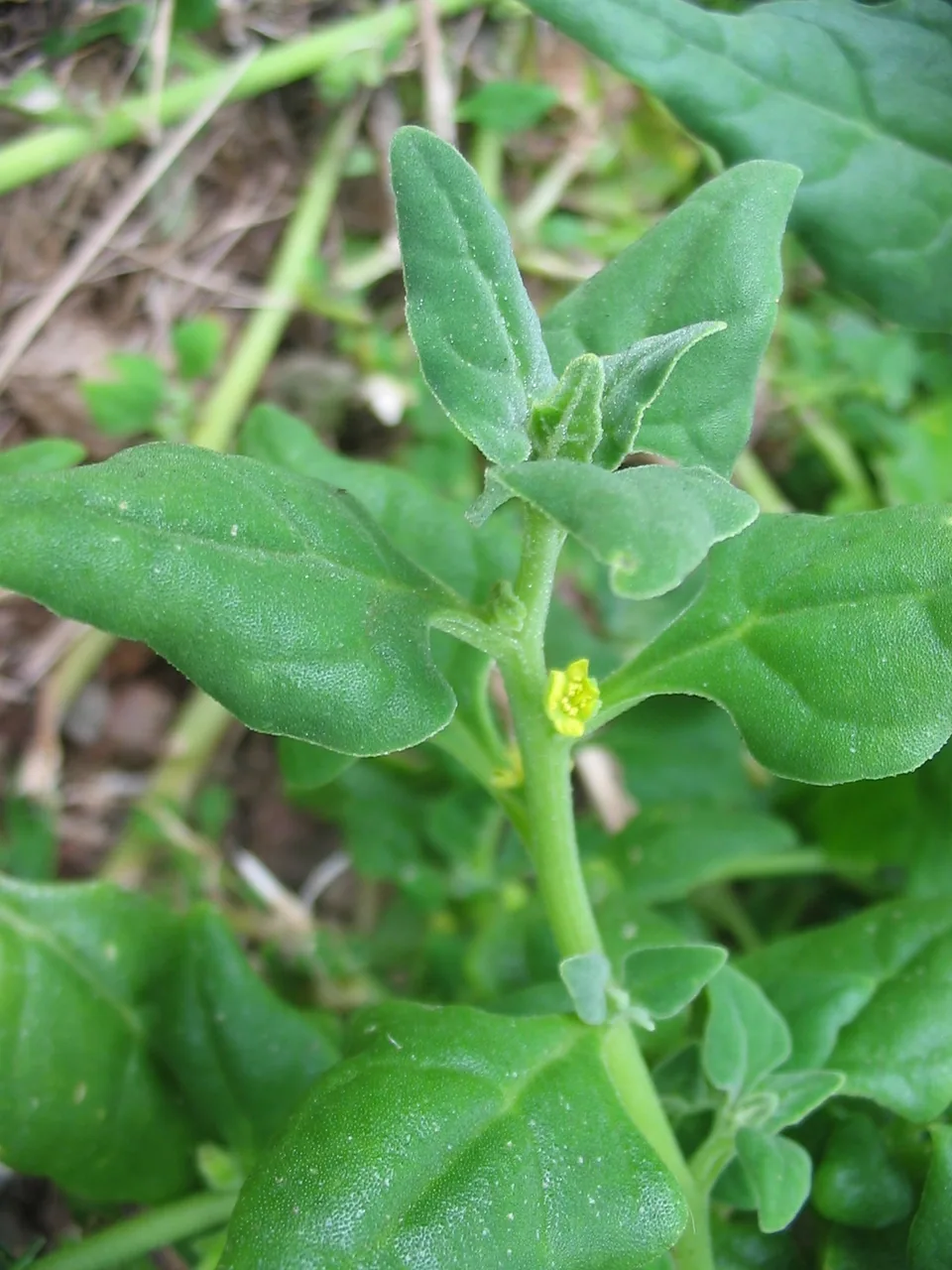
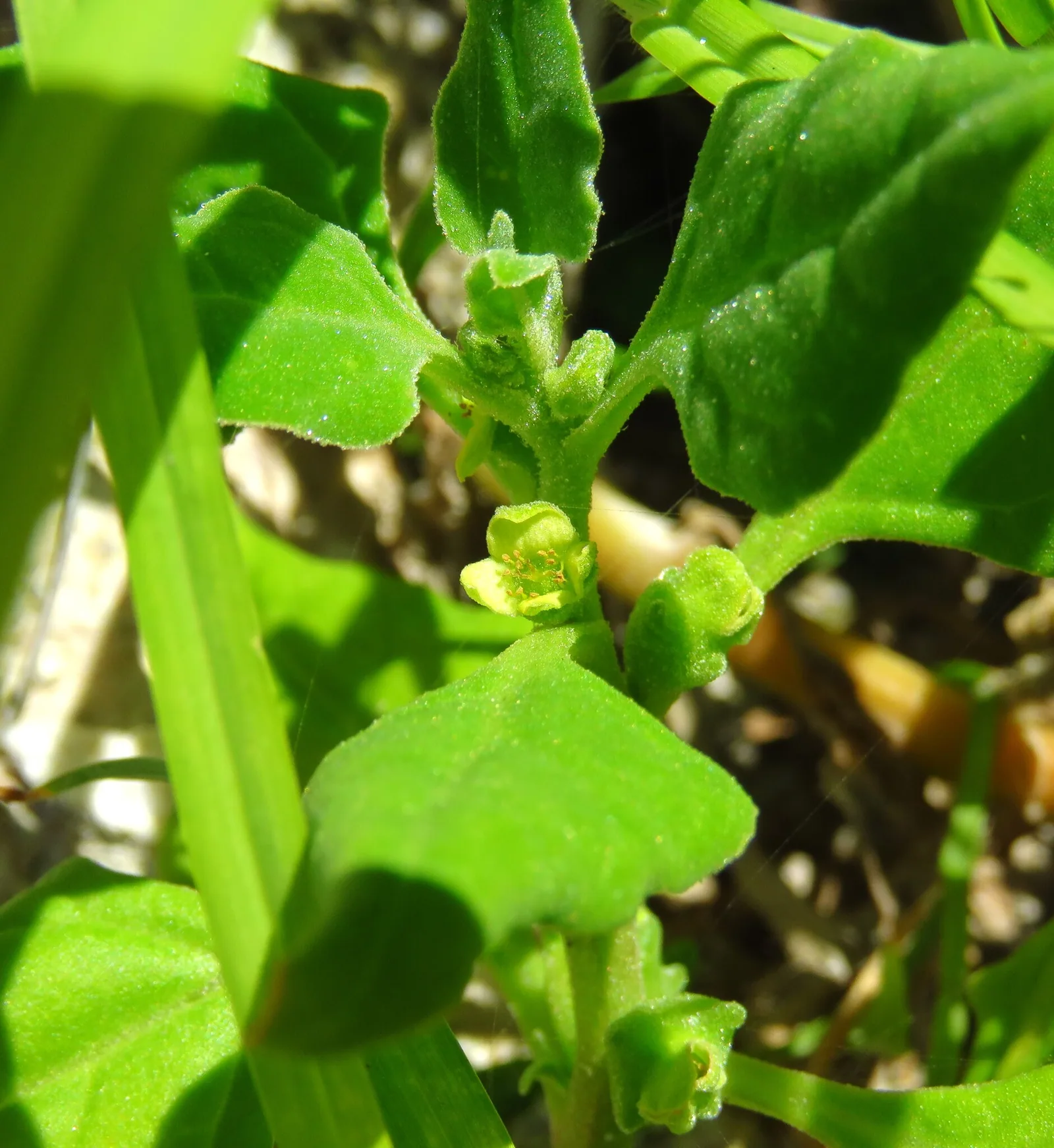

Cómo cultivar y cuidar New Zealand spinach
Tetragonia tetragonoides
Escrito por Emilio Marruso · última revisión
Tóxica para: Personas · Por qué
De un vistazo
La espinaca de Nueva Zelanda es una verdura generosa para huertos soleados: siémbrala cuando ya no haya riesgo de heladas y empieza a cosechar 50–70 días después. Aguanta la sequía, pero con riego constante sabe mejor y produce más. Recoge a menudo las hojas jóvenes y los brotes: salen otros nuevos que los sustituyen, para comer crudos o al vapor.
- Sol
Sol pleno
- Riego
Aguanta la sequía, pero con riego constante sabe mejor; tierra húmeda hasta que nazcan las plántulas
Qué dicen las fuentes (2)
Riego: Tolerante a la sequía; mejor sabor y rendimiento con riego constante
Although the flavor is best with consistent moisture, New Zealand spinach will still do well with little water without causing plants to bolt or producing a bitter taste.
— How to Grow New Zealand Spinach in Your Garden | USU [2] Notas sobre el riego: Mantén el suelo húmedo hasta que las plántulas comiencen a emerger
The soil should be kept moist until the seedlings begin to emerge.
— How to Grow New Zealand Spinach in Your Garden | USU [2] - Frío
Aguanta inviernos de hasta −6,7 °C (20 °F)
Rústica en inviernos normales · USDA 9 · RHS H4 · Z9
Qué dicen las fuentes (1)
Rusticidad, zona más fría: 9 [mínima invernal de −6,7 a −1,1 °C (de 20 a 30 °F)]
Shade tolerance no shade Water moderate Hardiness Zone 9+
— New Zealand Spinach (Tetragonia tetragonoides) — Practical Plants [3] - Distancia
90 cm entre hileras
Qué dicen las fuentes (1)
Distancia entre hileras: 91.44 cm (3 pies)
Plant in rows 3 feet apart, with seeds 2 inches apart within the row.
— How to Grow New Zealand Spinach in Your Garden | USU [2] - Plantación
Trasplanta cuando ya no haya riesgo de heladas
Qué dicen las fuentes (1)
Plantación: Después de que haya pasado el peligro de las heladas.
Or plant seeds inside 3-4 weeks before the last frost date, and transplant after the danger of frost has passed.
— How to Grow New Zealand Spinach in Your Garden | USU [2] - Abonado
Abona cada mes; si florece pronto y deja de crecer, le falta alimento
Qué dicen las fuentes (3)
Frecuencia: Mensual
New Zealand spinach needs generous fertilization, otherwise it flowers early which stops growth. Fertilizing monthly, applying ¼ cup per 10 feet of row of a nitrogen-based fertilizer (21-0-0).
— How to Grow New Zealand Spinach in Your Garden | USU [2] Although New Zealand spinach is drought tolerant, water consistently for the best flavor. Fertilize frequently with a high nitrogen fertilizer.
— How to Grow New Zealand Spinach in Your Garden | USU [2] Signos de carencia: Floración temprana que detiene el crecimiento
New Zealand spinach needs generous fertilization, otherwise it flowers early which stops growth. Fertilizing monthly, applying ¼ cup per 10 feet of row of a nitrogen-based fertilizer (21-0-0).
— How to Grow New Zealand Spinach in Your Garden | USU [2] - Cosecha
Recoge hojas jóvenes y brotes 50–70 días después de sembrar; corta las puntas a 10 cm
Qué dicen las fuentes (2)
Cosecha: 50-70 días desde la semilla; las hojas jóvenes y las puntas se cosechan con frecuencia
From seed to harvest takes 50-70 days. Only the young leaves and tips are gathered for use.
— How to Grow New Zealand Spinach in Your Garden | USU [2] Cómo cosechar: Recoge solo las hojas y puntas jóvenes; corta las puntas a 4 pulgadas (10.16 cm) para que las hojas nuevas reemplacen a las viejas.
Only the young leaves and tips are gathered for use. Regular trimming and good fertilization of the plants encourages lush growth. Cut the tips back at 4 inches and allow new leaves to replace the older leaves.
— How to Grow New Zealand Spinach in Your Garden | USU [2] - Plagas
Los escarabajos hacen agujeritos, pero rebrota rápido; el exceso de humedad y sombra trae mildiu
Qué dicen las fuentes (1)
Plagas: escarabajos masticadores
It has been found that various chewing beetles may feed on the leaves, causing small, round holes to appear.
— How to Grow New Zealand Spinach in Your Garden | USU [2] - Multiplicación
Por semilla o por esquejes
Qué dicen las fuentes (2)
Propagación: Semilla; esquejes
Easily grown from seed and once established self-sows freely.
— Tetragonia tetragonoides • New Zealand Plant Conservation Network [5] Like the Betel Leaf , they can also be grown by propagation , that is by taking a cutting and rooting in water then transplanting it once roots have formed.
— Warrigal Greens Growing Guide - Bush Food - The Gourmantic Garden [4] - Siembra
Siembra a 1 cm tras las heladas, o en interior 3–4 semanas antes; nace en 2–3 semanas
Qué dicen las fuentes (4)
Siembra: Después de que pase el peligro de heladas al aire libre; en interiores 3-4 semanas antes de la última fecha de helada
Según Practical Plants: Seed - sow early to mid spring in a greenhouse.
— New Zealand Spinach (Tetragonia tetragonoides) — Practical Plants [3] Seeds can be directly sown after frost danger has passed. Or plant seeds inside 3-4 weeks before the last frost date, and transplant after the danger of frost has passed.
— How to Grow New Zealand Spinach in Your Garden | USU [2] Profundidad de siembra: 1.27 cm (1/2 pulgada)
Seeds should be planted ½ inch deep in fine soil. The soil should be kept moist until the seedlings begin to emerge.
— How to Grow New Zealand Spinach in Your Garden | USU [2] Días de germinación: hasta 14-21 (2-3 semanas)
Seeds take up to 2 or 3 weeks to emerge and do not emerge uniformly.
— How to Grow New Zealand Spinach in Your Garden | USU [2] - Seguridad
Rica en oxalatos, que pueden ser dañinos en grandes cantidades
Resumen
La espinaca de Nueva Zelanda es una alternativa de clima cálido a la espinaca regular que prospera en condiciones calurosas y secas. [2] No es resistente y se siembra después de la última helada o se inicia en interiores. [2] Las hojas tienen un alto contenido de oxalato y se recomienda blanquearlas. [2]
Citado en inglés, como en la fuente.
Esta ficha está incompleta: las fuentes consultadas aún no cubren todos los campos.
Aún no cubierto por nuestras fuentes: Distancia de plantación
Cuidados
Riego
Riego
Tolerante a la sequía; mejor sabor y rendimiento con riego constante
Qué dicen las fuentes (1)
Although the flavor is best with consistent moisture, New Zealand spinach will still do well with little water without causing plants to bolt or producing a bitter taste.Notas sobre el riego
Mantén el suelo húmedo hasta que las plántulas comiencen a emerger
Qué dicen las fuentes (1)
The soil should be kept moist until the seedlings begin to emerge.Luz
Clima y frío
9 [mínima invernal de −6,7 a −1,1 °C (de 20 a 30 °F)]
Qué dicen las fuentes (1)
Shade tolerance
no shade
Water
moderate
Hardiness
Zone 9+Dónde cultivarla
Las fuentes dan valores distintos según la región, la zona o las condiciones de cultivo.
Lo que dice cada fuente
Según Utah State University Extension: 30.5 cm (12 pulgadas) entre filas; filas separadas 91.4 cm (3 pies)
Qué dicen las fuentes (1)
Según Utah State University Extension: Plant in rows 3 feet apart, with seeds 2 inches apart within the row. When plants are 1-2 inches tall, thin to 12 inches apart.Propagación
Semilla; esquejes
Qué dicen las fuentes (2)
Easily grown from seed and once established self-sows freely.Like the Betel Leaf , they can also be grown by propagation , that is by taking a cutting and rooting in water then transplanting it once roots have formed.Cultivo
Siembra y crecimiento
Días de germinación
hasta 14-21 (2-3 semanas)
Qué dicen las fuentes (1)
Seeds take up to 2 or 3 weeks to emerge and do not emerge uniformly.Profundidad de siembra
1.27 cm (1/2 pulgada)
Qué dicen las fuentes (1)
Seeds should be planted ½ inch deep in fine soil. The soil should be kept moist until the seedlings begin to emerge.Distancia entre hileras
91.44 cm (3 pies)
Qué dicen las fuentes (1)
Plant in rows 3 feet apart, with seeds 2 inches apart within the row.Días hasta la madurez
50-70 días desde la semilla hasta la cosecha
Qué dicen las fuentes (1)
From seed to harvest takes 50-70 days. Only the young leaves and tips are gathered for use.Cosecha y conservación
Cómo cosechar
Recoge solo las hojas y puntas jóvenes; corta las puntas a 4 pulgadas (10.16 cm) para que las hojas nuevas reemplacen a las viejas.
Qué dicen las fuentes (1)
Only the young leaves and tips are gathered for use. Regular trimming and good fertilization of the plants encourages lush growth. Cut the tips back at 4 inches and allow new leaves to replace the older leaves.Conservación
Almacena a 1.7 °C (35 °F) y 95-100% de humedad durante 2-3 semanas.
Qué dicen las fuentes (1)
Before the next harvest, store at 35º F and 95- 100% humidity for 2-3 weeks.Plagas y enfermedades
Plagas
escarabajos masticadores
Qué dicen las fuentes (1)
It has been found that various chewing beetles may feed on the leaves, causing small, round holes to appear.Abonado
Frecuencia
Mensual
Qué dicen las fuentes (2)
New Zealand spinach needs generous fertilization, otherwise it flowers early which stops growth. Fertilizing monthly, applying ¼ cup per 10 feet of row of a nitrogen-based fertilizer (21-0-0).Although New Zealand spinach is drought tolerant, water consistently for the best flavor. Fertilize frequently with a high nitrogen fertilizer.Abonos naturales
Materia orgánica bien compostada, no más de 2,54 cm [1 in] por 9,29 m² de jardín
Qué dicen las fuentes (1)
If fertilizer applications are warranted, work the fertilizer into the top 6 inches of soil. If you fertilize with compost, apply no more than 1 inch of well-composted organic matter per 100 square feet of garden area.Abonos minerales
Fertilizante nitrogenado 21-0-0, 59.3 mL por cada 3.05 m [10 ft] de hilera cada mes
Qué dicen las fuentes (1)
New Zealand spinach needs generous fertilization, otherwise it flowers early which stops growth. Fertilizing monthly, applying ¼ cup per 10 feet of row of a nitrogen-based fertilizer (21-0-0).Signos de carencia
Floración temprana que detiene el crecimiento
Qué dicen las fuentes (1)
New Zealand spinach needs generous fertilization, otherwise it flowers early which stops growth. Fertilizing monthly, applying ¼ cup per 10 feet of row of a nitrogen-based fertilizer (21-0-0).Problemas
Mildiu
Síntoma: Problemas con el mildiu por exceso de humedad y sombra
Qué hacer: Cultiva a pleno sol y evita el exceso de humedad
Qué dicen las fuentes (1)
It prefers full sun - excess moisture and shade can result in problems with mildew.
— Plants of Tasmania Nursery & Gardens [1] Escarabajos masticadores
Síntoma: Agujeros pequeños y redondos en las hojas
Qué hacer: El control generalmente no es necesario porque las plantas crecen lo suficientemente rápido
Qué dicen las fuentes (1)
It has been found that various chewing beetles may feed on the leaves, causing small, round holes to appear. Generally plants grow rapidly enough that control is not necessary.
— How to Grow New Zealand Spinach in Your Garden | USU [2]
Remedios
Las fuentes consultadas no dan remedios para esta planta.
Toxicidad
Según la fuente, citada textualmente. No es un consejo médico ni veterinario: si una persona o un animal pudo haber ingerido esta planta, contacta con un centro de toxicología o con un veterinario.
New Zealand spinach does have a high oxalate content, which can be dangerous at high concentrations.
[2]
Calendario
Siembra
Después de que pase el peligro de heladas al aire libre; en interiores 3-4 semanas antes de la última fecha de helada
Lo que dice cada fuente
Según Practical Plants: De principios a mediados de la primavera en un invernadero
Qué dicen las fuentes (2)
Según Practical Plants: Seed - sow early to mid spring in a greenhouse.Seeds can be directly sown after frost danger has passed. Or plant seeds inside 3-4 weeks before the last frost date, and transplant after the danger of frost has passed.Plantación
Después de que haya pasado el peligro de las heladas.
Qué dicen las fuentes (1)
Or plant seeds inside 3-4 weeks before the last frost date, and transplant after the danger of frost has passed.Cosecha
50-70 días desde la semilla; las hojas jóvenes y las puntas se cosechan con frecuencia
Qué dicen las fuentes (1)
From seed to harvest takes 50-70 days. Only the young leaves and tips are gathered for use.Meses tal como los dan las fuentes, en su mayoría de Estados Unidos (hemisferio norte). En el hemisferio sur se desplazan unos seis meses.
Respecto a las heladas
Estimación menos precisa: no hay ninguna estación meteorológica a menos de 300 km.
Busca las fechas de heladas por código postal o ciudad
Siembra en interior: de 3 a 4 semanas antes de la última helada
Or plant seeds inside 3-4 weeks before the last frost date, and transplant after the danger of frost has passed.
— How to Grow New Zealand Spinach in Your Garden | USU [2] Siembra al aire libre: hacia la última helada
Seeds can be directly sown after frost danger has passed.
— How to Grow New Zealand Spinach in Your Garden | USU [2]
Cuenta desde las fechas medias de las heladas de tu zona.
Comestibilidad
Según la fuente, citada textualmente. No comas una planta basándote solo en esta página: los errores de identificación pueden ser peligrosos.
Plantas similares
- Bananero de Etiopía Ensete ventricosum
- Agretti Soda inermis
- Apio caballar Smyrnium olusatrum
- Allium triquetrum Allium triquetrum
- Alpine dock Rumex alpinus
- Bledo Amaranthus hybridus
- American hogpeanut Amphicarpaea bracteata
- American Yellow Rocket Barbarea orthoceras
Fuentes
Cada valor anterior se cita de estos documentos. Los enlaces llevan al editor original.
- Plants of Tasmania Nursery & Gardens · potn.com.au, consultado
- How to Grow New Zealand Spinach in Your Garden | USU · extension.usu.edu, consultado
- New Zealand Spinach (Tetragonia tetragonoides) — Practical Plants · practicalplants.org, consultado
- Warrigal Greens Growing Guide - Bush Food - The Gourmantic Garden · thegourmanticgarden.com, consultado
- Tetragonia tetragonoides • New Zealand Plant Conservation Network · nzpcn.org.nz, consultado
- Tetragonia tetragonoides - Useful Temperate Plants · temperate.theferns.info, consultado
Escrito por Emilio Marruso · última revisión