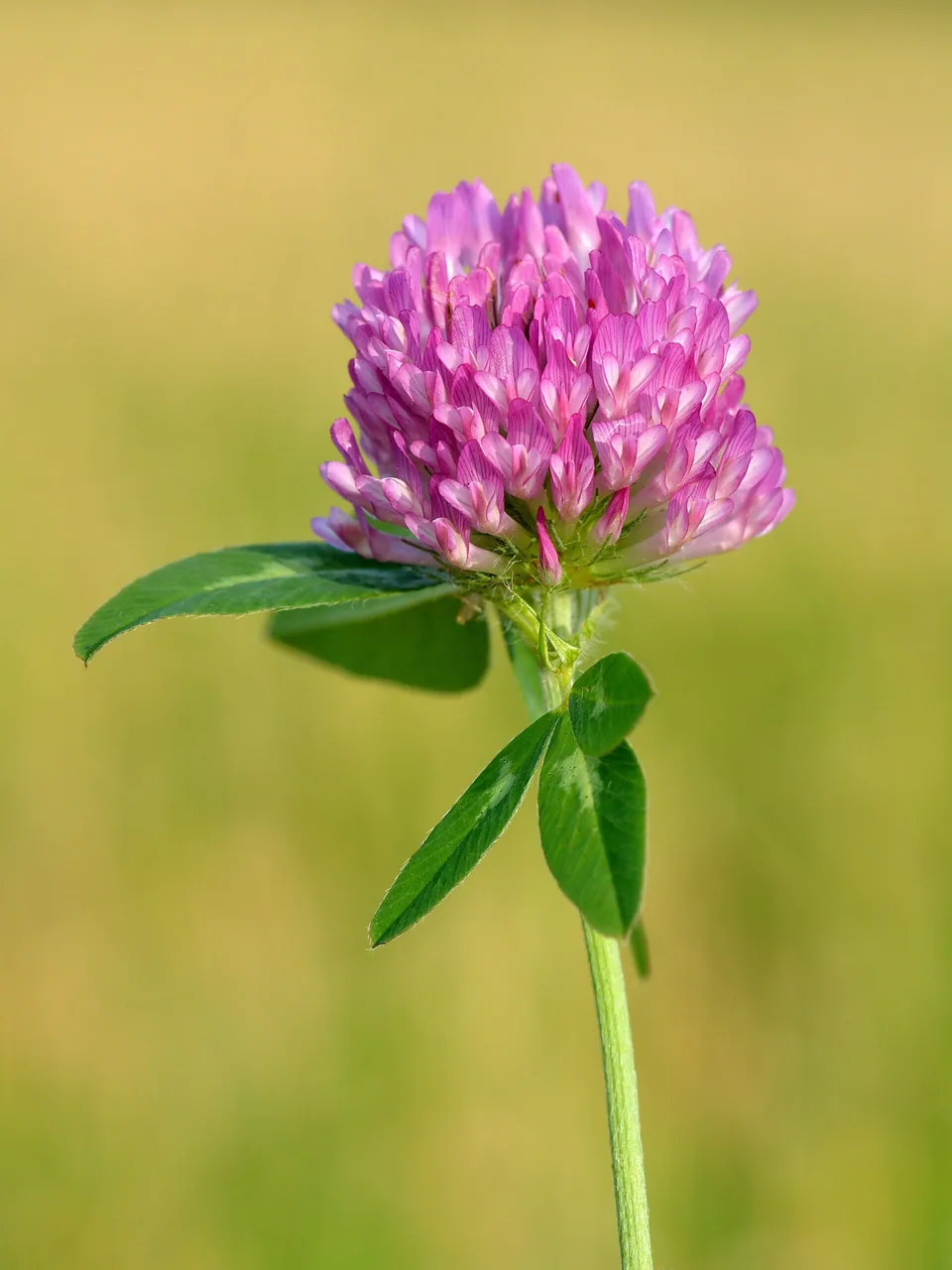


Cómo cultivar y cuidar Trébol rojo
Trifolium pratense
Escrito por Emilio Marruso · última revisión
De un vistazo
El trébol rojo es una planta fácil de empezar desde semilla en un rincón soleado. Sus hojas tiernas y sus cabezuelas de flores, de sabor dulce o a heno, son comestibles crudas o cocinadas, y las flores jóvenes alegran una ensalada. Recoge las hojas antes de que florezca y disfruta viéndola crecer entre 15 y 61 cm de alto.
- Sol
Sol pleno
Qué dicen las fuentes (2)
Luz: Pleno sol
Light: Full sun (6 or more hours of direct sunlight a day)
— Trifolium pratense (Cow Grass, Peavine Clover, Purple Clover, Red Clover) | North Carolina Extension Gardener Plant Toolbox [1] It is more prevalent in under-fertilized lawns and grows well in full sun.
— Lawn and Turfgrass Weeds: Red Clover, Trifolium pratense L. [3] - Frío
Aguanta inviernos de hasta −40 °C (−40 °F)
Muy rústica · USDA 3a · RHS H7 · Z3
Qué dicen las fuentes (2)
Rusticidad, zona más fría: 3a [mínima invernal de −40 a −37,2 °C (de −40 a −35 °F)]
USDA Plant Hardiness Zone: 3a, 3b, 4a, 4b, 5a, 5b, 6a, 6b, 7a, 7b, 8a, 8b, 9a, 9b - Fruit:
— Trifolium pratense (Cow Grass, Peavine Clover, Purple Clover, Red Clover) | North Carolina Extension Gardener Plant Toolbox [1] Rusticidad, zona más cálida: 9b [mínima invernal de −3,9 a −1,1 °C (de 25 a 30 °F)]
USDA Plant Hardiness Zone: 3a, 3b, 4a, 4b, 5a, 5b, 6a, 6b, 7a, 7b, 8a, 8b, 9a, 9b - Fruit:
— Trifolium pratense (Cow Grass, Peavine Clover, Purple Clover, Red Clover) | North Carolina Extension Gardener Plant Toolbox [1] - Abonado
Abona en el momento de la siembra, mejor guiándote por un análisis del suelo
Qué dicen las fuentes (4)
Cuándo: En el momento de la siembra
In the absence of a soil test, use a fertilizer treatment of about 20 lb N/ac, 60 lb P/ac and 40 lb K/ac at seeding time when seed are drilled.
— Red Clover (Trifolium pratense) | Mississippi State University Extension Service [2] Abonos minerales: Según análisis del suelo; sin uno, 22.4 kg [49,4 lb] de N, 67.3 kg [148,4 lb] de P y 44.8 kg [98,8 lb] de K por hectárea al sembrar con siembra directa
Campos utilizados para heno: In the absence of a soil test, apply a mixed fertilizer such as a 0-30-90 each year to red clover fields used for hay.
— Red Clover (Trifolium pratense) | Mississippi State University Extension Service [2] Sembrado sobre granos pequeños o ryegrass para forraje de invierno: When red clover is seeded on small grains or ryegrass for winter forage, about 60 lb P/ac should be applied at the time of seeding. or mix seed and fertilizer together and apply them at the same time.
— Red Clover (Trifolium pratense) | Mississippi State University Extension Service [2] Fertility treatments are best recommended on the basis of a soil test. In the absence of a soil test, use a fertilizer treatment of about 20 lb N/ac, 60 lb P/ac and 40 lb K/ac at seeding time when seed are drilled.
— Red Clover (Trifolium pratense) | Mississippi State University Extension Service [2] - Cosecha
Recoge las hojas tiernas antes de que florezca; las flores se comen crudas o cocinadas
Qué dicen las fuentes (8)
Cosecha: Hojas jóvenes antes de que la planta florezca; forraje: cosecha inicial 60-70 días después de la siembra, luego cada 30-35 días; generalmente dos o tres cosechas por año
Según NC State Extension (edible leaves): Its young leaves should be harvested before the plant flowers.
— Trifolium pratense (Cow Grass, Peavine Clover, Purple Clover, Red Clover) | North Carolina Extension Gardener Plant Toolbox [1] Misisipi (forraje): Initial harvest 60-70 days after seeding and subsequent harvest on a 30-35 day interval will generally allow for three harvests
— Red Clover (Trifolium pratense) | Mississippi State University Extension Service [2] Pensilvania (forraje): Red clover, a short-lived perennial, can usually be harvested two or three times per year.
— Red Clover [5] Its young leaves should be harvested before the plant flowers.
— Trifolium pratense (Cow Grass, Peavine Clover, Purple Clover, Red Clover) | North Carolina Extension Gardener Plant Toolbox [1] Initial harvest 60-70 days after seeding and subsequent harvest on a 30-35 day interval will generally allow for three harvests during the seeding year.
— Red Clover (Trifolium pratense) | Mississippi State University Extension Service [2] Red clover, a short-lived perennial, can usually be harvested two or three times per year.
— Red Clover [5] Cómo cosechar: las hojas jóvenes se cosechan antes de que la planta florezca; para heno, se corta en la etapa de floración
Its young leaves should be harvested before the plant flowers. They can be used in salads or soups or cooked similar to spinach.
— Trifolium pratense (Cow Grass, Peavine Clover, Purple Clover, Red Clover) | North Carolina Extension Gardener Plant Toolbox [1] It should be cut at bloom stage to maintain good hay quality.
— Red Clover (Trifolium pratense) | Mississippi State University Extension Service [2] - Plagas
Podredumbre del trébol, del cuello y de la raíz, oídio y antracnosis; elige variedades resistentes
Qué dicen las fuentes (4)
Enfermedades: pudrición del trébol, pudrición de la corona y de la raíz, mildiu polvoriento, antracnosis del norte, antracnosis del sur, virus del mosaico amarillo
It is listed as invasive in a few states scattered around the county including WV and KY. Clover rot can be an issue.
— Trifolium pratense (Cow Grass, Peavine Clover, Purple Clover, Red Clover) | North Carolina Extension Gardener Plant Toolbox [1] It is susceptible to crown- and root-rotting disease complexes, contributing to its short-lived nature.
— Red Clover [5] Susceptibility to powdery mildew, southern anthracnose, and yellow mosaic virus is higher than other clovers.
— Red Clover (Trifolium pratense) | Mississippi State University Extension Service [2] Varieties resistant to northern and southern anthracnose and powdery mildew are recommended for use throughout the state.
— Red Clover [5] - Atención
Se resiembra sola y se extiende con raíces vigorosas, así que puede invadir el césped
- Tamaño
De 15 a 61 cm de alto y de 20 a 51 cm de ancho
Qué dicen las fuentes (2)
Altura adulta: 15-61 cm (0.5-2 pies)
Dimensions: Height: 0 ft. 6 in. - 2 ft. 0 in. Width: 0 ft. 8 in. - 1 ft. 8 in.
— Trifolium pratense (Cow Grass, Peavine Clover, Purple Clover, Red Clover) | North Carolina Extension Gardener Plant Toolbox [1] Anchura adulta: 20-51 cm (8 pulg-1 pie 8 pulg)
Dimensions: Height: 0 ft. 6 in. - 2 ft. 0 in. Width: 0 ft. 8 in. - 1 ft. 8 in.
— Trifolium pratense (Cow Grass, Peavine Clover, Purple Clover, Red Clover) | North Carolina Extension Gardener Plant Toolbox [1] - Multiplicación
Se multiplica por semilla
Qué dicen las fuentes (1)
Propagación: Semilla
Recommended Propagation Strategy: Seed Country Or Region Of Origin: Eurasia
— Trifolium pratense (Cow Grass, Peavine Clover, Purple Clover, Red Clover) | North Carolina Extension Gardener Plant Toolbox [1] - Siembra
Siembra en primavera, o a finales de verano en climas cálidos, a 6–13 mm de profundidad
Qué dicen las fuentes (10)
Siembra: Pensilvania: primavera (abril a principios de mayo); Misisipi: 15 de agosto al 30 de septiembre, resiembra del 15 de octubre al 20 de noviembre; cultivo de cobertura en Iowa: agosto hasta principios de septiembre
Pensilvania: Seeding red clover in the spring (April to early May) or with a spring oat companion crop in a conventionally prepared seedbed is common.
— Red Clover [5] Misisipi: Seed should be planted between Aug. 15 to Sept. 30. in prepared seed bed
— Red Clover (Trifolium pratense) | Mississippi State University Extension Service [2] Misisipi (pastos establecidos): Established pastures should be overseeded between October 15 and November 20th.
— Red Clover (Trifolium pratense) | Mississippi State University Extension Service [2] Iowa (cultivo de cobertura): Planting date : August through early September Seeding depth : 0.25” to 0.5” – rainfall/soil moisture needed to get good establishment
— Red clover as a cover crop | Integrated Crop Management [6] Seeding red clover in the spring (April to early May) or with a spring oat companion crop in a conventionally prepared seedbed is common.
— Red Clover [5] Seed should be planted between Aug. 15 to Sept. 30. in prepared seed bed at a rate of 6 to lb/ac at depth of 1/4 to 1/2 inch.
— Red Clover (Trifolium pratense) | Mississippi State University Extension Service [2] Established pastures should be overseeded between October 15 and November 20th.
— Red Clover (Trifolium pratense) | Mississippi State University Extension Service [2] Planting date : August through early September Seeding depth :
— Red clover as a cover crop | Integrated Crop Management [6] Profundidad de siembra: 0.6-1.3 cm (1/4 a 1/2 pulgada)
Seed should be planted between Aug. 15 to Sept. 30. in prepared seed bed at a rate of 6 to lb/ac at depth of 1/4 to 1/2 inch.
— Red Clover (Trifolium pratense) | Mississippi State University Extension Service [2] Seeding depth : 0.25” to 0.5” – rainfall/soil moisture needed to get good establishment
— Red clover as a cover crop | Integrated Crop Management [6]
Resumen
El trébol rojo es una legumbre perenne de vida corta que fija nitrógeno y se cultiva como forraje, heno y abono verde. [1][3] Crece a pleno sol y sus flores y hojas jóvenes son comestibles. [3][1]
Citado en inglés, como en la fuente.
Cuidados
Luz
Pleno sol
Qué dicen las fuentes (2)
Light:
Full sun (6 or more hours of direct sunlight a day)It is more prevalent in under-fertilized lawns and grows well in full sun.Clima y frío
Rusticidad, zona más fría
3a [mínima invernal de −40 a −37,2 °C (de −40 a −35 °F)]
Qué dicen las fuentes (1)
USDA Plant Hardiness Zone:
3a, 3b, 4a, 4b, 5a, 5b, 6a, 6b, 7a, 7b, 8a, 8b, 9a, 9b
-
Fruit:Rusticidad, zona más cálida
9b [mínima invernal de −3,9 a −1,1 °C (de 25 a 30 °F)]
Qué dicen las fuentes (1)
USDA Plant Hardiness Zone:
3a, 3b, 4a, 4b, 5a, 5b, 6a, 6b, 7a, 7b, 8a, 8b, 9a, 9b
-
Fruit:Suelo
Las fuentes dan valores distintos según la región, la zona o las condiciones de cultivo.
Lo que dice cada fuente
Misisipi (forraje): 5.5
Pensilvania (rendimiento máximo): 6.5
Qué dicen las fuentes (2)
Misisipi (forraje): Soil pH should be maintained above 5.5. Fertility treatments are best recommended on the basis of a soil test.Pensilvania (rendimiento máximo): To obtain maximum yield, maintain soil pH at 6.5 or higher.Propagación
Semilla
Qué dicen las fuentes (1)
Recommended Propagation Strategy:
Seed
Country Or Region Of Origin:
EurasiaCultivo
La planta
Ciclo de vida
Familia
Fabáceas
Qué dicen las fuentes (1)
Red clover belongs to the legume family (Fabaceae) and is classified as a short-lived perennial.Altura adulta
15-61 cm (0.5-2 pies)
Qué dicen las fuentes (1)
Dimensions: Height: 0 ft. 6 in. - 2 ft. 0 in. Width: 0 ft. 8 in. - 1 ft. 8 in.Anchura adulta
20-51 cm (8 pulg-1 pie 8 pulg)
Qué dicen las fuentes (1)
Dimensions: Height: 0 ft. 6 in. - 2 ft. 0 in. Width: 0 ft. 8 in. - 1 ft. 8 in.Siembra y crecimiento
Profundidad de siembra
0.6-1.3 cm (1/4 a 1/2 pulgada)
Qué dicen las fuentes (2)
Seed should be planted between Aug. 15 to Sept. 30. in prepared seed bed at a rate of 6 to lb/ac at depth of 1/4 to 1/2 inch.Seeding depth : 0.25” to 0.5” – rainfall/soil moisture needed to get good establishmentDías hasta la madurez
primera cosecha de forraje 60-70 días después de la siembra, luego cada 30-35 días
Qué dicen las fuentes (1)
Initial harvest 60-70 days after seeding and subsequent harvest on a 30-35 day interval will generally allow for three harvests during the seeding year.Cosecha y conservación
Cómo cosechar
las hojas jóvenes se cosechan antes de que la planta florezca; para heno, se corta en la etapa de floración
Qué dicen las fuentes (2)
Its young leaves should be harvested before the plant flowers. They can be used in salads or soups or cooked similar to spinach.It should be cut at bloom stage to maintain good hay quality.Plagas y enfermedades
Enfermedades
pudrición del trébol, pudrición de la corona y de la raíz, mildiu polvoriento, antracnosis del norte, antracnosis del sur, virus del mosaico amarillo
Qué dicen las fuentes (4)
It is listed as invasive in a few states scattered around the county including WV and KY. Clover rot can be an issue.It is susceptible to crown- and root-rotting disease complexes, contributing to its short-lived nature.Susceptibility to powdery mildew, southern anthracnose, and yellow mosaic virus is higher than other clovers.Varieties resistant to northern and southern anthracnose and powdery mildew are recommended for use throughout the state.Abonado
Cuándo
En el momento de la siembra
Qué dicen las fuentes (1)
In the absence of a soil test, use a fertilizer treatment of about 20 lb N/ac, 60 lb P/ac and 40 lb K/ac at seeding time when seed are drilled.Frecuencia
Las fuentes dan valores distintos según la región, la zona o las condiciones de cultivo.
Lo que dice cada fuente
Campos utilizados para heno: Cada año
Qué dicen las fuentes (1)
Campos utilizados para heno: In the absence of a soil test, apply a mixed fertilizer such as a 0-30-90 each year to red clover fields used for hay.Abonos minerales
Según análisis del suelo; sin uno, 22.4 kg [49,4 lb] de N, 67.3 kg [148,4 lb] de P y 44.8 kg [98,8 lb] de K por hectárea al sembrar con siembra directa
Lo que dice cada fuente
Campos utilizados para heno: Un fertilizante mixto como 0-30-90 cada año, sin análisis del suelo
Sembrado sobre granos pequeños o ryegrass para forraje de invierno: 67.3 kg [148,4 lb] de P/ha al sembrar
Qué dicen las fuentes (3)
Campos utilizados para heno: In the absence of a soil test, apply a mixed fertilizer such as a 0-30-90 each year to red clover fields used for hay.Sembrado sobre granos pequeños o ryegrass para forraje de invierno: When red clover is seeded on small grains or ryegrass for winter forage, about 60 lb P/ac should be applied at the time of seeding. or mix seed and fertilizer together and apply them at the same time.Fertility treatments are best recommended on the basis of a soil test. In the absence of a soil test, use a fertilizer treatment of about 20 lb N/ac, 60 lb P/ac and 40 lb K/ac at seeding time when seed are drilled.Problemas
Maleza
Síntoma: La autosiembra y los rizomas vigorosos hacen que la planta sea maleza.
Qué hacer: Mejora la densidad del césped mediante un buen establecimiento; los herbicidas que contienen dicamba, clopiralida, fluroxipir y quinclorac lo controlan en los jardines.
Qué dicen las fuentes (2)
Its self-seeding and vigorous rhizomes can make this plant weedy.
— Trifolium pratense (Cow Grass, Peavine Clover, Purple Clover, Red Clover) | North Carolina Extension Gardener Plant Toolbox [1] This weed is best controlled by herbicides containing dicamba, clopyralid, fluroxypyr, and quinclorac.
— Lawn and Turfgrass Weeds: Red Clover, Trifolium pratense L. [3] Podredumbre del trébol y podredumbre de la corona y de la raíz
Síntoma: La podredumbre del trébol puede ser un problema; los complejos de enfermedades que pudren la corona y la raíz acortan la vida de la planta.
Qué hacer: Busca variedades con buena resistencia a enfermedades y persistencia.
Qué dicen las fuentes (3)
It is listed as invasive in a few states scattered around the county including WV and KY. Clover rot can be an issue.
— Trifolium pratense (Cow Grass, Peavine Clover, Purple Clover, Red Clover) | North Carolina Extension Gardener Plant Toolbox [1] It is susceptible to crown- and root-rotting disease complexes, contributing to its short-lived nature.
— Red Clover [5] Look for good disease resistance and persistence in a red clover variety.
— Red Clover [5] Mildiu polvoriento, antracnosis del sur, virus del mosaico amarillo
Síntoma: La susceptibilidad es mayor que en otros tréboles.
Qué hacer: La fuente no indica un manejo.
Qué dicen las fuentes (1)
Susceptibility to powdery mildew, southern anthracnose, and yellow mosaic virus is higher than other clovers.
— Red Clover (Trifolium pratense) | Mississippi State University Extension Service [2]
Remedios
Cada remedio indica qué dicen las fuentes oficiales; los remedios tradicionales sin fuente oficial aparecen marcados. Los perjudiciales están para que sepas evitarlos.
Cuidar la planta
pulgones
mariquitas y crisopas No verificado
Remedio tradicional, no verificado por una fuente oficial.
Cómo: Se pueden introducir depredadores naturales como mariquitas y crisopas para controlar la población de pulgones.
Calendario
Siembra
Pensilvania: primavera (abril a principios de mayo); Misisipi: 15 de agosto al 30 de septiembre, resiembra del 15 de octubre al 20 de noviembre; cultivo de cobertura en Iowa: agosto hasta principios de septiembre
Lo que dice cada fuente
Pensilvania: primavera (abril a principios de mayo)
Misisipi: 15 de agosto al 30 de septiembre
Misisipi (pastos establecidos): 15 de octubre al 20 de noviembre (resiembra)
Iowa (cultivo de cobertura): agosto hasta principios de septiembre
Qué dicen las fuentes (8)
Pensilvania: Seeding red clover in the spring (April to early May) or with a spring oat companion crop in a conventionally prepared seedbed is common.Misisipi: Seed should be planted between Aug. 15 to Sept. 30. in prepared seed bedMisisipi (pastos establecidos): Established pastures should be overseeded between October 15 and November 20th.Iowa (cultivo de cobertura): Planting date : August through early September
Seeding depth : 0.25” to 0.5” – rainfall/soil moisture needed to get good establishmentSeeding red clover in the spring (April to early May) or with a spring oat companion crop in a conventionally prepared seedbed is common.Seed should be planted between Aug. 15 to Sept. 30. in prepared seed bed at a rate of 6 to lb/ac at depth of 1/4 to 1/2 inch.Established pastures should be overseeded between October 15 and November 20th.Planting date : August through early September
Seeding depth :Cosecha
Hojas jóvenes antes de que la planta florezca; forraje: cosecha inicial 60-70 días después de la siembra, luego cada 30-35 días; generalmente dos o tres cosechas por año
Lo que dice cada fuente
Según NC State Extension (edible leaves): Hojas jóvenes antes de que la planta florezca
Misisipi (forraje): Cosecha inicial 60-70 días después de la siembra, luego cada 30-35 días
Pensilvania (forraje): Generalmente dos o tres cosechas por año
Qué dicen las fuentes (6)
Según NC State Extension (edible leaves): Its young leaves should be harvested before the plant flowers.Misisipi (forraje): Initial harvest 60-70 days after seeding and subsequent harvest on a 30-35 day interval will generally allow for three harvestsPensilvania (forraje): Red clover, a short-lived perennial, can usually be harvested two or three times per year.Its young leaves should be harvested before the plant flowers.Initial harvest 60-70 days after seeding and subsequent harvest on a 30-35 day interval will generally allow for three harvests during the seeding year.Red clover, a short-lived perennial, can usually be harvested two or three times per year.Meses tal como los dan las fuentes, en su mayoría de Estados Unidos (hemisferio norte). En el hemisferio sur se desplazan unos seis meses.
Comestibilidad
Según la fuente, citada textualmente. No comas una planta basándote solo en esta página: los errores de identificación pueden ser peligrosos.
The flowering heads and foliage are both edible, both raw or cooked. Its young leaves should be harvested before the plant flowers.
[1]The flowering heads as well as the seed pods can be dried and used as a flour substitute. The young flower are also eaten raw in salads.
[1]The edible flowers taste sweet or like hay but they are not easily digestible.
[1]
Plantas similares
- Buffalo Clover Trifolium reflexum
- Trébol blanco Trifolium repens
- Trébol encarnado Trifolium incarnatum
- Pie de liebre Trifolium arvense
- Lesser Trefoil Trifolium dubium
- Más conocido como alsike Trifolium hybridum
- Afghan Redbud Cercis griffithii
- American hogpeanut Amphicarpaea bracteata
Fuentes
Cada valor anterior se cita de estos documentos. Los enlaces llevan al editor original.
- Trifolium pratense (Cow Grass, Peavine Clover, Purple Clover, Red Clover) | North Carolina Extension Gardener Plant Toolbox · plants.ces.ncsu.edu, consultado
- Red Clover (Trifolium pratense) | Mississippi State University Extension Service · extension.msstate.edu, consultado
- Lawn and Turfgrass Weeds: Red Clover, Trifolium pratense L. · extension.psu.edu, consultado
- Purple Clover - Trifolium pratense | North Carolina Extension Gardener Plant Toolbox · plants.ces.ncsu.edu, consultado
- Red Clover · extension.psu.edu, consultado
- Red clover as a cover crop | Integrated Crop Management · crops.extension.iastate.edu, consultado
Escrito por Emilio Marruso · última revisión