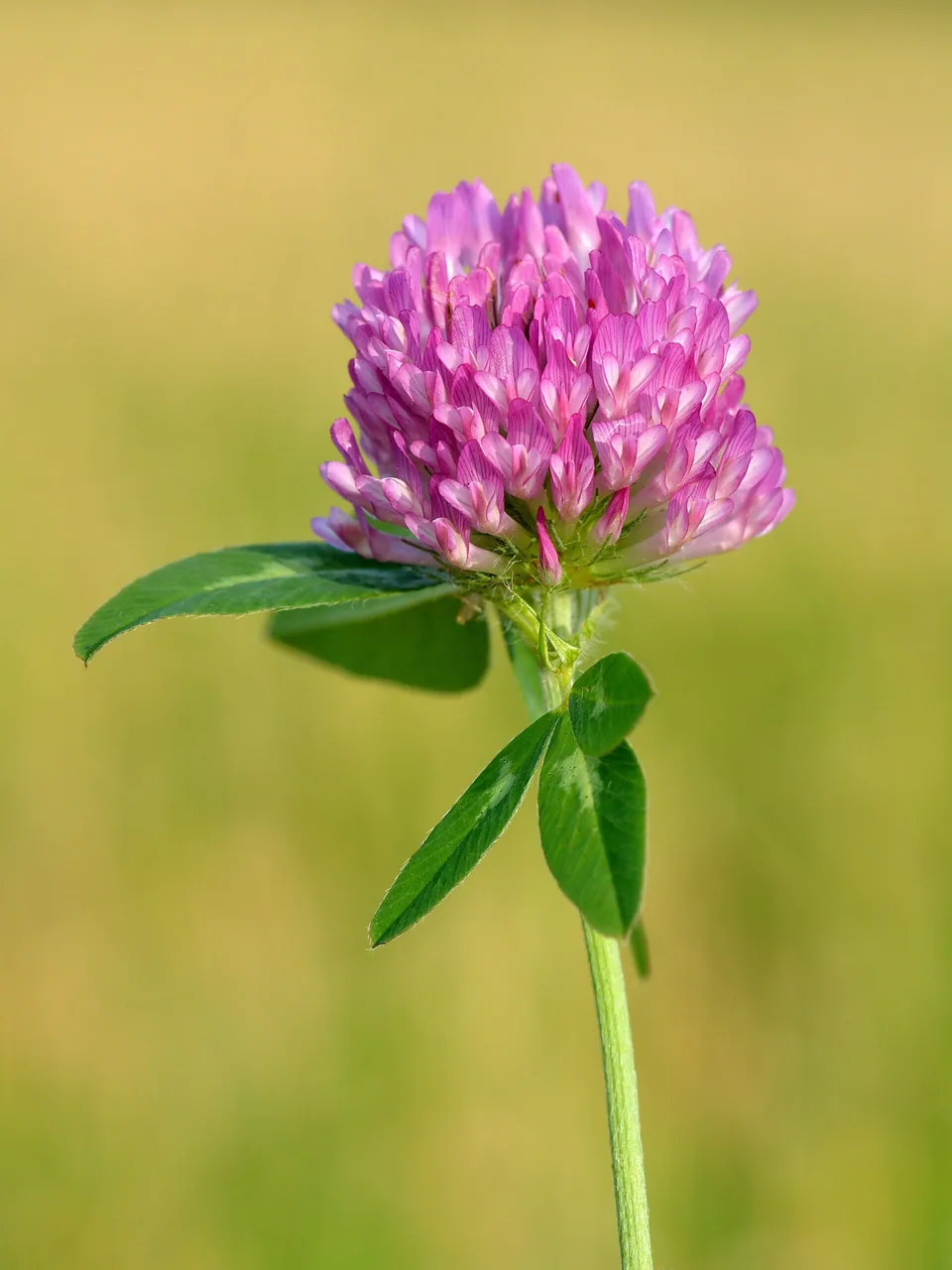


How to Grow and Care for Red Clover
Trifolium pratense
Written by Emilio Marruso · last checked
At a glance
Red clover is an easy plant to start from seed in a sunny spot. Its young leaves and sweet, hay-scented flower heads are edible, raw or cooked, and the young flowers brighten a salad. Pick the leaves before the plant blooms, and enjoy watching it fill out to 6 inches to 2 feet tall.
- Sun
Full sun
What the sources say (2)
Light: Full sun
Light: Full sun (6 or more hours of direct sunlight a day)
— Trifolium pratense (Cow Grass, Peavine Clover, Purple Clover, Red Clover) | North Carolina Extension Gardener Plant Toolbox [1] It is more prevalent in under-fertilized lawns and grows well in full sun.
— Lawn and Turfgrass Weeds: Red Clover, Trifolium pratense L. [3] - Cold
Survives winters down to −40 °F (−40 °C)
Very hardy · USDA 3a · RHS H7 · Z3
What the sources say (2)
Hardiness, coldest zone: 3a [winter low −40 to −37.2 °C (−40 to −35 °F)]
USDA Plant Hardiness Zone: 3a, 3b, 4a, 4b, 5a, 5b, 6a, 6b, 7a, 7b, 8a, 8b, 9a, 9b - Fruit:
— Trifolium pratense (Cow Grass, Peavine Clover, Purple Clover, Red Clover) | North Carolina Extension Gardener Plant Toolbox [1] Hardiness, warmest zone: 9b [winter low −3.9 to −1.1 °C (25 to 30 °F)]
USDA Plant Hardiness Zone: 3a, 3b, 4a, 4b, 5a, 5b, 6a, 6b, 7a, 7b, 8a, 8b, 9a, 9b - Fruit:
— Trifolium pratense (Cow Grass, Peavine Clover, Purple Clover, Red Clover) | North Carolina Extension Gardener Plant Toolbox [1] - Feeding
Feed at sowing time, best guided by a soil test
What the sources say (4)
When: At seeding time
In the absence of a soil test, use a fertilizer treatment of about 20 lb N/ac, 60 lb P/ac and 40 lb K/ac at seeding time when seed are drilled.
— Red Clover (Trifolium pratense) | Mississippi State University Extension Service [2] Mineral fertilizers: By soil test; without one, 22.4 kg [49.4 lb] N, 67.3 kg [148.4 lb] P and 44.8 kg [98.8 lb] K per hectare at seeding when drilled
fields used for hay: In the absence of a soil test, apply a mixed fertilizer such as a 0-30-90 each year to red clover fields used for hay.
— Red Clover (Trifolium pratense) | Mississippi State University Extension Service [2] seeded on small grains or ryegrass for winter forage: When red clover is seeded on small grains or ryegrass for winter forage, about 60 lb P/ac should be applied at the time of seeding. or mix seed and fertilizer together and apply them at the same time.
— Red Clover (Trifolium pratense) | Mississippi State University Extension Service [2] Fertility treatments are best recommended on the basis of a soil test. In the absence of a soil test, use a fertilizer treatment of about 20 lb N/ac, 60 lb P/ac and 40 lb K/ac at seeding time when seed are drilled.
— Red Clover (Trifolium pratense) | Mississippi State University Extension Service [2] - Harvest
Pick young leaves before it flowers; flower heads are edible raw or cooked
What the sources say (8)
Harvest: Young leaves before the plant flowers; forage: initial harvest 60-70 days after seeding, then every 30-35 days; usually two or three harvests per year
According to NC State Extension (edible leaves): Its young leaves should be harvested before the plant flowers.
— Trifolium pratense (Cow Grass, Peavine Clover, Purple Clover, Red Clover) | North Carolina Extension Gardener Plant Toolbox [1] Mississippi (forage): Initial harvest 60-70 days after seeding and subsequent harvest on a 30-35 day interval will generally allow for three harvests
— Red Clover (Trifolium pratense) | Mississippi State University Extension Service [2] Pennsylvania (forage): Red clover, a short-lived perennial, can usually be harvested two or three times per year.
— Red Clover [5] Its young leaves should be harvested before the plant flowers.
— Trifolium pratense (Cow Grass, Peavine Clover, Purple Clover, Red Clover) | North Carolina Extension Gardener Plant Toolbox [1] Initial harvest 60-70 days after seeding and subsequent harvest on a 30-35 day interval will generally allow for three harvests during the seeding year.
— Red Clover (Trifolium pratense) | Mississippi State University Extension Service [2] Red clover, a short-lived perennial, can usually be harvested two or three times per year.
— Red Clover [5] How to harvest: young leaves are harvested before the plant flowers; for hay, cut at the bloom stage
Its young leaves should be harvested before the plant flowers. They can be used in salads or soups or cooked similar to spinach.
— Trifolium pratense (Cow Grass, Peavine Clover, Purple Clover, Red Clover) | North Carolina Extension Gardener Plant Toolbox [1] It should be cut at bloom stage to maintain good hay quality.
— Red Clover (Trifolium pratense) | Mississippi State University Extension Service [2] - Pests
Clover rot, crown and root rot, powdery mildew and anthracnose; choose resistant varieties
What the sources say (4)
Diseases: clover rot, crown and root rot, powdery mildew, northern anthracnose, southern anthracnose, yellow mosaic virus
It is listed as invasive in a few states scattered around the county including WV and KY. Clover rot can be an issue.
— Trifolium pratense (Cow Grass, Peavine Clover, Purple Clover, Red Clover) | North Carolina Extension Gardener Plant Toolbox [1] It is susceptible to crown- and root-rotting disease complexes, contributing to its short-lived nature.
— Red Clover [5] Susceptibility to powdery mildew, southern anthracnose, and yellow mosaic virus is higher than other clovers.
— Red Clover (Trifolium pratense) | Mississippi State University Extension Service [2] Varieties resistant to northern and southern anthracnose and powdery mildew are recommended for use throughout the state.
— Red Clover [5] - Watch out
It self-seeds and spreads by strong roots, so it can turn weedy in lawns
- Size
6 in to 2 ft tall and 8 to 20 in wide
What the sources say (2)
Mature height: 15-61 cm (0.5-2 ft)
Dimensions: Height: 0 ft. 6 in. - 2 ft. 0 in. Width: 0 ft. 8 in. - 1 ft. 8 in.
— Trifolium pratense (Cow Grass, Peavine Clover, Purple Clover, Red Clover) | North Carolina Extension Gardener Plant Toolbox [1] Mature width: 20-51 cm (8 in-1 ft 8 in)
Dimensions: Height: 0 ft. 6 in. - 2 ft. 0 in. Width: 0 ft. 8 in. - 1 ft. 8 in.
— Trifolium pratense (Cow Grass, Peavine Clover, Purple Clover, Red Clover) | North Carolina Extension Gardener Plant Toolbox [1] - Propagation
Grows from seed
What the sources say (1)
Propagation: Seed
Recommended Propagation Strategy: Seed Country Or Region Of Origin: Eurasia
— Trifolium pratense (Cow Grass, Peavine Clover, Purple Clover, Red Clover) | North Carolina Extension Gardener Plant Toolbox [1] - Sowing
Sow in spring, or in late summer in warm climates, 1/4 to 1/2 inch deep
What the sources say (10)
Sowing: Pennsylvania: spring (April to early May); Mississippi: August 15 to September 30, overseeding October 15 to November 20; Iowa cover crop: August through early September
Pennsylvania: Seeding red clover in the spring (April to early May) or with a spring oat companion crop in a conventionally prepared seedbed is common.
— Red Clover [5] Mississippi: Seed should be planted between Aug. 15 to Sept. 30. in prepared seed bed
— Red Clover (Trifolium pratense) | Mississippi State University Extension Service [2] Mississippi (established pastures): Established pastures should be overseeded between October 15 and November 20th.
— Red Clover (Trifolium pratense) | Mississippi State University Extension Service [2] Iowa (cover crop): Planting date : August through early September Seeding depth : 0.25” to 0.5” – rainfall/soil moisture needed to get good establishment
— Red clover as a cover crop | Integrated Crop Management [6] Seeding red clover in the spring (April to early May) or with a spring oat companion crop in a conventionally prepared seedbed is common.
— Red Clover [5] Seed should be planted between Aug. 15 to Sept. 30. in prepared seed bed at a rate of 6 to lb/ac at depth of 1/4 to 1/2 inch.
— Red Clover (Trifolium pratense) | Mississippi State University Extension Service [2] Established pastures should be overseeded between October 15 and November 20th.
— Red Clover (Trifolium pratense) | Mississippi State University Extension Service [2] Planting date : August through early September Seeding depth :
— Red clover as a cover crop | Integrated Crop Management [6] Sowing depth: 0.6-1.3 cm (1/4 to 1/2 inch)
Seed should be planted between Aug. 15 to Sept. 30. in prepared seed bed at a rate of 6 to lb/ac at depth of 1/4 to 1/2 inch.
— Red Clover (Trifolium pratense) | Mississippi State University Extension Service [2] Seeding depth : 0.25” to 0.5” – rainfall/soil moisture needed to get good establishment
— Red clover as a cover crop | Integrated Crop Management [6]
Overview
Red clover is a short-lived, nitrogen-fixing perennial legume grown as a forage crop, hay and green manure. [1][3] It grows in full sun and its flowers and young leaves are edible. [3][1]
Red Clover care
How much light Red Clover needs
Full sun
What the sources say (2)
Light:
Full sun (6 or more hours of direct sunlight a day)It is more prevalent in under-fertilized lawns and grows well in full sun.How much cold Red Clover can take
Hardiness, coldest zone
3a [winter low −40 to −37.2 °C (−40 to −35 °F)]
What the sources say (1)
USDA Plant Hardiness Zone:
3a, 3b, 4a, 4b, 5a, 5b, 6a, 6b, 7a, 7b, 8a, 8b, 9a, 9b
-
Fruit:Hardiness, warmest zone
9b [winter low −3.9 to −1.1 °C (25 to 30 °F)]
What the sources say (1)
USDA Plant Hardiness Zone:
3a, 3b, 4a, 4b, 5a, 5b, 6a, 6b, 7a, 7b, 8a, 8b, 9a, 9b
-
Fruit:Best soil for Red Clover
The sources give different values depending on region, zone or growing conditions.
What each source says
Mississippi (forage): 5.5
Pennsylvania (maximum yield): 6.5
What the sources say (2)
Mississippi (forage): Soil pH should be maintained above 5.5. Fertility treatments are best recommended on the basis of a soil test.Pennsylvania (maximum yield): To obtain maximum yield, maintain soil pH at 6.5 or higher.How to propagate Red Clover
Seed
What the sources say (1)
Recommended Propagation Strategy:
Seed
Country Or Region Of Origin:
EurasiaHow to grow Red Clover
The plant
Life cycle
Family
Fabaceae
What the sources say (1)
Red clover belongs to the legume family (Fabaceae) and is classified as a short-lived perennial.Mature height
15-61 cm (0.5-2 ft)
What the sources say (1)
Dimensions: Height: 0 ft. 6 in. - 2 ft. 0 in. Width: 0 ft. 8 in. - 1 ft. 8 in.Mature width
20-51 cm (8 in-1 ft 8 in)
What the sources say (1)
Dimensions: Height: 0 ft. 6 in. - 2 ft. 0 in. Width: 0 ft. 8 in. - 1 ft. 8 in.Sowing and growth
Sowing depth
0.6-1.3 cm (1/4 to 1/2 inch)
What the sources say (2)
Seed should be planted between Aug. 15 to Sept. 30. in prepared seed bed at a rate of 6 to lb/ac at depth of 1/4 to 1/2 inch.Seeding depth : 0.25” to 0.5” – rainfall/soil moisture needed to get good establishmentDays to maturity
first forage harvest 60-70 days after seeding, then every 30-35 days
What the sources say (1)
Initial harvest 60-70 days after seeding and subsequent harvest on a 30-35 day interval will generally allow for three harvests during the seeding year.Harvest and storage
How to harvest
young leaves are harvested before the plant flowers; for hay, cut at the bloom stage
What the sources say (2)
Its young leaves should be harvested before the plant flowers. They can be used in salads or soups or cooked similar to spinach.It should be cut at bloom stage to maintain good hay quality.Pests and diseases
Diseases
clover rot, crown and root rot, powdery mildew, northern anthracnose, southern anthracnose, yellow mosaic virus
What the sources say (4)
It is listed as invasive in a few states scattered around the county including WV and KY. Clover rot can be an issue.It is susceptible to crown- and root-rotting disease complexes, contributing to its short-lived nature.Susceptibility to powdery mildew, southern anthracnose, and yellow mosaic virus is higher than other clovers.Varieties resistant to northern and southern anthracnose and powdery mildew are recommended for use throughout the state.Fertilizing
When
At seeding time
What the sources say (1)
In the absence of a soil test, use a fertilizer treatment of about 20 lb N/ac, 60 lb P/ac and 40 lb K/ac at seeding time when seed are drilled.How often
The sources give different values depending on region, zone or growing conditions.
What each source says
fields used for hay: Each year
What the sources say (1)
fields used for hay: In the absence of a soil test, apply a mixed fertilizer such as a 0-30-90 each year to red clover fields used for hay.Mineral fertilizers
By soil test; without one, 22.4 kg [49.4 lb] N, 67.3 kg [148.4 lb] P and 44.8 kg [98.8 lb] K per hectare at seeding when drilled
What each source says
fields used for hay: A mixed fertilizer such as 0-30-90 each year, without a soil test
seeded on small grains or ryegrass for winter forage: 67.3 kg [148.4 lb] P/ha at seeding
What the sources say (3)
fields used for hay: In the absence of a soil test, apply a mixed fertilizer such as a 0-30-90 each year to red clover fields used for hay.seeded on small grains or ryegrass for winter forage: When red clover is seeded on small grains or ryegrass for winter forage, about 60 lb P/ac should be applied at the time of seeding. or mix seed and fertilizer together and apply them at the same time.Fertility treatments are best recommended on the basis of a soil test. In the absence of a soil test, use a fertilizer treatment of about 20 lb N/ac, 60 lb P/ac and 40 lb K/ac at seeding time when seed are drilled.Red Clover pests and problems
Weediness
Symptom: Self-seeding and vigorous rhizomes make the plant weedy.
What to do: Improve turf density through good establishment; herbicides containing dicamba, clopyralid, fluroxypyr and quinclorac control it in lawns.
What the sources say (2)
Its self-seeding and vigorous rhizomes can make this plant weedy.
— Trifolium pratense (Cow Grass, Peavine Clover, Purple Clover, Red Clover) | North Carolina Extension Gardener Plant Toolbox [1] This weed is best controlled by herbicides containing dicamba, clopyralid, fluroxypyr, and quinclorac.
— Lawn and Turfgrass Weeds: Red Clover, Trifolium pratense L. [3] Clover rot and crown and root rot
Symptom: Clover rot can be an issue; crown- and root-rotting disease complexes shorten stand life.
What to do: Look for varieties with good disease resistance and persistence.
What the sources say (3)
It is listed as invasive in a few states scattered around the county including WV and KY. Clover rot can be an issue.
— Trifolium pratense (Cow Grass, Peavine Clover, Purple Clover, Red Clover) | North Carolina Extension Gardener Plant Toolbox [1] It is susceptible to crown- and root-rotting disease complexes, contributing to its short-lived nature.
— Red Clover [5] Look for good disease resistance and persistence in a red clover variety.
— Red Clover [5] Powdery mildew, southern anthracnose, yellow mosaic virus
Symptom: Susceptibility is higher than in other clovers.
What to do: Source gives no management.
What the sources say (1)
Susceptibility to powdery mildew, southern anthracnose, and yellow mosaic virus is higher than other clovers.
— Red Clover (Trifolium pratense) | Mississippi State University Extension Service [2]
Remedies
Each remedy shows what official sources say about it; traditional remedies without an official source are marked as such. Harmful ones are listed so you know to avoid them.
Treating the plant
aphids
ladybugs and lacewings Not verified
Traditional remedy, not verified by an official source.
How: Natural predators like ladybugs and lacewings can be introduced to control the aphid population.
Calendar
Sowing
Pennsylvania: spring (April to early May); Mississippi: August 15 to September 30, overseeding October 15 to November 20; Iowa cover crop: August through early September
What each source says
Pennsylvania: spring (April to early May)
Mississippi: August 15 to September 30
Mississippi (established pastures): October 15 to November 20 (overseeding)
Iowa (cover crop): August through early September
What the sources say (8)
Pennsylvania: Seeding red clover in the spring (April to early May) or with a spring oat companion crop in a conventionally prepared seedbed is common.Mississippi: Seed should be planted between Aug. 15 to Sept. 30. in prepared seed bedMississippi (established pastures): Established pastures should be overseeded between October 15 and November 20th.Iowa (cover crop): Planting date : August through early September
Seeding depth : 0.25” to 0.5” – rainfall/soil moisture needed to get good establishmentSeeding red clover in the spring (April to early May) or with a spring oat companion crop in a conventionally prepared seedbed is common.Seed should be planted between Aug. 15 to Sept. 30. in prepared seed bed at a rate of 6 to lb/ac at depth of 1/4 to 1/2 inch.Established pastures should be overseeded between October 15 and November 20th.Planting date : August through early September
Seeding depth :Harvest
Young leaves before the plant flowers; forage: initial harvest 60-70 days after seeding, then every 30-35 days; usually two or three harvests per year
What each source says
According to NC State Extension (edible leaves): Young leaves before the plant flowers
Mississippi (forage): Initial harvest 60-70 days after seeding, then every 30-35 days
Pennsylvania (forage): Usually two or three harvests per year
What the sources say (6)
According to NC State Extension (edible leaves): Its young leaves should be harvested before the plant flowers.Mississippi (forage): Initial harvest 60-70 days after seeding and subsequent harvest on a 30-35 day interval will generally allow for three harvestsPennsylvania (forage): Red clover, a short-lived perennial, can usually be harvested two or three times per year.Its young leaves should be harvested before the plant flowers.Initial harvest 60-70 days after seeding and subsequent harvest on a 30-35 day interval will generally allow for three harvests during the seeding year.Red clover, a short-lived perennial, can usually be harvested two or three times per year.Months as given by the sources, which are mostly from the United States (northern hemisphere). In the southern hemisphere they shift by about six months.
Edibility
Reported by the source, quoted verbatim. Do not eat a plant on the basis of this page alone: identification mistakes can be dangerous.
The flowering heads and foliage are both edible, both raw or cooked. Its young leaves should be harvested before the plant flowers.
[1]The flowering heads as well as the seed pods can be dried and used as a flour substitute. The young flower are also eaten raw in salads.
[1]The edible flowers taste sweet or like hay but they are not easily digestible.
[1]
Similar plants
- Buffalo Clover Trifolium reflexum
- Clover Trifolium repens
- Crimson Clover Trifolium incarnatum
- Hair-foot trefoil Trifolium arvense
- Lesser Trefoil Trifolium dubium
- Alsike Clover Trifolium hybridum
- Afghan Redbud Cercis griffithii
- American hogpeanut Amphicarpaea bracteata
Sources
Every value above is quoted from these documents. Links lead to the original publisher.
- Trifolium pratense (Cow Grass, Peavine Clover, Purple Clover, Red Clover) | North Carolina Extension Gardener Plant Toolbox · plants.ces.ncsu.edu, consulted
- Red Clover (Trifolium pratense) | Mississippi State University Extension Service · extension.msstate.edu, consulted
- Lawn and Turfgrass Weeds: Red Clover, Trifolium pratense L. · extension.psu.edu, consulted
- Purple Clover - Trifolium pratense | North Carolina Extension Gardener Plant Toolbox · plants.ces.ncsu.edu, consulted
- Red Clover · extension.psu.edu, consulted
- Red clover as a cover crop | Integrated Crop Management · crops.extension.iastate.edu, consulted
Written by Emilio Marruso · last checked