
How to Grow and Care for Clover
Trifolium repens
Written by Emilio Marruso · last checked
At a glance
White clover is a cheerful perennial that grows in full sun to part shade and stays just 4–6 inches tall. Sow it in spring or late summer, keep the soil moist while it gets going, and it spreads on its own creeping stems. Every part is edible: young leaves go in salads and dried flowers make a tea.
- Sun
Full sun to part shade
What the sources say (2)
Light: Full sun to part shade
It likes moist soil, sun to part shade.
— Trifolium repens (Clover, Dutch Clover, Ladino Clover, Purple Dutch Clover, Shamrock, White Clover, White Sweet Clover) | North Carolina Extension Gardener Plant Toolbox [1] Grows best in full sun to part shade and will easily grow in a wide variety of soil types.
— Dutch White Clover | Natural Resources [6] - Water
Keep the soil moist for the first month or two after sprouting; it does poorly in dry soil
What the sources say (2)
Watering notes: Keep the soil moist for the first month or two after sprouting; shallow roots do not do well in dry soils
For the first month or two, make sure the soil stays moist.
— Dutch White Clover | Natural Resources [6] It has a shallow root system that does not do well in dry soils.
— White Clover | Home & Garden Information Center [8] - Cold
Survives winters down to −40 °F (−40 °C)
Very hardy · USDA 3a · RHS H7 · Z3
What the sources say (2)
Hardiness, coldest zone: 3a [winter low −40 to −37.2 °C (−40 to −35 °F)]
3a, 3b, 4a, 4b, 5a, 5b, 6a, 6b, 7a, 7b, 8a, 8b, 9a, 9b, 10a, 10b
— Trifolium repens (Clover, Dutch Clover, Ladino Clover, Purple Dutch Clover, Shamrock, White Clover, White Sweet Clover) | North Carolina Extension Gardener Plant Toolbox [1] Hardiness, warmest zone: 10b [winter low 1.7 to 4.4 °C (35 to 40 °F)]
3a, 3b, 4a, 4b, 5a, 5b, 6a, 6b, 7a, 7b, 8a, 8b, 9a, 9b, 10a, 10b
— Trifolium repens (Clover, Dutch Clover, Ladino Clover, Purple Dutch Clover, Shamrock, White Clover, White Sweet Clover) | North Carolina Extension Gardener Plant Toolbox [1] - Feeding
Starter fertilizer at planting, then once a year, following a soil test
What the sources say (2)
When: Before planting, by soil test, with a starter fertilizer at establishment
Lime and fertilizer needs of white clover should be determined by soil testing before planting. For best results, the soil pH should be between 6 and 7. A starter fertilizer application of 20-60-20 lbs. per acre will often assist in establishing white clover.
— White Clover [5] How often: Once a year, according to soil test
Clover stands should be fertilized annually according to soil test recommendations, even in pasture settings.
— White Clover [5] - Harvest
Pick from spring into summer; young leaves for salads, dried flowers for tea
What the sources say (1)
Harvest: Spring into summer (foraging)
Time to forage: Spring into Summer. Identification: Low growing, creeping plant; bright green compound leaves formed of three leaflets
— Dutch White Clover | Natural Resources [6] - Pests
Can get clover rot; don't use it too often as a cover crop
What the sources say (1)
Diseases: clover rot
No serious diseases or insect problems. Clover is a host to 'clover rot' and should not be used too frequently as a cover crop.
— Trifolium repens (Clover, Dutch Clover, Ladino Clover, Purple Dutch Clover, Shamrock, White Clover, White Sweet Clover) | North Carolina Extension Gardener Plant Toolbox [1] - Watch out
Can take over a weak lawn; pull it by hand and keep the grass thick and healthy
- Size
4–6 inches tall, 12 inches or more wide
What the sources say (2)
Mature height: 10.2-15.2 cm (4 to 6 in)
Trifolium repens , or Clover, is a prostrate, mat-forming herbaceous perennial about four to six inches tall and spreading 12 inches or more by stems that root freely.
— Trifolium repens (Clover, Dutch Clover, Ladino Clover, Purple Dutch Clover, Shamrock, White Clover, White Sweet Clover) | North Carolina Extension Gardener Plant Toolbox [1] Mature width: 30.5 cm (12 in) or more
Trifolium repens , or Clover, is a prostrate, mat-forming herbaceous perennial about four to six inches tall and spreading 12 inches or more by stems that root freely.
— Trifolium repens (Clover, Dutch Clover, Ladino Clover, Purple Dutch Clover, Shamrock, White Clover, White Sweet Clover) | North Carolina Extension Gardener Plant Toolbox [1] - Propagation
Grows from seed and spreads by creeping stems
What the sources say (2)
Propagation: Seed; also spreads by stolons
Easily grown from seed, Clover responds to mowing with aggressive growth and spreads aggressively by rooting at nodes forming mats up to 12 inches wide.
— Trifolium repens (Clover, Dutch Clover, Ladino Clover, Purple Dutch Clover, Shamrock, White Clover, White Sweet Clover) | North Carolina Extension Gardener Plant Toolbox [1] It reproduces by seed and by creeping stolons.
— White Clover | Home & Garden Information Center [8] - Sowing
Sow in spring as it warms or in late summer, no deeper than 1/4 inch
What the sources say (5)
Sowing: Spring after it starts warming up, or late summer (a couple of months before the first frost); frost seeding in early spring when the soil is still honeycombed with frost, into existing grass pastures
adding clover to a lawn (fonte: Iowa State Extension): Plant in the spring after it starts warming up, or in late summer (a couple of months before the first frost).
— Dutch White Clover | Natural Resources [6] existing grass pastures (fonte: Penn State Extension): White clover can be "frost seeded" (in early spring when the soil is still honeycombed with frost)
— White Clover [5] Plant in the spring after it starts warming up, or in late summer (a couple of months before the first frost).
— Dutch White Clover | Natural Resources [6] White clover can be "frost seeded" (in early spring when the soil is still honeycombed with frost) into existing grass pastures to improve pasture production and quality.
— White Clover [5] Sowing depth: no deeper than 0.6 cm (1/4 in)
Do not plant deeper than ¼ inch when seeding. Press wheels or cultipacking used with or after band seeding will improve the seed-soil contact and the chances of obtaining a good stand.
— White Clover [5]
Overview
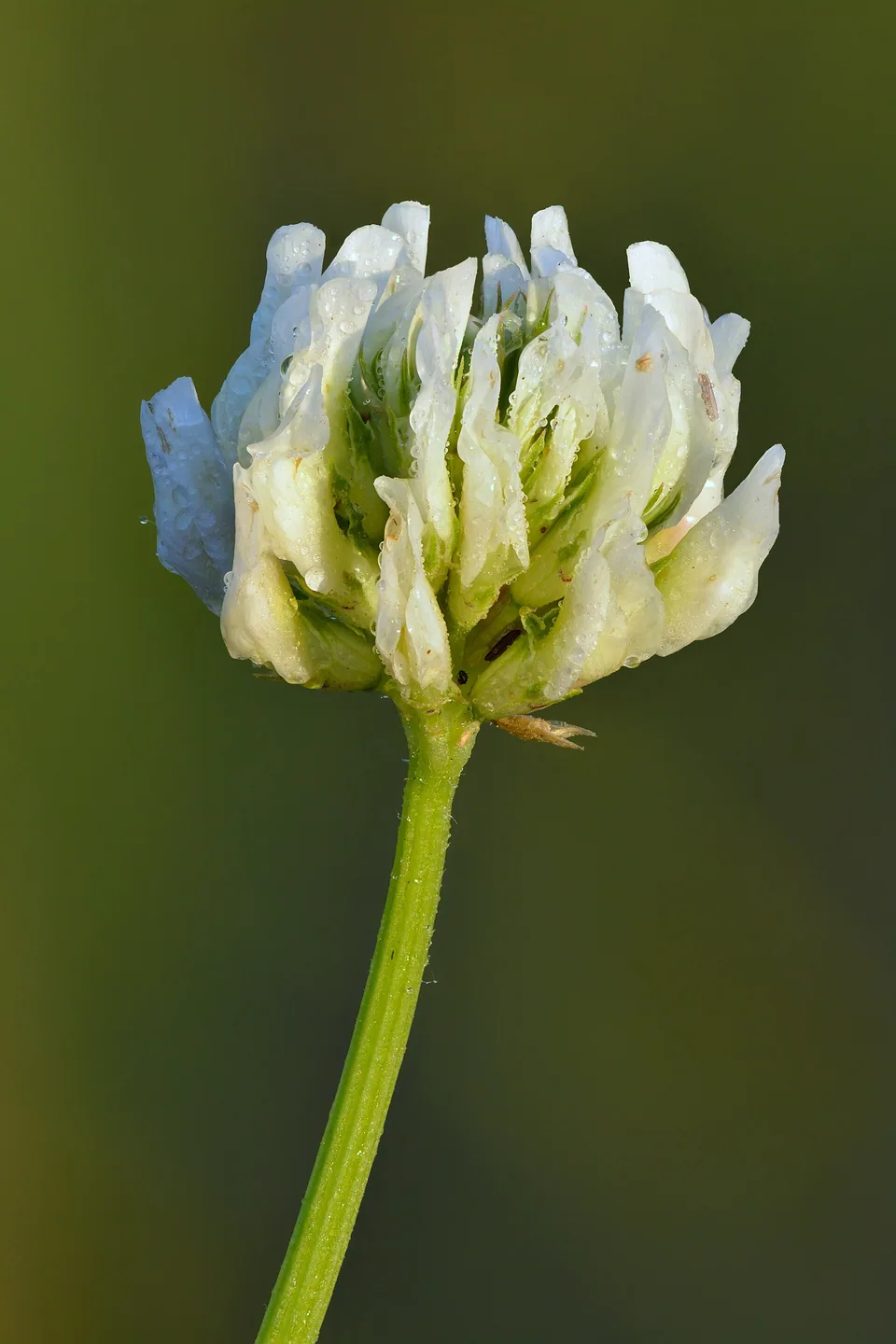
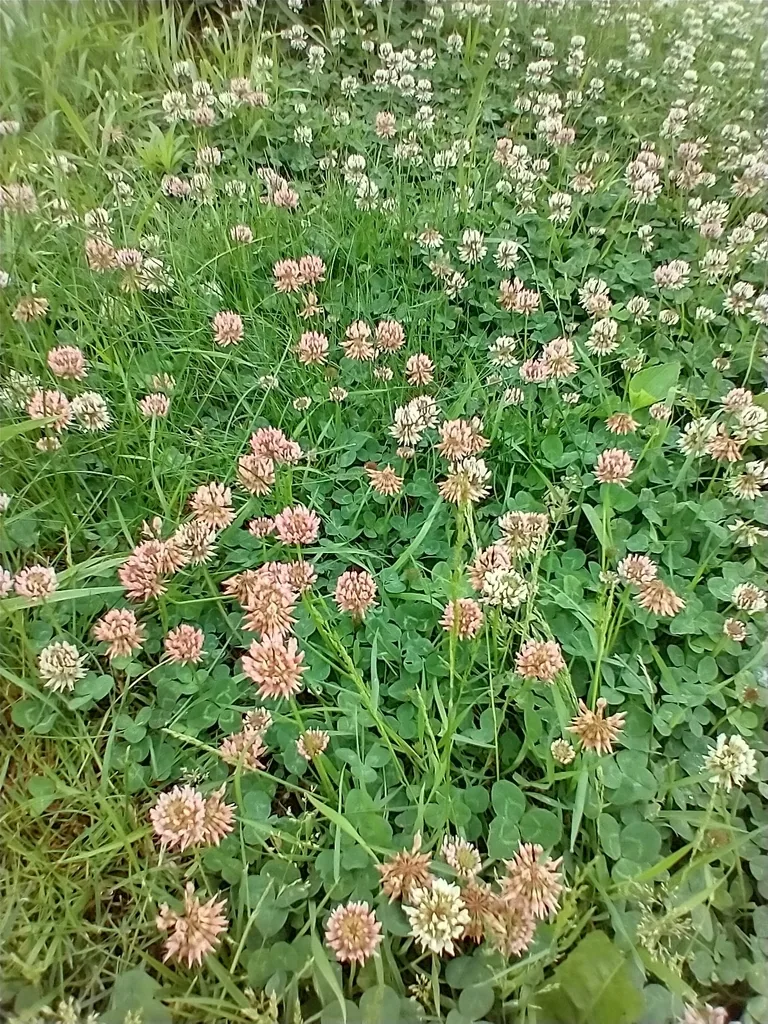
White clover is a prostrate, mat-forming herbaceous perennial about four to six inches [10–15 cm] tall that spreads by stems that root freely. [1] It grows best in full sun to part shade and, as a legume, fixes nitrogen in the soil. [6][8] All above ground parts of the plant are edible. [6]
Clover care
Measurements in square brackets are our conversion into the other unit system; the quoted text is unchanged.
How to water Clover
Watering
The sources give different values depending on region, zone or growing conditions.
What each source says
established clover (fonte: Iowa State Extension): Does not need much water once established
According to NC State Extension: Likes moist soil
According to Clemson Extension: Shallow root system that does not do well in dry soils
What the sources say (4)
established clover (fonte: Iowa State Extension): Clover doesn't need much water once it’s established, but the newly sprouted clover does need some cAccording to NC State Extension: It likes moist soil, sun to part shade.According to Clemson Extension: It has a shallow root system that does not do well in dry soils.Clover doesn't need much water once it’s established, but the newly sprouted clover does need some care.Watering notes
Keep the soil moist for the first month or two after sprouting; shallow roots do not do well in dry soils
How much light Clover needs
Full sun to part shade
What the sources say (2)
It likes moist soil, sun to part shade.Grows best in full sun to part shade and will easily grow in a wide variety of soil types.How much cold Clover can take
Hardiness, coldest zone
3a [winter low −40 to −37.2 °C (−40 to −35 °F)]
What the sources say (1)
3a, 3b, 4a, 4b, 5a, 5b, 6a, 6b, 7a, 7b, 8a, 8b, 9a, 9b, 10a, 10bHardiness, warmest zone
10b [winter low 1.7 to 4.4 °C (35 to 40 °F)]
What the sources say (1)
3a, 3b, 4a, 4b, 5a, 5b, 6a, 6b, 7a, 7b, 8a, 8b, 9a, 9b, 10a, 10bBest soil for Clover
Soil pH, minimum
The sources give different values depending on region, zone or growing conditions.
What each source says
According to Penn State Extension: 6.0
What the sources say (2)
According to Penn State Extension: It grows best during cool, moist weather on well-drained, fertile soils with a pH between 6 and 7 (Table 1).It grows best during cool, moist weather on well-drained, fertile soils with a pH between 6 and 7 (Table 1).Soil pH, maximum
The sources give different values depending on region, zone or growing conditions.
What each source says
According to Penn State Extension: 7.0
What the sources say (2)
According to Penn State Extension: It grows best during cool, moist weather on well-drained, fertile soils with a pH between 6 and 7 (Table 1).It grows best during cool, moist weather on well-drained, fertile soils with a pH between 6 and 7 (Table 1).How to propagate Clover
Seed; also spreads by stolons
What the sources say (2)
Easily grown from seed, Clover responds to mowing with aggressive growth and spreads aggressively by rooting at nodes forming mats up to 12 inches wide.It reproduces by seed and by creeping stolons.How to grow Clover
The plant
Life cycle
perennial (herbaceous)
What the sources say (1)
Trifolium repens , or Clover, is a prostrate, mat-forming herbaceous perennial about four to six inches tall and spreading 12 inches or more by stems that root freely.Family
Fabaceae
What the sources say (1)
White clover is in the legume family (Fabaceae) and is capable of fixing its nitrogenMature height
10.2-15.2 cm (4 to 6 in)
What the sources say (1)
Trifolium repens , or Clover, is a prostrate, mat-forming herbaceous perennial about four to six inches tall and spreading 12 inches or more by stems that root freely.Mature width
30.5 cm (12 in) or more
What the sources say (1)
Trifolium repens , or Clover, is a prostrate, mat-forming herbaceous perennial about four to six inches tall and spreading 12 inches or more by stems that root freely.Sowing and growth
Sowing depth
no deeper than 0.6 cm (1/4 in)
What the sources say (1)
Do not plant deeper than ¼ inch when seeding. Press wheels or cultipacking used with or after band seeding will improve the seed-soil contact and the chances of obtaining a good stand.Harvest and storage
How to harvest
foraging: harvest only as much as you will use; whole plants or cuttings can be harvested
What the sources say (1)
Naturalized non-native plant that is widely abundant, harvest as much as you will use; can harvest whole plants or cuttings.Pests and diseases
Diseases
clover rot
What the sources say (1)
No serious diseases or insect problems. Clover is a host to 'clover rot' and should not be used too frequently as a cover crop.Fertilizing
When
Before planting, by soil test, with a starter fertilizer at establishment
What the sources say (1)
Lime and fertilizer needs of white clover should be determined by soil testing before planting. For best results, the soil pH should be between 6 and 7. A starter fertilizer application of 20-60-20 lbs. per acre will often assist in establishing white clover.How often
Once a year, according to soil test
What the sources say (1)
Clover stands should be fertilized annually according to soil test recommendations, even in pasture settings.Mineral fertilizers
Starter fertilizer 20-60-20 at establishment, i.e. 22.4 kg [49.4 lb] N, 67.3 kg [148.4 lb] P₂O₅ and 22.4 kg [49.4 lb] K₂O per hectare
What each source says
white clover under 30% of a clover-grass mixture: 33.6 to 56.0 kg [74–123.5 lb] N/ha to boost the grass
What the sources say (2)
white clover under 30% of a clover-grass mixture: When white clover makes up less than 30% of a white clover-grass mixture, apply 30 to 50 lbs. of N per acre to enhance grass production.A starter fertilizer application of 20-60-20 lbs. per acre will often assist in establishing white clover. If the soil test indicates nutrients in excess of this amount, they should be applied before seeding and incorporated into the seedbed.Avoid
Nitrogen top-dressing of a winter grain into which white clover is being seeded
What the sources say (1)
If white clover is to be seeded into an established winter grain, top-dress applications of N to the small grain should not be made.Clover pests and problems
Lawn takeover
Symptom: Vigorous growth can overwhelm portions of a lawn and contribute to the decline of the grass if the turf is already struggling
What to do: Hand pulling or a manual weeding tool slows its spread; maintain healthy, dense turf
What the sources say (2)
Its vigorous growth can overwhelm portions of a lawn and contribute to the decline of the grass if the turf is already struggling from other stresses.
— White Clover: Identification and Management | University of Maryland Extension [2] Maintain healthy, dense turf that can compete with weeds and prevent weed germination and establishment.
— White Clover: Identification and Management | University of Maryland Extension [2] Clover rot
Symptom: Clover is a host to clover rot
What to do: Should not be used too frequently as a cover crop
What the sources say (1)
Clover is a host to 'clover rot' and should not be used too frequently as a cover crop.
— Trifolium repens (Clover, Dutch Clover, Ladino Clover, Purple Dutch Clover, Shamrock, White Clover, White Sweet Clover) | North Carolina Extension Gardener Plant Toolbox [1] Bloat in livestock
Symptom: Bloat can be a problem in predominantly white clover pastures
What to do: Graze at intervals that do not allow the grass to shade the white clover excessively when grown with tall grass
What the sources say (1)
In predominantly white clover pastures, bloat can be a problem.
— White Clover [5] Drought
Symptom: Shallow roots can be vulnerable to drought
What to do: Not specified in the sources
What the sources say (1)
However, its shallow roots can be vulnerable to drought.
— White Clover: Identification and Management | University of Maryland Extension [2]
Remedies
Each remedy shows what official sources say about it; traditional remedies without an official source are marked as such. Harmful ones are listed so you know to avoid them.
Treating the plant
powdery mildew
pulling out infected clover and replanting Partly works
How: pull or rake out the infected clover and replant it, while mitigating the conditions that promote powdery mildew
Your best approach will most likely be to pull/rake out the infected clover and replant it
— extension.umaine.edu [9] What the evidence says Your best approach will most likely be to pull/rake out the infected clover and replant it
— extension.umaine.edu [9]
Getting rid of it
white clover in lawn
hand pulling and digging out Partly works
How: loosen the soil at the base of small clumps with a spade or your fingers, pluck the clover up and get all of the roots
Get rid of small clumps as soon as you notice them by gently loosening the soil around the base with a spade or your fingers, then plucking the clover up. Be sure you get all of the roots.
— bobvila.com [10] What the evidence says Pulling up or digging out individual plants is a viable option at the beginning of an infestation (when the plants are not yet abundant) and for young white clover plants, but more extensive patches of clover may require stripping off the sod entirely.
— White Clover: Identification and Management | University of Maryland Extension [2] smothering with plastic sheeting Not verified
Traditional remedy, not verified by an official source.
How: place plastic sheeting (a garbage bag will do) on top of large clover patches, securing the corners
white clover in garden beds
hoeing Works
How: clovers in a home garden can be managed with hoeing, hand-pulling or cultivation
In a home garden, clovers can be managed with hoeing, hand-pulling or cultivation.
— ipm.ucanr.edu [11] What the evidence says In a home garden, clovers can be managed with hoeing, hand-pulling or cultivation.
— ipm.ucanr.edu [11] thick organic mulch Works
How: a 4-inch thick organic mulch applied before the seeds germinate prevents establishment of clovers
Before seeds germinate, a 4-inch thick organic mulch (e.g., compost, wood chips, etc.) can prevent establishment of clovers.
— ipm.ucanr.edu [11] What the evidence says Before seeds germinate, a 4-inch thick organic mulch (e.g., compost, wood chips, etc.) can prevent establishment of clovers.
— ipm.ucanr.edu [11]
Calendar
Sowing
Spring after it starts warming up, or late summer (a couple of months before the first frost); frost seeding in early spring when the soil is still honeycombed with frost, into existing grass pastures
What each source says
adding clover to a lawn (fonte: Iowa State Extension): Spring after it starts warming up, or late summer (a couple of months before the first frost)
existing grass pastures (fonte: Penn State Extension): Frost seeding in early spring when the soil is still honeycombed with frost
What the sources say (4)
adding clover to a lawn (fonte: Iowa State Extension): Plant in the spring after it starts warming up, or in late summer (a couple of months before the first frost).existing grass pastures (fonte: Penn State Extension): White clover can be "frost seeded" (in early spring when the soil is still honeycombed with frost)Plant in the spring after it starts warming up, or in late summer (a couple of months before the first frost).White clover can be "frost seeded" (in early spring when the soil is still honeycombed with frost) into existing grass pastures to improve pasture production and quality.Harvest
Spring into summer (foraging)
What the sources say (1)
Time to forage: Spring into Summer.
Identification: Low growing, creeping plant; bright green compound leaves formed of three leafletsMonths as given by the sources, which are mostly from the United States (northern hemisphere). In the southern hemisphere they shift by about six months.
Edibility
Reported by the source, quoted verbatim. Do not eat a plant on the basis of this page alone: identification mistakes can be dangerous.
All parts are edible and can be eaten raw or cooked.
[1]Dried flowers used in tea, young leaves used in salads.
[1]All above ground parts of the plant are edible include leaves, stems, and flowers; leaves can be eaten raw, cooked, or brewed into a tea.
[6]It also provides good forage for livestock. Easily grown from seed, Clover responds to mowing with aggressive growth
[1]
Indicative values
Values from a secondary source, not checked word for word like the rest of this page. Use them as a starting point.
- Drought tolerant
- yesIndicative value, adapt it to your climate · Secondary source
- Soil
- Humus rich, Rocky, gravelly, dry, Well-drainedIndicative value, adapt it to your climate · Secondary source
- Growth rate
- ModerateIndicative value, adapt it to your climate · Secondary source
- Pruning
- June, July, August, July, September, MayIndicative value, adapt it to your climate · Secondary source
- Pests
- Pest resistant, Disease resistantIndicative value, adapt it to your climate · Secondary source
Similar plants
- Buffalo Clover Trifolium reflexum
- Crimson Clover Trifolium incarnatum
- Hair-foot trefoil Trifolium arvense
- Lesser Trefoil Trifolium dubium
- Red Clover Trifolium pratense
- Alsike Clover Trifolium hybridum
- Afghan Redbud Cercis griffithii
- American Groundnut Apios americana
Sources
Every value above is quoted from these documents. Links lead to the original publisher.
- Trifolium repens (Clover, Dutch Clover, Ladino Clover, Purple Dutch Clover, Shamrock, White Clover, White Sweet Clover) | North Carolina Extension Gardener Plant Toolbox · plants.ces.ncsu.edu, consulted
- White Clover: Identification and Management | University of Maryland Extension · extension.umd.edu, consulted
- White Clover | NC State Extension Publications · content.ces.ncsu.edu, consulted
- Ladino Clover - Trifolium repens | North Carolina Extension Gardener Plant Toolbox · plants.ces.ncsu.edu, consulted
- White Clover · extension.psu.edu, consulted
- Dutch White Clover | Natural Resources · naturalresources.extension.iastate.edu, consulted
- Clover - Trifolium repens | North Carolina Extension Gardener Plant Toolbox · plants.ces.ncsu.edu, consulted
- White Clover | Home & Garden Information Center · hgic.clemson.edu, consulted
- extension.umaine.edu · extension.umaine.edu
- bobvila.com · bobvila.com
- ipm.ucanr.edu · ipm.ucanr.edu
Written by Emilio Marruso · last checked