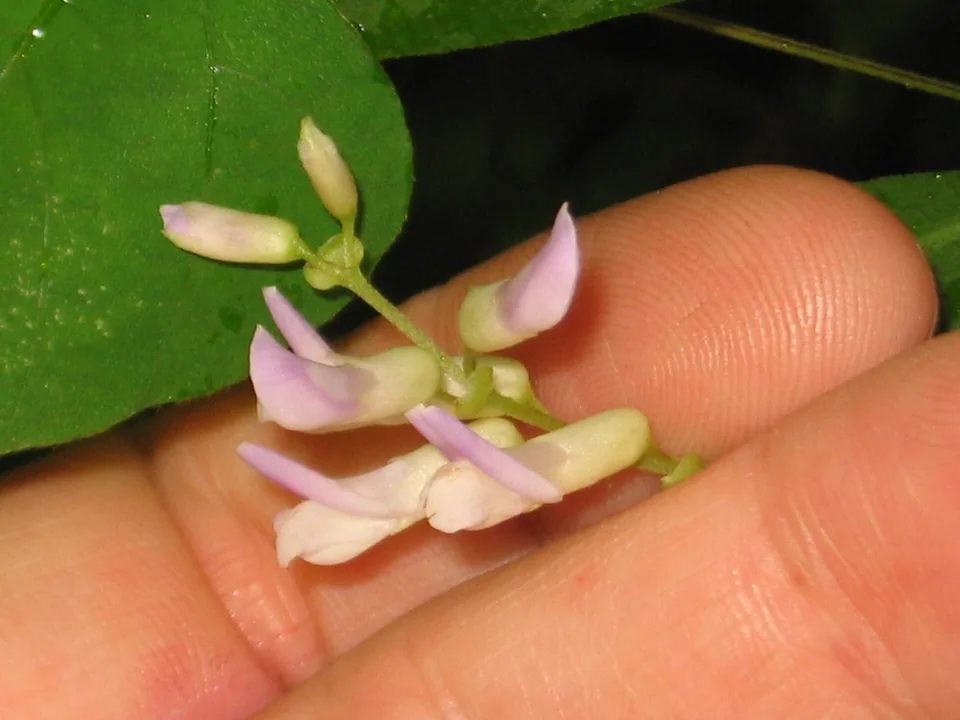
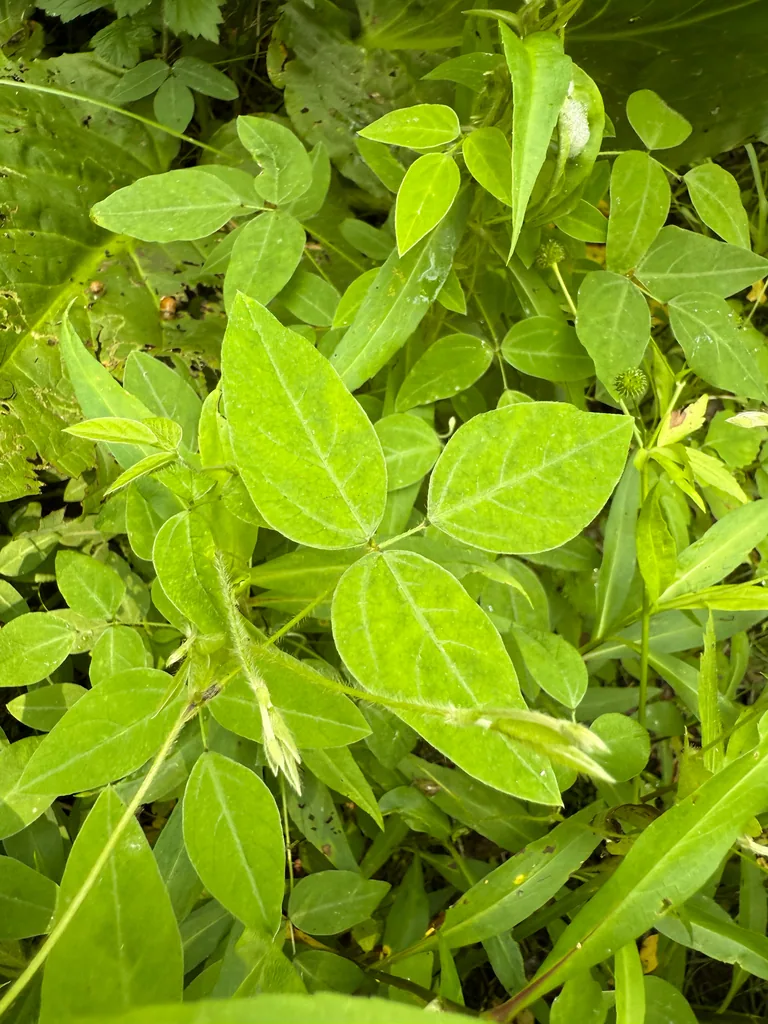

How to Grow and Care for American hogpeanut
Amphicarpaea bracteata
Written by Emilio Marruso · last checked
At a glance
This legume hides a treat underground: its buried seeds can be dug up all winter and eaten raw or boiled. It grows anywhere from full sun to full shade as long as the soil stays moist, and the seeds from its above-ground pods cook just like lentils. Even the peeled root can be boiled and eaten.
- Sun
Full sun to full shade
What the sources say (3)
Light: Full sun to full shade
American hog-peanut grows well in most light conditions from full sun to full shade in moist soils of any type
— American Hog-peanut, Amphicarpaea bracteata – Wisconsin Horticulture [1] Requires a moist humus-rich soil in a shady position
— Amphicarpaea bracteata - Useful Temperate Plants [4] Hog peanut grows in moist soils in woods, meadows and prairies in full sun to partial shade.
— Hog-peanut, Amphicarpaea bracteata (L.) Fernald [6] - Water
Keep the soil moist
What the sources say (2)
Watering: Moist soil
American hog-peanut grows well in most light conditions from full sun to full shade in moist soils of any type
— American Hog-peanut, Amphicarpaea bracteata – Wisconsin Horticulture [1] Requires a moist humus-rich soil in a shady position
— Amphicarpaea bracteata - Useful Temperate Plants [4] - Cold
Survives winters down to 0 °F (−17.8 °C)
Hardy in very cold winters · USDA 7 · RHS H6 · Z7
What the sources say (1)
Hardiness, coldest zone: 7 [winter low −17.8 to −12.2 °C (0 to 10 °F)]
Light partial sun Shade tolerance permanent shade Water moderate Hardiness Zone 7+
— Hog Peanut (Amphicarpaea bracteata) — Practical Plants [5] - Planting
Plant out in late spring or early summer, after a first winter in the greenhouse
What the sources say (1)
Planting: Late spring or early summer (seedlings grown on in the greenhouse for their first winter)
grow them on in the greenhouse for their first winter, planting them out in late spring or early summer
— Hog Peanut (Amphicarpaea bracteata) — Practical Plants [5] - Harvest
Dig the underground seeds all winter; eat them raw or boiled, and cook pod seeds like lentils
What the sources say (1)
Harvest: Throughout the winter (underground seeds)
They can be harvested throughout the winter and can be eaten raw or cooked
— Amphicarpaea bracteata - Useful Temperate Plants [4] - Propagation
By seed, or dig up the buried seeds like tubers and pot them
What the sources say (2)
Propagation: Seed; buried seeds harvested like tubers and potted up
many of the seeds are produced under the ground and these can be harvested like tubers and potted up to make more plants.
— Hog Peanut (Amphicarpaea bracteata) — Practical Plants [5] Propagation is from the scattered upper stem seeds and from the buried seed pods.
— Hog-peanut, Amphicarpaea bracteata (L.) Fernald [6] - Sowing
Soak seeds 12 hours in warm water, then sow in spring in a greenhouse, in part shade
What the sources say (1)
Sowing: Spring (seed pre-soaked 12 hours in warm water, sown in a semi-shaded position in a greenhouse)
Seed - pre-soak for 12 hours in warm water and then sow in spring in a semi-shaded position in a greenhouse.
— Hog Peanut (Amphicarpaea bracteata) — Practical Plants [5]
Overview
American hog-peanut is a twining vine of the pea family native to eastern North America. [1] It grows from full sun to full shade in moist soils and is often considered a weed in cultivated places. [1] Its underground fruits are edible and it has occasionally been cultivated as an edible crop with low yields. [1]
This record is incomplete: the sources we read do not cover every field yet.
Not yet covered by our sources: Hardiness, warmest zone
American hogpeanut care
How to water American hogpeanut
Moist soil
What the sources say (2)
American hog-peanut grows well in most light conditions from full sun to full shade in moist soils of any typeRequires a moist humus-rich soil in a shady positionHow much light American hogpeanut needs
Full sun to full shade
What the sources say (3)
American hog-peanut grows well in most light conditions from full sun to full shade in moist soils of any typeRequires a moist humus-rich soil in a shady positionHog peanut grows in moist soils in woods, meadows and prairies in full sun to partial shade.How much cold American hogpeanut can take
Hardiness, coldest zone
7 [winter low −17.8 to −12.2 °C (0 to 10 °F)]
What the sources say (1)
Light
partial sun
Shade tolerance
permanent shade
Water
moderate
Hardiness
Zone 7+Hardiness, warmest zone
Not stated in the sources we read.
How to propagate American hogpeanut
Seed; buried seeds harvested like tubers and potted up
What the sources say (2)
many of the seeds are produced under the ground and these can be harvested like tubers and potted up to make more plants.Propagation is from the scattered upper stem seeds and from the buried seed pods.How to grow American hogpeanut
The plant
Life cycle
annual to short-lived perennial
What the sources say (1)
is a vining herbaceous annual to short-lived perennial plant in the pea family (Fabaceae)Family
Fabaceae
What the sources say (1)
is a vining herbaceous annual to short-lived perennial plant in the pea family (Fabaceae)Remedies
Each remedy shows what official sources say about it; traditional remedies without an official source are marked as such. Harmful ones are listed so you know to avoid them.
Getting rid of it
unwanted hog peanut vine
repeated hand pulling Partly works
How: pull repeatedly, several times a year for several years
To control where the plants are not wanted, pull repeatedly, several times a year for several years
— American Hog-peanut, Amphicarpaea bracteata – Wisconsin Horticulture [1] What the evidence says Pulling and digging is best for small, newly emerged weeds and is done more easily after a soaking rain or deep watering.
— yardandgarden.extension.iastate.edu [7]
unwanted weedy vines
persistent cutting or mowing Partly works
How: Persistent and frequent cutting or mowing will eventually exhaust the root system and kill the vine over several growing seasons
Persistent and frequent cutting or mowing will eventually exhaust the root system and kill the vine over the period of several growing seasons.
— yardandgarden.extension.iastate.edu [7] What the evidence says Persistent and frequent cutting or mowing will eventually exhaust the root system and kill the vine over the period of several growing seasons.
— yardandgarden.extension.iastate.edu [7]
Calendar
Sowing
Spring (seed pre-soaked 12 hours in warm water, sown in a semi-shaded position in a greenhouse)
What the sources say (1)
Seed - pre-soak for 12 hours in warm water and then sow in spring in a semi-shaded position in a greenhouse.Planting
Late spring or early summer (seedlings grown on in the greenhouse for their first winter)
What the sources say (1)
grow them on in the greenhouse for their first winter, planting them out in late spring or early summerHarvest
Throughout the winter (underground seeds)
What the sources say (1)
They can be harvested throughout the winter and can be eaten raw or cookedMonths as given by the sources, which are mostly from the United States (northern hemisphere). In the southern hemisphere they shift by about six months.
Edibility
Reported by the source, quoted verbatim. Do not eat a plant on the basis of this page alone: identification mistakes can be dangerous.
Indicative values
Values from a secondary source, not checked word for word like the rest of this page. Use them as a starting point.
- Mature height
- 0-0 cm [0 in]Indicative value, adapt it to your climate · Secondary source
- Drought tolerant
- yesIndicative value, adapt it to your climate · Secondary source
- Soil pH
- 5.5-7.5Indicative value, adapt it to your climate · Secondary source
- Care level
- MediumIndicative value, adapt it to your climate · Secondary source
- Growth rate
- LowIndicative value, adapt it to your climate · Secondary source
- Pruning
- June, July, August, May, June, July, May, MayIndicative value, adapt it to your climate · Secondary source
Similar plants
- Bean Phaseolus vulgaris
- Bicolor Lespedeza Lespedeza bicolor
- Black Locust Robinia pseudoacacia
- Black Medick Medicago lupulina
- Bur Medick Medicago polymorpha
- Bush Clover Lespedeza thunbergii
- Candelabra Bush Senna alata
- Clover Trifolium repens
Sources
Every value above is quoted from these documents. Links lead to the original publisher.
- American Hog-peanut, Amphicarpaea bracteata – Wisconsin Horticulture · hort.extension.wisc.edu, consulted
- Amphicarpaea bracteata | CLIMBERS · climbers.lsa.umich.edu, consulted
- Amphicarpaea bracteata (American Hog Peanut): Minnesota Wildflowers · minnesotawildflowers.info, consulted
- Amphicarpaea bracteata - Useful Temperate Plants · temperate.theferns.info, consulted
- Hog Peanut (Amphicarpaea bracteata) — Practical Plants · practicalplants.org, consulted
- Hog-peanut, Amphicarpaea bracteata (L.) Fernald · friendsofeloisebutler.org, consulted
- yardandgarden.extension.iastate.edu · yardandgarden.extension.iastate.edu
Written by Emilio Marruso · last checked