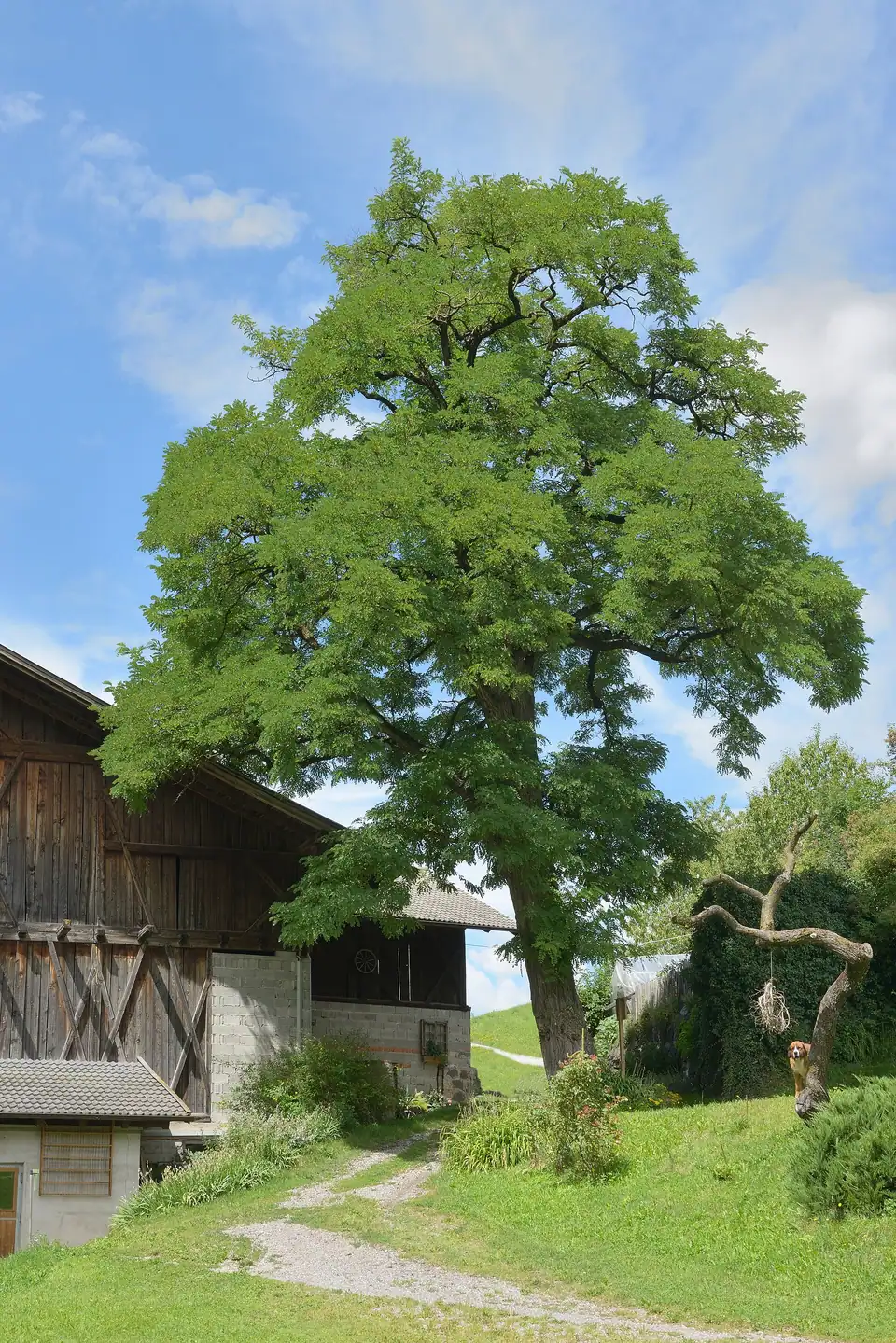


How to Grow and Care for Black Locust
Robinia pseudoacacia
Written by Emilio Marruso · last checked
Toxic to: Cats, Dogs, Horses, Livestock, People · Why
At a glance
Black locust is a deciduous tree that grows 30 to 50 feet tall and asks for very little in return. It makes its own nitrogen through its roots, so it never needs fertilizer, and it thrives in full sun or partial shade. You can start it from seed, and in season its flowers are even edible.
- Sun
Full sun to partial shade
What the sources say (1)
Light: Full sun to partial shade
Light: Full sun (6 or more hours of direct sunlight a day) Partial Shade (Direct sunlight only part of the day, 2-6 hours)
— Robinia pseudoacacia (Black Locust, Common Locust, False Acacia, Green Locust, Pea Flower Locust, White Locust, Yellow Locust) | North Carolina Extension Gardener Plant Toolbox [1] - Cold
Survives winters down to −40 °F (−40 °C)
Very hardy · USDA 3a · RHS H7 · Z3
What the sources say (2)
Hardiness, coldest zone: 3a [winter low −40 to −37.2 °C (−40 to −35 °F)]
USDA Plant Hardiness Zone: 3a, 3b, 4a, 4b, 5a, 5b, 6a, 6b, 7a, 7b, 8a, 8b
— Robinia pseudoacacia (Black Locust, Common Locust, False Acacia, Green Locust, Pea Flower Locust, White Locust, Yellow Locust) | North Carolina Extension Gardener Plant Toolbox [1] Hardiness, warmest zone: 8b [winter low −9.4 to −6.7 °C (15 to 20 °F)]
USDA Plant Hardiness Zone: 3a, 3b, 4a, 4b, 5a, 5b, 6a, 6b, 7a, 7b, 8a, 8b
— Robinia pseudoacacia (Black Locust, Common Locust, False Acacia, Green Locust, Pea Flower Locust, White Locust, Yellow Locust) | North Carolina Extension Gardener Plant Toolbox [1] - Feeding
No fertilizer needed: its roots make their own nitrogen
What the sources say (2)
How often: Not needed: it fixes its own nitrogen through root nodules
Because it fixes its own nitrogen by means of nodules on the roots, the black locus fertilizes itself.
— [3] Black locust grows in a variety of soil types and can fix nitrogen in the soil, so it is sometimes used to reclaim soil banks in abandoned sites.
— Robinia pseudoacacia (Black Locust, Common Locust, False Acacia, Green Locust, Pea Flower Locust, White Locust, Yellow Locust) | North Carolina Extension Gardener Plant Toolbox [1] - Harvest
The flowers are edible
- Pests
Locust borer can kill it; leaf miners turn leaves brown; also cankers and powdery mildew
What the sources say (2)
Pests: locust borer, locust leaf miner, caterpillars, weevils, scales, whiteflies
It is susceptible to locust borer (often fatal) and locust leaf miner (brown foliage). Other insect problems include caterpillars, weevils, scales, and whiteflies.
— Robinia pseudoacacia (Black Locust, Common Locust, False Acacia, Green Locust, Pea Flower Locust, White Locust, Yellow Locust) | North Carolina Extension Gardener Plant Toolbox [1] Diseases: canker, powdery mildew, leaf spots, wood rots, verticillium wilt
Possible disease problems include canker, powdery mildew, leaf spots, wood rots, and verticillium wilt.
— Robinia pseudoacacia (Black Locust, Common Locust, False Acacia, Green Locust, Pea Flower Locust, White Locust, Yellow Locust) | North Carolina Extension Gardener Plant Toolbox [1] - Size
30 to 50 ft tall and 20 to 35 ft wide
What the sources say (2)
Mature height: 914-1524 cm (30 to 50 feet)
It may grow 30 to 50 feet tall, and 20 to 35 feet wide, and its trunk may measure up to 3 to 4 feet in diameter.
— Robinia pseudoacacia (Black Locust, Common Locust, False Acacia, Green Locust, Pea Flower Locust, White Locust, Yellow Locust) | North Carolina Extension Gardener Plant Toolbox [1] Mature width: 610-1067 cm (20 to 35 feet)
It may grow 30 to 50 feet tall, and 20 to 35 feet wide, and its trunk may measure up to 3 to 4 feet in diameter.
— Robinia pseudoacacia (Black Locust, Common Locust, False Acacia, Green Locust, Pea Flower Locust, White Locust, Yellow Locust) | North Carolina Extension Gardener Plant Toolbox [1] - Propagation
Grows from seed
What the sources say (1)
Propagation: Seed
Recommended Propagation Strategy: Seed Country Or Region Of Origin:
— Robinia pseudoacacia (Black Locust, Common Locust, False Acacia, Green Locust, Pea Flower Locust, White Locust, Yellow Locust) | North Carolina Extension Gardener Plant Toolbox [1] - Safety
Poisonous if eaten, even deadly, for people, children, dogs, cats, horses and livestock
Overview
Robinia pseudoacacia is a deciduous flowering tree in the Fabaceae family. [1] It is listed for full sun to partial shade and for USDA zones 3a to 8b. [1] It is described as poisonous: if ingested, it may cause death in humans, livestock and pets. [1]
This record is incomplete: the sources we read do not cover every field yet.
Not yet covered by our sources: Watering, Pruning
Black Locust care
How to water Black Locust
Not stated in the sources we read.
How much light Black Locust needs
Full sun to partial shade
What the sources say (1)
Light:
Full sun (6 or more hours of direct sunlight a day)
Partial Shade (Direct sunlight only part of the day, 2-6 hours)How much cold Black Locust can take
Hardiness, coldest zone
3a [winter low −40 to −37.2 °C (−40 to −35 °F)]
What the sources say (1)
USDA Plant Hardiness Zone:
3a, 3b, 4a, 4b, 5a, 5b, 6a, 6b, 7a, 7b, 8a, 8bHardiness, warmest zone
8b [winter low −9.4 to −6.7 °C (15 to 20 °F)]
What the sources say (1)
USDA Plant Hardiness Zone:
3a, 3b, 4a, 4b, 5a, 5b, 6a, 6b, 7a, 7b, 8a, 8bHow to propagate Black Locust
Seed
What the sources say (1)
Recommended Propagation Strategy:
Seed
Country Or Region Of Origin:How to grow Black Locust
The plant
Life cycle
woody deciduous tree, relatively short-lived (about a 90-year life span)
What the sources say (2)
It is a relatively short-lived tree with about a 90-year life span.The black locust is a deciduous, flowering tree in the Fabaceae or bean family.Family
Fabaceae
What the sources say (1)
The black locust is a deciduous, flowering tree in the Fabaceae or bean family.Mature height
914-1524 cm (30 to 50 feet)
What the sources say (1)
It may grow 30 to 50 feet tall, and 20 to 35 feet wide, and its trunk may measure up to 3 to 4 feet in diameter.Mature width
610-1067 cm (20 to 35 feet)
What the sources say (1)
It may grow 30 to 50 feet tall, and 20 to 35 feet wide, and its trunk may measure up to 3 to 4 feet in diameter.Pests and diseases
Pests
locust borer, locust leaf miner, caterpillars, weevils, scales, whiteflies
What the sources say (1)
It is susceptible to locust borer (often fatal) and locust leaf miner (brown foliage). Other insect problems include caterpillars, weevils, scales, and whiteflies.Diseases
canker, powdery mildew, leaf spots, wood rots, verticillium wilt
What the sources say (1)
Possible disease problems include canker, powdery mildew, leaf spots, wood rots, and verticillium wilt.Fertilizing
How often
Not needed: it fixes its own nitrogen through root nodules
What the sources say (2)
Because it fixes its own nitrogen by means of nodules on the roots, the black locus fertilizes itself.Black locust grows in a variety of soil types and can fix nitrogen in the soil, so it is sometimes used to reclaim soil banks in abandoned sites.Black Locust pests and problems
Locust borer and locust leaf miner
Symptom: Locust borer is often fatal; leaf miner causes brown foliage
What to do: Not stated in the source
What the sources say (1)
It is susceptible to locust borer (often fatal) and locust leaf miner (brown foliage).
— Robinia pseudoacacia (Black Locust, Common Locust, False Acacia, Green Locust, Pea Flower Locust, White Locust, Yellow Locust) | North Carolina Extension Gardener Plant Toolbox [1] Diseases
Symptom: Canker, powdery mildew, leaf spots, wood rots and verticillium wilt
What to do: Not stated in the source
What the sources say (1)
Possible disease problems include canker, powdery mildew, leaf spots, wood rots, and verticillium wilt.
— Robinia pseudoacacia (Black Locust, Common Locust, False Acacia, Green Locust, Pea Flower Locust, White Locust, Yellow Locust) | North Carolina Extension Gardener Plant Toolbox [1]
Remedies
Each remedy shows what official sources say about it; traditional remedies without an official source are marked as such. Harmful ones are listed so you know to avoid them.
First aid
First aid: not a substitute for a doctor
ingestion of black locust parts or thorn prick
call the poison center Official source, not independently tested
If someone eats part of a black locust tree or is pricked by its thorns, use the web POISON CONTROL online tool to get help, or call your poison center at 1-800-222-1222 .
— poison.org [4] All black locust exposures should be taken seriously.
— poison.org [4] How: If someone eats part of a black locust tree or is pricked by its thorns, use the web POISON CONTROL online tool to get help, or call your poison center at 1-800-222-1222.
If someone eats part of a black locust tree or is pricked by its thorns, use the web POISON CONTROL online tool to get help, or call your poison center at 1-800-222-1222 .
— poison.org [4]
Treating the plant
locust borer
maintaining tree vigor Works
How: Cultural practices that improve or maintain the vigor of the tree decrease the need for preventive or rescue insecticide applications.
Cultural practices that improve or maintain the vigor of black locust trees will decrease the need for preventive or rescue insecticide applications.
— extension.usu.edu [5] What the evidence says Cultural practices that improve or maintain the vigor of black locust trees will decrease the need for preventive or rescue insecticide applications.
— extension.usu.edu [5]
Getting rid of it
root suckers and seedlings
digging and pulling out suckering roots in autumn Not verified
Traditional remedy, not verified by an official source.
Always wear appropriate protective gear like gloves when gardening and pruning.
— poison.org [4] How: Locate a sapling, use a shovel to expose the root, and start pulling. Do it in fall, when grass roots are not as strong and the ground is generally moist. Follow the root until you can pull no more, then cut it with a pruning saw or spade.
removing new saplings throughout the year Not verified
Traditional remedy, not verified by an official source.
Always wear appropriate protective gear like gloves when gardening and pruning.
— poison.org [4] How: The tree suckers, so new saplings must be removed throughout the year.
Is Black Locust toxic to pets?
Reported by the source, quoted verbatim. This is not medical or veterinary advice: if a person or an animal may have eaten this plant, contact a poison control centre or a veterinarian.
If ingested, it may cause death in humans and livestock and pets. Depression, weakness, dilated pupils, vomiting, bloody diarrhea, weak pulse, coldness of arms and legs, paleness, and shock.
[1]- Poisonous parts
Causes Contact Dermatitis: No Poison Part: Bark Leaves Seeds
[1]- Toxic principle
Poison Toxic Principle: Robin, a phytotoxin; robitin, a glycoside; robinine, an alkaloid.
[1]- Symptoms
If ingested, it may cause death in humans and livestock and pets. Depression, weakness, dilated pupils, vomiting, bloody diarrhea, weak pulse, coldness of arms and legs, paleness, and shock.
[1]- Severity
Poison Severity: High Poison Symptoms: If ingested, it may cause death
[1]
Problems: Poisonous to Humans Problem for Cats Problem for Children Problem for Dogs Problem for Horses
[1]- Poisonous parts
Causes Contact Dermatitis: No Poison Part: Bark Leaves Seeds
[1]- Toxic principle
Poison Toxic Principle: Robin, a phytotoxin; robitin, a glycoside; robinine, an alkaloid.
[1]- Symptoms
If ingested, it may cause death in humans and livestock and pets. Depression, weakness, dilated pupils, vomiting, bloody diarrhea, weak pulse, coldness of arms and legs, paleness, and shock.
[1]- Severity
Poison Severity: High Poison Symptoms: If ingested, it may cause death
[1]
Calendar
Pruning
Not stated in the sources we read.
Months as given by the sources, which are mostly from the United States (northern hemisphere). In the southern hemisphere they shift by about six months.
Edibility
Reported by the source, quoted verbatim. Do not eat a plant on the basis of this page alone: identification mistakes can be dangerous.
Edibility: flowers are edible. Dimensions: Height: 50 ft. 0 in.
[1]
Indicative values
Values from a secondary source, not checked word for word like the rest of this page. Use them as a starting point.
- Watering
- MinimumIndicative value, adapt it to your climate · Secondary source
- Soil
- Rocky, gravelly, dry, Well-drainedIndicative value, adapt it to your climate · Secondary source
- Soil pH
- 6-7.5Indicative value, adapt it to your climate · Secondary source
- Care level
- MediumIndicative value, adapt it to your climate · Secondary source
- Growth rate
- ModerateIndicative value, adapt it to your climate · Secondary source
- Pruning
- February, March, April, MayIndicative value, adapt it to your climate · Secondary source
Similar plants
- Bristly Locust Robinia hispida
- Afghan Redbud Cercis griffithii
- American Groundnut Apios americana
- American hogpeanut Amphicarpaea bracteata
- Amur Maackia Maackia amurensis
- Bauhinia Bauhinia blakeana
- Bean Phaseolus vulgaris
- Bicolor Lespedeza Lespedeza bicolor
Sources
Every value above is quoted from these documents. Links lead to the original publisher.
- Robinia pseudoacacia (Black Locust, Common Locust, False Acacia, Green Locust, Pea Flower Locust, White Locust, Yellow Locust) | North Carolina Extension Gardener Plant Toolbox · plants.ces.ncsu.edu, consulted
- False Acacia - Robinia pseudoacacia | North Carolina Extension Gardener Plant Toolbox · plants.ces.ncsu.edu, consulted
- uaex.uada.edu · uaex.uada.edu
- poison.org · poison.org
- extension.usu.edu · extension.usu.edu
Written by Emilio Marruso · last checked