
How to Grow and Care for Bauhinia
Bauhinia blakeana
Written by Emilio Marruso · last checked
At a glance
This tough tree asks for very little: once established it is very drought-tolerant and actually flowers best on dry, well-drained soil. Give it full sun or partial shade and room to spread 20–25 feet wide. Prune it at regular intervals while young for an even crown, because its weak wood can break in storms.
- Sun
Full sun to partial shade
- Water
Very drought-tolerant once established; it flowers best on dry soil
What the sources say (2)
Watering: Very drought-tolerant once established; flowers best on dry soils
Trees are very drought-tolerant and actually flower best on dry soils.
— ENH247 [2] It thrives in heat but the leaves may turn brown along the edges in dry heat or drought. Established trees have good drought tolerance.
— Blake's bauhinia - Bauhinia x blakeana | North Carolina Extension Gardener Plant Toolbox [1] - Cold
Survives winters down to 25 °F (−3.9 °C)
Half hardy: mild winters or an unheated greenhouse · USDA 9b · RHS H3 · Z9
What the sources say (2)
Hardiness, coldest zone: 9b [winter low −3.9 to −1.1 °C (25 to 30 °F)]
USDA Plant Hardiness Zone: 9b, 10a, 10b, 11a, 11b
— Blake's bauhinia - Bauhinia x blakeana | North Carolina Extension Gardener Plant Toolbox [1] Hardiness, warmest zone: 11b [winter low 7.2 to 10 °C (45 to 50 °F)]
USDA Plant Hardiness Zone: 9b, 10a, 10b, 11a, 11b
— Blake's bauhinia - Bauhinia x blakeana | North Carolina Extension Gardener Plant Toolbox [1] - Soil
Needs soil that drains well
What the sources say (1)
Watering notes: Good drainage is important
Good drainage is important and it is best to protect the plant from frost to prevent damage to the foliage.
— Blake's bauhinia - Bauhinia x blakeana | North Carolina Extension Gardener Plant Toolbox [1] - Feeding
Tends to run short of nutrients, especially potassium
What the sources say (1)
Signs of deficiency: Prone to nutritional deficiencies, especially potassium
Problems include a tendency to show nutri-tional deficiencies, especially potassium; the weak wood, which is susceptible to breakage in storms
— ENH247 [2] - Pruning
Prune young trees regularly for an even crown; it can be trained to a single trunk
- Pests
Borers, caterpillars, mites and Chinese rose beetle; leaf spot and leaf scorch
What the sources say (3)
Pests: borers, caterpillars, mites, Chinese rose beetle
Pests Borers, caterpillars, mites. Diseases Leaf spot, leaf scorch diseases.
— ENH247 [2] Chinese rose beetle may damage the leaves. As the tree ages, the limbs tend to droop, which may require pruning to allow clearance under the canopy.
— Blake's bauhinia - Bauhinia x blakeana | North Carolina Extension Gardener Plant Toolbox [1] Diseases: leaf spot, leaf scorch
Pests Borers, caterpillars, mites. Diseases Leaf spot, leaf scorch diseases.
— ENH247 [2] - Watch out
Weak wood can break in storms; trees with several trunks may split where they fork
- Size
20–25 ft wide
What the sources say (2)
Mature width: 610-762 cm (20-25 ft)
Dimensions: Height: 12 ft. 0 in. - 20 ft. 0 in. Width: 20 ft. 0 in. - 25 ft. 0 in.
— Blake's bauhinia - Bauhinia x blakeana | North Carolina Extension Gardener Plant Toolbox [1] Description Height: 20 to 40 feet Spread: 20 to 25 feet Crown uniformity: irregular
— ENH247 [2] - Propagation
By cuttings, air layering or grafting
What the sources say (2)
Propagation: Cuttings; layering (air-layering); grafting onto seedlings of a parent species
Propagation can only be accomplished by cuttings, layering, or grafting onto seedlings of one of the parent species.
— Blake's bauhinia - Bauhinia x blakeana | North Carolina Extension Gardener Plant Toolbox [1] Orchid tree may need occasional pruning to maintain its shape. Propagation is by cuttings or air-layering.
— ENH247 [2]
Overview
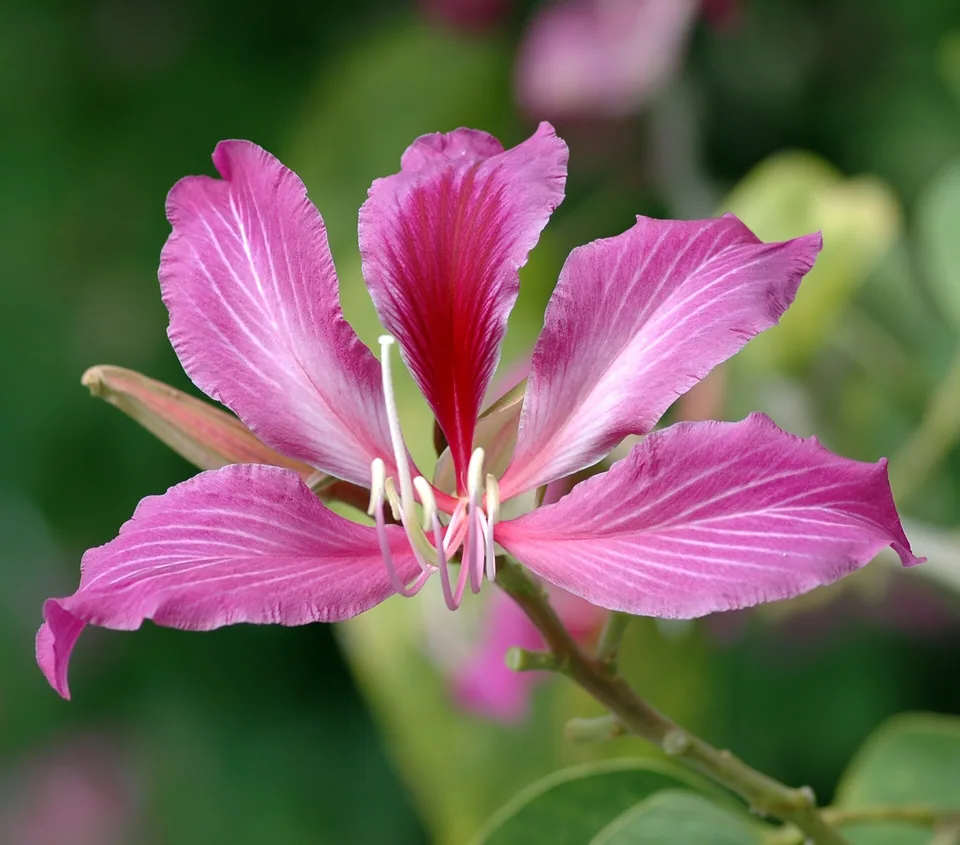
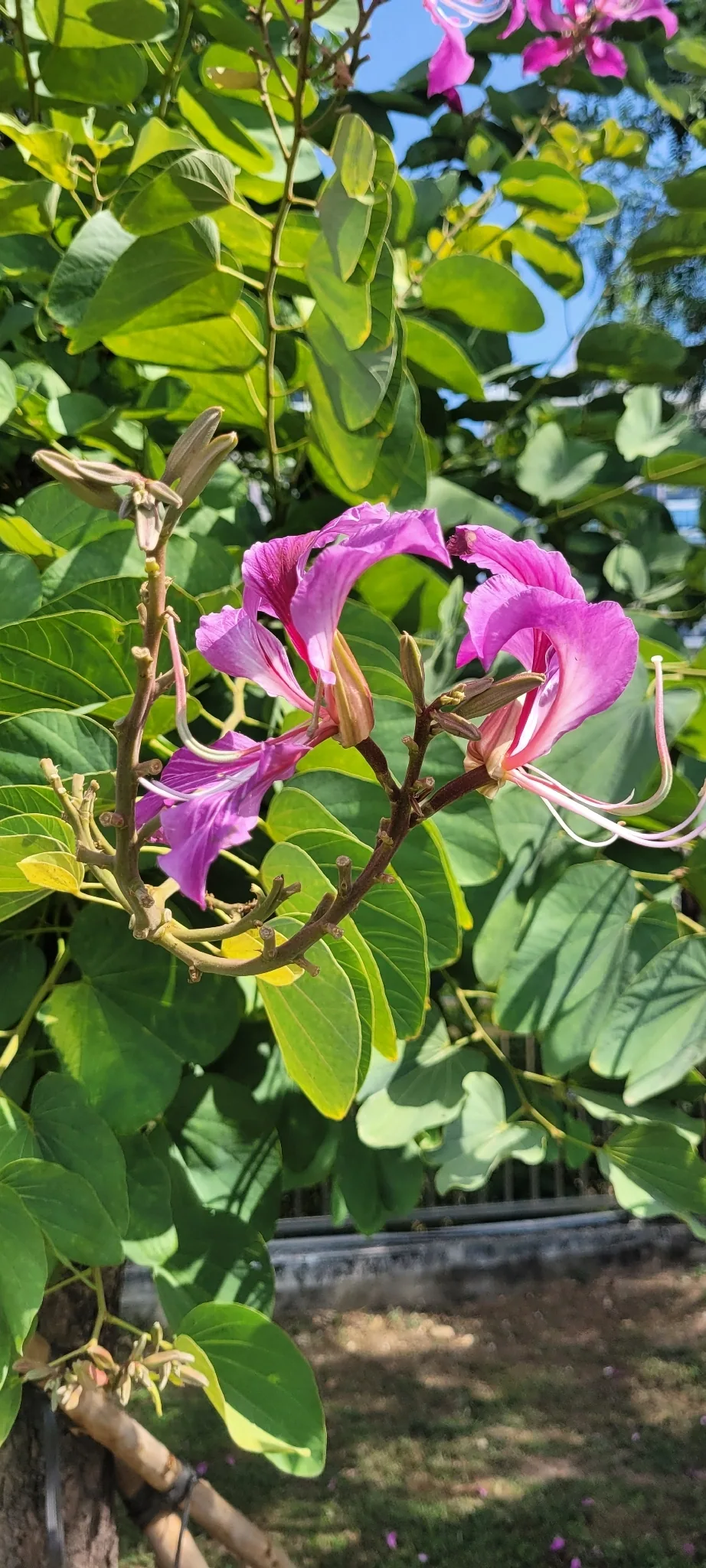
Hong Kong orchid tree is a sterile hybrid, multitrunked, semi-evergreen flowering tree with large orchid-like flowers. [1] It grows best in full sun on well-drained soil and is very drought-tolerant. [2] Its weak wood is susceptible to breakage in storms. [2]
This record is incomplete: the sources we read do not cover every field yet.
Not yet covered by our sources: Pruning
Bauhinia care
How to water Bauhinia
Watering
Very drought-tolerant once established; flowers best on dry soils
What the sources say (2)
Trees are very drought-tolerant and actually flower best on dry soils.It thrives in heat but the leaves may turn brown along the edges in dry heat or drought. Established trees have good drought tolerance.Watering notes
Good drainage is important
What the sources say (1)
Good drainage is important and it is best to protect the plant from frost to prevent damage to the foliage.How much light Bauhinia needs
How much cold Bauhinia can take
Hardiness, coldest zone
9b [winter low −3.9 to −1.1 °C (25 to 30 °F)]
What the sources say (1)
USDA Plant Hardiness Zone:
9b, 10a, 10b, 11a, 11bHardiness, warmest zone
11b [winter low 7.2 to 10 °C (45 to 50 °F)]
What the sources say (1)
USDA Plant Hardiness Zone:
9b, 10a, 10b, 11a, 11bHow to propagate Bauhinia
Cuttings; layering (air-layering); grafting onto seedlings of a parent species
What the sources say (2)
Propagation can only be accomplished by cuttings, layering, or grafting onto seedlings of one of the parent species.Orchid tree may need occasional pruning to maintain its shape. Propagation is by cuttings or air-layering.How to grow Bauhinia
The plant
Life cycle
perennial
What the sources say (1)
Whole Plant Traits: Plant Type: Perennial Tree Woody Plant Leaf Characteristics: Broadleaf EvergreenFamily
Fabaceae
What the sources say (1)
Genus: Bauhinia Species: x blakeana Family: Fabaceae Life Cycle: WoodyMature height
Mature width
610-762 cm (20-25 ft)
Pests and diseases
Pests
borers, caterpillars, mites, Chinese rose beetle
What the sources say (2)
Pests Borers, caterpillars, mites. Diseases Leaf spot, leaf scorch diseases.Chinese rose beetle may damage the leaves. As the tree ages, the limbs tend to droop, which may require pruning to allow clearance under the canopy.Diseases
leaf spot, leaf scorch
What the sources say (1)
Pests Borers, caterpillars, mites. Diseases Leaf spot, leaf scorch diseases.Fertilizing
Signs of deficiency
Prone to nutritional deficiencies, especially potassium
What the sources say (1)
Problems include a tendency to show nutri-tional deficiencies, especially potassium; the weak wood, which is susceptible to breakage in stormsBauhinia pests and problems
Wood breakage
Symptom: Weak wood susceptible to breakage in storms; multi-trunk trees may break at the crotch.
What to do: Prune young trees at regular intervals to achieve a more uniform crown; can be trained to a single trunk.
Chinese rose beetle
Symptom: May damage the leaves.
What the sources say (1)
Chinese rose beetle may damage the leaves. As the tree ages, the limbs tend to droop, which may require pruning to allow clearance under the canopy.
— Blake's bauhinia - Bauhinia x blakeana | North Carolina Extension Gardener Plant Toolbox [1]
Remedies
The sources we checked give no remedies for this plant.
Calendar
Pruning
Not stated in the sources we read.
Months as given by the sources, which are mostly from the United States (northern hemisphere). In the southern hemisphere they shift by about six months.
Indicative values
Values from a secondary source, not checked word for word like the rest of this page. Use them as a starting point.
- Hours of sun
- 6-8 hoursIndicative value, adapt it to your climate · Secondary source
- Drought tolerant
- yesIndicative value, adapt it to your climate · Secondary source
- Soil pH
- 6-7.5Indicative value, adapt it to your climate · Secondary source
- Care level
- MediumIndicative value, adapt it to your climate · Secondary source
- Growth rate
- HighIndicative value, adapt it to your climate · Secondary source
- Pruning
- December, March, MayIndicative value, adapt it to your climate · Secondary source
Similar plants
- Afghan Redbud Cercis griffithii
- American Groundnut Apios americana
- Amur Maackia Maackia amurensis
- Bicolor Lespedeza Lespedeza bicolor
- Black Locust Robinia pseudoacacia
- Blue False Indigo Baptisia australis
- Blue Ridge Golden-banner Thermopsis villosa
- Bristly Locust Robinia hispida
Sources
Every value above is quoted from these documents. Links lead to the original publisher.
- Blake's bauhinia - Bauhinia x blakeana | North Carolina Extension Gardener Plant Toolbox · plants.ces.ncsu.edu, consulted
- ENH247 · edis.ifas.ufl.edu, consulted
- Plants of Hawai'i | Bishop Museum · plantsofhawaii.org, consulted
Written by Emilio Marruso · last checked