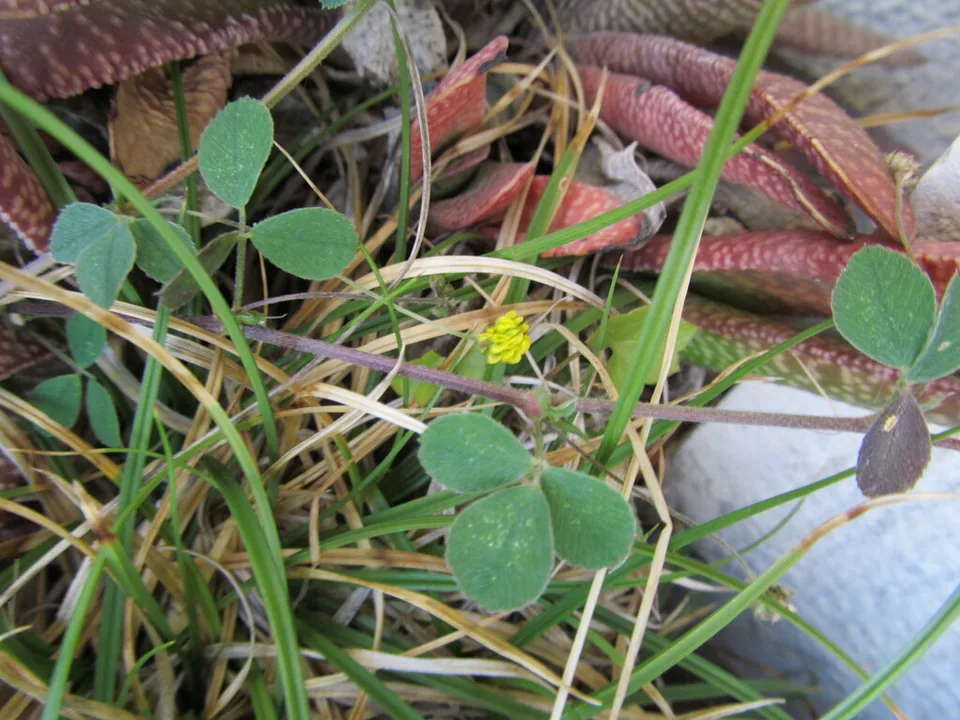
How to Grow and Care for Black Medick
Medicago lupulina
Written by Emilio Marruso · last checked
Toxic to: Livestock · Why
At a glance
Black medic is an easygoing annual that grows from seed in full sun or partial shade, and it even does well in containers. Its leaves and seeds can be eaten once cooked, and livestock find it tasty. Keep an eye on it after flowering: its seedpods help it spread fast, so pull extra plants along with their large root.
- Sun
Full sun to partial shade
What the sources say (1)
Light: Full sun to partial shade
in areas with full to partial sun, moist to mesic conditions
— Medicago lupulina (Black Clover, Black Medick, Black Nonesuch, Hop Clover, Trefoil, Yellow Trefoil) | North Carolina Extension Gardener Plant Toolbox [1] - Cold
Survives winters down to −40 °F (−40 °C)
Very hardy · USDA 3a · RHS H7 · Z3
What the sources say (2)
Hardiness, coldest zone: 3a [winter low −40 to −37.2 °C (−40 to −35 °F)]
3a, 3b, 4a, 4b, 5a, 5b, 6a, 6b, 7a, 7b, 8a, 8b, 9a, 9b
— Medicago lupulina (Black Clover, Black Medick, Black Nonesuch, Hop Clover, Trefoil, Yellow Trefoil) | North Carolina Extension Gardener Plant Toolbox [1] Hardiness, warmest zone: 9b [winter low −3.9 to −1.1 °C (25 to 30 °F)]
3a, 3b, 4a, 4b, 5a, 5b, 6a, 6b, 7a, 7b, 8a, 8b, 9a, 9b
— Medicago lupulina (Black Clover, Black Medick, Black Nonesuch, Hop Clover, Trefoil, Yellow Trefoil) | North Carolina Extension Gardener Plant Toolbox [1] - Feeding
Once established, use twice as much nitrogen as phosphorus; let a soil test set the amount
What the sources say (1)
Mineral fertilizers: A nitrogen to phosphorus ratio of 2:1 once the stand is established, with rates set by a soil test
A nitrogen/phosphorus ratio of 2:1 is recommended where black medic has become established. Follow soil test recommendations for fertilizer applications.
— Black Medic (Medicago lupulina) | Mississippi State University Extension Service [2] - Harvest
Leaves and seeds can be eaten, but only cooked
- Watch out
Spreads fast by seed after flowering; hand pull it, removing the large root
- Propagation
An annual that grows from seed
What the sources say (4)
Propagation: Seed
Recommended Propagation Strategy: Seed Country Or Region Of Origin:
— Medicago lupulina (Black Clover, Black Medick, Black Nonesuch, Hop Clover, Trefoil, Yellow Trefoil) | North Carolina Extension Gardener Plant Toolbox [1] Black medic reproduces exclusively from seed. Young plants have leaves with three leaflets
— Black Medic [8] Life cycle: annual
Black medic is a member of the legume family (Fabaceae) and is classified as a winter or summer annual.
— Lawn and Turfgrass Weeds: Black Medic (Medicago lupulina L.) [3] Black medic ( Medicago lupulina ) is an herbaceous winter or summer annual broadleaf landscape weed.
— Black Medic (Medicago lupulina) Identification and Control in Residential Landscapes | USU [5] - Sowing
In warm climates, sow from September 1 to October 10
What the sources say (2)
Sowing: September 1 to October 10 (Mississippi pasture seeding)
Mississippi: Planting date is from September 1 to October 10 at a rate of 10 to 12 lb/ac.
— Black Medic (Medicago lupulina) | Mississippi State University Extension Service [2] Planting date is from September 1 to October 10 at a rate of 10 to 12 lb/ac.
— Black Medic (Medicago lupulina) | Mississippi State University Extension Service [2] - Containers
Grows in containers too
What the sources say (1)
In containers: Yes
Landscape Location: Container Hanging Baskets Meadow Slope/Bank Woodland
— Medicago lupulina (Black Clover, Black Medick, Black Nonesuch, Hop Clover, Trefoil, Yellow Trefoil) | North Carolina Extension Gardener Plant Toolbox [1] - Safety
Livestock that eat too much of it can get bloat
Overview
Black medic is a prostrate annual or short-lived perennial legume that is usually treated as a lawn and disturbed-ground weed. [1] It grows in dry, nutrient-poor soils in full sun to partial shade and fixes nitrogen through root nodules. [1] It reproduces by seed, and plants are controlled by hand pulling or by improving turf density and soil fertility. [8][4]
Black Medick care
How much light Black Medick needs
Full sun to partial shade
What the sources say (1)
in areas with full to partial sun, moist to mesic conditionsHow much cold Black Medick can take
Hardiness, coldest zone
3a [winter low −40 to −37.2 °C (−40 to −35 °F)]
What the sources say (1)
3a, 3b, 4a, 4b, 5a, 5b, 6a, 6b, 7a, 7b, 8a, 8b, 9a, 9bHardiness, warmest zone
9b [winter low −3.9 to −1.1 °C (25 to 30 °F)]
What the sources say (1)
3a, 3b, 4a, 4b, 5a, 5b, 6a, 6b, 7a, 7b, 8a, 8b, 9a, 9bWhere to grow Black Medick
Yes
What the sources say (1)
Landscape Location:
Container
Hanging Baskets
Meadow
Slope/Bank
WoodlandHow to propagate Black Medick
Seed
What the sources say (2)
Recommended Propagation Strategy:
Seed
Country Or Region Of Origin:Black medic reproduces exclusively from seed. Young plants have leaves with three leafletsHow to grow Black Medick
The plant
Life cycle
annual
What the sources say (2)
Black medic is a member of the legume family (Fabaceae) and is classified as a winter or summer annual.Black medic ( Medicago lupulina ) is an herbaceous winter or summer annual broadleaf landscape weed.Family
Fabaceae
What the sources say (1)
Black medic is a member of the legume family (Fabaceae) and is classified as a winter or summer annual.Fertilizing
Mineral fertilizers
A nitrogen to phosphorus ratio of 2:1 once the stand is established, with rates set by a soil test
What the sources say (1)
A nitrogen/phosphorus ratio of 2:1 is recommended where black medic has become established. Follow soil test recommendations for fertilizer applications.Black Medick pests and problems
Weedy spread by seed
Symptom: Forms dense clusters of seedpods after flowering and spreads aggressively.
What to do: Hand pull or use weeding tools that remove the large taproot.
What the sources say (1)
This aggressive plant forms dense clusters of seedpods after flowering. To manage this plant in the landscape, requires hand pulling or weeding tools that can remove the large taproot.
— Medicago lupulina (Black Clover, Black Medick, Black Nonesuch, Hop Clover, Trefoil, Yellow Trefoil) | North Carolina Extension Gardener Plant Toolbox [1]
Remedies
Each remedy shows what official sources say about it; traditional remedies without an official source are marked as such. Harmful ones are listed so you know to avoid them.
Getting rid of it
black medic
hand pulling with the roots Partly works
How: Pull out the plants by hand, including their roots, when the soil is moist; easiest when the plants are young.
Pulling out plants by hand (including their roots) can be an adequate method for small infestations, especially when the soil is moist.
— Black Medic (Medicago lupulina) Identification and Control in Residential Landscapes | USU [5] What the evidence says Pulling out plants by hand (including their roots) can be an adequate method for small infestations, especially when the soil is moist.
— Black Medic (Medicago lupulina) Identification and Control in Residential Landscapes | USU [5] bark or leaf mulch layer Partly works
How: Apply a layer of bark or leaf mulch at least 3 inches thick around garden beds.
Applying a layer of bark or leaf mulch at least 3 inches thick around garden beds can suppress weed growth, including black medic.
— Black Medic (Medicago lupulina) Identification and Control in Residential Landscapes | USU [5] What the evidence says Applying a layer of bark or leaf mulch at least 3 inches thick around garden beds can suppress weed growth, including black medic.
— Black Medic (Medicago lupulina) Identification and Control in Residential Landscapes | USU [5] tilling and hand hoeing Partly works
How: Till the bed, then keep clear with additional tillage, hand hoeing or hand pulling.
Tilling garden beds and other landscaped areas can be practical for controlling black medic, but it will also bring new weed seeds to the surface.
— Black Medic (Medicago lupulina) Identification and Control in Residential Landscapes | USU [5] What the evidence says Tilling garden beds and other landscaped areas can be practical for controlling black medic, but it will also bring new weed seeds to the surface.
— Black Medic (Medicago lupulina) Identification and Control in Residential Landscapes | USU [5] raising the mower height to 3 inches Partly works
How: Raise the mower height to 3 inches or more; this helps suppress black medic and other lawn weeds.
raising the mower height to 3 inches or more can help suppress black medic and other lawn weeds.
— Black Medic (Medicago lupulina) Identification and Control in Residential Landscapes | USU [5] What the evidence says raising the mower height to 3 inches or more can help suppress black medic and other lawn weeds.
— Black Medic (Medicago lupulina) Identification and Control in Residential Landscapes | USU [5] cardboard topped with bark mulch Partly works
How: For large areas, lay down pieces of cardboard, top them with shredded bark at least 3 inches deep and let the bed rest for a season.
lay down pieces of cardboard, top them with shredded bark (a layer at least 3 inches deep), and let the bed “rest” for a season.
— finegardening.com [9] What the evidence says Applying a layer of bark or leaf mulch at least 3 inches thick around garden beds can suppress weed growth, including black medic.
— Black Medic (Medicago lupulina) Identification and Control in Residential Landscapes | USU [5] vinegar spray Partly works
Vinegar contains acetic acid that in concentrations over 11 percent can cause burns if it gets on your skin and permanent corneal injury if it comes in contact with your eyes.
— extension.illinois.edu [12] First, ensure you're wearing protective clothing to shield your skin and eyes from irritation.
— housedigest.com [10] How: Spray the leaves, thoroughly coating the foliage; repeated applications may be needed because black medic can resprout.
You can use regular household vinegar, which usually contains about 5% acetic acid, but for a more robust action, opting for herbicidal products with a 20% to 30% acetic acid concentration can significantly boost your weed-killing efforts.
— housedigest.com [10] What the evidence says Vinegar can treat and kill weeds, but it must be herbicidal vinegar or acetic acid, not household vinegar
— extension.illinois.edu [11] salt Harmful
How: Salt is a common ingredient in homemade weed killers.
Salt is another common ingredient found in homemade weed killers and has been used for centuries.
— extension.illinois.edu [13] What the evidence says Salt is soluble and thus highly mobile in your soil allowing it to spread to areas planted with desirable vegetables and ornamentals, damaging them along with your weeds.
— extension.illinois.edu [13] corn gluten meal Not verified
Traditional remedy, not verified by an official source.
How: Work corn gluten meal into the top 2 to 3 inches of soil before the weed seeds germinate, and water thoroughly.
Is Black Medick toxic to pets?
Reported by the source, quoted verbatim. This is not medical or veterinary advice: if a person or an animal may have eaten this plant, contact a poison control centre or a veterinarian.
Calendar
Sowing
September 1 to October 10 (Mississippi pasture seeding)
What each source says
Mississippi: September 1 to October 10
What the sources say (2)
Mississippi: Planting date is from September 1 to October 10 at a rate of 10 to 12 lb/ac.Planting date is from September 1 to October 10 at a rate of 10 to 12 lb/ac.Months as given by the sources, which are mostly from the United States (northern hemisphere). In the southern hemisphere they shift by about six months.
Edibility
Reported by the source, quoted verbatim. Do not eat a plant on the basis of this page alone: identification mistakes can be dangerous.
Indicative values
Values from a secondary source, not checked word for word like the rest of this page. Use them as a starting point.
- Watering
- FrequentIndicative value, adapt it to your climate · Secondary source
- Soil pH
- 6-7.5Indicative value, adapt it to your climate · Secondary source
- Growth rate
- HighIndicative value, adapt it to your climate · Secondary source
- Pruning
- March, April, May, December, January, February, August, December, January, February, March, April, MayIndicative value, adapt it to your climate · Secondary source
Similar plants
- Bur Medick Medicago polymorpha
- Moon trefoil Medicago arborea
- American Groundnut Apios americana
- American hogpeanut Amphicarpaea bracteata
- Bicolor Lespedeza Lespedeza bicolor
- Black Locust Robinia pseudoacacia
- Bristly Locust Robinia hispida
- Bush Clover Lespedeza thunbergii
Sources
Every value above is quoted from these documents. Links lead to the original publisher.
- Medicago lupulina (Black Clover, Black Medick, Black Nonesuch, Hop Clover, Trefoil, Yellow Trefoil) | North Carolina Extension Gardener Plant Toolbox · plants.ces.ncsu.edu, consulted
- Black Medic (Medicago lupulina) | Mississippi State University Extension Service · extension.msstate.edu, consulted
- Lawn and Turfgrass Weeds: Black Medic (Medicago lupulina L.) · extension.psu.edu, consulted
- Black Medic, Medicago lupulina – Wisconsin Horticulture · hort.extension.wisc.edu, consulted
- Black Medic (Medicago lupulina) Identification and Control in Residential Landscapes | USU · extension.usu.edu, consulted
- Black Clover - Medicago lupulina | North Carolina Extension Gardener Plant Toolbox · plants.ces.ncsu.edu, consulted
- Medicago lupulina - MREC - UF/IFAS - University of Florida, Institute of Food and Agricultural Sciences - UF/IFAS · mrec.ifas.ufl.edu, consulted
- Black Medic · extension.psu.edu, consulted
- finegardening.com · finegardening.com
- housedigest.com · housedigest.com
- extension.illinois.edu · extension.illinois.edu
- extension.illinois.edu · extension.illinois.edu
- extension.illinois.edu · extension.illinois.edu
Written by Emilio Marruso · last checked