DIY Raised Beds: How to Build, Fill and Choose Safe Lumber
Measure a raised bed from the inside, choose a soil mix for the site, and check the treatment tag before using lumber around vegetables.
by Emilio MarrusoPublished
Set a low, open-bottom frame on well-drained ground, make it narrow enough to reach from the paths, and measure its inside before ordering fill. Choose a soil mix based on what is under the bed. If buying treated lumber, check the tag for the preservative and skip old or unidentified treated boards. See Maryland Extension's guidance on University of Maryland Extension, Building raised beds, University of Maryland Extension, Soil to fill raised beds and University of Maryland Extension, Safety of materials used for building raised beds [1] [2] [3].
In short:
- Locate the bed where water can drain and you can reach the middle.
- Multiply interior length, width and fill depth to buy the right volume.
- Verify the wood treatment or choose a material you can identify.
- Example interior
- 8 ft (2.4 m) long by 4 ft (1.2 m) wide
- Example soil depth
- 12 in (30.5 cm)
- Calculated soil volume
- 32 cubic feet (906.1 L)
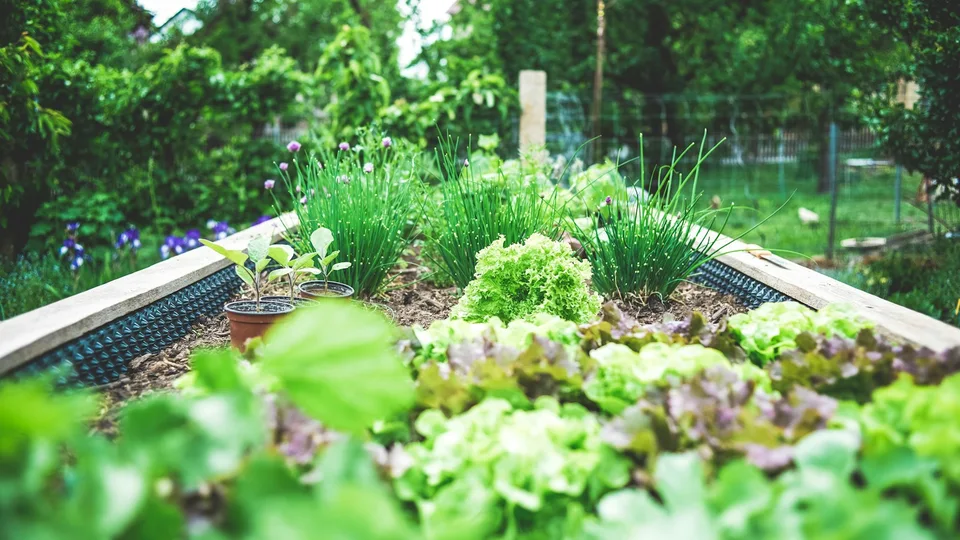
Where should a raised bed go?
Choose a sunny, level site with good drainage. Walk around the proposed bed before marking the corners. Leave enough room for kneeling, turning and carrying soil. Maryland Extension lists typical widths of 2 to 4 ft (0.6 to 1.2 m). If you can work from only one side, use your comfortable reach to choose a narrower bed. You should be able to work without stepping on the soil [1] [2].
| Surface below the bed | How to prepare it | How to fill |
|---|---|---|
| Existing garden with good drainage | Test the soil and keep access from the paths [2]. | Use the existing soil and amend it according to its condition. |
| Compacted ground | Remove vegetation and use a garden fork to loosen without flipping the subsoil [2]. | Maryland gives compost to topsoil options of 1:2 or 1:1 by volume for this situation. |
| Pavement | Provide an exit for water and enough root depth for the crop [2]. | Maryland recommends equal volumes of compost and soilless mix for this scenario. |
A low frame on good soil gives roots access to the ground below. On pavement, the fill provides the entire rooting depth. Maryland specifies a minimum of 8 in (20.3 cm) for leafy greens, beans and cucumbers on a hard surface. For peppers, tomatoes and squash the guidance gives 12 to 24 in (30.5 to 61.0 cm). A tomato in this setting depends on the bed for both depth and water [2].
How do you build the frame?
Step 1 Mark the space and test your reach
Use string or lay the boards on the ground to see how the bed fits. Reach toward the middle from the exact spot where you will stand or kneel. Check that a path still works once you put tools, a watering hose or supports next to the bed. If a fence blocks one side, move the frame away or reduce its width [1].
Step 2 Set and secure the sides
Assemble the boards into a stable rectangle with secure corners. Check the frame for square by comparing its diagonals and check that it sits level. Confirm that the side boards and fasteners are suited to holding the fill, especially if you stack boards for a deeper bed. Place the assembled frame and check that water can still leave from below [1] [2].
Step 3 Calculate the volume before buying soil
For the example in the box, the depth of 12 in (30.5 cm) is 1 ft (0.3 m). Multiply the interior dimensions in feet, 8 × 4 × 1, to get 32 cubic feet (906.1 L). Use the depth you actually plan to fill. The converted dimensions are for reference and the volume uses the original dimensions before rounding. Outside dimensions would include the thickness of the boards and overstate the space for soil.
If you choose Maryland's 1:1 compost-to-topsoil option for compacted ground in this example, divide the total into 16 cubic feet (453.1 L) of each. Use one consistent unit when comparing bags or asking for a bulk delivery. The example applies only to this geometry and this chosen mix [2].
Is pressure-treated wood safe for vegetable beds?
Look at the treatment tag before buying wood. Maryland Extension distinguishes residential micronized copper azole, or MCA, from older preparations such as chromated copper arsenate, or CCA. MCA contains copper and does not contain arsenic. The Maryland guidance recommends avoiding older treatments, including CCA, creosote and pentachlorophenol. For reclaimed wood with no readable identification, choose a material you can verify [3].
In a field study by Oregon State University Extension, Pressure-treated wood for raised bed construction in Oregon, copper increased in soil immediately next to Douglas-fir boards treated with copper azole (CA-C). The researchers detected no increase in copper in the vegetables and herbs they tested. The study result concerns CA-C under those conditions. If you want to limit soil contact with known treated boards, Maryland lists painting, staining and lining the sides as options. A side liner should leave water a way out of the bed [3] [4].
What should you check after filling?
Look for a settled hollow where water might collect, and check whether the mix drains after watering. Beds on hard surfaces can dry quickly and can be exposed to reflected heat. Check moisture within the fill rather than judging from one dry board or from a wet patch beside the bed. Keep the paths clear enough to reach plants without compacting their root zone [1] [2].
If you are buying soil in bulk, ask what it contains and where it came from. Maryland recommends asking a seller for test results and for information on how the material was mixed and stored. A description on a bag gives you less information than knowing whether the mix contains mineral soil, compost or both [2].
Frequently asked questions
Can the same soil mix go in every raised bed?
Choose the mix after you check the soil underneath. Existing garden soil, compacted ground and pavement each call for a different approach in Maryland's guidance [2].
Should you line the whole frame with plastic?
If you use a liner to separate treated wood from fill, put it along the inside walls and keep a path for drainage [3].
Sources
- University of Maryland Extension, Building raised beds · extension.umd.edu, consulted
- University of Maryland Extension, Soil to fill raised beds · extension.umd.edu, consulted
- University of Maryland Extension, Safety of materials used for building raised beds · extension.umd.edu, consulted
- Oregon State University Extension, Pressure-treated wood for raised bed construction in Oregon · extension.oregonstate.edu, consulted
Written by Emilio Marruso · last checked