

How to Grow and Care for Tomato
Solanum lycopersicum
Written by Emilio Marruso · last checked
Toxic to: Cats, Dogs, Horses, People · Why
At a glance
Keep the soil consistently watered to avoid blossom end rot and splitting fruit.
- Sun
Full sun requires direct light at least 6 hours/day.
What the sources say (1)
Light: Full sun requires direct light at least 6 hours/day
Full sun requires direct light at least 6 hours/day
— Growing Tomatoes in a Home Garden | University of Maryland Extension [3] - Water
Supplemental watering is best done in the morning and applied directly to the soil surrounding the plants.
What the sources say (1)
Watering notes: Supplemental watering is best done in the morning and applied directly to the soil surrounding the plants.
Supplemental watering is best done in the morning and applied directly to the soil surrounding the plants.
— Growing Tomatoes in the Home Garden | Yard and Garden [4] - Planting
Transplant tomatoes into the garden after the danger of frost has passed.
What the sources say (1)
Planting: Transplant tomatoes into the garden after the danger of frost has passed.
Transplant tomatoes into the garden after the danger of frost has passed.
— Growing Tomatoes in the Home Garden | Yard and Garden [4] - Containers
A five-gallon bucket with holes drilled in the bottom is an easy and affordable option.
What the sources say (1)
In containers: A five-gallon [18.9 L] bucket with holes drilled in the bottom is an easy and affordable option.
A five-gallon bucket with holes drilled in the bottom is an easy and affordable option.
— University of Florida IFAS Extension — Tomatoes [5] - Pruning
Remove suckers from indeterminate tomato plants except for the sucker below the lowest flower/fruit cluster.
What the sources say (1)
Pinching:
Wisconsin · Indeterminate tomatoes: Remove suckers from indeterminate tomato plants except for the sucker below the lowest flower/fruit cluster.
— University of Wisconsin–Madison Extension — Tomato Pruning [6] - Feeding
too much fertilizer, especially nitrogen, can lead to extensive leafy growth with little fruit production.
What the sources say (1)
Avoid: too much fertilizer, especially nitrogen, can lead to extensive leafy growth with little fruit production.
too much fertilizer, especially nitrogen, can lead to extensive leafy growth with little fruit production.
— Solanum lycopersicum (Tomato, Tomatoes) | North Carolina Extension Gardener Plant Toolbox [1]
Overview
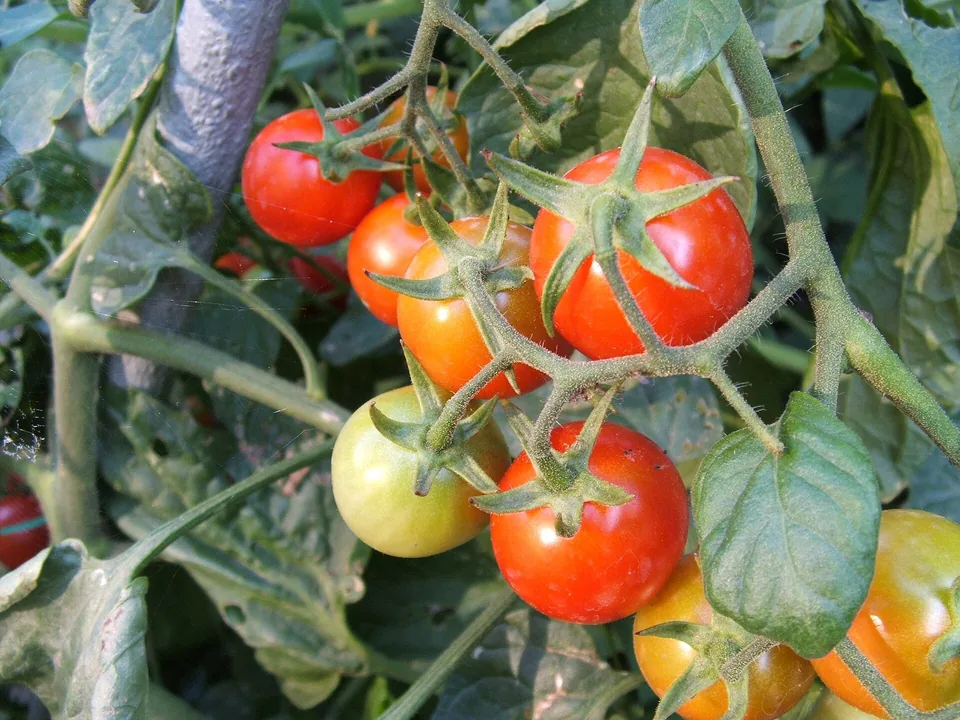
Tomato is a warm-season vegetable grown as an annual in temperate climates. [1][3] It needs full sun, a slightly acidic soil and consistent watering to avoid blossom end rot and fruit splitting. [1] Transplants go out after the danger of frost has passed, and seed is started indoors 5-6 weeks before planting. [4]
Tomato care
Measurements in square brackets are our conversion into the other unit system; the quoted text is unchanged.
How to water Tomato
Watering
One inch [2.5 cm] of water per week; keep the root zone moist by watering deeply and regularly, at least once weekly and more frequently during dry periods and when blossoms begin to develop
What the sources say (2)
Like most vegetables, tomatoes perform best when they receive one inch of water per week.Watering – Keep the root zone moist by watering deeply and regularly during dry periods. Water at least once weekly, more frequently when during dry periods and when blossoms begin to develop.Watering notes
Supplemental watering is best done in the morning and applied directly to the soil surrounding the plants.
What the sources say (1)
Supplemental watering is best done in the morning and applied directly to the soil surrounding the plants.How much light Tomato needs
Full sun requires direct light at least 6 hours/day
What the sources say (1)
Full sun requires direct light at least 6 hours/dayBest soil for Tomato
Soil pH, minimum
5.8
What each source says
According to NC State Extension: 5.8
According to Iowa State Extension: 6.0
What the sources say (3)
According to NC State Extension: Tomatoes need full sun and prefer moist, loamy and slightly acidic soil with a pH of 5.8 to 6.8.According to Iowa State Extension: Tomatoes prefer a slightly acidic soil with a pH of 6.0-6.8 but can be grown in slightly alkaline soils.Tomatoes need full sun and prefer moist, loamy and slightly acidic soil with a pH of 5.8 to 6.8.Soil pH, maximum
6.8
What each source says
According to NC State Extension: 6.8
According to Iowa State Extension: 6.8
What the sources say (4)
According to NC State Extension: Tomatoes need full sun and prefer moist, loamy and slightly acidic soil with a pH of 5.8 to 6.8.According to Iowa State Extension: Tomatoes prefer a slightly acidic soil with a pH of 6.0-6.8 but can be grown in slightly alkaline soils.Tomatoes need full sun and prefer moist, loamy and slightly acidic soil with a pH of 5.8 to 6.8.Tomatoes prefer a slightly acidic soil with a pH of 6.0-6.8 but can be grown in slightly alkaline soils.Where to grow Tomato
In containers
A five-gallon [18.9 L] bucket with holes drilled in the bottom is an easy and affordable option.
What the sources say (1)
A five-gallon bucket with holes drilled in the bottom is an easy and affordable option.Spacing
45.7-61.0 cm (18 to 24 inches); by training system: staked or determinate 45.7-61.0 cm (1.5-2 ft), wire-caged 61.0-91.4 cm (2-3 ft), sprawling 91.4-121.9 cm (3-4 ft)
What each source says
According to NC State Extension: 45.7-61.0 cm (18 to 24 inches)
According to University of Maryland Extension (in rows): 45.7-91.4 cm (18-36 in) in rows x 121.9-152.4 cm (48-60 in) between rows
indeterminate cultivars that are staked: 45.7-61.0 cm (1.5-2 ft)
grown in wire cages: 61.0-91.4 cm (2-3 ft)
allowed to sprawl over the ground: 91.4-121.9 cm (3-4 ft)
determinate tomatoes: 45.7-61.0 cm (1.5-2 ft)
What the sources say (8)
According to NC State Extension: Space plants 18 to 24 inches apart.According to University of Maryland Extension (in rows): Spacing: 18”-36” in rows x 48”-60” between rows.indeterminate cultivars that are staked: Indeterminate cultivars that are staked can be planted 1.5-2 feetgrown in wire cages: If grown in wire cages, space plants 2-3 feet apart.allowed to sprawl over the ground: Tomatoes allowed to sprawl over the ground should be spaced 3-4 feet apart.determinate tomatoes: Determinate tomatoes can be planted 1.5-2 feet apart in rows 4 feet apart.Larger fruits like beefsteak tomatoes are harder to produce in NC for this reason. Space plants 18 to 24 inches apart.Indeterminate cultivars that are staked can be planted 1.5-2 feet
apart within rows. If grown in wire cages, space plants 2-3 feet apart. Tomatoes allowed to sprawl over the ground should be spaced 3-4 feet apart.How to propagate Tomato
Seed; transplants
What the sources say (1)
Tomatoes can be started by seed indoors 5 to 6 weeks before planting or bought as transplants.How to grow Tomato
The plant
Life cycle
annual
What each source says
frost-free climates: perennial
What the sources say (2)
frost-free climates: Tomatoes are usually grown as an annual, but in frost-free climates, they are perennials.It is a perennial but is usually grown outdoors in temperate climates as an annual.Family
Solanaceae
What the sources say (1)
Tomatoes are an edible, annual or herbaceous perennial warm-season vegetable in the nightshade family (Solanaceae).Mature height
30.5-304.8 cm (1 to 10 ft)
What the sources say (1)
The plants can grow 1 to 10 feet tall and 1 to 4 feet wide.Mature width
30.5-121.9 cm (1 to 4 ft)
What the sources say (1)
The plants can grow 1 to 10 feet tall and 1 to 4 feet wide.Sowing and growth
Row spacing
121.9-152.4 cm (48-60 in; 4-5 ft)
What the sources say (2)
Spacing: 18”-36” in rows x 48”-60” between rows.Tomatoes allowed to sprawl over the ground should be spaced 3-4 feet apart. Rows should be spaced 4-5 feet apart.Days to maturity
65-90 days from transplant
What each source says
counted from sowing the seeds: 2 to 3 months, or up to 4 to 5 months, depending on the variety
What the sources say (2)
counted from sowing the seeds: Harvesting of fruits may occur 2 to 3 months after planting the seeds or up to 4 to 5 months, depending on the variety.Days to maturity: 65 - 90 from transplant.Harvest and storage
How to harvest
The sources disagree:
Harvest as soon as fruit color begins to change. This prevents many fruit problems (cracking, splitting, insect feeding, diseases) and increases the yield of edible fruit.
[3]Tomatoes should be allowed to ripen fully on the plant. Pick carefully from the plant when the entire fruit is a uniform color
[4]
Storage
Fully ripe fruit at room temperature for 5-6 days; mature green fruit picked before the first frost: wrap each in newspaper and keep in a cool (60 to 65 °F; 15.6-18.3 °C), dark place, moving them to room temperature when they begin to color
What the sources say (3)
Tomatoes can be stored at room temperature for 5-6 days.Individually wrap each tomato in a piece of newspaper. Store wrapped tomatoes in a cool (60 to 65°F), dark location, such as a basement or cellar.When the tomatoes begin to color, remove the newspaper and place them at room temperature.Saving seeds
Save seed from open-pollinated (heirloom) varieties, which come true to type if not cross-pollinated with another variety of the same species; seed saved from F1 hybrids does not resemble the parent plant
What the sources say (2)
These seedlings come true to type as long as they are not allowed to cross-pollinate with another variety of the same species.Seeds saved from hybrid plants will not produce progeny that resembles the parent plantPests and diseases
Pests
stink bugs, cutworms, tomato hornworms, tobacco hornworms, aphids, cabbage looper, whiteflies, tomato fruit worms, flea beetles, red spider mites, slugs, Colorado potato beetle
What the sources say (1)
Tomatoes are susceptible to many pests, including stink bugs, cutworms, tomato hornworms, tobacco hornworms, aphids, cabbage looper, whiteflies, tomato fruit worms, flea beetles, red spider mites, slugs and Colorado potato beetle.Diseases
blights, blossom end rot, verticillium wilt, fusarium wilt, tobacco mosaic virus, septoria leaf spot, bacterial and viral diseases
What the sources say (2)
Diseases include blights, blossom end-rot, verticillium wilt, fusarium wilt, tobacco mosaic virus, and bacterial and viral diseasesAvoid overhead irrigation as it splashes soil, helping to spread common diseases like septoria leaf spot.Fertilizing
When
The sources give different values depending on region, zone or growing conditions.
What each source says
Maryland · Home garden: Use starter fertilizer for transplants. Side-dress after first fruits appear.
Iowa · Home garden: Three to four weeks after transplanting, fertilize the tomato plants with a dilute fertilizer solution.
What the sources say (2)
Maryland · Home garden: Use starter fertilizer for transplants. Side-dress after first fruits appear.Iowa · Home garden: Three to four weeks after transplanting, fertilize the tomato plants with a dilute fertilizer solution.Mineral fertilizers
Without a soil test: 48.8-97.6 g/m² of an all-purpose fertilizer such as 10-10-10, incorporated before planting; 3 to 4 weeks after transplanting, a water-soluble fertilizer or 14.8-29.6 mL of 10-10-10 dissolved in 3.785 L [1 gal] of water.
What the sources say (2)
If a soil test has not been conducted, apply and incorporate 1-2 pounds of all-purpose garden fertilizer, such as 10-10-10, per 100 square feet before planting.Use a water-soluble fertilizer or dissolve 1-2 tablespoons of 10-10-10 or a similar analysis fertilizer in a gallon of water.Micronutrients
Calcium: where soil calcium is low, 59.3 mL of gypsum mixed into the soil of each planting hole helps prevent blossom end rot. Magnesium (Epsom salt) only if a soil test shows a magnesium deficiency.
What the sources say (2)
If the soil calcium level is low, mix 1/4 cup of gypsum into the soil of each planting hole to help prevent blossom end rot.Do not add Epsom salts (magnesium sulfate) to the soil unless soil testing shows a magnesium deficiency.Avoid
too much fertilizer, especially nitrogen, can lead to extensive leafy growth with little fruit production.
What the sources say (1)
too much fertilizer, especially nitrogen, can lead to extensive leafy growth with little fruit production.Signs of excess
Extensive leafy growth with little fruit production; fruit development can be inhibited.
What the sources say (2)
While they need decent nutrition, too much fertilizer, especially nitrogen, can lead to extensive leafy growth with little fruit production.Over-fertilization promotes excessive vegetative (leafy) growth and may inhibit fruit development.Spacing
Between plants
45-60 cm [18–24 in] between plants, depending on their eventual size and the training system.
What each source says
indeterminate cultivars, staked: 46-61 cm [18–24 in] within the row
in wire cages: 61-91 cm [24–36 in]
sprawling on the ground: 91-122 cm [36–48 in]
determinate cultivars: 46-61 cm [18–24 in] in rows 122 cm [48 in] apart
in containers: One plant per pot of at least 18.9 L [5 gal], 30-61 cm [12–24 in] deep
What the sources say (8)
indeterminate cultivars, staked: Indeterminate cultivars that are staked can be planted 1.5-2 feet apart within rows.in wire cages: If grown in wire cages, space plants 2-3 feet apart. Tomatoes allowed to sprawlsprawling on the ground: Tomatoes allowed to sprawl over the ground should be spaced 3-4 feet apart.determinate cultivars: Determinate tomatoes can be planted 1.5-2 feet apart in rows 4 feet apart.in containers: Tomatoes can also be grown in containers at a minimum of 5 gallons and 1 to 2 feet deep, one plant per pot.Space plants 45–60cm (18–24in) apart, depending on their eventual size – check seed packets for exact spacings.Space plants 18 to 24 inches apart. Tomatoes will grow extra roots on portions of the stemSpacing Plant spacing depends on the growth habit of the cultivar and the training system.Between rows
122-152 cm [48–60 in] between rows.
What each source says
determinate cultivars: 122 cm [48 in]
What the sources say (3)
determinate cultivars: Determinate tomatoes can be planted 1.5-2 feet apart in rows 4 feet apart.Rows should be spaced 4-5 feet apart. Determinate tomatoes can be plantedSpacing: 18”-36” in rows x 48”-60” between rows.Roots
Root system
Relatively shallow, fibrous root system; roots form along the buried portion of the stem.
What the sources say (2)
Tomatoes have a relatively shallow, fibrous rooting system, so cultivate carefully or use a thick mulch to prevent weeds.Roots will form along the buried portion of the stem. - Avoid setting the root ball deeply into cold soil.Propagation
Germination
Seeds need 18 °C [64 °F] to germinate; sow indoors 5-6 weeks before the intended outdoor planting date.
What the sources say (2)
Seeds need a temperature of about 18°C (64°F) to germinate, so use a heated propagator or place on a warm windowsillTomato seeds should be sown indoors 5-6 weeks before the intended outdoor planting date.After harvest
Storage
Ripe fruit at room temperature for 5-6 days; green fruit picked before the first killing frost: 10-21 °C [50–70 °F] at 90% relative humidity for 1-3 weeks, then ripened at 21 °C [70 °F].
What the sources say (3)
Tomatoes can be stored at room temperature for 5-6 days. Tomatoes can also be dried, frozen, cannedPick green tomatoes before the first killing frost and store in medium cool (50°- 70°F), moist (90% RH) conditions for 1 to 3 weeks.moist (90% RH) conditions for 1 to 3 weeks. When desired, ripen fruits at 70°F.Heat and drought
Heat
Red pigments do not form well above 32 °C [90 °F]: in hot weather the fruit of red-fruited cultivars is often yellow-orange.
What the sources say (2)
The red pigments in tomato fruit don’t form well when temperatures are above 90°F.However, in hot weather, the fruit of red-fruited cultivars is often yellow-orange.Drought
Needs deep, regular watering during dry periods to keep the root zone moist.
What each source says
in containers: May need watering daily in hot weather
Pruning
When to prune
The sources give different values depending on region, zone or growing conditions.
What each source says
Vermont · End of season: Late in the season, cutting plant tops off will allow green tomatoes to finish ripening before frost
What the sources say (1)
Vermont · End of season: Late in the season, cutting plant tops off will allow green tomatoes to finish ripening before frostPinching
The sources give different values depending on region, zone or growing conditions.
What each source says
Wisconsin · Indeterminate tomatoes: Remove suckers from indeterminate tomato plants except for the sucker below the lowest flower/fruit cluster.
What the sources say (1)
Wisconsin · Indeterminate tomatoes: Remove suckers from indeterminate tomato plants except for the sucker below the lowest flower/fruit cluster.Tomato pests and problems
Blossom end rot and fruit cracking
Symptom: Cracks and blossom end rot on fruit when soil moisture is uneven
What to do: Keep the soil consistently watered; where soil calcium is low, mix 1/4 cup of gypsum into each planting hole
What the sources say (2)
Consistent watering is essential, especially during fruit development. Plants that do not grow with even soil moisture can develop cracks and blossom end rot.
— Growing Tomatoes in the Home Garden | Yard and Garden [4] If the soil calcium level is low, mix 1/4 cup of gypsum into the soil of each planting hole to help prevent blossom end rot.
— Growing Tomatoes in a Home Garden | University of Maryland Extension [3] Septoria leaf spot and other foliar diseases
Symptom: Foliar disease spread by soil splash
What to do: Avoid overhead irrigation, select resistant varieties, keep foliage dry
What the sources say (2)
Avoid overhead irrigation as it splashes soil, helping to spread common diseases like septoria leaf spot.
— Growing Tomatoes in the Home Garden | Yard and Garden [4] Select varieties with disease resistance. - Water and fertilize to maintain plants in a vigorous condition. - Avoid fluctuations of too much and too little water. - Keep foliage dry.
— Growing Tomatoes in the Home Garden | Yard and Garden [4] Blossom drop in hot summers
Symptom: Hot summers can cause blossoms to drop before setting fruit
What to do: Plant as early as possible
What the sources say (1)
Plant as early as possible, as North Carolina's hot summers can cause blossoms to drop before setting fruit.
— Solanum lycopersicum (Tomato, Tomatoes) | North Carolina Extension Gardener Plant Toolbox [1] Physiological leaf curl
Symptom: Physiological leafroll occurs when the edges of the leaves roll upward and inward.
What to do: Leaf roll does not reduce plant growth or tomato yield, so no management is necessary.
What the sources say (2)
Physiological leafroll occurs when the edges of the leaves roll upward and inward.
— Iowa State University Extension and Outreach — Managing Tomato Diseases, Disorders, and Pests [7] Leaf roll does not reduce plant growth or tomato yield, so no management is necessary.
— University of Minnesota Extension — Tomato disorders [10] Few or no flowers
Symptom: High day and night temperatures will reduce flower production on tomato plants
What the sources say (1)
High day and night temperatures will reduce flower production on tomato plants
— Iowa State University Extension and Outreach — Managing Tomato Diseases, Disorders, and Pests [7] Early blight
Symptom: Larger spots have target-like concentric rings.
What to do: Keep leaves dry to reduce the spreading of disease.
Remedies
Each remedy shows what official sources say about it; traditional remedies without an official source are marked as such. Harmful ones are listed so you know to avoid them.
Treating the plant
blossom end rot
crushed eggshells Not proven
Iowa soils contain plenty of calcium, so adding calcium will not solve the problem.
— Iowa State University Extension and Outreach — Managing Tomato Diseases, Disorders, and Pests [7] How: Put a good handful of crushed eggshells in the planting hole; they slowly release calcium into the soil.
Next, I toss in a good handful of crushed eggshells. Tomatoes are notorious for developing blossom end rot, which is caused by calcium deficiency. Eggshells slowly release calcium into the soil and help keep your plants healthy.
— danismidlife.com [12] What the evidence says Eggshells can take anywhere from one to five years to break down and may not be readily available to plants and soil, including crushed eggshells
— extension.illinois.edu [13]
yellow leaves
epsom salts Harmful
Do not add Epsom salts (magnesium sulfate) to the soil unless soil testing shows a magnesium deficiency.
— Growing Tomatoes in a Home Garden | University of Maryland Extension [3] How: Mix a tablespoon of Epsom salts into the soil around the plant to prevent yellowing leaves and promote strong cell walls and better fruit development.
A tablespoon of Epsom salts mixed in the soil around the plant helps prevent yellowing leaves and promotes strong cell walls and better fruit development.
— danismidlife.com [12] What the evidence says Epsom salts (magnesium sulfate) should only be used if a soil test shows a magnesium deficiency. In most gardens, they can harm plants rather than help them.
— extension.oregonstate.edu [14]
aphids
strong water spray Not verified
Traditional remedy, not verified by an official source.
How: Spray the aphids off the plants with a strong stream of water.
dish soap spray Not verified
Traditional remedy, not verified by an official source.
Do not use dish soap products with added ingredients like bleach or degreaser.
— gardeningknowhow.com [15] spraying home remedies that contain dish detergent on plants on a sunny day can injure the plant, essentially burning it.
— extension.psu.edu [16] How: Dissolve one tablespoon of a mild, pure dish soap in a quart of water; spray all over the affected plants, including the undersides of the leaves, and reapply after it has dried and as needed.
garlic spray Not verified
Traditional remedy, not verified by an official source.
Spray on infested plants every 7-10 days, avoiding application during hot, sunny days to prevent leaf burn.
— farmstandapp.com [18] How: Soak 3-4 minced garlic cloves in 2 tablespoons of mineral oil for 24 hours, strain, add 1 teaspoon of mild liquid soap and mix with 1 quart of water; spray on infested plants every 7-10 days.
neem oil spray Not verified
Traditional remedy, not verified by an official source.
Avoid spraying during pollination hours to protect beneficial insects
— farmstandapp.com [18] How: Mix 2 teaspoons of neem oil with 1 teaspoon of mild liquid soap in 1 quart of warm water and apply every 7-14 days, coating all parts thoroughly.
whiteflies
oil and dish soap spray Official source, not independently tested
spraying home remedies that contain dish detergent on plants on a sunny day can injure the plant, essentially burning it.
— extension.psu.edu [16] How: Use a 0.25 to 0.5% oil spray (2 to 4 teaspoons of horticultural or canola oil and a few drops of dish soap per gallon of water) weekly.
Use a 0.25 to 0.5% oil spray (2 to 4 teaspoons horticultural or canola oil & a few drops of dish soap per gallon of water) weekly.
— hgic.clemson.edu [17]
powdery mildew
baking soda spray Not verified
Traditional remedy, not verified by an official source.
Always test on a few leaves first to ensure your plants don’t show sensitivity.
— farmstandapp.com [18] Avoid application during hot, sunny days as this can cause leaf burn.
— farmstandapp.com [18] How: Mix 1 tablespoon of baking soda with 1 tablespoon of vegetable oil and 1 teaspoon of mild liquid soap in 1 gallon of water; spray on the plants every 7-14 days, focusing on the undersides of the leaves, as a preventative measure before powdery mildew appears or at the very first signs.
early blight
milk spray Not verified
Traditional remedy, not verified by an official source.
How: Combine 1 part milk with 9 parts water in a spray bottle and apply to the plants weekly, especially during humid weather.
caterpillars
cayenne pepper spray Not verified
Traditional remedy, not verified by an official source.
The pepper spray can be very potent if it gets on your skin or in your eyes.
— extension.psu.edu [16] How: Mix one to two tablespoons of cayenne pepper in a quart of water, add a few drops of dish soap and spray the entire plant, including stems, leaves and any fruits.
fungal diseases
aspirin spray Not verified
Traditional remedy, not verified by an official source.
How: Dissolve 1-2 uncoated aspirin tablets (325mg each) in 1 gallon of water and spray on the plants every 2-3 weeks.
Is Tomato toxic to pets?
Reported by the source, quoted verbatim. This is not medical or veterinary advice: if a person or an animal may have eaten this plant, contact a poison control centre or a veterinarian.
Animals
#problem for cats #problem for dogs #problem for horses
[1]The source flags the risk for this animal but does not explain why.
People
Poison Severity: Medium Poison Symptoms: Leaves and stems cause headaches, abdominal pain,
[1]Leaves and stems cause headaches, abdominal pain, dilated pupils, vomiting, diarrhea, hypersalivation, severe gastrointestinal upset, circulatory and respiratory depression, and loss of sensation if eaten in large quantities.
[1]- Poisonous parts
Poison Part: Leaves Stems
[1]- Toxic principle
Poison Toxic Principle: Toxic alkaloid tomatine and solanine
[1]- Symptoms
Leaves and stems cause headaches, abdominal pain, dilated pupils, vomiting, diarrhea, hypersalivation, severe gastrointestinal upset, circulatory and respiratory depression, and loss of sensation if eaten in large quantities.
[1]
Calendar
Sowing
Indoors 5-6 weeks before the intended outdoor planting date
What the sources say (2)
Tomato seeds should be sown indoors 5-6 weeks before the intended outdoor planting date.Tomatoes can be started by seed indoors 5 to 6 weeks before planting or bought as transplants.Planting
Transplant tomatoes into the garden after the danger of frost has passed.
What the sources say (1)
Transplant tomatoes into the garden after the danger of frost has passed.Harvest
2 to 3 months after planting the seeds or up to 4 to 5 months, depending on the variety; 65-90 days from transplant
What each source says
Iowa: Most cultivars begin to ripen in August; early cultivars mid-to-late July
According to University of Maryland Extension: 65-90 days from transplant
According to NC State Extension: 2 to 3 months after planting the seeds, or up to 4 to 5 months
What the sources say (5)
Iowa: The fruit of most tomato cultivars generally begins to ripen in August.According to University of Maryland Extension: Days to maturity: 65 - 90 from transplant.According to NC State Extension: Harvesting of fruits may occur 2 to 3 months after planting the seeds or up to 4 to 5 months, depending on the variety.Harvesting of fruits may occur 2 to 3 months after planting the seeds or up to 4 to 5 months, depending on the variety.Days to maturity: 65 - 90 from transplant.Pruning
Under review: our second check questioned this value.
Months as given by the sources, which are mostly from the United States (northern hemisphere). In the southern hemisphere they shift by about six months.
Relative to frost
Less precise estimate: there is no weather station within 300 km.
Find frost dates by ZIP code or city
Transplant: around the last frost
Transplant tomatoes into the garden after the danger of frost has passed.
— Growing Tomatoes in the Home Garden | Yard and Garden [4]
Count from the average frost dates where you live.
Edibility
Reported by the source, quoted verbatim. Do not eat a plant on the basis of this page alone: identification mistakes can be dangerous.
The fruits or berries of the tomato are edible. They may be eaten raw, cooked, dried, or processed.
[1]
Indicative values
Values from a secondary source, not checked word for word like the rest of this page. Use them as a starting point.
- Hours of sun
- 6-8 hoursIndicative value, adapt it to your climate · Secondary source
- Soil
- Well-drainedIndicative value, adapt it to your climate · Secondary source
- Growth rate
- HighIndicative value, adapt it to your climate · Secondary source
Similar plants
- Bittersweet Solanum dulcamara
- Brazilian nightshade Solanum seaforthianum
- Eggplant Solanum melongena
- Potato Solanum tuberosum
- Sticky nightshade Solanum sisymbriifolium
- Apple of Sodom Solanum mammosum
- Chilean Nightshade Chilean Solanum crispum
- Ashwagandha Withania somnifera
Sources
Every value above is quoted from these documents. Links lead to the original publisher.
- Solanum lycopersicum (Tomato, Tomatoes) | North Carolina Extension Gardener Plant Toolbox · plants.ces.ncsu.edu, consulted
- Solanum | North Carolina Extension Gardener Plant Toolbox · plants.ces.ncsu.edu, consulted
- Growing Tomatoes in a Home Garden | University of Maryland Extension · extension.umd.edu, consulted
- Growing Tomatoes in the Home Garden | Yard and Garden · yardandgarden.extension.iastate.edu, consulted
- University of Florida IFAS Extension — Tomatoes · gardeningsolutions.ifas.ufl.edu, consulted
- University of Wisconsin–Madison Extension — Tomato Pruning · hort.extension.wisc.edu, consulted
- Iowa State University Extension and Outreach — Managing Tomato Diseases, Disorders, and Pests · yardandgarden.extension.iastate.edu, consulted
- University of Minnesota Extension — Early blight in tomato and potato · extension.umn.edu, consulted
- University of Vermont Extension — Tips for Growing Great Tomatoes · uvm.edu, consulted
- University of Minnesota Extension — Tomato disorders · extension.umn.edu, consulted
- rhs.org.uk · rhs.org.uk
- danismidlife.com · danismidlife.com
- extension.illinois.edu · extension.illinois.edu
- extension.oregonstate.edu · extension.oregonstate.edu
- gardeningknowhow.com · gardeningknowhow.com
- extension.psu.edu · extension.psu.edu
- hgic.clemson.edu · hgic.clemson.edu
- farmstandapp.com · farmstandapp.com
Written by Emilio Marruso · last checked