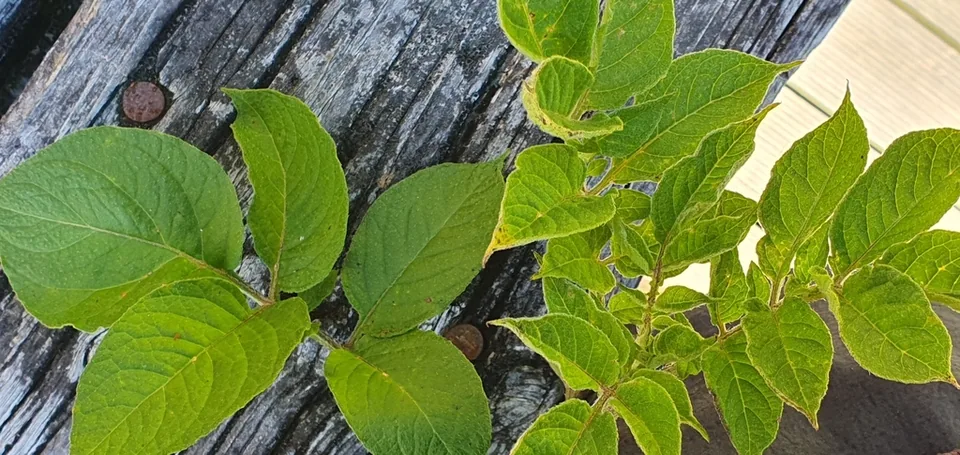
How to Grow and Care for Potato
Solanum tuberosum
Written by Emilio Marruso · last checked
Toxic to: People · Why
At a glance
Potatoes are a rewarding crop for a sunny spot: plant seed potatoes 3–5 inches deep in spring, give them 1 inch of water a week, and you can dig new potatoes just 6–8 weeks later. Let the rest grow until the vines die back, then cure them for two weeks and store them in the dark to enjoy boiled, baked, fried or roasted for months.
- Sun
Full sun
What the sources say (2)
Light: Full sun
Potatoes grow best in full sun and well-drained, sandy and acidic soil.
— Solanum tuberosum (Irish Potato, Irish Potatoes, Pomme de Terre, Potato, Potatoes, White Potato, White Potatoes) | North Carolina Extension Gardener Plant Toolbox [1] The planting site should receive at least six hours of direct sun each day.
— Growing Potatoes in the Home Garden | Yard and Garden [3] - Water
1 inch a week, watered deeply; avoid overhead watering
What the sources say (6)
Watering: About 1 inch [2.5 cm] of water per week during the growing season, watered deeply once a week in dry weather; keep plants well-watered if rainfall is lacking, especially while tubers are developing
Like most other vegetables, potatoes require 1 inch of water per week during the growing season.
— Growing Potatoes in the Home Garden | Yard and Garden [3] Water deeply once a week in dry weather.
— Growing Potatoes in the Home Garden | Yard and Garden [3] Keep plants well-watered if rainfall is lacking, especially while tubers are developing.
— Growing Potatoes in a Home Garden | University of Maryland Extension [2] Watering notes: Avoid overhead watering as it can spread fungal diseases; alternating wet and dry periods during tuber development can cause hollow heart, growth cracks and knobs; poorly drained soil may cause tubers to rot
Avoid overhead watering as it can spread fungal diseases.
— Growing Potatoes in a Home Garden | University of Maryland Extension [2] Alternating wet and dry periods during tuber development can cause hollow heart, growth cracks, and knobs.
— Growing Potatoes in the Home Garden | Yard and Garden [3] Poorly drained soil may cause tubers to rot, and acidic soil helps to prevent bacterial scabs.
— Solanum tuberosum (Irish Potato, Irish Potatoes, Pomme de Terre, Potato, Potatoes, White Potato, White Potatoes) | North Carolina Extension Gardener Plant Toolbox [1] - Cold
Survives winters down to −50 °F (−45.6 °C)
Very hardy · USDA 2a · RHS H7 · Z2
What the sources say (2)
Hardiness, coldest zone: 2a [winter low −45.6 to −42.8 °C (−50 to −45 °F)]
2a, 2b, 3a, 3b, 4a, 4b, 5a, 5b, 6a, 6b, 7a, 7b, 8a, 8b, 9a, 9b, 10a, 10b, 11a, 11b
— Solanum tuberosum (Irish Potato, Irish Potatoes, Pomme de Terre, Potato, Potatoes, White Potato, White Potatoes) | North Carolina Extension Gardener Plant Toolbox [1] Hardiness, warmest zone: 11b [winter low 7.2 to 10 °C (45 to 50 °F)]
2a, 2b, 3a, 3b, 4a, 4b, 5a, 5b, 6a, 6b, 7a, 7b, 8a, 8b, 9a, 9b, 10a, 10b, 11a, 11b
— Solanum tuberosum (Irish Potato, Irish Potatoes, Pomme de Terre, Potato, Potatoes, White Potato, White Potatoes) | North Carolina Extension Gardener Plant Toolbox [1] - Soil
Soil pH of 5.5 or higher
What the sources say (4)
Soil pH, minimum: 5.5
According to Penn State Extension: The soil should have a pH of 5.5 to 6.5.
— Potato Production [4] According to University of Maryland Extension: Potatoes grow best in well-drained soil high in organic matter with a pH of 6.0 to 6.5.
— Growing Potatoes in a Home Garden | University of Maryland Extension [2] where potato scab disease is a persistent problem: Where potato scab disease is a persistent problem, a soil pH of 4.8 to 5.8 is recommended.
— Growing Potatoes in a Home Garden | University of Maryland Extension [2] The soil should have a pH of 5.5 to 6.5.
— Potato Production [4] - Spacing
2–3 ft between rows
- Planting
Plant in spring as soon as the ground can be worked
What the sources say (5)
Planting: March 15 to May 1 depending on location; as soon as the ground can be worked in spring (early to mid-April in central Iowa)
According to University of Maryland Extension: Plant potatoes from March 15 to May 1, depending on your location.
— Growing Potatoes in a Home Garden | University of Maryland Extension [2] North Carolina: In North Carolina try to have potatoes planted sometime between mid-February and the end of March; they can tolerate a bit of frost.
— Solanum tuberosum (Irish Potato, Irish Potatoes, Pomme de Terre, Potato, Potatoes, White Potato, White Potatoes) | North Carolina Extension Gardener Plant Toolbox [1] central part of the state (Iowa): This is usually early to mid-April in the central part of the state, a week earlier in southern Iowa, and a week later in northern Iowa.
— Growing Potatoes in the Home Garden | Yard and Garden [3] Plant potatoes from March 15 to May 1, depending on your location.
— Growing Potatoes in a Home Garden | University of Maryland Extension [2] Potatoes should be planted as soon as the ground can be worked in the spring.
— Growing Potatoes in the Home Garden | Yard and Garden [3] - Feeding
Feed before planting and again when tubers form; avoid excess nitrogen and lots of manure
What the sources say (5)
When: Before planting, with a side-dressing when tubers begin to form
commercial production: - four to five weeks later another third of the nitrogen is side-dressed, and - remaining nitrogen is added based on petiole nitrate testing at flowering.
— Potato Production [4] Fertilizer needs: High requirement for nutrients, either from soil organic matter or fertilizers . Apply fertilizer before planting. Side-dress 6 weeks later when tubers begin to form.
— Growing Potatoes in a Home Garden | University of Maryland Extension [2] Broadcast and incorporate the fertilizer shortly before planting.
— Growing Potatoes in the Home Garden | Yard and Garden [3] Avoid: Large amounts of manure or other organic matter, which can increase potato scab; excess nitrogen; excess potassium
Don't apply large amounts of organic matter, such as manure, to the soil where potatoes will be grown. The addition of organic matter may increase the occurrence of potato scab.
— Growing Potatoes in the Home Garden | Yard and Garden [3] Excess nitrogen fertilization delays maturity, while excess potassium greatly hinders the uptake of magnesium and reduces the firmness of the potato (decreases the specific gravity).
— Potato Production [4] - Harvest
New potatoes 6–8 weeks after planting; storage potatoes after the vines die
What the sources say (8)
Harvest: New potatoes 6 to 8 weeks after planting, usually once the plants have flowered; storage potatoes after the vines have died and the crop is mature, most cultivars 90-120 days after planting
North Carolina: Potatoes can be harvested mature when the tubers are fully grown or the plant has dried up around June.
— Solanum tuberosum (Irish Potato, Irish Potatoes, Pomme de Terre, Potato, Potatoes, White Potato, White Potatoes) | North Carolina Extension Gardener Plant Toolbox [1] Northeast U.S.: potatoes are generally harvested from mid-July through October in the Northeast U.S.
— Potato Production [4] Small, tender “new” potatoes can be harvested 6 to 8 weeks after planting, usually once the plants have flowered.
— Growing Potatoes in a Home Garden | University of Maryland Extension [2] Most potato cultivars mature 90-120 days after planting.
— Growing Potatoes in the Home Garden | Yard and Garden [3] How to harvest: New potatoes: dig gently around the plants with a garden fork about 6 to 8 weeks after planting, usually once the plants have flowered. Storage potatoes: harvest after the vines have died; leave tubers in the ground for 2 weeks after die-back so the skin thickens. Do not dig when the soil is wet; avoid bruising, skinning or cutting the tubers.
Gently dig the soil around the young potatoes with a garden fork to avoid damaging the plant and bruising or spearing tubers.
— Growing Potatoes in a Home Garden | University of Maryland Extension [2] If you plan to store potatoes, leave tubers in the ground for 2 weeks after plants die back. This will allow them to develop a thickened skin.
— Growing Potatoes in a Home Garden | University of Maryland Extension [2] Don't dig potatoes if the soil is wet.
— Growing Potatoes in a Home Garden | University of Maryland Extension [2] When harvesting potatoes, avoid bruising, skinning, or cutting the tubers.
— Growing Potatoes in the Home Garden | Yard and Garden [3] - Pests
Colorado potato beetles, aphids, blights and scab
What the sources say (2)
Pests: Colorado potato beetles, flea beetles, aphids, leafhoppers, wireworms, corn borers
Several insects can cause severe problems in potatoes, including Colorado potato beetles, flea beetles, aphids, leafhoppers, wireworms, and corn borers.
— Potato Production [4] Diseases: early blight, late blight, common scab, powdery scab, blackleg, leaf roll virus, mosaic viruses, rhizoctonia, verticillium wilt, fusarium dry rot, bacterial soft rot
These include early blight, late blight, common and powdery scab, blackleg, leaf roll and mosaic viruses, rhizoctonia, verticillium wilt, fusarium dry rot, and bacterial soft rot.
— Potato Production [4] - Watch out
Light turns tubers green and toxic: hill soil around the plants and store in the dark
- Size
1–1.5 ft wide
What the sources say (1)
Mature width: 30-46 cm (1 to 1.5 ft)
Width: 1 ft. 0 in. - 1 ft. 6 in.
— Solanum tuberosum (Irish Potato, Irish Potatoes, Pomme de Terre, Potato, Potatoes, White Potato, White Potatoes) | North Carolina Extension Gardener Plant Toolbox [1] - Propagation
Plant seed potatoes (small tubers or pieces with at least two eyes)
What the sources say (2)
Propagation: Seed potatoes (small tubers or pieces of tubers with at least two eyes)
Before planting, cut seed potatoes so each piece has at least two eyes and allow it to rest outside for a day to let the cut end scab over.
— Solanum tuberosum (Irish Potato, Irish Potatoes, Pomme de Terre, Potato, Potatoes, White Potato, White Potatoes) | North Carolina Extension Gardener Plant Toolbox [1] Potatoes are most often grown from "seed potatoes," which are small tubers or pieces of tubers that sprout into a new plant.
— Solanum tuberosum (Irish Potato, Irish Potatoes, Pomme de Terre, Potato, Potatoes, White Potato, White Potatoes) | North Carolina Extension Gardener Plant Toolbox [1] - Safety
Never eat green parts or green tubers: they contain a toxin
Overview
Potato is grown for its edible underground tubers, which develop from planted seed potatoes. [3][1] It grows best in full sun and well-drained soil, with a steady supply of moisture during tuber development. [1][3] Green tubers and green parts of the plant contain solanine and should not be eaten. [1]
Potato care
Measurements in square brackets are our conversion into the other unit system; the quoted text is unchanged.
How to water Potato
Watering
About 1 inch [2.5 cm] of water per week during the growing season, watered deeply once a week in dry weather; keep plants well-watered if rainfall is lacking, especially while tubers are developing
What the sources say (3)
Like most other vegetables, potatoes require 1 inch of water per week during the growing season.Water deeply once a week in dry weather.Keep plants well-watered if rainfall is lacking, especially while tubers are developing.Watering notes
Avoid overhead watering as it can spread fungal diseases; alternating wet and dry periods during tuber development can cause hollow heart, growth cracks and knobs; poorly drained soil may cause tubers to rot
What the sources say (3)
Avoid overhead watering as it can spread fungal diseases.Alternating wet and dry periods during tuber development can cause hollow heart, growth cracks, and knobs.Poorly drained soil may cause tubers to rot, and acidic soil helps to prevent bacterial scabs.How much light Potato needs
Full sun
What the sources say (2)
Potatoes grow best in full sun and well-drained, sandy and acidic soil.The planting site should receive at least six hours of direct sun each day.How much cold Potato can take
Hardiness, coldest zone
2a [winter low −45.6 to −42.8 °C (−50 to −45 °F)]
What the sources say (1)
2a, 2b, 3a, 3b, 4a, 4b, 5a, 5b, 6a, 6b, 7a, 7b, 8a, 8b, 9a, 9b, 10a, 10b, 11a, 11bHardiness, warmest zone
11b [winter low 7.2 to 10 °C (45 to 50 °F)]
What the sources say (1)
2a, 2b, 3a, 3b, 4a, 4b, 5a, 5b, 6a, 6b, 7a, 7b, 8a, 8b, 9a, 9b, 10a, 10b, 11a, 11bBest soil for Potato
Soil pH, minimum
5.5
What each source says
According to Penn State Extension: 5.5
According to University of Maryland Extension: 6.0
where potato scab disease is a persistent problem: 4.8
What the sources say (4)
According to Penn State Extension: The soil should have a pH of 5.5 to 6.5.According to University of Maryland Extension: Potatoes grow best in well-drained soil high in organic matter with a pH of 6.0 to 6.5.where potato scab disease is a persistent problem: Where potato scab disease is a persistent problem, a soil pH of 4.8 to 5.8 is recommended.The soil should have a pH of 5.5 to 6.5.Soil pH, maximum
The sources give different values depending on region, zone or growing conditions.
What each source says
According to Penn State Extension: 6.5
According to University of Maryland Extension: 6.5
where potato scab disease is a persistent problem: 5.8
According to NC State Extension: 6.0
What the sources say (6)
According to Penn State Extension: The soil should have a pH of 5.5 to 6.5.According to University of Maryland Extension: Potatoes grow best in well-drained soil high in organic matter with a pH of 6.0 to 6.5.where potato scab disease is a persistent problem: Where potato scab disease is a persistent problem, a soil pH of 4.8 to 5.8 is recommended.According to NC State Extension: Soil pH: Acid (<6.0)The soil should have a pH of 5.5 to 6.5.Potatoes grow best in well-drained soil high in organic matter with a pH of 6.0 to 6.5.Where to grow Potato
In containers
Yes
What the sources say (2)
Raised beds provide good drainage and containers or grow bags can be suitable for growth as long as they are at least 2 feet deep and hold at least 30 gallons.Potatoes can be successfully grown in containers but potato "towers" don't usually work.Spacing
The sources give different values depending on region, zone or growing conditions.
What each source says
According to NC State Extension: 12.7-15.2 cm (5-6 in)
According to Penn State Extension: 17.8-30.5 cm (7-12 in)
According to Iowa State Extension: 30.5 cm (about 1 ft)
mainly harvesting new potatoes: 22.9 cm (9 in)
large storage potatoes as the goal: up to 50.8 cm (20 in)
What the sources say (5)
According to NC State Extension: Plant seed pieces 5 to 6 inches apart with the eyes facing up.According to Penn State Extension: Space seed pieces 7 to 12 inches apart in the row.According to Iowa State Extension: Set seed pieces, cut side down, and small whole potatoes about 1 foot apart in a furrow 4 inches deep.mainly harvesting new potatoes: If you would like to mainly harvest new potatoes, space plants 9” apart.large storage potatoes as the goal: If large storage potatoes are your goal space plants as far as 20” apart.How to propagate Potato
Seed potatoes (small tubers or pieces of tubers with at least two eyes)
What the sources say (2)
Before planting, cut seed potatoes so each piece has at least two eyes and allow it to rest outside for a day to let the cut end scab over.Potatoes are most often grown from "seed potatoes," which are small tubers or pieces of tubers that sprout into a new plant.How to grow Potato
The plant
Life cycle
perennial, grown as an annual crop
What the sources say (1)
Potatoes are herbaceous perennials in the nightshade family (Solanaceae), but they are grown as annual crops.Family
Solanaceae
What the sources say (1)
Potatoes are herbaceous perennials in the nightshade family (Solanaceae), but they are grown as annual crops.Mature height
Mature width
30-46 cm (1 to 1.5 ft)
What the sources say (1)
Width: 1 ft. 0 in. - 1 ft. 6 in.Sowing and growth
Sowing depth
7.6-12.7 cm (3 to 5 in) for seed pieces; 12.7-15.2 cm (5 to 6 in) for later crops
What the sources say (1)
Plant potatoes in furrows cut side down, 3- to 5-inches deep. Later crops should be planted 5- to 6-inches deep.Row spacing
61-91 cm (2 to 3 ft)
Days to maturity
Storage potatoes: 90-120 days after planting; new potatoes: 6 to 8 weeks after planting
What the sources say (2)
Potatoes grown for storage should be harvested after the vines have died and the crop is mature. Most potato cultivars mature 90-120 days after planting.Small, tender “new” potatoes can be harvested 6 to 8 weeks after planting, usually once the plants have flowered.Harvest and storage
How to harvest
New potatoes: dig gently around the plants with a garden fork about 6 to 8 weeks after planting, usually once the plants have flowered. Storage potatoes: harvest after the vines have died; leave tubers in the ground for 2 weeks after die-back so the skin thickens. Do not dig when the soil is wet; avoid bruising, skinning or cutting the tubers.
What the sources say (4)
Gently dig the soil around the young potatoes with a garden fork to avoid damaging the plant and bruising or spearing tubers.If you plan to store potatoes, leave tubers in the ground for 2 weeks after plants die back. This will allow them to develop a thickened skin.Don't dig potatoes if the soil is wet.When harvesting potatoes, avoid bruising, skinning, or cutting the tubers.Storage
Cure the tubers for two weeks at 10-16 °C (50 to 60°F) and high humidity (85 to 90 percent); then store in the dark at 4 °C (40°F) and 90 percent relative humidity. Do not freeze; do not store with apples or other fruit.
What the sources say (5)
Before storing the potatoes, cure the tubers at 50 to 60°F and high relative humidity (85 to 90 percent) for two weeks.Store potatoes at a temperature of 40°F and relative humidity of 90 percent.Store in a dark location as potatoes turn green when exposed to light.Do not allow potatoes to freeze.Do not store potatoes with apples or other fruit.Saving seeds
Saving your own seed potatoes is generally not worthwhile because viruses and diseases often show up the next year; buy certified seed potatoes. Seed from the plant fruits does not come true to variety.
What the sources say (2)
Saving your own seed potatoes is generally not worthwhile because viruses and diseases often show up the next year.However, the seed is extremely small and, if planted, will not come true to the desired variety.Pests and diseases
Pests
Colorado potato beetles, flea beetles, aphids, leafhoppers, wireworms, corn borers
What the sources say (1)
Several insects can cause severe problems in potatoes, including Colorado potato beetles, flea beetles, aphids, leafhoppers, wireworms, and corn borers.Diseases
early blight, late blight, common scab, powdery scab, blackleg, leaf roll virus, mosaic viruses, rhizoctonia, verticillium wilt, fusarium dry rot, bacterial soft rot
What the sources say (1)
These include early blight, late blight, common and powdery scab, blackleg, leaf roll and mosaic viruses, rhizoctonia, verticillium wilt, fusarium dry rot, and bacterial soft rot.Fertilizing
When
Before planting, with a side-dressing when tubers begin to form
What each source says
commercial production: At planting, a side-dressing four to five weeks later, and a final nitrogen application at flowering based on petiole nitrate testing
What the sources say (3)
commercial production: - four to five weeks later another third of the nitrogen is side-dressed, and - remaining nitrogen is added based on petiole nitrate testing at flowering.Fertilizer needs: High requirement for nutrients, either from soil organic matter or fertilizers . Apply fertilizer before planting. Side-dress 6 weeks later when tubers begin to form.Broadcast and incorporate the fertilizer shortly before planting.How often
Twice: before planting and a side-dressing 6 weeks later
What each source says
commercial production: Three times
What the sources say (2)
commercial production: Potatoes are typically fertilized three times: - at planting when approximately one-third of the nitrogen and all of the phosphate and potash is broadcasted and disked in, - four to five weeks later another third of the nitrogen is side-dressedFertilizer needs: High requirement for nutrients, either from soil organic matter or fertilizers . Apply fertilizer before planting. Side-dress 6 weeks later when tubers begin to form.Mineral fertilizers
48.8 to 97.6 g/m² of an all-purpose garden fertilizer such as 10-10-10, broadcast and incorporated shortly before planting, when no soil test is available
What each source says
commercial production: 168 to 202 kg [370.4–445.3 lb]/ha of nitrogen, depending on the cultivar
commercial production: At planting, one-third of the nitrogen and all of the phosphate and potash, broadcast and disked in
What the sources say (4)
commercial production: For conventionally grown potatoes, the amount of nitrogen applied typically ranges from 150 to 180 pounds per acre depending on the cultivar.commercial production: - at planting when approximately one-third of the nitrogen and all of the phosphate and potash is broadcasted and disked in,If a soil test has not been conducted, applying 1 to 2 pounds of all-purpose garden fertilizer, such as 10-10-10, per 100 square feet should be adequate for most home gardens.Broadcast and incorporate the fertilizer shortly before planting.Micronutrients
Magnesium, when soil magnesium is low or potassium is excessively high
What the sources say (1)
Magnesium is recommended when soil levels of magnesium are low, or potassium levels are excessively high.Avoid
Large amounts of manure or other organic matter, which can increase potato scab; excess nitrogen; excess potassium
What the sources say (2)
Don't apply large amounts of organic matter, such as manure, to the soil where potatoes will be grown. The addition of organic matter may increase the occurrence of potato scab.Excess nitrogen fertilization delays maturity, while excess potassium greatly hinders the uptake of magnesium and reduces the firmness of the potato (decreases the specific gravity).Signs of excess
Excess nitrogen delays maturity; excess potassium hinders magnesium uptake and lowers tuber firmness (specific gravity)
What the sources say (1)
Excess nitrogen fertilization delays maturity, while excess potassium greatly hinders the uptake of magnesium and reduces the firmness of the potato (decreases the specific gravity).Spacing
Between plants
The sources give different values depending on region, zone or growing conditions.
What each source says
North Carolina: 13-15 cm [5.1–5.9 in]
Maryland, home garden: 20-30 cm [8–12 in] in the row
for new potatoes (Maryland): 23 cm [9.1 in]
for large storage potatoes (Maryland): Up to 51 cm [20 in]
Iowa, home garden: 30 cm [12 in] apart in a furrow 10 cm [3.9 in] deep
Pennsylvania: 18-30 cm [7–12 in] in the row
What the sources say (6)
North Carolina: Plant seed pieces 5 to 6 inches apart with the eyes facing up.Maryland, home garden: Spacing: 8" - 12" in-rows x 24" - 36" between row.for new potatoes (Maryland): If you would like to mainly harvest new potatoes, space plants 9” apart.for large storage potatoes (Maryland): If large storage potatoes are your goal space plants as far as 20” apart.Iowa, home garden: Set seed pieces, cut side down, and small whole potatoes about 1 foot apart in a furrow 4 inches deep.Pennsylvania: Space seed pieces 7 to 12 inches apart in the row.Propagation
Germination
The sources give different values depending on region, zone or growing conditions.
What each source says
planting seed pieces: Soil at least 7.2 °C [45 °F]
What the sources say (1)
planting seed pieces: The soil temperature should be at least 45 degrees F.Cuttings
The sources give different values depending on region, zone or growing conditions.
What each source says
seed tuber pieces (not cuttings): Seed pieces of 42.5-56.7 g (3.8 cm [1.5 in] cubes) with 1 to 3 eyes, or small whole seed potatoes
cut seed pieces before planting: Hold several days at 15.6-21.1 °C [60–70 °F] and 85% relative humidity so the cut surfaces heal
What the sources say (2)
seed tuber pieces (not cuttings): Plant 1½ to 2 oz. seed pieces (1½-inch cubes) with 1 to 3 buds (“eyes”) or small, whole seed potatoescut seed pieces before planting: This problem may be prevented by treating the cut seed pieces with a fungicide or storing them at 60 to 70°F and 85% relative humidity for several days.After harvest
Storage
Cure 10-14 days at 10-15.6 °C [50–60 °F] and 85-90% relative humidity, then store in the dark at 4.4-10 °C [40–50 °F] and 90% relative humidity for 6-8 months; above 10 °C [50 °F] tubers sprout after 2-3 months, below 3.3 °C [38 °F] they turn sweet; do not let them freeze. New potatoes: refrigerate and use within 10 days.
What the sources say (8)
Storage potatoes are cured for 10 to 14 days at 50°F to 60°F and high humidity to heal over wounds and cuts.Before storing the potatoes, cure the tubers at 50 to 60°F and high relative humidity (85 to 90 percent) for two weeks.Medium cool (40°- 50°F), moist (90% RH) conditions; 6 to 8 months.Store potatoes at a temperature of 40°F and relative humidity of 90 percent.If storage temperatures are above 50°F, the tubers will begin to sprout after 2 or 3 months.When stored below 38°F, potatoes develop a sugary, sweet taste.Store in a dark location as potatoes turn green when exposed to light.Refrigerate new potatoes and use them within ten days.Heat and drought
Heat
Soil temperatures above 26.7 °C [80 °F] inhibit tuber development.
What the sources say (1)
Soil temperature in excess of 80°F will inhibit tuber development.Drought
Alternating wet and dry periods during tuber development cause hollow heart, growth cracks and knobs; keep plants watered when rain is lacking, especially while tubers develop.
What the sources say (2)
Alternating wet and dry periods during tuber development can cause hollow heart, growth cracks, and knobs.Keep plants well-watered if rainfall is lacking, especially while tubers are developing.Potato pests and problems
Green tubers
Symptom: Tubers exposed to light turn green
What to do: Hill soil around the plants and store in the dark
What the sources say (2)
Hilling potatoes provides loose soil for potatoes to develop and prevents tubers from being exposed and turning green.
— Growing Potatoes in the Home Garden | Yard and Garden [3] Store in a dark location as potatoes turn green when exposed to light.
— Growing Potatoes in the Home Garden | Yard and Garden [3] Potato scab
Symptom: Scab on tubers; organic matter may increase its occurrence
What to do: Use acidic soil and a scab-resistant cultivar
What the sources say (2)
The addition of organic matter may increase the occurrence of potato scab.
— Growing Potatoes in the Home Garden | Yard and Garden [3] Where potato scab disease is a persistent problem, a soil pH of 4.8 to 5.8 is recommended.
— Growing Potatoes in a Home Garden | University of Maryland Extension [2] Potato late blight
Symptom: Disease of potato plants
What to do: Buy certified disease-free seed potatoes
What the sources say (1)
Buying certified disease-free seeds can help prevent problems such as potato late blight.
— Solanum tuberosum (Irish Potato, Irish Potatoes, Pomme de Terre, Potato, Potatoes, White Potato, White Potatoes) | North Carolina Extension Gardener Plant Toolbox [1] Colorado potato beetle
Symptom: Beetle pest of potato
What to do: Apply a thick straw mulch after hilling up the soil
What the sources say (1)
Apply a thick straw mulch, after hilling up the soil, to keep the soil cool and moist and to deter Colorado potato beetles.
— Growing Potatoes in a Home Garden | University of Maryland Extension [2] Early Blight
Symptom: Concentric rings often form in lesions to produce characteristic target-board effect.
What to do: Avoid overhead irrigation.
What the sources say (2)
Concentric rings often form in lesions to produce characteristic target-board effect.
— University of California Statewide IPM Program — Early Blight of Potato [5] Avoid overhead irrigation.
— University of Connecticut Integrated Pest Management — Early Blight and Late Blight of Potato [6]
Remedies
Each remedy shows what official sources say about it; traditional remedies without an official source are marked as such. Harmful ones are listed so you know to avoid them.
Treating the plant
colorado potato beetle
hand-picking Partly works
How: Hand-pick beetles, eggs and small larvae from infested plants as soon as possible; remove overwintering beetles that appear on young plants in spring.
Hand-pick beetles, eggs and small larvae from infested plants as soon as possible (practical for a few insects on a few plants, but impractical for larger gardens and fields).
— yardandgarden.extension.iastate.edu [7] What the evidence says Hand-pick beetles, eggs and small larvae from infested plants as soon as possible (practical for a few insects on a few plants, but impractical for larger gardens and fields).
— yardandgarden.extension.iastate.edu [7] straw mulch Works
How: Apply a thick straw mulch after hilling up the soil.
Apply a thick straw mulch, after hilling up the soil, to keep the soil cool and moist and to deter Colorado potato beetles.
— Growing Potatoes in a Home Garden | University of Maryland Extension [2] What the evidence says Apply a thick straw mulch, after hilling up the soil, to keep the soil cool and moist and to deter Colorado potato beetles.
— Growing Potatoes in a Home Garden | University of Maryland Extension [2] basil leaf spray Not verified
Traditional remedy, not verified by an official source.
How: Spray with a mixture of basil leaves and water.
companion planting with eggplant, flax or green beans Not verified
Traditional remedy, not verified by an official source.
How: Companion plant with eggplant, flax, or green beans.
aphids
insecticidal soap spray Works
How: Use insecticidal soap on the aphids.
Spray away aphids with a blast of water from a garden hose. Use insecticidal soap.
— harvesttotable.com [8] What the evidence says For example, insecticidal soap is a safe, effective organic insecticide with minimal environmental impact.
— extension.psu.edu [9]
leafhoppers
insecticidal soap spray Works
How: Spray plants with a multipurpose insecticidal soap spray when nymphs are first found.
Treat the crop the first time you find a scattering of nymphs. Spray plants with a multipurpose insecticidal soap spray, like this one from [nome commerciale] .
— gardeningknowhow.com [10] What the evidence says For example, insecticidal soap is a safe, effective organic insecticide with minimal environmental impact.
— extension.psu.edu [9] floating row cover Not verified
Traditional remedy, not verified by an official source.
How: Cover plants with floating row cover to exclude leafhoppers.
blister beetles
handpicking with gloves Not verified
Traditional remedy, not verified by an official source.
They secrete oil that can cause the skin to blister.
— harvesttotable.com [8] How: Wear gloves and handpick the beetles from the leaves and destroy them.
flea beetles
diatomaceous earth Not verified
Traditional remedy, not verified by an official source.
How: Spread diatomaceous earth around seedlings.
wood ash Not verified
Traditional remedy, not verified by an official source.
How: Spread wood ashes around seedlings.
cutworms
paper collar Not verified
Traditional remedy, not verified by an official source.
How: Place a 3-inch paper collar around the stem of the plant.
wood ash Not verified
Traditional remedy, not verified by an official source.
How: Sprinkle wood ash around the base of plants and keep the garden free of weeds.
oak leaf mulch and tansy Not verified
Traditional remedy, not verified by an official source.
How: Use oak leaf mulch and companion plant tansy between rows.
wireworms
potato bait trap Not verified
Traditional remedy, not verified by an official source.
How: Bury pieces of raw potato in the soil as traps, check them every week and pick off and kill the wireworms on them.
flooding the soil Not verified
Traditional remedy, not verified by an official source.
How: Check the soil before planting; flood the soil if wireworms are present.
spider mites
water spray Not verified
Traditional remedy, not verified by an official source.
How: Spray away the mites with a blast of water; ladybugs and lacewings eat mites.
insecticidal soap spray Works
How: Use insecticidal soap on the mites.
Spider mites suck plant juices causing stippling. Spray away with a blast of water or use insecticidal soap or rotenone.
— harvesttotable.com [8] What the evidence says For example, insecticidal soap is a safe, effective organic insecticide with minimal environmental impact.
— extension.psu.edu [9]
potato tuberworm
hilling soil over tubers Not verified
Traditional remedy, not verified by an official source.
How: Hill up soil over tubers to keep worms from reaching them; handpick and destroy the caterpillars.
nematodes
soil solarization Not verified
Traditional remedy, not verified by an official source.
How: Rotate crops and solarize the soil with clear plastic in mid-summer.
Is Potato poisonous?
Reported by the source, quoted verbatim. This is not medical or veterinary advice: if a person or an animal may have eaten this plant, contact a poison control centre or a veterinarian.
All the green parts of the plant contain a toxin known as solanine and should not be ingested.
[1]Nausea, vomiting, salivation, drowsiness, abdominal pain, diarrhea, weakness, respiratory depression; may be fatal
[1]Green portions (chlorophyll) on potatoes are associated with solanine, a bitter, toxic glycoalkaloid.
[2]- Toxic principle
Green portions (chlorophyll) on potatoes are associated with solanine, a bitter, toxic glycoalkaloid.
[2]
Calendar
Planting
March 15 to May 1 depending on location; as soon as the ground can be worked in spring (early to mid-April in central Iowa)
What each source says
According to University of Maryland Extension: March 15 to May 1
North Carolina: Mid-February to the end of March
central part of the state (Iowa): Early to mid-April
What the sources say (5)
According to University of Maryland Extension: Plant potatoes from March 15 to May 1, depending on your location.North Carolina: In North Carolina try to have potatoes planted sometime between mid-February and the end of March; they can tolerate a bit of frost.central part of the state (Iowa): This is usually early to mid-April in the central part of the state, a week earlier in southern Iowa, and a week later in northern Iowa.Plant potatoes from March 15 to May 1, depending on your location.Potatoes should be planted as soon as the ground can be worked in the spring.Harvest
New potatoes 6 to 8 weeks after planting, usually once the plants have flowered; storage potatoes after the vines have died and the crop is mature, most cultivars 90-120 days after planting
What each source says
North Carolina: Mature potatoes around June (3-4 months after planting)
Northeast U.S.: Mid-July through October
What the sources say (4)
North Carolina: Potatoes can be harvested mature when the tubers are fully grown or the plant has dried up around June.Northeast U.S.: potatoes are generally harvested from mid-July through October in the Northeast U.S.Small, tender “new” potatoes can be harvested 6 to 8 weeks after planting, usually once the plants have flowered.Most potato cultivars mature 90-120 days after planting.Months as given by the sources, which are mostly from the United States (northern hemisphere). In the southern hemisphere they shift by about six months.
Edibility
Reported by the source, quoted verbatim. Do not eat a plant on the basis of this page alone: identification mistakes can be dangerous.
Indicative values
Values from a secondary source, not checked word for word like the rest of this page. Use them as a starting point.
- Hours of sun
- 5-6 hoursIndicative value, adapt it to your climate · Secondary source
- Drought tolerant
- yesIndicative value, adapt it to your climate · Secondary source
- Indoors
- yesIndicative value, adapt it to your climate · Secondary source
- Care level
- MediumIndicative value, adapt it to your climate · Secondary source
- Growth rate
- HighIndicative value, adapt it to your climate · Secondary source
- Pruning
- MayIndicative value, adapt it to your climate · Secondary source
Similar plants
- Bittersweet Solanum dulcamara
- Brazilian nightshade Solanum seaforthianum
- Eggplant Solanum melongena
- Sticky nightshade Solanum sisymbriifolium
- Tomato Solanum lycopersicum
- Apple of Sodom Solanum mammosum
- Chilean Nightshade Chilean Solanum crispum
- Ashwagandha Withania somnifera
Sources
Every value above is quoted from these documents. Links lead to the original publisher.
- Solanum tuberosum (Irish Potato, Irish Potatoes, Pomme de Terre, Potato, Potatoes, White Potato, White Potatoes) | North Carolina Extension Gardener Plant Toolbox · plants.ces.ncsu.edu, consulted
- Growing Potatoes in a Home Garden | University of Maryland Extension · extension.umd.edu, consulted
- Growing Potatoes in the Home Garden | Yard and Garden · yardandgarden.extension.iastate.edu, consulted
- Potato Production · extension.psu.edu, consulted
- University of California Statewide IPM Program — Early Blight of Potato · ipm.ucanr.edu, consulted
- University of Connecticut Integrated Pest Management — Early Blight and Late Blight of Potato · ipm.cahnr.uconn.edu, consulted
- yardandgarden.extension.iastate.edu · yardandgarden.extension.iastate.edu
- harvesttotable.com · harvesttotable.com
- extension.psu.edu · extension.psu.edu
- gardeningknowhow.com · gardeningknowhow.com
Written by Emilio Marruso · last checked