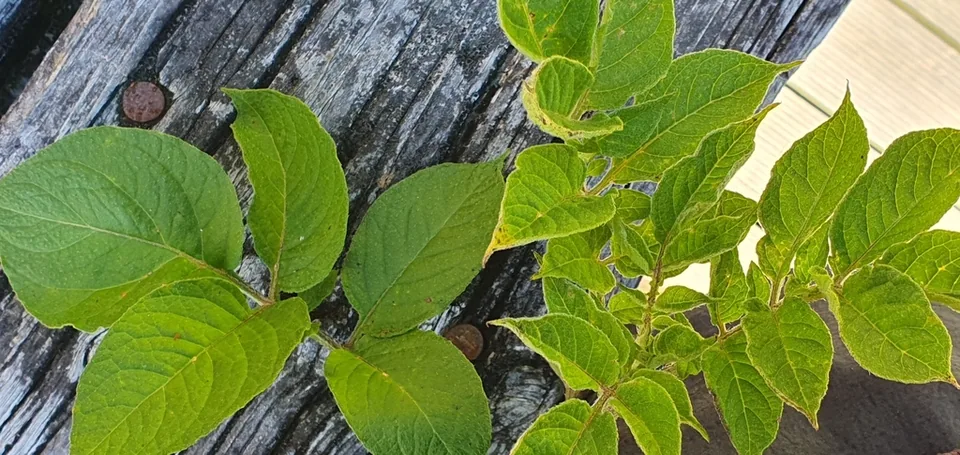
Cómo cultivar y cuidar Patata
Solanum tuberosum
Escrito por Emilio Marruso · última revisión
Tóxica para: Personas · Por qué
De un vistazo
La patata es un cultivo agradecido para un rincón soleado: planta las patatas de siembra a 8–13 cm de profundidad en primavera, dales 2,5 cm de agua a la semana y podrás sacar patatas nuevas solo 6–8 semanas después. Deja crecer el resto hasta que las matas se sequen, cúralas dos semanas y guárdalas a oscuras para disfrutarlas cocidas, asadas, fritas o al horno durante meses.
- Sol
Pleno sol
Qué dicen las fuentes (2)
Luz: Pleno sol
Potatoes grow best in full sun and well-drained, sandy and acidic soil.
— Solanum tuberosum (Irish Potato, Irish Potatoes, Pomme de Terre, Potato, Potatoes, White Potato, White Potatoes) | North Carolina Extension Gardener Plant Toolbox [1] The planting site should receive at least six hours of direct sun each day.
— Growing Potatoes in the Home Garden | Yard and Garden [3] - Riego
2,5 cm a la semana con un riego profundo; evita regar por encima de las hojas
Qué dicen las fuentes (6)
Riego: Alrededor de 1 pulgada [2,5 cm] de agua por semana durante la temporada de crecimiento, riega profundamente una vez por semana en clima seco; mantén las plantas bien regadas si la lluvia es escasa, especialmente mientras se desarrollan los tubérculos
Like most other vegetables, potatoes require 1 inch of water per week during the growing season.
— Growing Potatoes in the Home Garden | Yard and Garden [3] Water deeply once a week in dry weather.
— Growing Potatoes in the Home Garden | Yard and Garden [3] Keep plants well-watered if rainfall is lacking, especially while tubers are developing.
— Growing Potatoes in a Home Garden | University of Maryland Extension [2] Notas sobre el riego: Evita el riego por aspersión, ya que puede propagar enfermedades fúngicas; alternar períodos húmedos y secos durante el desarrollo de los tubérculos puede causar corazón hueco, grietas de crecimiento y protuberancias; el suelo con mal drenaje puede causar que los tubérculos se pudran
Avoid overhead watering as it can spread fungal diseases.
— Growing Potatoes in a Home Garden | University of Maryland Extension [2] Alternating wet and dry periods during tuber development can cause hollow heart, growth cracks, and knobs.
— Growing Potatoes in the Home Garden | Yard and Garden [3] Poorly drained soil may cause tubers to rot, and acidic soil helps to prevent bacterial scabs.
— Solanum tuberosum (Irish Potato, Irish Potatoes, Pomme de Terre, Potato, Potatoes, White Potato, White Potatoes) | North Carolina Extension Gardener Plant Toolbox [1] - Frío
Aguanta inviernos de hasta −45,6 °C (−50 °F)
Muy rústica · USDA 2a · RHS H7 · Z2
Qué dicen las fuentes (2)
Rusticidad, zona más fría: 2a [mínima invernal de −45,6 a −42,8 °C (de −50 a −45 °F)]
2a, 2b, 3a, 3b, 4a, 4b, 5a, 5b, 6a, 6b, 7a, 7b, 8a, 8b, 9a, 9b, 10a, 10b, 11a, 11b
— Solanum tuberosum (Irish Potato, Irish Potatoes, Pomme de Terre, Potato, Potatoes, White Potato, White Potatoes) | North Carolina Extension Gardener Plant Toolbox [1] Rusticidad, zona más cálida: 11b [mínima invernal de 7,2 a 10 °C (de 45 a 50 °F)]
2a, 2b, 3a, 3b, 4a, 4b, 5a, 5b, 6a, 6b, 7a, 7b, 8a, 8b, 9a, 9b, 10a, 10b, 11a, 11b
— Solanum tuberosum (Irish Potato, Irish Potatoes, Pomme de Terre, Potato, Potatoes, White Potato, White Potatoes) | North Carolina Extension Gardener Plant Toolbox [1] - Suelo
Suelo con pH de 5,5 o más
Qué dicen las fuentes (4)
pH del suelo, mínimo: 5.5
Según Penn State Extension: The soil should have a pH of 5.5 to 6.5.
— Potato Production [4] Según University of Maryland Extension: Potatoes grow best in well-drained soil high in organic matter with a pH of 6.0 to 6.5.
— Growing Potatoes in a Home Garden | University of Maryland Extension [2] donde la enfermedad de la sarna de la papa es un problema persistente: Where potato scab disease is a persistent problem, a soil pH of 4.8 to 5.8 is recommended.
— Growing Potatoes in a Home Garden | University of Maryland Extension [2] The soil should have a pH of 5.5 to 6.5.
— Potato Production [4] - Distancia
61–91 cm entre hileras
- Plantación
Planta en primavera en cuanto la tierra se pueda trabajar
Qué dicen las fuentes (5)
Plantación: del 15 de marzo al 1 de mayo según la ubicación; tan pronto como la tierra pueda trabajarse en primavera (de principios a mediados de abril en el centro de Iowa)
Según University of Maryland Extension: Plant potatoes from March 15 to May 1, depending on your location.
— Growing Potatoes in a Home Garden | University of Maryland Extension [2] Carolina del Norte: In North Carolina try to have potatoes planted sometime between mid-February and the end of March; they can tolerate a bit of frost.
— Solanum tuberosum (Irish Potato, Irish Potatoes, Pomme de Terre, Potato, Potatoes, White Potato, White Potatoes) | North Carolina Extension Gardener Plant Toolbox [1] parte central del estado (Iowa): This is usually early to mid-April in the central part of the state, a week earlier in southern Iowa, and a week later in northern Iowa.
— Growing Potatoes in the Home Garden | Yard and Garden [3] Plant potatoes from March 15 to May 1, depending on your location.
— Growing Potatoes in a Home Garden | University of Maryland Extension [2] Potatoes should be planted as soon as the ground can be worked in the spring.
— Growing Potatoes in the Home Garden | Yard and Garden [3] - Abonado
Abona antes de plantar y otra vez cuando se formen los tubérculos; evita el exceso de nitrógeno y de estiércol
Qué dicen las fuentes (5)
Cuándo: Antes de plantar, con un abono lateral cuando los tubérculos empiecen a formarse
producción comercial: - four to five weeks later another third of the nitrogen is side-dressed, and - remaining nitrogen is added based on petiole nitrate testing at flowering.
— Potato Production [4] Fertilizer needs: High requirement for nutrients, either from soil organic matter or fertilizers . Apply fertilizer before planting. Side-dress 6 weeks later when tubers begin to form.
— Growing Potatoes in a Home Garden | University of Maryland Extension [2] Broadcast and incorporate the fertilizer shortly before planting.
— Growing Potatoes in the Home Garden | Yard and Garden [3] Evitar: Grandes cantidades de estiércol u otra materia orgánica, que pueden aumentar la sarna de la papa; exceso de nitrógeno; exceso de potasio
Don't apply large amounts of organic matter, such as manure, to the soil where potatoes will be grown. The addition of organic matter may increase the occurrence of potato scab.
— Growing Potatoes in the Home Garden | Yard and Garden [3] Excess nitrogen fertilization delays maturity, while excess potassium greatly hinders the uptake of magnesium and reduces the firmness of the potato (decreases the specific gravity).
— Potato Production [4] - Cosecha
Patatas nuevas 6–8 semanas después de plantar; las de guardar cuando las matas se hayan secado
Qué dicen las fuentes (8)
Cosecha: Papas nuevas de 6 a 8 semanas después de la siembra, generalmente una vez que las plantas han florecido; papas de almacenamiento después de que las vides hayan muerto y el cultivo esté maduro, la mayoría de los cultivares 90-120 días después de la siembra
Carolina del Norte: Potatoes can be harvested mature when the tubers are fully grown or the plant has dried up around June.
— Solanum tuberosum (Irish Potato, Irish Potatoes, Pomme de Terre, Potato, Potatoes, White Potato, White Potatoes) | North Carolina Extension Gardener Plant Toolbox [1] Noreste de EE. UU.: potatoes are generally harvested from mid-July through October in the Northeast U.S.
— Potato Production [4] Small, tender “new” potatoes can be harvested 6 to 8 weeks after planting, usually once the plants have flowered.
— Growing Potatoes in a Home Garden | University of Maryland Extension [2] Most potato cultivars mature 90-120 days after planting.
— Growing Potatoes in the Home Garden | Yard and Garden [3] Cómo cosechar: Patatas nuevas: excava suavemente alrededor de las plantas con una horca de jardín unas 6 a 8 semanas después de la siembra, generalmente una vez que las plantas hayan florecido. Patatas de almacenamiento: cosecha después de que las vides hayan muerto; deja los tubérculos en el suelo durante 2 semanas después del secado para que la piel se engrose. No excaves cuando el suelo esté húmedo; evita magulladuras, raspaduras o cortes en los tubérculos.
Gently dig the soil around the young potatoes with a garden fork to avoid damaging the plant and bruising or spearing tubers.
— Growing Potatoes in a Home Garden | University of Maryland Extension [2] If you plan to store potatoes, leave tubers in the ground for 2 weeks after plants die back. This will allow them to develop a thickened skin.
— Growing Potatoes in a Home Garden | University of Maryland Extension [2] Don't dig potatoes if the soil is wet.
— Growing Potatoes in a Home Garden | University of Maryland Extension [2] When harvesting potatoes, avoid bruising, skinning, or cutting the tubers.
— Growing Potatoes in the Home Garden | Yard and Garden [3] - Plagas
Escarabajo de la patata, pulgones, mildiu y sarna
Qué dicen las fuentes (2)
Plagas: Escarabajos de la patata de Colorado, escarabajos pulga, pulgones, chicharritas, gusanos de alambre, barrenadores del maíz
Several insects can cause severe problems in potatoes, including Colorado potato beetles, flea beetles, aphids, leafhoppers, wireworms, and corn borers.
— Potato Production [4] Enfermedades: tizón temprano, tizón tardío, sarna común, sarna polvorienta, pierna negra, virus del enrollamiento de la hoja, virus del mosaico, rizoctonia, marchitez por verticillium, pudrición seca por fusarium, pudrición blanda bacteriana
These include early blight, late blight, common and powdery scab, blackleg, leaf roll and mosaic viruses, rhizoctonia, verticillium wilt, fusarium dry rot, and bacterial soft rot.
— Potato Production [4] - Atención
La luz vuelve los tubérculos verdes y tóxicos: aporca tierra alrededor de las plantas y guárdalos a oscuras
- Tamaño
30–46 cm de ancho
Qué dicen las fuentes (1)
Anchura adulta: 30-46 cm (1 a 1.5 pies)
Width: 1 ft. 0 in. - 1 ft. 6 in.
— Solanum tuberosum (Irish Potato, Irish Potatoes, Pomme de Terre, Potato, Potatoes, White Potato, White Potatoes) | North Carolina Extension Gardener Plant Toolbox [1] - Multiplicación
Planta patatas de siembra (tubérculos pequeños o trozos con al menos dos ojos)
Qué dicen las fuentes (2)
Propagación: Papas de siembra (tubérculos pequeños o trozos de tubérculos con al menos dos ojos)
Before planting, cut seed potatoes so each piece has at least two eyes and allow it to rest outside for a day to let the cut end scab over.
— Solanum tuberosum (Irish Potato, Irish Potatoes, Pomme de Terre, Potato, Potatoes, White Potato, White Potatoes) | North Carolina Extension Gardener Plant Toolbox [1] Potatoes are most often grown from "seed potatoes," which are small tubers or pieces of tubers that sprout into a new plant.
— Solanum tuberosum (Irish Potato, Irish Potatoes, Pomme de Terre, Potato, Potatoes, White Potato, White Potatoes) | North Carolina Extension Gardener Plant Toolbox [1] - Seguridad
No comas nunca las partes verdes ni los tubérculos verdes: contienen una toxina
Resumen
La papa se cultiva por sus tubérculos subterráneos comestibles, que se desarrollan a partir de las semillas de papa plantadas. [3][1] Crece mejor a pleno sol y en suelo bien drenado, con un suministro constante de humedad durante el desarrollo de los tubérculos. [1][3] Los tubérculos verdes y las partes verdes de la planta contienen solanina y no deben comerse. [1]
Citado en inglés, como en la fuente.
Cuidados
Las medidas entre corchetes son nuestra conversión al otro sistema de unidades; el texto citado no cambia.
Riego
Riego
Alrededor de 1 pulgada [2,5 cm] de agua por semana durante la temporada de crecimiento, riega profundamente una vez por semana en clima seco; mantén las plantas bien regadas si la lluvia es escasa, especialmente mientras se desarrollan los tubérculos
Qué dicen las fuentes (3)
Like most other vegetables, potatoes require 1 inch of water per week during the growing season.Water deeply once a week in dry weather.Keep plants well-watered if rainfall is lacking, especially while tubers are developing.Notas sobre el riego
Evita el riego por aspersión, ya que puede propagar enfermedades fúngicas; alternar períodos húmedos y secos durante el desarrollo de los tubérculos puede causar corazón hueco, grietas de crecimiento y protuberancias; el suelo con mal drenaje puede causar que los tubérculos se pudran
Qué dicen las fuentes (3)
Avoid overhead watering as it can spread fungal diseases.Alternating wet and dry periods during tuber development can cause hollow heart, growth cracks, and knobs.Poorly drained soil may cause tubers to rot, and acidic soil helps to prevent bacterial scabs.Luz
Pleno sol
Qué dicen las fuentes (2)
Potatoes grow best in full sun and well-drained, sandy and acidic soil.The planting site should receive at least six hours of direct sun each day.Clima y frío
Rusticidad, zona más fría
2a [mínima invernal de −45,6 a −42,8 °C (de −50 a −45 °F)]
Qué dicen las fuentes (1)
2a, 2b, 3a, 3b, 4a, 4b, 5a, 5b, 6a, 6b, 7a, 7b, 8a, 8b, 9a, 9b, 10a, 10b, 11a, 11bRusticidad, zona más cálida
11b [mínima invernal de 7,2 a 10 °C (de 45 a 50 °F)]
Qué dicen las fuentes (1)
2a, 2b, 3a, 3b, 4a, 4b, 5a, 5b, 6a, 6b, 7a, 7b, 8a, 8b, 9a, 9b, 10a, 10b, 11a, 11bSuelo
pH del suelo, mínimo
5.5
Lo que dice cada fuente
Según Penn State Extension: 5.5
Según University of Maryland Extension: 6.0
donde la enfermedad de la sarna de la papa es un problema persistente: 4.8
Qué dicen las fuentes (4)
Según Penn State Extension: The soil should have a pH of 5.5 to 6.5.Según University of Maryland Extension: Potatoes grow best in well-drained soil high in organic matter with a pH of 6.0 to 6.5.donde la enfermedad de la sarna de la papa es un problema persistente: Where potato scab disease is a persistent problem, a soil pH of 4.8 to 5.8 is recommended.The soil should have a pH of 5.5 to 6.5.pH del suelo, máximo
Las fuentes dan valores distintos según la región, la zona o las condiciones de cultivo.
Lo que dice cada fuente
Según Penn State Extension: 6.5
Según University of Maryland Extension: 6.5
donde la enfermedad de la sarna de la papa es un problema persistente: 5.8
Según NC State Extension: 6.0
Qué dicen las fuentes (6)
Según Penn State Extension: The soil should have a pH of 5.5 to 6.5.Según University of Maryland Extension: Potatoes grow best in well-drained soil high in organic matter with a pH of 6.0 to 6.5.donde la enfermedad de la sarna de la papa es un problema persistente: Where potato scab disease is a persistent problem, a soil pH of 4.8 to 5.8 is recommended.Según NC State Extension: Soil pH: Acid (<6.0)The soil should have a pH of 5.5 to 6.5.Potatoes grow best in well-drained soil high in organic matter with a pH of 6.0 to 6.5.Dónde cultivarla
En maceta
Sí
Qué dicen las fuentes (2)
Raised beds provide good drainage and containers or grow bags can be suitable for growth as long as they are at least 2 feet deep and hold at least 30 gallons.Potatoes can be successfully grown in containers but potato "towers" don't usually work.Distancia de plantación
Las fuentes dan valores distintos según la región, la zona o las condiciones de cultivo.
Lo que dice cada fuente
Según NC State Extension: 12.7-15.2 cm (5-6 pulgadas)
Según Penn State Extension: 17.8-30.5 cm (7-12 pulgadas)
Según Iowa State Extension: 30.5 cm (aproximadamente 1 pie)
principalmente para cosechar papas nuevas: 22.9 cm (9 pulgadas)
papas grandes para almacenar como objetivo: hasta 50.8 cm (20 pulgadas)
Qué dicen las fuentes (5)
Según NC State Extension: Plant seed pieces 5 to 6 inches apart with the eyes facing up.Según Penn State Extension: Space seed pieces 7 to 12 inches apart in the row.Según Iowa State Extension: Set seed pieces, cut side down, and small whole potatoes about 1 foot apart in a furrow 4 inches deep.principalmente para cosechar papas nuevas: If you would like to mainly harvest new potatoes, space plants 9” apart.papas grandes para almacenar como objetivo: If large storage potatoes are your goal space plants as far as 20” apart.Propagación
Papas de siembra (tubérculos pequeños o trozos de tubérculos con al menos dos ojos)
Qué dicen las fuentes (2)
Before planting, cut seed potatoes so each piece has at least two eyes and allow it to rest outside for a day to let the cut end scab over.Potatoes are most often grown from "seed potatoes," which are small tubers or pieces of tubers that sprout into a new plant.Cultivo
La planta
Ciclo de vida
perenne, cultivada como cultivo anual
Qué dicen las fuentes (1)
Potatoes are herbaceous perennials in the nightshade family (Solanaceae), but they are grown as annual crops.Familia
Solanáceas
Qué dicen las fuentes (1)
Potatoes are herbaceous perennials in the nightshade family (Solanaceae), but they are grown as annual crops.Altura adulta
Anchura adulta
30-46 cm (1 a 1.5 pies)
Qué dicen las fuentes (1)
Width: 1 ft. 0 in. - 1 ft. 6 in.Siembra y crecimiento
Profundidad de siembra
7.6-12.7 cm (3 a 5 pulgadas) para trozos de semilla; 12.7-15.2 cm (5 a 6 pulgadas) para cultivos posteriores
Qué dicen las fuentes (1)
Plant potatoes in furrows cut side down, 3- to 5-inches deep. Later crops should be planted 5- to 6-inches deep.Distancia entre hileras
61-91 cm (2 a 3 pies)
Días hasta la madurez
Patatas de almacenamiento: 90-120 días después de la siembra; patatas nuevas: 6 a 8 semanas después de la siembra
Qué dicen las fuentes (2)
Potatoes grown for storage should be harvested after the vines have died and the crop is mature. Most potato cultivars mature 90-120 days after planting.Small, tender “new” potatoes can be harvested 6 to 8 weeks after planting, usually once the plants have flowered.Cosecha y conservación
Cómo cosechar
Patatas nuevas: excava suavemente alrededor de las plantas con una horca de jardín unas 6 a 8 semanas después de la siembra, generalmente una vez que las plantas hayan florecido. Patatas de almacenamiento: cosecha después de que las vides hayan muerto; deja los tubérculos en el suelo durante 2 semanas después del secado para que la piel se engrose. No excaves cuando el suelo esté húmedo; evita magulladuras, raspaduras o cortes en los tubérculos.
Qué dicen las fuentes (4)
Gently dig the soil around the young potatoes with a garden fork to avoid damaging the plant and bruising or spearing tubers.If you plan to store potatoes, leave tubers in the ground for 2 weeks after plants die back. This will allow them to develop a thickened skin.Don't dig potatoes if the soil is wet.When harvesting potatoes, avoid bruising, skinning, or cutting the tubers.Conservación
Cura los tubérculos durante dos semanas a 10-16 °C (50 a 60°F) y alta humedad (85 a 90 por ciento); luego almacena en la oscuridad a 4 °C (40°F) y 90 por ciento de humedad relativa. No congeles; no almacenes con manzanas u otras frutas.
Qué dicen las fuentes (5)
Before storing the potatoes, cure the tubers at 50 to 60°F and high relative humidity (85 to 90 percent) for two weeks.Store potatoes at a temperature of 40°F and relative humidity of 90 percent.Store in a dark location as potatoes turn green when exposed to light.Do not allow potatoes to freeze.Do not store potatoes with apples or other fruit.Guardar semillas
Guarda tus propias patatas de siembra; generalmente no vale la pena porque los virus y enfermedades suelen aparecer al año siguiente; compra patatas de siembra certificadas. La semilla de los frutos de la planta no sale fiel a la variedad.
Qué dicen las fuentes (2)
Saving your own seed potatoes is generally not worthwhile because viruses and diseases often show up the next year.However, the seed is extremely small and, if planted, will not come true to the desired variety.Plagas y enfermedades
Plagas
Escarabajos de la patata de Colorado, escarabajos pulga, pulgones, chicharritas, gusanos de alambre, barrenadores del maíz
Qué dicen las fuentes (1)
Several insects can cause severe problems in potatoes, including Colorado potato beetles, flea beetles, aphids, leafhoppers, wireworms, and corn borers.Enfermedades
tizón temprano, tizón tardío, sarna común, sarna polvorienta, pierna negra, virus del enrollamiento de la hoja, virus del mosaico, rizoctonia, marchitez por verticillium, pudrición seca por fusarium, pudrición blanda bacteriana
Qué dicen las fuentes (1)
These include early blight, late blight, common and powdery scab, blackleg, leaf roll and mosaic viruses, rhizoctonia, verticillium wilt, fusarium dry rot, and bacterial soft rot.Abonado
Cuándo
Antes de plantar, con un abono lateral cuando los tubérculos empiecen a formarse
Lo que dice cada fuente
producción comercial: Al plantar, un abono lateral cuatro o cinco semanas después, y una aplicación final de nitrógeno en la floración según pruebas de nitrato en pecíolos
Qué dicen las fuentes (3)
producción comercial: - four to five weeks later another third of the nitrogen is side-dressed, and - remaining nitrogen is added based on petiole nitrate testing at flowering.Fertilizer needs: High requirement for nutrients, either from soil organic matter or fertilizers . Apply fertilizer before planting. Side-dress 6 weeks later when tubers begin to form.Broadcast and incorporate the fertilizer shortly before planting.Frecuencia
Dos veces: antes de plantar y un abono lateral 6 semanas después
Lo que dice cada fuente
producción comercial: Tres veces
Qué dicen las fuentes (2)
producción comercial: Potatoes are typically fertilized three times: - at planting when approximately one-third of the nitrogen and all of the phosphate and potash is broadcasted and disked in, - four to five weeks later another third of the nitrogen is side-dressedFertilizer needs: High requirement for nutrients, either from soil organic matter or fertilizers . Apply fertilizer before planting. Side-dress 6 weeks later when tubers begin to form.Abonos minerales
48.8 a 97.6 g/m² de un fertilizante de jardín de uso general como 10-10-10, distribuido e incorporado poco antes de plantar, cuando no haya análisis de suelo disponible
Lo que dice cada fuente
producción comercial: 168 a 202 kg [370,4–445,3 lb]/ha de nitrógeno, según el cultivar
producción comercial: Al plantar, un tercio del nitrógeno y todo el fosfato y la potasa, distribuidos e incorporados con disco
Qué dicen las fuentes (4)
producción comercial: For conventionally grown potatoes, the amount of nitrogen applied typically ranges from 150 to 180 pounds per acre depending on the cultivar.producción comercial: - at planting when approximately one-third of the nitrogen and all of the phosphate and potash is broadcasted and disked in,If a soil test has not been conducted, applying 1 to 2 pounds of all-purpose garden fertilizer, such as 10-10-10, per 100 square feet should be adequate for most home gardens.Broadcast and incorporate the fertilizer shortly before planting.Microelementos
Magnesio, cuando el magnesio del suelo es bajo o el potasio es excesivamente alto
Qué dicen las fuentes (1)
Magnesium is recommended when soil levels of magnesium are low, or potassium levels are excessively high.Evitar
Grandes cantidades de estiércol u otra materia orgánica, que pueden aumentar la sarna de la papa; exceso de nitrógeno; exceso de potasio
Qué dicen las fuentes (2)
Don't apply large amounts of organic matter, such as manure, to the soil where potatoes will be grown. The addition of organic matter may increase the occurrence of potato scab.Excess nitrogen fertilization delays maturity, while excess potassium greatly hinders the uptake of magnesium and reduces the firmness of the potato (decreases the specific gravity).Signos de exceso
El exceso de nitrógeno retrasa la madurez; el exceso de potasio dificulta la absorción de magnesio y reduce la firmeza del tubérculo (gravedad específica)
Qué dicen las fuentes (1)
Excess nitrogen fertilization delays maturity, while excess potassium greatly hinders the uptake of magnesium and reduces the firmness of the potato (decreases the specific gravity).Distancias
Entre plantas
Las fuentes dan valores distintos según la región, la zona o las condiciones de cultivo.
Lo que dice cada fuente
Carolina del Norte: 13-15 cm [5,1–5,9 in]
Maryland, huerto familiar: 20-30 cm [8–12 in] en la hilera
para papas nuevas (Maryland): 23 cm [9,1 in]
para papas grandes de almacenamiento (Maryland): Hasta 51 cm [20 in]
Iowa, huerto familiar: 30 cm [12 in] de separación en un surco de 10 cm [3,9 in] de profundidad
Pensilvania: 18-30 cm [7–12 in] en la hilera
Qué dicen las fuentes (6)
Carolina del Norte: Plant seed pieces 5 to 6 inches apart with the eyes facing up.Maryland, huerto familiar: Spacing: 8" - 12" in-rows x 24" - 36" between row.para papas nuevas (Maryland): If you would like to mainly harvest new potatoes, space plants 9” apart.para papas grandes de almacenamiento (Maryland): If large storage potatoes are your goal space plants as far as 20” apart.Iowa, huerto familiar: Set seed pieces, cut side down, and small whole potatoes about 1 foot apart in a furrow 4 inches deep.Pensilvania: Space seed pieces 7 to 12 inches apart in the row.Propagación
Germinación
Las fuentes dan valores distintos según la región, la zona o las condiciones de cultivo.
Lo que dice cada fuente
plantación de trozos de patata de siembra: Suelo de al menos 7,2 °C [45 °F]
Qué dicen las fuentes (1)
plantación de trozos de patata de siembra: The soil temperature should be at least 45 degrees F.Esquejes
Las fuentes dan valores distintos según la región, la zona o las condiciones de cultivo.
Lo que dice cada fuente
trozos de tubérculo de semilla (no esquejes): Trozos de semilla de 42,5-56,7 g (cubos de 3,8 cm [1,5 in]) con 1 a 3 ojos, o papas pequeñas enteras de semilla
Corta los trozos de semilla antes de plantarlos: Mantén varios días a 15,6-21,1 °C [60–70 °F] y 85% de humedad relativa para que las superficies cortadas cicatricen
Qué dicen las fuentes (2)
trozos de tubérculo de semilla (no esquejes): Plant 1½ to 2 oz. seed pieces (1½-inch cubes) with 1 to 3 buds (“eyes”) or small, whole seed potatoesCorta los trozos de semilla antes de plantarlos: This problem may be prevented by treating the cut seed pieces with a fungicide or storing them at 60 to 70°F and 85% relative humidity for several days.Tras la cosecha
Conservación
Cura durante 10-14 días a 10-15.6 °C [50–60 °F] y 85-90% de humedad relativa, luego almacena en la oscuridad a 4.4-10 °C [40–50 °F] y 90% de humedad relativa durante 6-8 meses; por encima de 10 °C [50 °F] los tubérculos brotan después de 2-3 meses, por debajo de 3.3 °C [38 °F] se vuelven dulces; no los dejes congelar. Patatas nuevas: refrigera y usa dentro de 10 días.
Qué dicen las fuentes (8)
Storage potatoes are cured for 10 to 14 days at 50°F to 60°F and high humidity to heal over wounds and cuts.Before storing the potatoes, cure the tubers at 50 to 60°F and high relative humidity (85 to 90 percent) for two weeks.Medium cool (40°- 50°F), moist (90% RH) conditions; 6 to 8 months.Store potatoes at a temperature of 40°F and relative humidity of 90 percent.If storage temperatures are above 50°F, the tubers will begin to sprout after 2 or 3 months.When stored below 38°F, potatoes develop a sugary, sweet taste.Store in a dark location as potatoes turn green when exposed to light.Refrigerate new potatoes and use them within ten days.Calor y sequía
Calor
Las temperaturas del suelo superiores a 26.7 °C [80 °F] inhiben el desarrollo de los tubérculos.
Qué dicen las fuentes (1)
Soil temperature in excess of 80°F will inhibit tuber development.Sequía
Los períodos alternados de humedad y sequía durante el desarrollo de los tubérculos causan corazón hueco, grietas de crecimiento y protuberancias; mantén las plantas regadas cuando falte lluvia, especialmente mientras se desarrollan los tubérculos.
Qué dicen las fuentes (2)
Alternating wet and dry periods during tuber development can cause hollow heart, growth cracks, and knobs.Keep plants well-watered if rainfall is lacking, especially while tubers are developing.Problemas
Tubérculos verdes
Síntoma: Los tubérculos expuestos a la luz se vuelven verdes
Qué hacer: Aporca tierra alrededor de las plantas y almacena en la oscuridad
Qué dicen las fuentes (2)
Hilling potatoes provides loose soil for potatoes to develop and prevents tubers from being exposed and turning green.
— Growing Potatoes in the Home Garden | Yard and Garden [3] Store in a dark location as potatoes turn green when exposed to light.
— Growing Potatoes in the Home Garden | Yard and Garden [3] Sarna de la papa
Síntoma: Sarna en los tubérculos; la materia orgánica puede aumentar su aparición
Qué hacer: Usa suelo ácido y un cultivar resistente a la sarna
Qué dicen las fuentes (2)
The addition of organic matter may increase the occurrence of potato scab.
— Growing Potatoes in the Home Garden | Yard and Garden [3] Where potato scab disease is a persistent problem, a soil pH of 4.8 to 5.8 is recommended.
— Growing Potatoes in a Home Garden | University of Maryland Extension [2] Tizón tardío de la papa
Síntoma: Enfermedad de las plantas de papa
Qué hacer: Compra semillas de papa certificadas libres de enfermedades
Qué dicen las fuentes (1)
Buying certified disease-free seeds can help prevent problems such as potato late blight.
— Solanum tuberosum (Irish Potato, Irish Potatoes, Pomme de Terre, Potato, Potatoes, White Potato, White Potatoes) | North Carolina Extension Gardener Plant Toolbox [1] Escarabajo de la papa de Colorado
Síntoma: Escarabajo plaga de la papa
Qué hacer: Aplica un mantillo grueso de paja después de aporcar el suelo
Qué dicen las fuentes (1)
Apply a thick straw mulch, after hilling up the soil, to keep the soil cool and moist and to deter Colorado potato beetles.
— Growing Potatoes in a Home Garden | University of Maryland Extension [2] Tizón temprano
Síntoma: En las lesiones suelen formarse anillos concéntricos que les dan el aspecto característico de una diana.
Qué hacer: Evita el riego por aspersión.
Qué dicen las fuentes (2)
Concentric rings often form in lesions to produce characteristic target-board effect.
— University of California Statewide IPM Program — Early Blight of Potato [5] Avoid overhead irrigation.
— University of Connecticut Integrated Pest Management — Early Blight and Late Blight of Potato [6]
Remedios
Cada remedio indica qué dicen las fuentes oficiales; los remedios tradicionales sin fuente oficial aparecen marcados. Los perjudiciales están para que sepas evitarlos.
Cuidar la planta
escarabajo de la papa de Colorado
recogida manual Funciona en parte
Cómo: Recoge a mano los escarabajos, huevos y larvas pequeñas de las plantas infestadas lo antes posible; elimina los escarabajos que pasan el invierno y aparecen en las plantas jóvenes en primavera.
Hand-pick beetles, eggs and small larvae from infested plants as soon as possible (practical for a few insects on a few plants, but impractical for larger gardens and fields).
— yardandgarden.extension.iastate.edu [7] Qué dicen las pruebas Hand-pick beetles, eggs and small larvae from infested plants as soon as possible (practical for a few insects on a few plants, but impractical for larger gardens and fields).
— yardandgarden.extension.iastate.edu [7] mantillo de paja Funciona
Cómo: Aplica un mantillo grueso de paja después de aporcar el suelo.
Apply a thick straw mulch, after hilling up the soil, to keep the soil cool and moist and to deter Colorado potato beetles.
— Growing Potatoes in a Home Garden | University of Maryland Extension [2] Qué dicen las pruebas Apply a thick straw mulch, after hilling up the soil, to keep the soil cool and moist and to deter Colorado potato beetles.
— Growing Potatoes in a Home Garden | University of Maryland Extension [2] Rociador de hojas de albahaca No verificado
Remedio tradicional, no verificado por una fuente oficial.
Cómo: Rocía con una mezcla de hojas de albahaca y agua.
Siembra asociada con berenjena, lino o frijoles verdes No verificado
Remedio tradicional, no verificado por una fuente oficial.
Cómo: Planta como compañera con berenjena, lino o judías verdes.
pulgones
spray de jabón insecticida Funciona
Cómo: Usa jabón insecticida sobre los pulgones.
Spray away aphids with a blast of water from a garden hose. Use insecticidal soap.
— harvesttotable.com [8] Qué dicen las pruebas For example, insecticidal soap is a safe, effective organic insecticide with minimal environmental impact.
— extension.psu.edu [9]
chicharritas
spray de jabón insecticida Funciona
Cómo: Rocía las plantas con un jabón insecticida multiusos en aerosol cuando se encuentren las primeras ninfas.
Treat the crop the first time you find a scattering of nymphs. Spray plants with a multipurpose insecticidal soap spray, like this one from [nome commerciale] .
— gardeningknowhow.com [10] Qué dicen las pruebas For example, insecticidal soap is a safe, effective organic insecticide with minimal environmental impact.
— extension.psu.edu [9] cobertura flotante de hileras No verificado
Remedio tradicional, no verificado por una fuente oficial.
Cómo: Cubre las plantas con una cubierta flotante de hilera para excluir los saltahojas.
escarabajos vesicantes
recolección manual con guantes No verificado
Remedio tradicional, no verificado por una fuente oficial.
They secrete oil that can cause the skin to blister.
— harvesttotable.com [8] Cómo: Usa guantes y recoge los escarabajos a mano de las hojas y destrúyelos.
escarabajos de la pulga
tierra de diatomeas No verificado
Remedio tradicional, no verificado por una fuente oficial.
Cómo: Esparce tierra de diatomeas alrededor de las plántulas.
ceniza de madera No verificado
Remedio tradicional, no verificado por una fuente oficial.
Cómo: Esparce cenizas de madera alrededor de las plántulas.
gusanos cortadores
collar de papel No verificado
Remedio tradicional, no verificado por una fuente oficial.
Cómo: Coloca un collar de papel de 3 pulgadas alrededor del tallo de la planta.
ceniza de madera No verificado
Remedio tradicional, no verificado por una fuente oficial.
Cómo: Espolvorea ceniza de madera alrededor de la base de las plantas y mantén el jardín libre de malezas.
mantillo de hojas de roble y tanaceto No verificado
Remedio tradicional, no verificado por una fuente oficial.
Cómo: Usa mantillo de hojas de roble y planta tanaceto como compañero entre las hileras.
gusanos de alambre
trampa de cebo con papa No verificado
Remedio tradicional, no verificado por una fuente oficial.
Cómo: Entierra trozos de papa cruda en el suelo como trampas, revísalos cada semana y retira y mata los gusanos de alambre que encuentres en ellos.
inundando el suelo No verificado
Remedio tradicional, no verificado por una fuente oficial.
Cómo: Revisa el suelo antes de plantar; inunda el suelo si hay gusanos de alambre.
ácaros araña
rociado con agua No verificado
Remedio tradicional, no verificado por una fuente oficial.
Cómo: Elimina los ácaros con un chorro de agua; las mariquitas y las crisopas se alimentan de ácaros.
spray de jabón insecticida Funciona
Cómo: Usa jabón insecticida sobre los ácaros.
Spider mites suck plant juices causing stippling. Spray away with a blast of water or use insecticidal soap or rotenone.
— harvesttotable.com [8] Qué dicen las pruebas For example, insecticidal soap is a safe, effective organic insecticide with minimal environmental impact.
— extension.psu.edu [9]
polilla de la papa
aporcar tierra sobre los tubérculos No verificado
Remedio tradicional, no verificado por una fuente oficial.
Cómo: Aporca tierra sobre los tubérculos para evitar que los gusanos lleguen a ellos; recoge a mano y destruye las orugas.
nematodos
solarización del suelo No verificado
Remedio tradicional, no verificado por una fuente oficial.
Cómo: Rota los cultivos y solariza el suelo con plástico transparente a mediados del verano.
Toxicidad
Según la fuente, citada textualmente. No es un consejo médico ni veterinario: si una persona o un animal pudo haber ingerido esta planta, contacta con un centro de toxicología o con un veterinario.
All the green parts of the plant contain a toxin known as solanine and should not be ingested.
[1]Nausea, vomiting, salivation, drowsiness, abdominal pain, diarrhea, weakness, respiratory depression; may be fatal
[1]Green portions (chlorophyll) on potatoes are associated with solanine, a bitter, toxic glycoalkaloid.
[2]- Principio tóxico
Green portions (chlorophyll) on potatoes are associated with solanine, a bitter, toxic glycoalkaloid.
[2]
Calendario
Plantación
del 15 de marzo al 1 de mayo según la ubicación; tan pronto como la tierra pueda trabajarse en primavera (de principios a mediados de abril en el centro de Iowa)
Lo que dice cada fuente
Según University of Maryland Extension: del 15 de marzo al 1 de mayo
Carolina del Norte: de mediados de febrero a finales de marzo
parte central del estado (Iowa): de principios a mediados de abril
Qué dicen las fuentes (5)
Según University of Maryland Extension: Plant potatoes from March 15 to May 1, depending on your location.Carolina del Norte: In North Carolina try to have potatoes planted sometime between mid-February and the end of March; they can tolerate a bit of frost.parte central del estado (Iowa): This is usually early to mid-April in the central part of the state, a week earlier in southern Iowa, and a week later in northern Iowa.Plant potatoes from March 15 to May 1, depending on your location.Potatoes should be planted as soon as the ground can be worked in the spring.Cosecha
Papas nuevas de 6 a 8 semanas después de la siembra, generalmente una vez que las plantas han florecido; papas de almacenamiento después de que las vides hayan muerto y el cultivo esté maduro, la mayoría de los cultivares 90-120 días después de la siembra
Lo que dice cada fuente
Carolina del Norte: Papas maduras alrededor de junio (3-4 meses después de la siembra)
Noreste de EE. UU.: Mediados de julio hasta octubre
Qué dicen las fuentes (4)
Carolina del Norte: Potatoes can be harvested mature when the tubers are fully grown or the plant has dried up around June.Noreste de EE. UU.: potatoes are generally harvested from mid-July through October in the Northeast U.S.Small, tender “new” potatoes can be harvested 6 to 8 weeks after planting, usually once the plants have flowered.Most potato cultivars mature 90-120 days after planting.Meses tal como los dan las fuentes, en su mayoría de Estados Unidos (hemisferio norte). En el hemisferio sur se desplazan unos seis meses.
Comestibilidad
Según la fuente, citada textualmente. No comas una planta basándote solo en esta página: los errores de identificación pueden ser peligrosos.
Valores orientativos
Valores de una fuente secundaria, no comprobados palabra por palabra como el resto de esta página. Úselos como punto de partida.
- Horas de sol
- 5-6 horasValor orientativo, adáptalo a tu clima · Fuente secundaria
- Resiste la sequía
- SíValor orientativo, adáptalo a tu clima · Fuente secundaria
- En interior
- SíValor orientativo, adáptalo a tu clima · Fuente secundaria
- Nivel de cuidado
- MedioValor orientativo, adáptalo a tu clima · Fuente secundaria
- Crecimiento
- AltaValor orientativo, adáptalo a tu clima · Fuente secundaria
- Poda
- MayoValor orientativo, adáptalo a tu clima · Fuente secundaria
Plantas similares
- Dulcamara Solanum dulcamara
- Brazilian nightshade Solanum seaforthianum
- Berenjena Solanum melongena
- Sticky nightshade Solanum sisymbriifolium
- Tomate Solanum lycopersicum
- Manzana de sodoma Solanum mammosum
- Natre Solanum crispum
- Bufera Withania somnifera
Fuentes
Cada valor anterior se cita de estos documentos. Los enlaces llevan al editor original.
- Solanum tuberosum (Irish Potato, Irish Potatoes, Pomme de Terre, Potato, Potatoes, White Potato, White Potatoes) | North Carolina Extension Gardener Plant Toolbox · plants.ces.ncsu.edu, consultado
- Growing Potatoes in a Home Garden | University of Maryland Extension · extension.umd.edu, consultado
- Growing Potatoes in the Home Garden | Yard and Garden · yardandgarden.extension.iastate.edu, consultado
- Potato Production · extension.psu.edu, consultado
- University of California Statewide IPM Program — Early Blight of Potato · ipm.ucanr.edu, consultado
- University of Connecticut Integrated Pest Management — Early Blight and Late Blight of Potato · ipm.cahnr.uconn.edu, consultado
- yardandgarden.extension.iastate.edu · yardandgarden.extension.iastate.edu
- harvesttotable.com · harvesttotable.com
- extension.psu.edu · extension.psu.edu
- gardeningknowhow.com · gardeningknowhow.com
Escrito por Emilio Marruso · última revisión